JEV and the System One Model: Why It Changes the Economics of AI

Aquib Jawed
25 Sep, 2026

Most of the AI we ship today is a very expensive way to answer a very simple question.
"Is this ticket about billing?" "Did the agent actually finish the task?" "Should this refund go through?" These are yes/no or pick-one decisions. Yet we route them through giant LLMs that write paragraphs, burn tokens, and take seconds to reply. Then we write more code to parse that paragraph back into a yes or a no.
On September 15, 2026, a San Francisco startup called TypeSafe AI announced Jev, and it takes a different bet. Jev doesn't chat. It doesn't write. It decides. And according to TypeSafe, it does that up to 193x faster and 445x cheaper than frontier LLMs.
Those numbers deserve a closer look, and so does the idea behind them. Let's break it down.
What is a System One model?
The name comes from psychology. Daniel Kahneman described two modes of thinking: System 2 is slow and deliberate, like solving a math problem. System 1 is fast and instinctive, like knowing a face is angry the moment you see it.
Today's LLMs are built to lean into System 2. They reason step by step, write long answers, and "think" out loud. That's great for essays, code, and research. It's overkill for the thousands of small judgment calls that sit inside every software product.
A System One model is built for those snap judgments. You give it a situation and a clear question. It gives back a typed answer, with a probability attached, in milliseconds. No prose. No parsing. Just a value your code can act on.
Jev is the first model in this category. It comes from TypeSafe AI, founded in 2024.
How they work: a traditional LLM vs Jev
Take one simple task: a support ticket comes in and you need to know which team gets it, and whether the customer wants a refund.
With a traditional LLM, you write a prompt, send the ticket, and the model generates a reply one token at a time. Maybe it returns JSON. Maybe it adds a friendly sentence first. You parse it, validate it, retry if it breaks, and then make a second call for the refund question. Each call takes seconds and you pay for every word it writes.
With Jev, you send three things in one request (docs overview):
State: the ticket and any data around it
Questions: each one with a fixed answer shape
Model: e.g.
jev-latest
Jev answers every question in parallel against the same state. Each answer comes back as a probability over the options you defined, not as text.
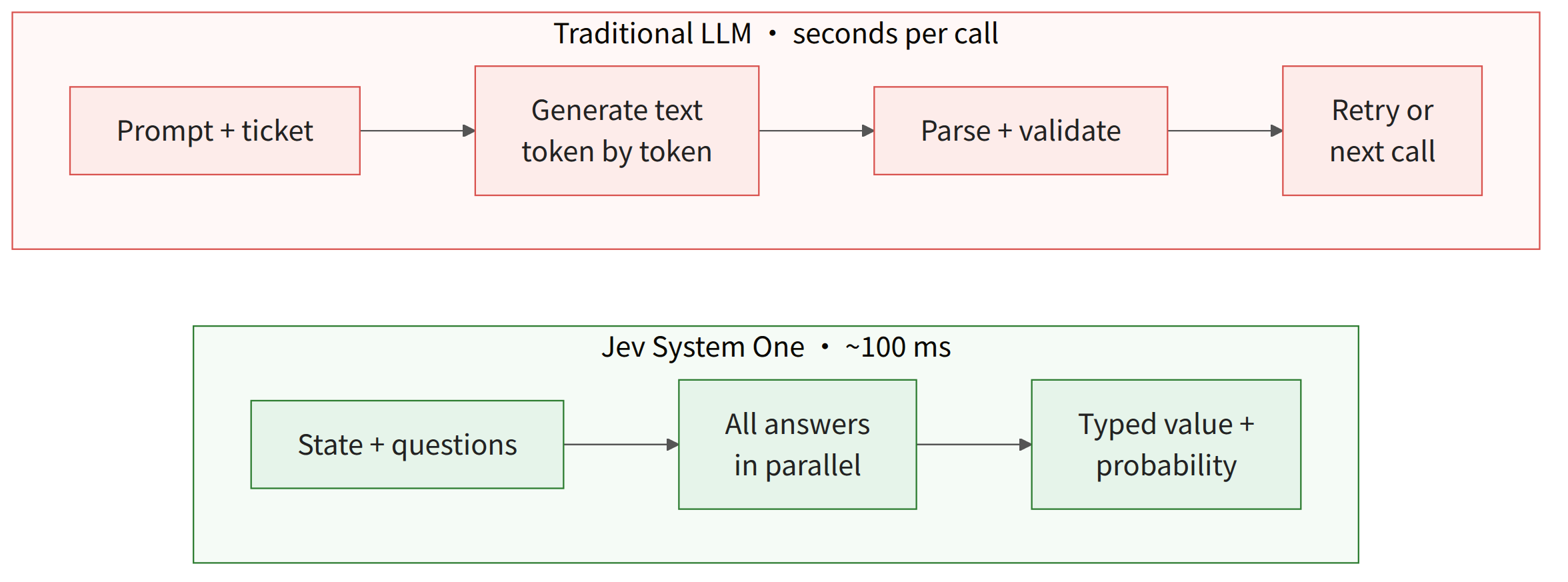
Jev supports three answer types:
Noul (yes/no): a single probability from 0 to 1
Choice: pick one of up to 255 options, with the full probability map
Score: rate on an ordered scale of 2 to 10 levels
The training is different too. LLMs are shaped with RLHF so their answers read well to humans. Jev is trained with what TypeSafe calls Reinforcement Learning for Calibrated Decisions (RLCD). The goal is honest probabilities: when Jev says 90%, it should be right about 90% of the time.
Where Jev differs, and why it matters
Traditional LLM | Traditional LLM | |
|---|---|---|
Built for | Conversation, writing, reasoning | Fast, structured decisions inside code |
Output | Free-form text | Typed value + probability + confidence |
How answers are produced | One token at a time | All questions sampled in parallel |
Training | RLHF / RLVR | RLCD (calibrated decisions) |
Malformed output | Possible, needs parsing and retries | Structurally impossible; answer always fits the schema |
Response time | Seconds, sometimes minutes | 70–500 ms, most around 100 ms |
Sources: TypeSafe announcement, Flavio Copes deep dive.
The pros that stand out to me:
No more parsing glue. The answer always matches the options you set. TypeSafe reports a 0% type-error rate. That removes a whole layer of fragile code most teams quietly maintain.
Confidence you can build on. Every answer carries a probability. You can auto-approve above 0.9, ask a human between 0.5 and 0.9, and escalate below that. LLMs rarely give you an honest number like this.
Speed that feels instant. At ~100 ms, a decision fits inside a page load or an API call. You can put AI in paths where a 5-second LLM wait was never an option.
Fan-out for free. Ask 13 questions about the same ticket in one call. In one TypeSafe test that was 12.2x cheaper and 10x faster than asking them one by one.
It actually reads. In MindStudio's hands-on test, a duplicate-charge ticket scored 98% for refund intent. Add "I am not asking for a refund" and it dropped to 3%. That's comprehension, not keyword matching.
Cost effectiveness: the part that made me stop scrolling
Jev's pricing is $0.042 per million input tokens. Output tokens are free, or in TypeSafe's words, "too cheap to meter."
That second part is the real shift. With LLMs, the output is where the bill grows: every word of reasoning, every polite sentence, every retry. Jev's output is a handful of numbers, so there's nothing to charge for.
Let's make it concrete. Say you process 1 million support tickets a month, about 300 tokens each:
300 million input tokens × $0.042 per million = about $12.60 a month
One ticket costs roughly $0.0000126
If TypeSafe's 445x claim holds, the same workload on a frontier LLM would run around $5,600 a month, before retries
MindStudio's eight test requests cost about $0.00016 in total. That's not a typo.
The bigger point is what this unlocks. When a decision costs a fraction of a cent, you stop rationing AI. You can check every agent step, score every lead, and verify every citation, instead of sampling 5% because the budget said so.
Server costs and serving load
TypeSafe hasn't published its hardware, model size or infrastructure. So treat this section as how the design should play out, not as disclosed numbers.
Why LLMs are expensive to serve. The costly part of running an LLM is generation. Each new token needs another pass through the model, and the GPU has to hold a growing memory of everything written so far. A 2,000-token answer means 2,000 sequential steps. Long answers tie up GPUs for seconds per request, which caps how many users one server can handle.
Why Jev should be lighter. Jev skips long generation entirely. It reads the input once and produces a small set of probabilities, with all questions sampled in parallel. That means:
Shorter GPU time per request: milliseconds of work instead of seconds
Less memory per request: no ever-growing output to track
More requests per GPU: short, uniform jobs are easier to batch together
Predictable load: every request is roughly the same size, so capacity planning gets simpler. No surprise 10,000-token answers
What this means for you as a builder. You won't run Jev's servers, but you still pay for load. Faster responses mean fewer open connections, fewer timeouts, fewer retry storms, and less queueing on your side. Your own backend gets lighter too.
For now, early access has limits of 250,000 tokens per second and 1,200 requests per minute, and the service runs from the US West Coast. If your users are in India or Europe, add network time on top of the 70–500 ms.
It's early. Here are the nuances to watch
Jev is ten days old and in waitlisted early access. The promise is big, but so are the open questions.
The benchmarks are self-reported. TypeSafe built its own evaluation workflows and admits the 445x figure is at the "higher end." No independent benchmark exists yet. Treat 40–400x as a claim until your own data confirms it.
Forced choices can hide confusion. MindStudio asked about cafeteria hours with only three department options. Jev picked "sales" at 0.31 confidence instead of saying "this doesn't fit." If you don't add an "other" option, it will pick something. Always give it an exit.
"No hallucination" isn't "always right." The format is guaranteed. The answer isn't. Jev can still misclassify, read things too literally, or be steered by hostile text in the input.
Clear blind spots. It struggles with math and counting, relative dates, multi-hop reasoning, and anything that needs writing. Text only, no images or audio yet.
Question design becomes a skill. "Broken feature with a workaround" works better than "moderately severe." Stuffing unrelated context into the state lowers accuracy. Teams will need to learn a new way of asking.
Early-stage vendor risk. Rate limits are "dynamic," the service runs from one region, and model versions will change. Pin the version (e.g.
jev-1.13.0), log it with every decision, and re-test before upgrading.Confidence shifts responsibility to you. Jev gives you a probability, not a verdict. Where you set the threshold for auto-approving a refund is now a product and policy decision, and your team owns it.
Closing thoughts
Jev won't replace LLMs, and it isn't trying to. The more interesting future is both working together: an LLM does the slow thinking, and a System One model makes the hundreds of quick calls around it. Routing, checking, scoring, approving.
We've spent three years using the most powerful models for the smallest jobs. If Jev's numbers hold up under independent testing, that habit gets very hard to justify.
Sources
What should you do next?
You've read the article. Now turn your skills into proof of work and unlock more opportunities.
Build your proof of work portfolio
Create a clean portfolio with projects, assignments, resumes, and AI stack details that companies actually want to see.
Create your Fueler portfolio →Apply through assignments, not resumes
Stand out by solving real tasks from companies hiring on Fueler.
Explore assignments →Get discovered by companies
Make your work public and let recruiters discover your skills through actual projects instead of keywords.
Get discovered →
