If You Start Your Portfolio in Final Year, You’re Already Behind

Riten Debnath
23 Dec, 2025
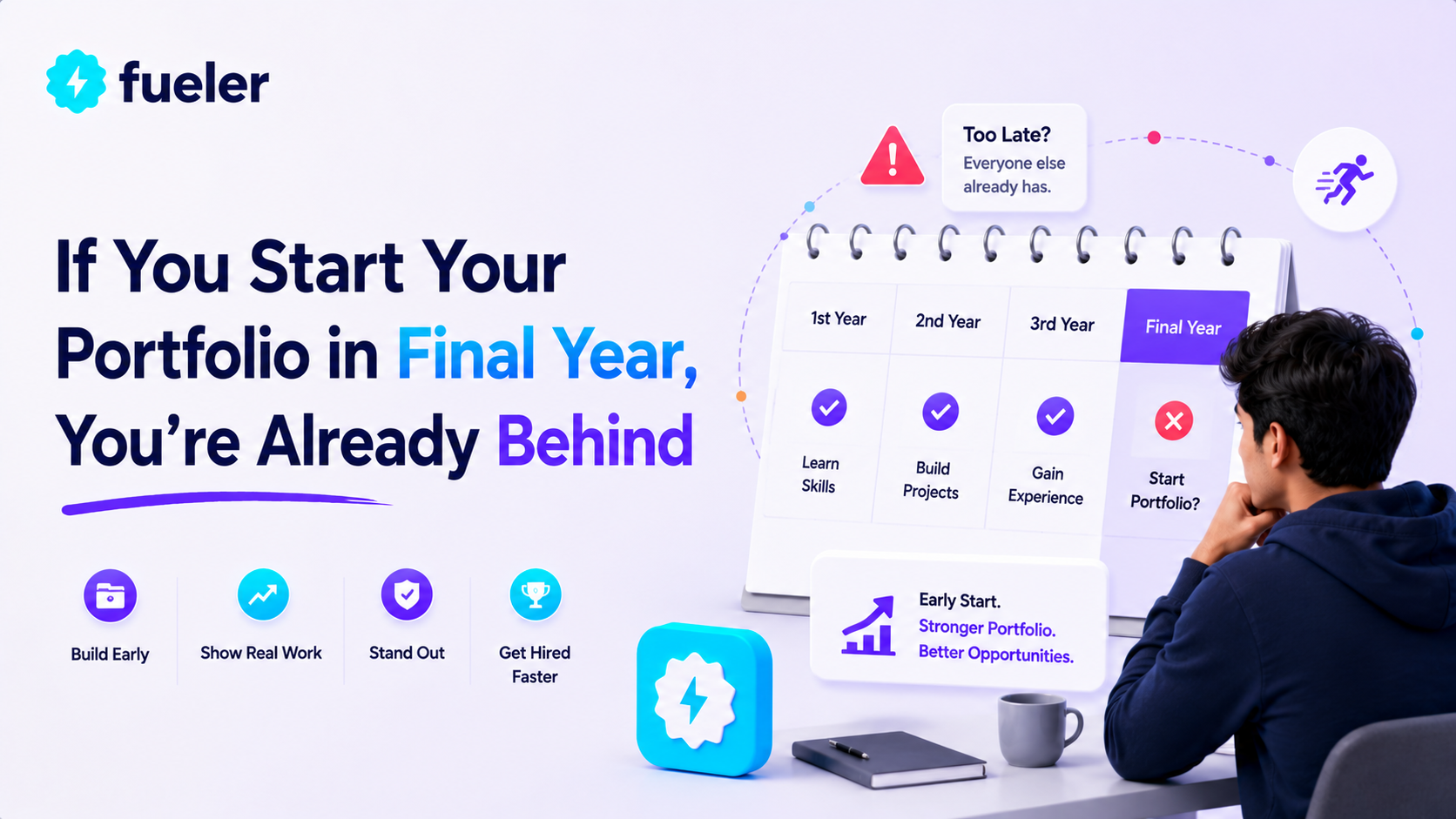
Waiting till your final year of college to start your portfolio is one of the biggest mistakes I see students make.
I am Riten, founder of Fueler. We are building a portfolio platform that helps companies hire through assignments and proof of work. Every week, I see students struggle during internships and placements, not because they are not talented, but because they started showing their work too late.
A portfolio is not something you build when you need a job.
A portfolio is something you build while you are learning, experimenting, and growing.
Why final year is already late
Most students follow the same path. They focus only on classes and exams, collect certificates from courses and workshops, and start making a resume just before placements. This feels safe, but it does not work anymore.
Companies today want to see what you can actually do. They want proof, not promises. When you start your portfolio in your final year, you are trying to show years of learning in just a few months. That pressure shows in your work.
From my experience building Fueler and speaking with hiring managers, late portfolios usually look rushed, shallow, and copied. There is no story, no depth, and no clear growth.
What smart students do differently
The students who stand out do not wait.
- They start projects in their first or second year.
- They try things without worrying about perfection.
- They write about what they learned from each project.
- They slowly document their work as proof of work.
- They build a portfolio step by step.
This gives them a huge advantage.
Their portfolio shows progress over time. It shows curiosity. It shows effort. And most importantly, it shows thinking.
You do not need to build a startup or win a big competition. Small projects matter. Class projects matter. Side experiments matter. What matters is how you explain them.
You do not need trophies to build a portfolio
Many students think a portfolio only means hackathon wins, case competition ranks, or big brand internships. That is not true.
- If you worked on a project during a hackathon but did not win, that project still counts.
- If you built something for a college club, that counts.
- If you wrote articles, designed posters, edited videos, or managed social media for fun, that counts.
The project is not important. The learning is.
When you explain what problem you worked on, what you tried, what failed, and what you learned, that becomes powerful proof of work.
How early portfolios change your career
Starting early changes everything.
1. You get internships earlier.
When you apply in your second or third year, recruiters see real work instead of empty resumes.
2. You stand out in campus placements.
While others talk about marks and certificates, your portfolio does the talking.
3. You get to work with startups before graduating.
Startups care more about skills and execution than degrees. Proof of work builds trust.
4. You start building a personal brand.
When you consistently share your work online, people start recognizing your effort.
At Fueler, we see this pattern again and again. Students who build portfolios early find it easier to apply for opportunities. They feel more confident. They face fewer rejections.
Your field does not matter, proof of work does
I want to be very clear about this.
It does not matter if you are into design, coding, writing, marketing, AI, data, finance, or any other field. A portfolio works everywhere.
- Designers show designs.
- Developers show projects.
- Writers show articles.
- Marketers show campaigns and experiments.
AI learners show models, experiments, and case studies.
In every field, your work speaks louder than your resume.
The earlier you start, the more time your work gets to compound.
Start small, but start now
If you are in first or second year, you have time. Use it well.
1. Pick one skill you want to learn.
2. Build one small project around it.
3. Write down what you learned.
4. Publish it on Fueler.
5. Repeat.
You do not need expensive tools or paid courses. The internet already has everything. What matters is consistency.
A strong portfolio is built over years, not weeks.
If you are already in final year, do not panic. Start today. But understand this truth so you do not repeat the same mistake in the future.
Frequently Asked Questions
1. When should a student start building a portfolio?
A student should start building a portfolio in the first or second year of college. This gives enough time to experiment, fail, learn, and improve. Early portfolios show growth over time, which hiring managers value a lot. Waiting till final year reduces your chances because you rush your work and miss real learning.
2. What should a college portfolio include?
A good college portfolio should include real projects, not just certificates. Each project should explain the problem, your approach, what tools you used, challenges you faced, and what you learned. Whether it is coding projects, design work, writing samples, or marketing experiments, clarity and context matter more than complexity.
3. Is a portfolio more important than a resume for freshers?
For many roles, yes. A resume tells what you claim you know. A portfolio shows what you can actually do. Hiring managers increasingly prefer portfolios because they reduce hiring risk. A strong portfolio can even compensate for average grades or a lesser known college.
4. How can students with no experience build a portfolio?
Experience comes from doing, not from waiting. Students can build portfolios through college assignments, personal projects, online challenges, internships, volunteering, or self-initiated work. Even learning projects count if they are documented properly with honest insights and outcomes.
5. Do companies really hire based on portfolios and proof of work?
Yes. Many companies, especially startups and modern teams, hire through assignments and proof of work. They want to see how you think and solve problems. Platforms like Fueler exist because companies trust real work more than marks and resumes. Proof of work makes hiring faster and more reliable.
What is Fueler Portfolio?
Fueler is a career portfolio platform that helps companies find the best talent for their organization based on their proof of work.
You can create your portfolio on Fueler, thousands of freelancers around the world use Fueler to create their professional-looking portfolios and become financially independent. Discover inspiration for your portfolio
Sign up for free on Fueler or get in touch to learn more.
What should you do next?
You've read the article. Now turn your skills into proof of work and unlock more opportunities.
Build your proof of work portfolio
Create a clean portfolio with projects, assignments, resumes, and AI stack details that companies actually want to see.
Create your Fueler portfolio →Apply through assignments, not resumes
Stand out by solving real tasks from companies hiring on Fueler.
Explore assignments →Get discovered by companies
Make your work public and let recruiters discover your skills through actual projects instead of keywords.
Get discovered →
