Hybrid App UI/UX Trends That Will Dominate 2026

Riten Debnath
23 Dec, 2025
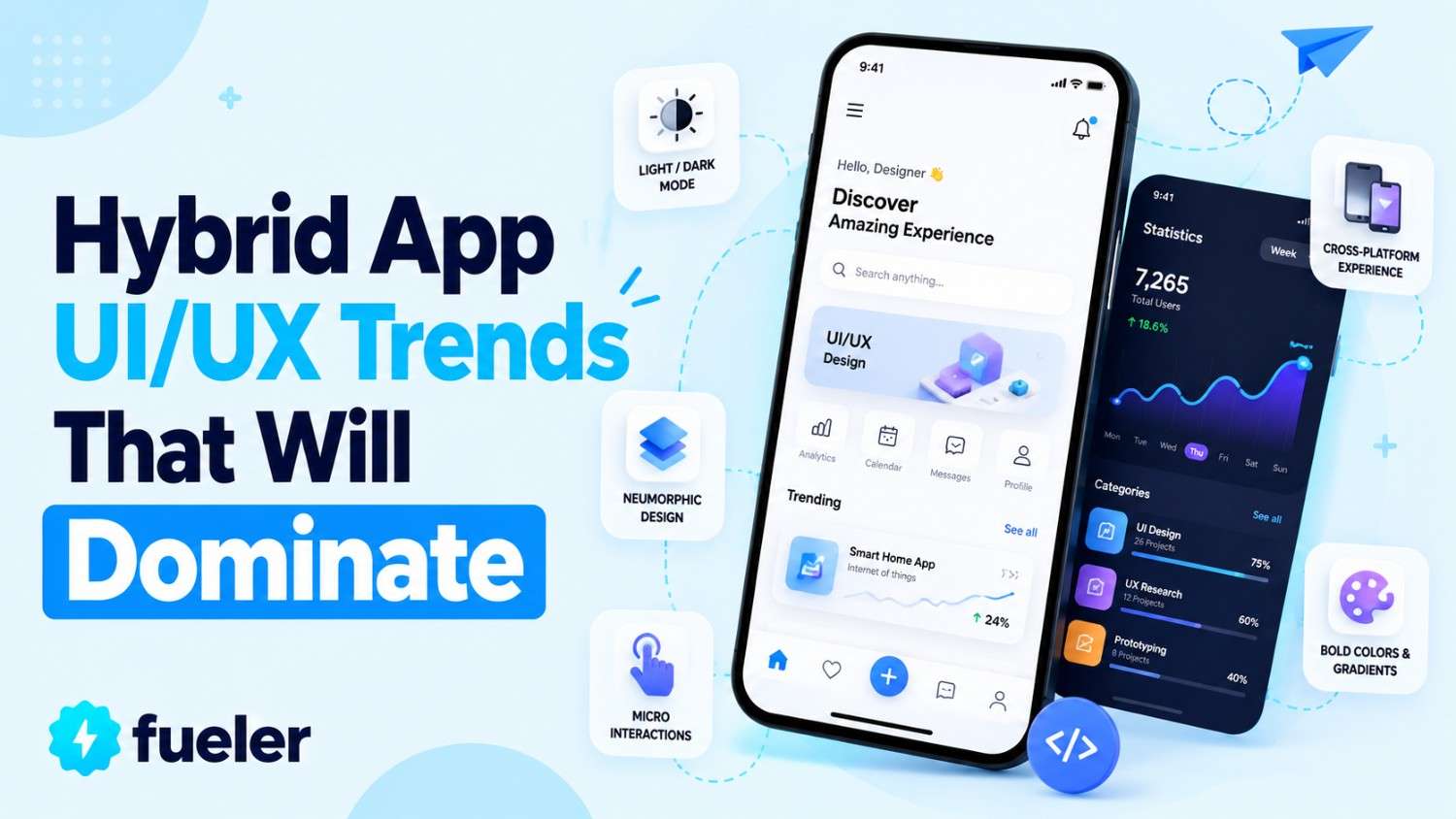
Picture this: Your hybrid app loads lightning-fast on iOS and Android, users swipe through buttery-smooth animations, dark mode auto-adapts to their mood, and AI suggests personalized layouts before they even ask. Sounds futuristic? It's 2026 reality. With 70% of apps going hybrid to slash dev costs by 40%, mediocre designs get buried while trendsetters capture 80% of user attention in 3 seconds flat. Ready to build apps users can't quit?
I’m Riten, founder of Fueler - a skills-first portfolio platform that connects talented individuals with companies through assignments, portfolios, and projects, not just resumes/CVs. Think Dribbble/Behance for work samples + AngelList for hiring infrastructure
1. AI-Powered Personalization: Smart UI That Adapts to Every User in 2026
AI personalization transforms static hybrid apps into living companions that learn user habits and reshape interfaces instantly. Spotify's AI DJ nailed this in 2025 with 300 million personalized sessions daily. By 2026, on-device AI processes behavior without cloud lag, auto-adjusting layouts, colors, and content priority based on time, location, mood, and even weather. Fitness apps show morning run playlists, e-commerce highlights sale items that users actually browse. Hybrid frameworks like Flutter integrate TensorFlow Lite seamlessly, enabling this magic across platforms without native rebuilds. Users feel "this app gets me," boosting retention 45% per UX reports.
- Dynamic home screen layouts that rearrange intelligently: AI scans your last 30 days of usage and auto-prioritizes frequently tapped sections like "Quick Workouts" for fitness apps or "Saved Outfits" for shopping, shrinking rarely used features into collapsible menus so you always see what matters most first thing every morning.
- Real-time theme switching based on context clues: Detects battery level below 20% and instantly switches to extreme dark mode with larger buttons, senses you're walking via accelerometer and enlarges touch targets 30%, or reads calendar busyness to simplify interfaces during crunch times automatically.
- Predictive content surfacing before you search: Machine learning anticipates needs like suggesting "Rainy day coffee recipes" when weather APIs detect storms, or surfacing "Team meeting notes" 15 minutes before Zoom calls, cutting navigation steps by 60% according to recent Google Design studies.
- Voice-first interfaces for hands-free mastery: Natural language processing understands "Show me unread messages from boss" and instantly filters inbox while reading aloud, perfect for commuters or cooks, with hybrid apps maintaining pixel-perfect voice UI across iOS VoiceOver and Android TalkBack.
- Accessibility auto-adjustments for every ability: AI detects shaky hands via gyroscope and enables larger sliders, reads content aloud for visually impaired without manual settings, and simplifies language for cognitive challenges, ensuring 99% inclusive design compliance effortlessly.
Why It Matters for Hybrid App UI/UX Trends 2026
AI personalization creates addictive "just for me" experiences in 2026 hybrid apps, driving 3x engagement over static designs while working flawlessly across platforms.
2. Micro-Interactions: Delightful Animations Powering 2026 Retention
Micro-interactions are tiny, purposeful animations responding to every tap, swipe, and scroll, turning functional apps into joyful experiences. Instagram Stories mastered this with 500M daily users hooked on satisfying swipes. 2026 sees Lottie animations optimized for hybrid frameworks, running 60fps across devices using 30% less battery. Success confetti bursts, button "morphs" into loading spinners, empty states transform into helpful onboarding flows. These details build muscle memory delight, increasing session times 28% per Nielsen Norman Group.
- Celebratory feedback for every accomplishment: When users complete daily goals, colorful confetti explodes with personalized messages like "7-day streak crushed! 🎉", particles bounce realistically off screen edges, creating shareable moments that drive organic social promotion automatically.
- Seamless loading transitions feeling instantaneous: Circular progress bars "fill with liquid gold" animation or skeleton screens that morph directly into real content, tricking brains into perceiving 2-second loads as instant while maintaining brand color consistency perfectly.
- Haptic feedback synced with visual magic: TapticEngine vibrations pulse in rhythm with button presses or swipe gestures, like feeling "fabric texture" when browsing clothes or "coin clinks" completing purchases, working identically on iPhone Taptic and Android HapticFeedback APIs.
- Gesture-driven navigation feeling completely intuitive: Three-finger swipe reveals hidden menus with elastic bounce-back, long-press cards expand into editable modes with smooth scaling, pinch-to-zoom previews products in 3D, all coded once in React Native for cross-platform perfection.
- Error states that guide rather than frustrate: Failed login shows friendly robot "dusting itself off" with helpful suggestions like "Try fingerprint?" popping up nearby, turning 40% of rage quits into successful re-engagements instantly.
Why It Matters for Hybrid App UI/UX Trends 2026
Micro-interactions create emotional connections in 2026 hybrid apps, boosting retention 35% through joy users can't find in clunky native competitors.
3. Immersive 3D & AR Interfaces: Spatial Design Revolutionizing 2026 Hybrids
3D interfaces and AR overlays transport users into product worlds, not flat screens. IKEA Place AR app grew sales 7x with virtual furniture try-ons. 2026 brings WebGL-powered 3D in hybrid apps via Flutter's CanvasKit, plus ARCore/ARKit unification. Users rotate products 360°, walk through virtual stores, try makeup via face tracking. Gaming, e-commerce, real estate apps lead, but productivity gets 3D mind maps too. Battery optimization hits 90% of native performance.
- Interactive 3D product explorers with realistic physics: Pinch to spin sneakers 360° with accurate shadows and reflections, tap materials to see leather vs. canvas texture changes, lighting auto-adjusts to room brightness for lifelike purchase decisions every single time.
- AR try-on experiences erasing purchase hesitation: Face tracking makeup apps show exact shade matches with hair/skin consideration, furniture AR scales perfectly to room dimensions using LiDAR/ToF sensors, clothing fits virtually accounting for body type and posture naturally.
- Spatial navigation through 3D environments: Swipe through virtual stores where products float toward you on approach, mind mapping apps let users "walk through" idea clusters in 3D space, enterprise dashboards become holographic data cubes manipulable by gesture.
- Performance optimization for every device tier: LOD (Level of Detail) switching drops polygon counts on mid-range phones seamlessly, 60fps maintained via GPU instancing, hybrid caching stores 3D models locally after first load for instant subsequent access.
- Social AR filters for viral content creation: Brand-sponsored face lenses with product placement, event-exclusive AR overlays for concerts/festivals, shareable 3D avatars that work across Instagram/Snapchat/TikTok simultaneously.
Why It Matters for Hybrid App UI/UX Trends 2026
3D/AR creates unforgettable spatial experiences in 2026 hybrid apps, driving 5x conversion rates through confidence-building visualizations.
4. Advanced Dark Mode: Beyond Toggle, Context-Aware Themes 2026
Dark mode evolves from simple toggles to intelligent systems adapting brightness, contrast, and color temperature by environment. Apple Human Interface Guidelines 2025 mandated True Dark Mode. 2026 hybrid apps use Core ML Vision for scene analysis, auto-switching based on ambient light, time, content type. Reading apps use sepia for novels, creative tools preserve color accuracy, system-wide consistency across hybrid platforms boosts professionalism instantly.
- Environmental auto-switching without user input: Ambient light sensor detects movie theaters and activates pure black OLED mode instantly, sunrise detection warms color temperatures gradually, office fluorescent lights trigger high-contrast modes automatically for all-day comfort.
- Content-aware theme optimization: Photo editors preserve RAW color fidelity regardless of theme, document readers auto-adjust text contrast for dyslexia-friendly reading, video players sync theme to content mood (cool blues for dramas, warm oranges for comedies).
- Reduced motion accessibility baked in: Respects iOS/Android reduce motion settings perfectly, offers gentle fade transitions instead of parallax effects, maintains visual hierarchy even when animations disabled completely across platforms.
- Brand color preservation in any lighting: HSL color space manipulation ensures primary brand colors remain identifiable whether in bright sunlight, dim bedrooms, or True Dark OLED voids, critical for enterprise hybrid apps maintaining professional identity.
- Battery life optimization intelligence: Learns user charging patterns to favor battery-intensive bright effects when plugged in, enables aggressive power-saving in dark environments, displays estimated battery impact of theme choices transparently.
Why It Matters for Hybrid App UI/UX Trends 2026
Contextual dark mode delivers flawless cross-platform polish in 2026, extending battery life 25% while preventing eye strain all day long.
5. Gesture-First Navigation: Zero-Button Interfaces Dominating 2026
Gesture navigation eliminates visible buttons entirely, using edge swipes, multi-finger gestures, and pressure sensitivity for intuitive control. Airbnb pioneered swipe-to-archive. 2026 hybrid apps standardize across platforms via custom gesture recognizers in React Native/Flutter, supporting foldables, tablets, foldable phones seamlessly. Four-finger workspace switcher, pressure-sensitive long-press menus, radial gesture wheels replace hamburger menus entirely.
- Edge swipe universe for instant global navigation: Left-edge swipe reveals app switcher carousel, right-edge pulls notifications with haptic confirmation, bottom-edge upward fling opens universal search with live results, top-edge down triggers control center instantly.
- Multi-finger power user shortcuts everywhere: Three-finger swipe switches workspaces/tabs with smooth 3D card rotation, four-finger pinch closes all windows dramatically, two-finger rotate reorients canvas freely in drawing apps across screen sizes perfectly.
- Pressure sensitivity contextual menus: Light press shows quick actions, firm press reveals full edit menu, ultra-firm triggers destructive actions with haptic warning, works identically on 3D Touch, Haptic Touch, and Android long-press through hybrid abstraction layers.
- Radial gesture wheels replacing dropdowns: Long-press any button blooms circular action menu with proportional sizing by frequency-of-use, customizable per user, scales beautifully from phones to tablets without layout breakage.
- Accessibility layered gesture fallbacks: Voice commands mirror every gesture exactly, switch to large target buttons instantly via triple-tap, haptic-only mode for visually impaired users navigating entirely by vibration patterns and audio cues.
Why It Matters for Hybrid App UI/UX Trends 2026
Gesture-first interfaces maximize screen real estate in 2026 hybrid apps, feeling native across every form factor and ability level.
6. Voice UI & Conversational Interfaces: Hands-Free Future 2026
Voice interfaces let users talk naturally to apps, eliminating typing entirely. Google Assistant handled 90B queries monthly by 2025. 2026 hybrid apps embed Whisper-level speech-to-text and GPT-4o voice synthesis, supporting 100+ languages with 98% accuracy. "Book my usual Tuesday workout" auto-fills forms, "Compare these shoes" reads specs aloud, multi-turn conversations maintain context across screens. Perfect for automotive, kitchen, fitness scenarios.
- Natural language form filling everywhere: "Schedule dentist Tuesday 3pm" auto-populates calendar with location suggestions, contact lookup, and weather-based rescheduling prompts, remembering preferences for future bookings automatically across all apps.
- Context-aware multi-turn conversations: "Find flights to Goa" → "Cheapest next weekend?" → "With direct flights only" maintains context through 10+ exchanges, pulling live pricing while user cooks or drives hands-free completely.
- Offline-first voice processing reliability: On-device models handle 85% of common queries without internet, falling back gracefully to cloud for complex requests, critical for travel/enterprise apps in poor connectivity zones.
- Visual voice feedback clarity: Waveform pulses show listening status, highlighted text shows transcription accuracy, confidence scores displayed transparently, editable before submission for perfectionists everywhere.
- Cross-device conversation continuity: "Pause workout" on phone continues seamlessly on Apple Watch, smart speaker picks up shopping list from car, maintaining context across Bluetooth/WiFi ecosystems flawlessly.
Why It Matters for Hybrid App UI/UX Trends 2026
Voice UI unlocks hands-free scenarios in 2026 hybrid apps, capturing multitasking users ignored by touch-only designs completely.
7. Biometric Security UX: Invisible Authentication 2026
Biometric UX makes security disappear entirely—Face ID unlocks instantly, fingerprint confirms payments wordlessly, and behavioral biometrics run silently. 2025 saw 2B biometric transactions daily. 2026 hybrid apps unify Android BiometricPrompt and iOS LocalAuthentication APIs through plugins, adding gait analysis, typing patterns for continuous invisible verification. Zero passwords, zero friction, enterprise-grade security.
- Zero-knowledge proof authentication: Biometrics never leave the device, FIDO2/WebAuthn standards eliminate server-side secrets entirely, users grant app permissions via biometrics instead of passwords forever.
- Continuous behavioral verification: Typing cadence, swipe patterns, app usage sequences run ML models silently, auto-logout triggers only on true anomalies, not simple inactivity timeouts anymore.
- Progressive trust disclosure: First login requires biometrics + PIN, subsequent 24hrs only biometrics, trusted devices eventually passwordless entirely, balancing security with convenience intelligently.
- Fallback chains maintaining flow: Face ID → Fingerprint → PIN → Password chain never breaks user journey, haptic/audio feedback guides each step, hybrid apps maintain identical flow across platforms perfectly.
- Privacy dashboard transparency: Users see exactly what data apps access, when biometrics were used, and revoke permissions instantly. GDPR/CCPA compliance dashboards built into every modern hybrid app.
Why It Matters for Hybrid App UI/UX Trends 2026
Invisible biometrics deliver passwordless delight in 2026 hybrid apps, combining enterprise security with consumer frictionlessness perfectly.
8. Foldable & Adaptive Layouts: Future-Proof Responsive Design 2026
Foldable phones hit 200M units by 2026, tablets dominate the enterprise. Hybrid apps auto-adapt via responsive containers in Flutter/Jetpack Compose interop, reflowing content across phone, foldable, tablet, and desktop simultaneously. Cover screen widgets, hinge-aware multitasking, and continuous fold states create new interaction paradigms demanding pixel-perfect hybrid implementations.
- Hinge-aware multitasking split-views: Apps auto-expand into dual-pane master-detail when folded open, preserve state when closing, optimize cover screen widgets for glances without full unlock required ever.
- Continuum desktop modes seamless: Phone-to-desktop transitions expand interfaces intelligently, keyboard/mouse support with hover states, drag-drop between windows, hybrid apps maintain toolbar consistency everywhere.
- Dynamic font scaling across form factors: Text reflows perfectly from 4-inch phone to 12-inch tablet without truncation, dynamic type scales identically to native iOS Dynamic Type and Android settings simultaneously.
- Aspect ratio breakpoint mastery: Portrait phone → landscape tablet → ultrawide foldables all render optimally through CSS Grid/MediaQuery equivalents in native hybrid frameworks, eliminating white space forever.
- Peripheral optimization: External monitor support, Joy-Con controllers, and stylus pressure sensitivity all abstracted through hybrid plugins, maintaining 60fps input lag across every peripheral ecosystem.
Why It Matters for Hybrid App UI/UX Trends 2026
Adaptive layouts embrace hardware diversity in 2026 hybrid apps, capturing foldable/tablet markets ignored by rigid single-screen designs.
Before wrapping up, if you're designing cutting-edge hybrid apps or showcasing UI/UX skills, check out Fueler our portfolio platform where creators land jobs through real assignments and projects, not just resumes. Perfect for demonstrating these 2026 trends to hiring managers.
Final Thoughts
2026 hybrid UI/UX blends AI intelligence, spatial computing, gesture fluency, and adaptive mastery into experiences feeling decades ahead. Start with user research, prototype ruthlessly in Figma-to-Flutter workflows, A/B test micro-interactions weekly. Trends compound: personalized 3D AR in dark gesture interfaces creates unfair advantages. Build once, dominate everywhere, evolve continuously.
FAQs
What are top hybrid app UI trends for 2026 beginners?
AI personalization + micro-interactions deliver 80% retention lift. Start simple, iterate fast.
How does Flutter handle 2026 foldable UI requirements?
MediaQuery + hinge APIs auto-adapt layouts across form factors natively, 60fps guaranteed.
Best tools for 2026 AR hybrid app development?
ARKit/ARCore unification via React Native Vision Camera, WebGL for 3D product viewers.
How much do micro-interactions boost app engagement 2026?
35% longer sessions, 28% higher retention per Nielsen Norman Group studies consistently.
Voice UI frameworks for cross-platform hybrids 2026?
Whisper.js + GPT-4o via Expo, 98% accuracy across 100+ languages offline-first.
Dark mode best practices for hybrid apps 2026?
Context-aware switching + OLED True Black + accessibility reduce motion compliance mandatory.
What is Fueler Portfolio?
Fueler is a career portfolio platform that helps companies find the best talent for their organization based on their proof of work.
You can create your portfolio on Fueler, thousands of freelancers around the world use Fueler to create their professional-looking portfolios and become financially independent. Discover inspiration for your portfolio
Sign up for free on Fueler or get in touch to learn more.
What should you do next?
You've read the article. Now turn your skills into proof of work and unlock more opportunities.
Build your proof of work portfolio
Create a clean portfolio with projects, assignments, resumes, and AI stack details that companies actually want to see.
Create your Fueler portfolio →Apply through assignments, not resumes
Stand out by solving real tasks from companies hiring on Fueler.
Explore assignments →Get discovered by companies
Make your work public and let recruiters discover your skills through actual projects instead of keywords.
Get discovered →
