How to Get Your First Video Editing Job in 2026?

Riten Debnath
09 Aug, 2026
Last updated: August 2026
Most aspiring video editors follow a remarkably predictable, broken playbook. They spend weeks polishing a glossy 60-second showreel filled with random travel footage, dump it into a PDF resume, and cold-email dozens of busy YouTube creators or marketing managers every single morning. The result is almost always total silence.
The problem is not a lack of video editing jobs. Millions of brands, agencies, and creators are actively searching for editorial talent. However, decision-makers are utterly overwhelmed by low-quality, template-driven applications. Hiring managers do not care about fancy software transitions or aesthetic color passes if you cannot prove your ability to hold viewer attention, fix real story narrative problems, or deliver polished video files under tight production deadlines.
I’m Riten, founder of Fueler, a skills-first portfolio platform building the career infrastructure for 100 million creative professionals. Fueler connects talented individuals with companies through assignments, portfolios, and projects, not just resumes or CVs. Think of it as Dribbble/Behance for work samples combined with AngelList for hiring infrastructure.
Landing your first paid editing role in 2026 requires abandoning passive job board applications. Instead, you must position yourself as an immediate problem solver who shows, rather than tells, what you can execute.
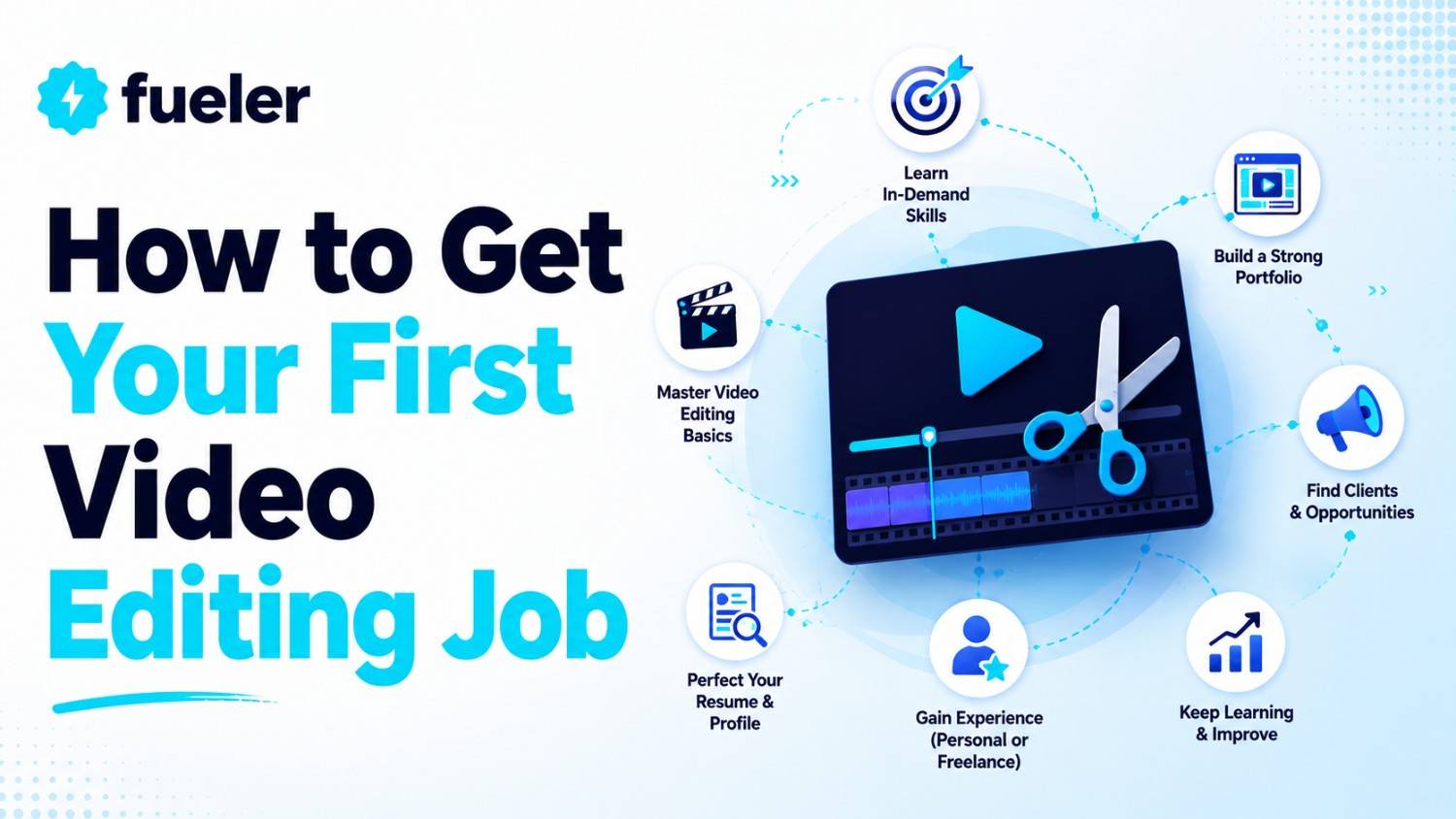
In this detailed guide, we will unpack 8 practical, proven, and realistic strategies to get your first video editing job, build a convincing line of proof of work, and secure your first paying clients.
Audit Content Creators and Send Unsolicited Spec Edits
Waiting for a creator or business to post a job opening guarantees you will compete with hundreds of other applicants on price and speed. The most effective way to grab immediate attention is by identifying existing pacing or structural flaws in a target client’s public content and fixing those issues before you ever ask for money.
Instead of sending a generic pitch saying you love their channel, pick a recent video from a creator who uploads consistently. Take the first two minutes of their video, re-cut the hook to strip out dead space, adjust the audio balancing, add clean text overlays, and re-frame the footage for maximum visual engagement. Upload this revised clip to a private link and send a brief, respectful message explaining exactly why you made those specific edits to improve their audience retention.
- Download raw long-form videos from creators who currently have weak visual hooks or poor dynamic audio levels on their public channels. Re-edit the opening sequence to prove you understand how to capture viewer attention within the first five seconds.
- Focus your speculative edits on fixing obvious structural issues such as awkward silence gaps, bad color balance, or missing graphic context rather than adding flashy, distracting visual effects.
- Send your speculative work directly to the creator or head of content via email or Twitter direct messages, accompanied by a quick, two-sentence explanation of the creative changes you made.
- Keep your speculative edit short, usually between thirty and sixty seconds, so the creator can evaluate your technical eye and narrative pacing without wasting their time.
- Offer the initial revised clip completely free of charge, using the positive reaction as a natural setup to discuss editing their next upcoming project for a paid fee.
Why It Matters
Sending unsolicited speculative edits removes all risk for the prospective client because they can immediately see the exact quality of your work. Instead of asking a busy client to trust a list of software skills on a resume, you demonstrate real initiative, technical execution, and commercial value upfront.
Convert Long-Form Videos into Platform-Specific Short Clips
Podcasters, corporate speakers, and YouTube channels often produce hours of valuable long-form content every week, but they struggle to repurpose that material into short-form videos for social media feeds. This gap represents one of the fastest, most reliable entry points for beginner editors who want to land consistent retainer clients.
Choose a mid-sized podcast or long-form business channel that currently uploads full video episodes but lacks an active short-form presence. Select a compelling two-minute section of an episode, isolate the core lesson, trim the filler words, format the video vertically, add accurate burnt-in captions, and include clean background audio layers. Deliver three finished short-form clips directly to the host as a free showcase of what their distribution could look like.
- Extract key insightful audio moments from long-form interview shows and reframe the raw horizontal video into clean vertical formats designed for social feeds.
- Add custom kinetic typography, subtle sound effects on graphic pop-ups, and precise jump cuts to keep the pacing fast and engaging.
- Organize your repurposed short clips inside a clean online project gallery like Fueler, allowing prospective podcast clients to easily browse your full library of short-form formats in one place.
- Pitch the long-form creator on a monthly retainer package where you automatically transform every new episode they publish into five high-impact short-form clips.
- Track basic performance metrics on the clips you produce, such as view counts or retention curves, so you can prove the tangible business impact of your editing work.
Why It Matters
Busy creators rarely have the bandwidth to chop up their own long-form assets into modern vertical videos. By offering a dedicated repurposing service, you solve a major content distribution bottleneck for creators who already have raw media assets ready to be edited.
Target Local Businesses and B2B Agencies
Most beginner video editors focus exclusively on internet famous YouTubers, completely ignoring local businesses and business-to-business corporate agencies in their immediate area. Local service providers, real estate firms, fitness studios, and corporate agencies usually have marketing budgets set aside, yet their video content often looks amateurish and unpolished.
Walk into local businesses or reach out to regional marketing agencies with a straightforward pitch centered on customer acquisition content. Offer to edit customer testimonial videos, product showcase clips, or local advertisement videos. Because these organizations care about generating sales leads rather than viral entertainment, your focus should be on clean audio, sharp color grading, clear text overlays, and professional branding.
- Reach out to real estate agents, law offices, or medical clinics that record raw video talking-head clips but lack in-house post-production staff.
- Position your services to local marketing agencies as a dependable white-label freelance editor who can handle their excess editing workload during busy client launches.
- Create standardized editing packages tailored specifically to local business needs, such as a set of three customer story videos or four monthly promotional reels.
- Focus heavily on pristine dialogue clarity, precise background music mixing, and clear calls to action that make the business look professional.
- Collect written statements from local business owners detailing how your edited videos helped improve their brand presentation or customer trust.
Why It Matters
Local businesses and B2B agencies treat video editing as an investment rather than a cost. They are less likely to demand complex, hyper-fast viral editing styles, making them ideal clients for beginners who can deliver clean, professional, and reliable work on time.
Partner with Assistant Editors and Post-Production Houses
High-volume post-production houses, senior freelance editors, and media agencies frequently face tight project deadlines and heavy footage loads. Instead of hiring a full-time lead editor, they often seek junior assistant editors to handle foundational post-production tasks like footage organization, audio syncing, proxy creation, and rough assemblies.
Contact established freelance editors or boutique video production companies on LinkedIn or Twitter. Rather than asking for a full video editor job, ask if they need assistance with time-consuming tasks like ingesting footage, setting up project files, syncing multi-camera shoots, generating transcriptions, or cutting initial rough drafts. This low-friction offer makes it easy for busy professionals to delegate work to you without taking on huge risks.
- Offer senior video editors dedicated assistance with logging raw footage, organizing timeline tracks, and creating light proxies for heavy 4K footage files.
- Demonstrate complete mastery over project file organization, including clean track naming, color-coded clips, and organized media bins inside standard editing software.
- Build a dedicated assistant editor portfolio page on Fueler, featuring screenshots of your organized timeline structures, multi-cam sync setups, and rough assembly cuts.
- Guarantee rapid turnarounds for basic tasks like pulling highlights, cutting out dead takes, or applying base color correction profiles to raw footage.
- Maintain absolute reliability and clear communication on every small task assigned to you, earning the trust required to eventually take over full project edits.
Why It Matters
Working as an assistant editor provides direct, practical experience inside real professional post-production workflows. You get paid while learning industry standards from experienced mentors, building valuable professional relationships that naturally lead to direct client referrals over time.
Participate in Public Editing Challenges and Open Briefs
Creative communities, editing YouTubers, software platforms, and stock footage sites regularly publish free open-source editing briefs and community editing contests. These challenges provide raw video assets, high-quality audio stems, and clear project guidelines, giving you real footage to work with even if you have zero past clients.
Treat every community editing brief as if it were a high-paying corporate assignment. Download the provided raw footage, follow the creative brief carefully, and produce a finished edit that showcases strong story pacing, tight sound design, and clean visual graphics. Share your submission publicly across social media channels, tagging the host, explaining your creative choices, and linking to your full project process documentation.
- Source high-quality raw footage packages from public editing competitions, community Discord groups, or stock media challenge events.
- Edit the raw footage strictly according to the brief's objectives, focusing on storytelling flow rather than relying solely on flashy transitions.
- Document your complete editing process by capturing screenshots of your organized software timelines, audio track layouts, and before-and-after color passes.
- Post your finished edit on public platforms alongside thoughtful commentary on how you solved specific storytelling problems presented by the raw media.
- Use these completed challenge entries as primary portfolio pieces to prove your technical abilities to prospective clients who ask for past work samples.
Why It Matters
Participating in open editing briefs eliminates the "no footage to edit" excuse that stops many beginners in their tracks. It allows you to build a practical, multi-style portfolio using professional-grade raw media assets while getting direct feedback from creative peers and hiring managers.
Offer Free First-Stage Rough Cuts for Open Job Listings
When creators or companies post active job listings on freelance platforms or social media, they are immediately flooded with hundreds of generic resumes and links to random video reels. Most applicants send identical, copy-pasted cover letters that hiring managers ignore completely.
Stand out immediately by offering to produce a thirty-second rough cut of their actual project footage as part of your application. If the job posting includes a link to raw media files or sample footage, download it immediately, edit a tight opening sequence, and submit that customized clip alongside your application message. If no raw files are provided, ask for a small two-minute sample clip to edit on a trial basis so they can judge your pacing firsthand.
- Scan job boards and social media channels daily for video editing job posts that include links to sample footage or raw channel assets.
- Download the provided sample assets immediately and edit a thirty-second clip that demonstrates exceptional pacing, sound design, and narrative clarity.
- Submit your application with a link to the edited trial clip right at the top of your message, skipping long, boring introductory paragraphs.
- Explain the specific editorial choices you made in the sample cut, showing how your decisions support the client's goal for the video.
- Frame the free rough cut as a low-risk trial, letting the client evaluate your speed, communication, and technical style before signing a contract.
Why It Matters
Hiring managers do not want to review dozens of general portfolios; they want to know who can execute their specific project best. Delivering a custom, project-specific rough cut instantly moves your application to the top of the pile because you have already completed a piece of the actual job.
Build a Niche-Specific Video Editing Portfolio Showcase
A generic video reel that mixes wedding footage, gaming highlights, commercial edits, and corporate interviews confuses prospective clients. Hiring managers hire specialists who understand the unique pacing, visual language, and audience expectations of their specific niche.
Select one or two target niches you genuinely enjoy, such as educational YouTube essays, high-retention short-form finance reels, or corporate SaaS product videos. Build a dedicated portfolio showcase that features three to four comprehensive project breakdowns within that specific niche. Instead of just embedding a finished video file, include project goal statements, script notes, timeline screenshots, and a short explanation of how your edit kept viewers engaged.
- Focus your portfolio assets exclusively on one clear content style or industry niche rather than presenting an unorganized mix of unrelated video genres.
- Write detailed case study breakdowns for every project, explaining the initial client goal, the raw footage challenges, and your specific editorial solutions.
- Host your comprehensive project breakdowns on a clean, professional platform like Fueler, where clients can view your timeline process, script annotations, and final video outputs without distraction.
- Include detailed technical specifications for each edit, such as the software tools used, color grading steps applied, and audio plugins deployed.
- Update your niche showcase regularly with fresh, relevant project breakdowns that match current platform formats and video trends.
Why It Matters
Clients hire editors who make them feel confident that their specific video style will be executed flawlessly. A specialized, process-oriented portfolio showcase instantly positions you as an expert in that specific format, allowing you to charge higher rates right from your very first job.
Leverage Organic Direct Outreach via Twitter and LinkedIn
Waiting passively for job applications to be reviewed on high-volume freelance boards often leads to slow results and low pay rates. Direct, thoughtful outreach on professional social platforms like Twitter (X) and LinkedIn puts you in direct contact with founders, creative directors, and content leads who hire editors continuously.
Identify twenty to thirty active content managers, creative directors, or growing media creators who post regularly on social media. Engage meaningfully with their content by leaving insightful comments on their video posts, analyzing their pacing choices, or offering constructive feedback. After building basic familiarity, send a concise, customized direct message offering a specific value addition, such as a sample edit, a video audit, or extra editing support for their upcoming launches.
- Build a focused list of active creative leads, agency owners, and channel managers on LinkedIn and Twitter who regularly publish video content.
- Engage with their posted videos consistently by providing smart, professional observations regarding their visual presentation, audio balance, or pacing.
- Send personalized direct messages that reference a specific video they published, pointing out one thing done exceptionally well and one area that could be improved.
- Share a direct link to your Fueler portfolio within your outreach messages, giving potential clients instant access to your complete proof of work documentation.
- Maintain a structured outreach tracking spreadsheet to follow up politely with prospective contacts every few days without being annoying.
Why It Matters
Direct outreach bypasses competitive job boards entirely and establishes a personal relationship with key decision-makers. Most premium editing contracts are awarded through direct conversations and professional networks rather than public job postings.
How Does This Connect to Building a Strong Career or Portfolio?
In today's competitive job market, listing software tools like Premiere Pro or DaVinci Resolve on a resume is simply not enough. Clients and hiring managers do not hire software tools; they hire proven execution, reliable delivery, and clear problem-solving abilities. Documenting your complete post-production workflow, sharing raw timeline screenshots, and displaying your creative decisions establishes immediate professional trust. When you showcase real assignments and detailed project breakdowns on platforms like Fueler, you create a compelling portfolio that highlights your true value, helping you land jobs based on undeniable proof of work rather than basic paper resumes.
Final Thoughts
Landing your first paid video editing job in 2026 comes down to shifting your focus from making passive applications to proactively proving your technical value. Stop waiting for permission or formal job postings to start editing footage. Find creators with content problems, fix their videos through speculative edits, document your editorial process, and present your work with total clarity. When you consistently deliver value upfront and back it up with clear proof of work, your first paid editing job will follow naturally.
Frequently Asked Questions
Do I need a college degree to get a video editing job?
No formal college degree is required to work as a video editor. Clients and hiring managers care exclusively about your technical abilities, narrative pacing skills, reliability, and tangible proof of work demonstrated through real project breakdowns.
What is the best software to learn for beginner video editors?
Adobe Premiere Pro and DaVinci Resolve are the industry standards for professional desktop editing. Focus on mastering one primary application thoroughly to build fast keyboard habits, organized project workflows, and clean timeline management.
How do I get raw video footage to build my portfolio?
You can download royalty-free footage from stock sites, participate in public community editing challenges, or re-cut public domain long-form podcast clips and YouTube videos into original speculative edits.
How long does it take to land your first video editing client?
With consistent, targeted outreach and high-quality speculative edits, beginner editors often land their first paying client within three to six weeks of active outreach. The timeline depends heavily on how fast you execute outreach.
Should I edit videos for free when starting out?
Never do generic free work without a strategic goal. Only offer free edits as targeted thirty-second speculative samples or trial cuts that solve a specific problem for a client, using them directly as leverage to secure a paid contract.
Why 100,000+ professionals use Fueler
Fueler helps professionals showcase proof of work through projects, assignments, case studies, and achievements.
- Thousands of professionals use Fueler to create their digital portfolio
- Thousands of projects are published on Fueler. Check here
- Startups and Companies hire through proof of work on Fueler
- Used by freelancers, creators, marketers, video editors, writers, designers, and product managers
Our mission is to help the next 100 million professionals build a verified professional identity through proof of work

What should you do next?
You've read the article. Now turn your skills into proof of work and unlock more opportunities.
Build your proof of work portfolio
Create a clean portfolio with projects, assignments, resumes, and AI stack details that companies actually want to see.
Create your Fueler portfolio →Apply through assignments, not resumes
Stand out by solving real tasks from companies hiring on Fueler.
Explore assignments →Get discovered by companies
Make your work public and let recruiters discover your skills through actual projects instead of keywords.
Get discovered →
