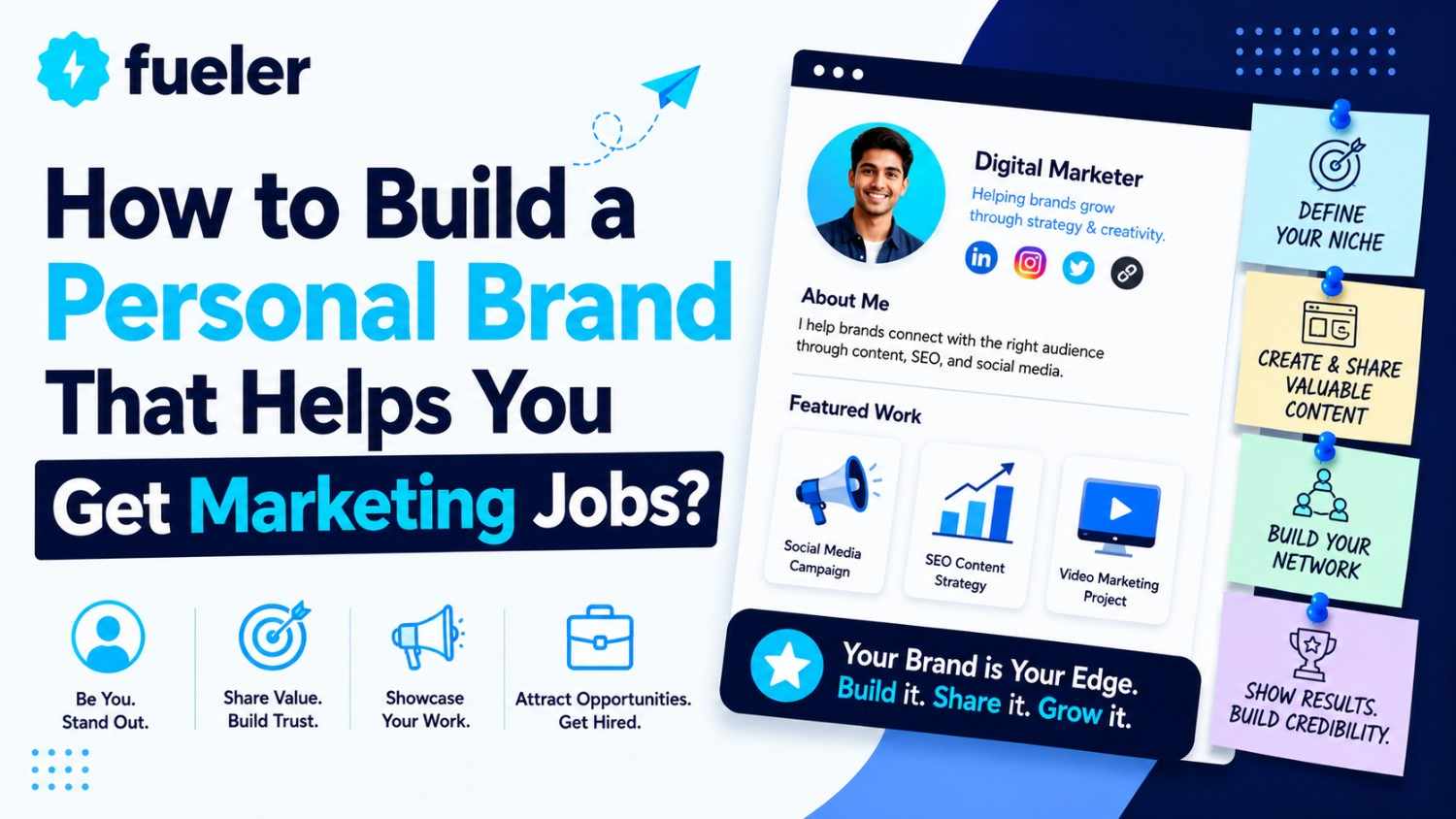
How to Build a Personal Brand That Helps You Get Marketing Jobs?

Riten Debnath
29 Jul, 2026
Last updated: July 2026
Building a personal brand does not mean becoming an influencer who posts empty motivational quotes every morning. If your online presence focuses on generic advice instead of real campaign breakdowns, hiring managers will scroll right past your profile.
I’m Riten, founder of Fueler, a skills-first portfolio platform building the career infrastructure for 100 million creative professionals. Fueler connects talented individuals with companies through assignments, portfolios, and projects, not just resumes or CVs. Think of it as Dribbble/Behance for work samples combined with AngelList for hiring infrastructure.
Understanding how to showcase your actual thinking turns your personal brand into a magnet for top marketing roles. In this article, you will learn practical, stress-free ways to position your work so companies reach out to you first.

Documenting Your Work Process Instead of Posting Self-Promotional Hype
Most marketers fail at personal branding because they treat their profiles like digital billboards. Posting vague statements about your passion for growth tells a recruiter nothing about how you actually solve business problems.
Sharing the messy middle of your projects, the raw data, failed experiments, and unexpected campaign pivots instantly builds trust. When you document how you work in public, you invite hiring leads to evaluate your problem-solving skills in real time.
- Publishing Detailed Campaign Post-Mortems: Breaking down why a specific ad test failed or how an email campaign hit a wall proves you value honest data over vanity metrics, making you look like a seasoned operator.
- Sharing Raw Research Notes and Schematics: Posting your initial audience research grids, message testing frameworks, or copywriting drafts shows prospective employers the structured discipline behind your final creative assets.
- Explaining Tool Selection Rationale: Discussing why you chose a simple email trigger sequence instead of an expensive automation suite highlights your respect for company budgets and operational efficiency.
- Highlighting Real Iterations and Edits: Showing early design mockups alongside final landing page builds reveals how you incorporate performance feedback to improve conversion outcomes continuously.
- Openly Discussing Metric Trade-offs: Explaining why you sacrificed top-of-funnel impression volume to secure higher-quality, sales-ready leads demonstrates strong commercial alignment with revenue goals.
Why It Matters
Transparent documentation separates active practitioners from smooth talkers who rely on buzzwords. Showing how you navigate operational friction builds undeniable proof of your capability long before a formal interview.
Niche Down Your Core Marketing Discipline Publicly
Trying to position yourself as an expert in organic search, paid acquisition, brand strategy, and short-form video all at once confuses hiring managers. Generalists often get lost in competitive applicant pools because teams hire for specific immediate pain points.
Pick one or two core channels where you consistently deliver measurable outcomes and build your brand around them. When a company needs to scale its newsletter or fix its ad spend efficiency, your profile should be the obvious answer.
- Focusing Content on Single Channel Mechanics: Writing exclusively about conversion rate optimization or technical SEO establishes you as a targeted specialist who understands complex channel mechanics deeply.
- Targeting Industry-Specific Marketing Problems: Tailoring your insights to B2B SaaS onboarding or direct-to-consumer e-commerce fulfillment signals that you understand the unique unit economics of those specific business models.
- Creating Frameworks for Specific Deliverables: Publishing step-by-step templates for product launch emails or ad copy testing gives your audience immediate value while highlighting your operational system.
- Curating Niche Industry Case Studies: Analyzing how top brands in your chosen niche solve acquisition challenges proves you stay updated on category-specific competitive playbooks and growth trends.
- Declining Off-Topic Public Commentary: Resisting the urge to comment on every trending viral story keeps your digital brand focused tightly on your core area of marketing expertise.
Why It Matters
Specialization commands higher salaries and speeds up hiring decisions because companies buy solutions to explicit problems. A clear niche makes your profile memorable when team leads search for specific skills.
Building Public Case Studies from Teardowns and Mock Assignments
You do not need years of client experience or huge budgets to prove you know how to market a product. Conducting unsolicited teardowns of existing brand campaigns proves you can analyze live strategies and spot high-value growth opportunities independently.
Pick a brand you admire, analyze their current onboarding sequence or search strategy, and rebuild it with clear explanations. These unsolicited projects demonstrate initiative, tactical depth, and business curiosity that resumes simply cannot match.
- Deconstructing Poorly Performing Funnels: Analyzing broken email signup flows or confusing landing pages for public brands highlights your ability to spot conversion friction and propose clean fixes.
- Redesigning Real Ad Creatives: Rebuilding weak social ad images or rewritten search headlines shows hiring managers how you apply audience psychology to improve real-world campaign performance.
- Auditing Organic Search Keyword Gaps: Publishing a mini-SEO audit identifying missed long-tail keyword opportunities for a target company proves you can drive immediate organic traffic gains.
- Proposing Clear A/B Test Hypotheses: Explaining how you would split-test a company's main hero section copy demonstrates a scientific, data-driven approach to marketing growth.
- Mapping Out Cross-Channel Distribution Strategies: Outlining how a brand could syndicate a single core whitepaper across five different social channels demonstrates efficient distribution planning skills.
Why It Matters
Public teardowns turn theoretical knowledge into tangible proof of execution that recruiters can review immediately. Showing initiative through mock projects proves you possess the proactive drive every manager wants on their team.
Maintaining a Clean, Single-Link Proof of Work Asset Hub
Scattering your best projects across old cloud drives, design tools, and buried social posts makes it hard for busy recruiters to evaluate your talent. A messy presentation creates friction, forcing hiring leads to abandon your application.
Centralize your best case studies, writing samples, and campaign breakdowns into a single, clean portfolio link. Organise your work with clear context so anyone can understand your role, process, and results within seconds.
- Structuring Projects with Clear Context: Providing a brief overview of the initial goal, your specific role, the tools used, and final metrics gives recruiters a complete picture of your capabilities.
- Embedding Multi-Format Campaign Assets: Presenting live copy drafts, visual mockups, and performance spreadsheets in one clean layout allows visitors to inspect your work quality easily.
- Highlighting Verified Project Metrics: Presenting clear percentage improvements in conversion rates, click-through rates, or subscriber growth backs up your claims with verifiable performance data.
- Eliminating Layout and Navigation Friction: Using simple portfolio layouts ensures hiring managers can access your top three projects within two clicks on mobile or desktop devices.
- Updating Project Entries Routinely: Refreshing your portfolio link with recent assignment outcomes proves that your skills are active, modern, and continuously sharpening.
Why It Matters
A well-organized proof of work hub acts as a round-the-clock sales page for your professional career. Eliminating presentation friction helps recruiters verify your skills fast and move you directly to the interview round.
Engaging in Meaningful Industry Conversations Instead of Passive Liking
Building a brand is a two-way street that requires active participation in relevant industry discussions. Leaving thoughtful, value-additive comments on posts by marketing directors and founders puts your name directly on their radar.
Avoid posting generic praise like "Great post!" or "Totally agree!" Add real insight by offering a brief alternative perspective, sharing a personal data point, or asking a sharp operational question that advances the conversation.
- Adding Data Points to Existing Discussions: Sharing real metrics from your own campaign experiments in comment threads adds genuine value and establishes your credibility naturally.
- Asking Sharp Operational Questions: Inquiring about how a founder managed campaign attribution or budget shifts shows high-level business thinking that catches the attention of senior leaders.
- Politely Challenging Generic Advice: Offering a grounded, real-world counterpoint to oversimplified marketing advice demonstrates independent thinking and practical experience.
- Summarizing Long Industry Reports: Breaking down dense 50-page industry studies into five clear, actionable takeaways in public threads builds immediate goodwill with busy peers.
- Connecting Peers with Helpful Resources: Tagging relevant tools, frameworks, or case studies in response to someone's public problem establishes you as a helpful, well-connected professional.
Why It Matters
High-value commenting exposes your profile to senior marketing leaders who are actively hiring but rarely read traditional application piles. Smart public discourse builds professional relationships faster than cold outreach.
Consistent Distribution of Short-Form Learning Snippets
Creating massive 3,000-word guides every week is exhausting and usually unsustainable for busy professionals. Instead, break your daily learning, micro-experiments, and marketing realizations into short, bite-sized public posts.
Sharing quick campaign takeaways regularly keeps your brand active in algorithmic feeds without causing creator burnout. Consistency signals discipline and passion for your craft, two traits that hiring teams prize heavily.
- Sharing Weekly Campaign Learnings: Posting two brief observations every Friday about what worked or failed in your ad accounts builds a consistent rhythm of transparent building.
- Translating Complex Concepts into Simple Terms: Explaining confusing technical topics like server-side tracking or attribution windows in simple language proves you understand your craft deeply.
- Posting Screenshot Annotations: Sharing annotated images of great email copy or clever onboarding screens helps your audience visualize effective marketing tactics instantly.
- Documenting Tool Workflows: Showing brief screen recordings of how you use automation tools to streamline content scheduling proves you value modern operational speed.
- Reflecting on Industry Shifts: Writing short observations on how search algorithm updates or privacy changes impact marketing strategies demonstrates forward-thinking awareness.
Why It Matters
Consistent micro-distribution keeps you top-of-mind across your network so people think of you first when a job opens up. Regular publishing builds an organic archive that acts as a living resume of your growth.
Aligning Brand Messaging with Commercial Business Outcomes
Unskilled marketers talk exclusively about aesthetics, social media likes, and viral impressions. High-earning growth leads focus their personal brand around revenue, acquisition costs, customer retention, and profit margins.
Position your public brand around business metrics so employers view you as an investment rather than an expense. Frame every project breakdown around how your marketing actions directly supported broader corporate financial goals.
- Connecting Copy Adjustments to Revenue: Explaining how changing a single headline improved lead quality and shortened the sales team's closing cycle demonstrates commercial alignment.
- Focusing on Customer Acquisition Costs: Discussing strategies to lower paid channel CAC while keeping user quality high proves you care about company profitability and capital efficiency.
- Highlighting Retention and LTV Improvements: Showing how onboarding email sequences reduced early user churn signals that you understand long-term customer value models.
- Framing Experiments Around ROI: Evaluating campaign tests based on net revenue generated rather than vanity clicks proves you prioritize actual corporate survival and growth.
- Discussing Budget Allocation Strategy: Explaining how you reallocate underperforming marketing spend into high-yield channels demonstrates mature resource management skills.
Why It Matters
Translating marketing activities into revenue language bridges the gap between creative tasks and business survival. Executives hire marketers who talk about profit, capital efficiency, and customer lifetime value.
Levering Strategic Network Cross-Promotions and Collaborations
You do not have to build your audience entirely alone from scratch. Partnering with peers, co-hosting small webinars, or writing guest breakdowns for established marketing newsletters helps you tap into existing communities.
Co-creating content with other marketers exposes your work to their followers while building lasting professional relationships. Networking through shared work projects is far more effective than asking strangers for favors in cold messages.
- Co-Authoring Deep-Dive Teardowns: Teaming up with a peer to analyze a complex product launch lets you pool research efforts and cross-promote the final piece to both audiences.
- Hosting Informal Skill-Share Sessions: Organizing small virtual roundtables to discuss specific tools or ad strategies positions you as an active community builder within your niche.
- Contributing Guest Breakdown Sections: Offering brief, expert commentary for established industry newsletters exposes your analytical skills to thousands of engaged subscribers.
- Interviewing Senior Practitioners: Asking experienced marketing leads structured questions about their operational workflows builds your network while delivering value to your audience.
- Tagging Collaborators with Context: Crediting team members and peers properly on joint projects builds a reputation for fairness, humility, and strong collaborative spirit.
Why It Matters
Collaborative distribution expands your professional footprint into networks you could not reach on your own. Building relationships through shared projects turns industry peers into active advocates who refer job opportunities to you.
How Does This Connect to Building a Strong Career or Portfolio?
Building a personal brand without a central hub for your proof of work is like running ads to a broken landing page. Your content grabs attention, but your portfolio converts that attention into real job offers. Showing clear project breakdowns, mock assignments, and metric outcomes gives recruiters undeniable proof of your abilities. Documenting your strategic process highlights your business awareness, tool fluency, and execution speed. Platforms like Fueler allow you to showcase these real-world projects and proof of work cleanly, helping you land top marketing roles based on merit rather than traditional resumes.
Final Thoughts
A strong personal brand is simply proof of your work made visible to the people who can hire you. By focusing on transparent documentation, clear specialization, practical teardowns, and business outcomes, you stand out effortlessly in a crowded job market. Stop waiting for traditional recruiters to find your static resume, publish your thinking, build real project assets, and let your work open doors for you. The marketers who showcase verified proof of work today are the ones who control their career trajectories tomorrow.

Frequently Asked Questions
Do I need a massive social media following to build a hiring brand?
No, hiring managers care about the quality of your insights and proof of work, not your follower count. A hundred engaged industry peers matter far more than ten thousand casual followers.
What is the best platform to build a personal brand for marketing jobs?
LinkedIn and specialized portfolio platforms like Fueler are ideal because recruiters and founders actively search these spaces for verified project work and practical industry breakdowns.
How do I build a personal brand if I cannot share NDA client data?
Focus on the strategic methodology, create mock teardowns of public brands, or anonymize the figures by sharing percentage growth metrics instead of sensitive financial totals.
How often should I post content to attract hiring managers?
Focus on quality over daily noise. Publishing one thorough campaign breakdown or public teardown every week is more effective than posting generic motivational text daily.
Can a personal brand replace a traditional resume completely?
Yes, displaying clear proof of work and public project breakdowns frequently allows candidates to skip traditional resume screenings and jump straight to final interview rounds.
Why 100,000+ professionals use Fueler
Fueler helps professionals showcase proof of work through projects, assignments, case studies, and achievements.
- Thousands of professionals use Fueler to create their digital portfolio
- Thousands of projects are published on Fueler. Check here
- Startups and Companies hire through proof of work on Fueler
- Used by freelancers, creators, marketers, video editors, writers, designers, and product managers
Our mission is to help the next 100 million professionals build a verified professional identity through proof of work

What should you do next?
You've read the article. Now turn your skills into proof of work and unlock more opportunities.
Build your proof of work portfolio
Create a clean portfolio with projects, assignments, resumes, and AI stack details that companies actually want to see.
Create your Fueler portfolio →Apply through assignments, not resumes
Stand out by solving real tasks from companies hiring on Fueler.
Explore assignments →Get discovered by companies
Make your work public and let recruiters discover your skills through actual projects instead of keywords.
Get discovered →
