How Recruiters Evaluate Your Digital Portfolio

Riten Debnath
02 Apr, 2026
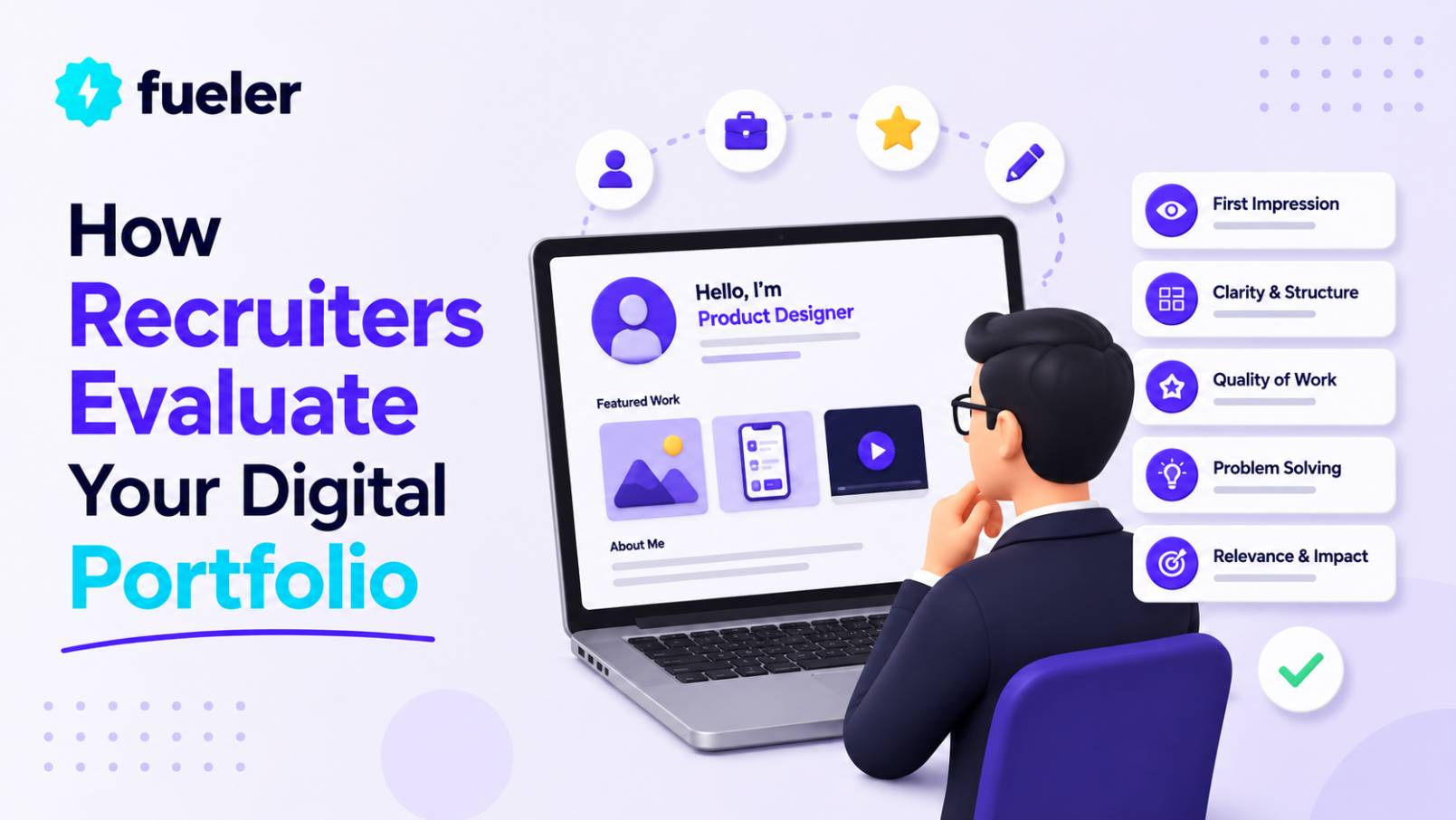
I am Riten, founder of Fueler. One of the most valuable things I have done while building this platform is talking to the people on the other side of the hiring table. Recruiters. Hiring managers. Founders who review candidates. I wanted to understand exactly how they look at portfolios. What makes them lean forward. What makes them close the tab.
In this article, I am sharing everything I have learned from those conversations. Understanding how recruiters evaluate your portfolio is one of the most valuable things you can know when building one.
The First 10 Seconds: The Initial Judgment
Every recruiter I have spoken to describes the same experience when they open a portfolio. Within the first 10 seconds, they have already formed an impression. This is not a reflection of their attention span. It is the reality of how human perception works. First impressions happen fast.
In those first 10 seconds, they are not reading every word. They are scanning for signals. Is this page easy to understand? Does the headline tell me clearly what this person does? Are there actual projects I can click into? Does the overall presentation look professional and organized?
If any of these signals fail, most recruiters close the tab and move on to the next candidate. Your portfolio needs to pass this first test before any of the detailed content even matters.
What Recruiters Are Looking for in Your Projects
Once a portfolio passes the initial impression test, recruiters move into evaluation mode. They start clicking into individual projects. And here, the questions they are asking change significantly.
The first question is relevance. Is this work related to the role we are hiring for? A portfolio full of excellent work in the wrong area does not help you for this specific opportunity. This is why curating your portfolio for each application matters.
The second question is specificity. Can I tell what this person did specifically, as opposed to what their team did? Recruiters know that most work happens in teams. They are trying to find your individual contribution within that team context. Be explicit about what you personally did.
The third question is impact. What did this work achieve? What changed as a result of this person's contribution? If a project has no stated outcome, recruiters are left guessing. And they rarely guess in your favor.
The fourth question is skill demonstration. Does this project actually prove the skill it claims to demonstrate? Saying a project shows your strategic thinking is very different from having a project entry that clearly walks through your strategic reasoning and the results it produced.
Red Flags That Recruiters Notice Immediately
Recruiters have seen enough portfolios to quickly identify the patterns that signal a weak candidate or a poorly built portfolio. Knowing these red flags helps you avoid them.
The most common red flag is projects with no outcomes. A portfolio that shows the work but never tells you what it achieved is incomplete. It raises the question: did this work actually produce anything valuable? Always include at least one result per project, even if it is qualitative.
Outdated work is another significant red flag. A portfolio where the most recent project is from four or five years ago signals that the person has not kept their skills current or has not done anything worth showcasing recently. Remove outdated work and add recent projects regularly.
Too many projects with no curation is a third pattern that hurts portfolios. When a portfolio contains 30 or 40 projects of varying quality, it signals that the person does not have good judgment about their own work. A curated portfolio of 8 strong projects is always better than an uncurated archive of everything you have ever touched.
Generic language is a fourth red flag. Descriptions that could apply to any candidate in any industry, like 'managed projects and worked with cross-functional teams,' communicate nothing specific about the person's actual contribution or capability. Be specific. Always.
What Makes a Portfolio Memorable
Beyond passing the red flag test, the best portfolios are the ones that recruiters remember when they close their laptop for the day. These portfolios have a few things in common.
They have a clear point of view. Reading the portfolio, you understand not just what the person has done but how they think, what they care about, and what kind of professional they are. This personality and perspective make a portfolio memorable in a way that a list of projects cannot.
They show honest and specific stories. Not just data, but the narrative of what happened. The challenge that seemed impossible. The pivot that changed the project's direction. The insight that unlocked the solution. These moments make a portfolio human and compelling.
And they are consistent in quality. Every project entry is documented to the same standard. Every project has context, contribution, and outcome. Every piece of evidence is clear and accessible. This consistency signals discipline and professionalism.
How Fueler Makes Your Portfolio Recruiter-Ready
Fueler is designed with the recruiter's evaluation process in mind. The portfolio structure guides you naturally toward including the context, contribution, and outcome that recruiters need to make a confident decision. The skill-tagging system ensures your portfolio is organized in a way that is immediately clear and relevant.
More importantly, companies that use Fueler for hiring are already sold on the idea of evaluating candidates through their work. When your portfolio is on Fueler, you are reaching an audience of employers who actively value what you have built rather than just where you have worked.
Build your recruiter-ready portfolio at fueler.io.
The Shift That Changes Everything
The most important shift you can make when building your portfolio is this: stop thinking about it as a document that you send and start thinking about it as a system that works for you. Recruiters are not the only ones who find your portfolio. Companies searching for talent on Fueler find it. Potential clients who click your LinkedIn link find it. Conference connections who Google you after meeting you find it. Every person who discovers your portfolio is a potential opportunity.
When you build your portfolio with recruiter psychology in mind, you are not just preparing for job applications. You are building a permanent career asset that compounds in value over time. Every project you add, every outcome you document, and every testimonial you collect makes the portfolio stronger for every future reader who encounters it.
The recruiters who remember portfolios months after seeing them are remembering the ones that told a clear story, showed real impact, and gave them confidence. Build that portfolio. Do it on Fueler. Start today.
Frequently Asked Questions
How do recruiters evaluate a digital portfolio?
Recruiters form an initial impression within 10 seconds based on clarity and organization. They then evaluate individual projects for relevance, specificity of contribution, and measurable impact. Red flags include missing outcomes, outdated work, and generic descriptions.
What do recruiters look for in a career portfolio?
Relevance to the role, clear individual contribution within team projects, measurable outcomes, and evidence that the claimed skills are genuinely demonstrated by the work shown.
How long do recruiters spend looking at a portfolio?
The first impression forms within 10 seconds. If the portfolio passes that test, recruiters typically spend 2 to 5 minutes reviewing individual projects before deciding whether to move the candidate forward.
How do I make my portfolio pass the recruiter's initial scan?
Lead with a specific and clear professional headline. Show 5 to 10 projects with descriptive titles. Ensure the layout is clean and easy to navigate. Remove anything outdated or irrelevant. Fueler's structure helps you achieve this automatically.
Do recruiters actually look at portfolios or just resumes?
Yes, especially in creative, technology, marketing, product, and growth roles. And the trend is expanding across all industries as proof-of-work hiring grows. A strong portfolio is increasingly the deciding factor between otherwise similar candidates.
What is Fueler Portfolio?
Fueler is a career portfolio platform that helps companies find the best talent for their organization based on their proof of work. You can create your portfolio on Fueler. Thousands of freelancers around the world use Fueler to create their professional-looking portfolios and become financially independent. Discover inspiration for your portfolio
Sign up for free on Fueler or get in touch to learn more.

What should you do next?
You've read the article. Now turn your skills into proof of work and unlock more opportunities.
Build your proof of work portfolio
Create a clean portfolio with projects, assignments, resumes, and AI stack details that companies actually want to see.
Create your Fueler portfolio →Apply through assignments, not resumes
Stand out by solving real tasks from companies hiring on Fueler.
Explore assignments →Get discovered by companies
Make your work public and let recruiters discover your skills through actual projects instead of keywords.
Get discovered →
