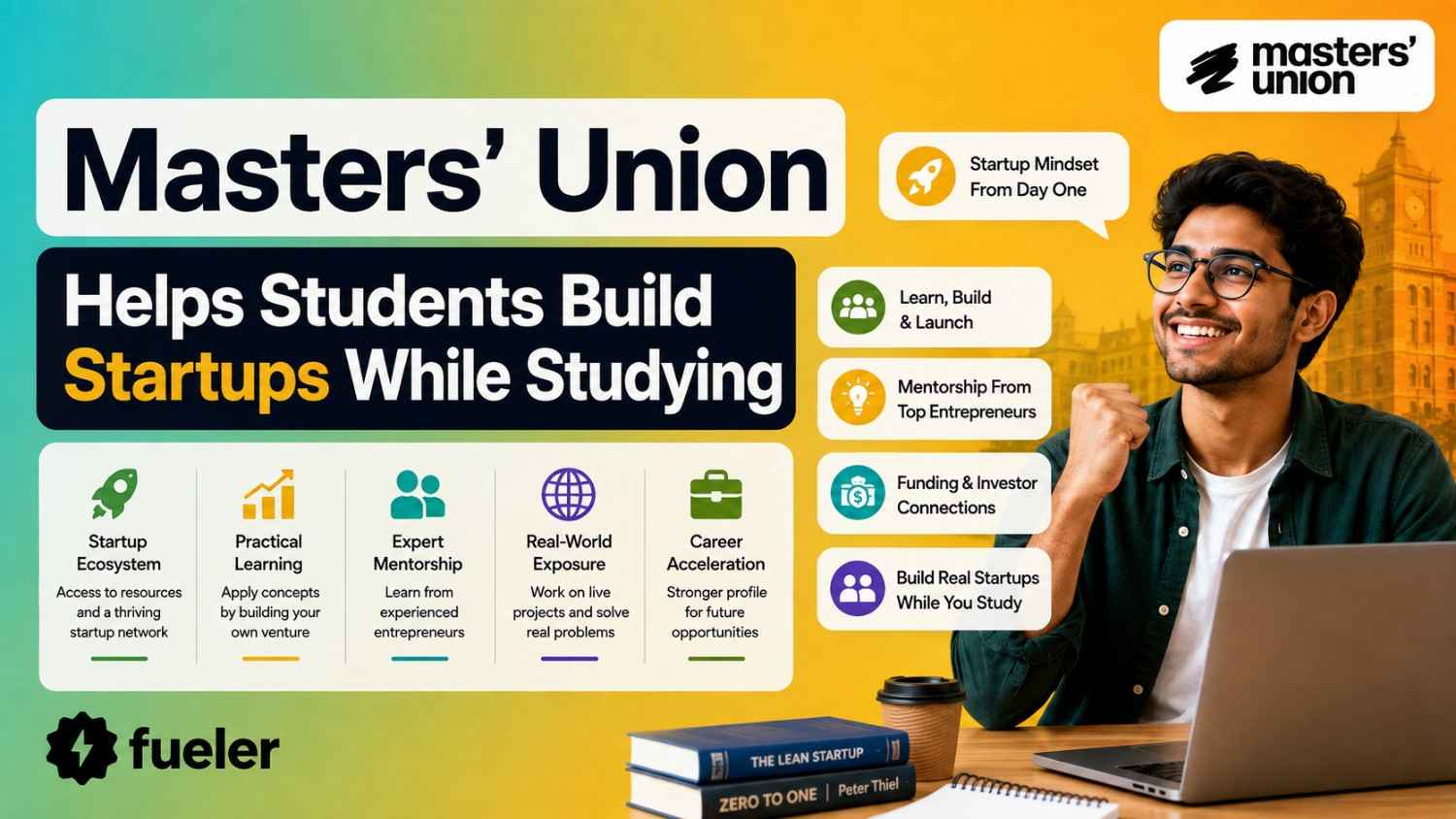
How Masters' Union Helps Students Build Startups While Studying

Riten Debnath
18 Aug, 2026
Last updated: August 2026
Most business schools preach entrepreneurship through slide decks and thirty-year-old Harvard case studies. You analyze how giant corporations solved problems in the 1990s, write a theoretical business plan for a final exam, and graduate without ever making a real sales call or spending a single rupee on customer acquisition.
I’m Riten, founder of Fueler, a skills-first portfolio platform building the career infrastructure for 100 million creative professionals. Fueler connects talented individuals with companies through assignments, portfolios, and projects, not just resumes or CVs. Think of it as Dribbble/Behance for work samples combined with AngelList for hiring infrastructure.
Working directly with thousands of founders and operators has taught me one clear lesson: the market only cares about execution. A business degree means very little if you cannot show a live product, active user metrics, or real revenue.
When Masters' Union launched, it directly targeted this gap in business education. Instead of treating startup creation as an elective seminar, they built their entire curriculum around launching live companies while still in school.
Let's dissect how the institution enables students to build real, revenue-generating startups during their studies, the financial safety nets they provide, and how this hands-on model actually works.

Quick Answer Summary
- Who It Is For: Aspiring founders, early-stage operators, product builders, and students who want to build a venture instead of taking traditional written exams.
- Cost: Tuition fees for flagship programs range from ₹22 Lakhs to ₹37 Lakhs plus taxes, depending on the program level and duration.
- Key Takeaway: Students receive pre-seed grants, mentorship from active CXOs, and financial stipends to run real businesses on campus.
- Best Suited For: Self-driven individuals looking to launch a venture, raise seed capital, or build verified proof of work for high-growth tech roles.
What is Masters' Union's Entrepreneurship Model?
Masters' Union operates on an experiential, "learning-by-doing" educational model. Located inside a tech hub in Gurugram, it eliminates tenured academic professors and replaces them with active founders, CXOs, and venture capitalists.
Instead of writing theoretical essays, students are required to build, test, and run live ventures as part of their academic evaluation.
This setup gives students access to initial seed grants, real ad budgets, legal setup support, and direct distribution channels. The goal is to lower the friction of launching a company so students can experience customer acquisition, product pivots, and cash flow management while still in a supported learning environment.
Key Facts Table
Detailed Explanation
How Masters' Union Helps Students Build Startups While Studying comes down to five operational pillars: equity-free seed funding, practitioner mentorship, live execution challenges, a dedicated founder stipend, and direct investor exposure.
Equity-Free Grants and Seed Capital
The biggest barrier for early-stage student founders is capital. Most young entrepreneurs spend months chasing small angel checks just to buy domain names, set up landing pages, or run initial ad campaigns.
Masters' Union addresses this by providing direct grant pools and pre-seed funding opportunities. During core modules like the Venture Initiation Programme, student teams receive initial seed capital to validate their ideas.
Because this initial capital operates as grant money or low-friction campus funding, students can test hypotheses, buy inventory, or run performance marketing campaigns without taking on personal debt.
The Venture Initiation Programme (VIP)
The flagship startup engine on campus is the Venture Initiation Programme (VIP). It is structured to mirror the natural lifecycle of a venture-backed startup:
- Pre-Seed & Market Validation: Students conduct consumer research, identify actual market gaps, and test business assumptions before spending money on code or inventory.
- Minimum Viable Product (MVP) Build: Teams build functional prototypes, landing pages, or low-code software products to test user demand quickly.
- Go-To-Market (GTM) Execution: Students run performance ads, manage distribution, set up sales operations, and acquire paying customers.
- Product-Market Fit (PMF) & Iteration: Teams analyze retention numbers, customer feedback, and unit economics to pivot or scale their operations.
This structured progression forces students to solve real operational problems like supply chain delays, ad fatigue, and customer churn in real time.
Real Student Startups Born Out of Masters' Union
Students executing through the Venture Initiation Programme and campus incubation ecosystem have built and launched several active companies:
- SeedsAI: Founded by student entrepreneurs Shubham Khatri and Vansh Miglani, SeedsAI develops voice-based AI solutions designed for the BFSI (Banking, Financial Services, and Insurance) sector. The startup raised $250,000 in early funding.
- Bullspree: Created by student founder Dharmil Bavishi, Bullspree is a gamified stock market investment and financial literacy app. It raised over $1 million, crossed 300,000 active users, and was featured on Shark Tank India.
- Hive School: An industry-oriented sales training platform and hybrid bootcamp built to upskill professionals.
- Project Clay: A structured peer-to-peer mentorship platform designed to connect young professionals with industry operators.
- PlaySuper & Eight Network: PlaySuper raised $600K through VIP Demo Day validation, while Eight Network raised $2.08 million, crossing over 1 million listeners.
Practitioner-Led Mentorship and Legal Support
When a student founder runs into a problem, whether it is setting up a legal entity, filing GST, or optimizing a Meta ad funnel, they do not consult a textbook. They consult practitioners.
Mentors include active founders, growth leads, and managing directors from companies across the Indian startup ecosystem. These instructors hold office hours to help students troubleshoot real business metrics.
Having access to operators who actively build companies in tech hubs like Gurgaon and Bangalore helps students avoid common operational mistakes.
The Founders' Fellowship Safety Net
One of the biggest anxieties for student entrepreneurs is the trade-off between building a startup and securing a stable job package during campus placements.
To solve this, Masters' Union introduced the Founders' Fellowship. Under this initiative, selected student founders whose ventures show promise receive a monthly stipend (up to ₹50,000 per month) alongside campus incubation support.
This financial safety net allows high-conviction founders to forego traditional placement drives and focus entirely on scaling their venture for several months post-graduation without worrying about basic living costs.
Portfolio Building and Proof of Work
At Fueler, we always emphasize that proof of work is the ultimate leverage in the modern economy. Masters' Union embeds this principle directly into its incubation workflow.
Whether a student startup scales to millions in revenue or shuts down after six months, the experience is not lost. Students track, document, and publish their execution metrics, wireframes, growth experiments, and financial models.
If a founder decides not to continue their venture, this public portfolio becomes a primary asset for landing high-level roles like Chief of Staff, Founder's Office, or Product Manager. Tech companies love hiring former founders because they already understand unit economics, user acquisition, and resource constraints.
How It Works
- Team Formation & Ideation: Students group together based on complementary skill sets, combining technical builders, growth marketers, and finance leads.
- Micro-Execution Challenges: Early in the academic cycle, students participate in short-term sprints like the Dropshipping Challenge to learn performance marketing, vendor management, and cash flow control.
- Pitching for Pre-Seed Grants: Teams pitch their validated concepts to campus panel judges to secure seed funding under the Venture Initiation Programme.
- Live Business Operations: Teams set up legal structures, build MVPs using low-code tools or custom software, and start acquiring paying customers.
- Mid-Program Pivots: Instructors analyze live dashboards, revenue numbers, and customer acquisition costs, helping student teams pivot when unit economics do not work.
- Demo Day Pitching: The program culminates in Demo Day, where student founders present their metrics, growth traction, and future plans directly to over 100 angel investors, VC partners, and syndicate leads.
Benefits
- Zero-Risk Environment: Launching a business inside an academic ecosystem lets you make costly operational mistakes while being supported by grants and mentors.
- Access to Early Capital: Direct pathways to grant pools, campus funds, and outside angel networks streamline early fundraising.
- Real Operational Skills: Students build hands-on skills in performance marketing, inventory management, user research, and financial modeling.
- Strong Co-founder Matching: Finding skilled co-founders within a cohort of ambitious peers simplifies early team building.
- High-Value Career Backup: Former student founders build verified proof of work that makes them strong candidates for Founder's Office and Product roles if they return to the job market.
Challenges / Limitations
- Demanding Workload: Managing live customer support, supply chain issues, and marketing campaigns alongside academic modules causes significant stress.
- High Failure Rates: Just like in the broader startup world, many student ventures fail to achieve Product-Market Fit during the program.
- Financial Risk of Program Tuition: The high base fee structure means students taking out large education loans face pressure if their startup does not generate immediate income.
- Requires Extreme Initiative: Students who expect step-by-step instructions struggle in an open-ended, execution-driven environment.
Comparison Table
Fees / Cost
Understanding the financial structure is important for any prospective student founder:
- Tuition Fees: Flagship programs (like the PGP-TBM) range from ₹22 Lakhs to ₹25 Lakhs in tuition.
- Living Costs: Housing, food, and daily expenses in Gurugram typically add ₹3 Lakhs to ₹5 Lakhs over the program length.
- Capital Grants Provided: Students receive equity-free micro-grants and access to dedicated campus investment pools to fund their initial venture operations.
- Fellowship Support: The Founders' Fellowship offers stipends up to ₹50,000/month for selected graduating entrepreneurs to reduce financial pressure.
Career Opportunities
For student founders whose businesses do not scale into full-time companies post-graduation, the experience opens up strategic roles across the startup ecosystem.
Key Roles for Ex-Student Founders
- Founder's Office / Chief of Staff: Working alongside scaling CEOs on strategic expansion, operational troubleshooting, and fundraising collateral.
- Product Manager: Leading cross-functional teams, defining features, and tracking product retention metrics.
- Growth Marketing Lead: Managing performance ad budgets, conversion rate optimization (CRO), and user acquisition funnels.
- Venture Capital Analyst: Sourcing deals, evaluating pitch decks, and conducting due diligence on early-stage tech companies.
Typical Compensation Ranges
Ex-student founders transitioning into corporate startup roles generally secure packages between ₹18 LPA and ₹35+ LPA, heavily influenced by their documented execution metrics and past work samples.
Who Should Choose This?
- Aspiring entrepreneurs who want to build a venture with built-in grants, mentorship, and co-founder matching.
- Students who learn best by building real products rather than taking written exams.
- Candidates targeting strategic roles like Founder's Office or Product Management who need verified proof of work.
- Self-starters are comfortable with ambiguity, tight deadlines, and public execution.
Who Should Avoid This?
- Anyone looking for a quiet academic environment centered on traditional textbooks and written research papers.
- Students who want a government-recognized degree for public sector examinations or PhD paths.
- Candidates who get easily overwhelmed by operational friction, financial risk, and customer feedback.
- Passive learners who expect a structured corporate placement pipeline without building anything hands-on.
Final Thoughts
The old model of business education treated entrepreneurship as a theoretical subject. You learned how to write a 50-page business plan, presented it to a professor, and received a grade. But market validation does not come from a classroom grade; it comes from real users paying for your product.
At Fueler, we see every day how proof of work changes career trajectories. What Masters' Union has done is turn its campus into a living incubator where building a startup is built into the learning process.
Whether your student venture scales into a long-term company or fails early, the execution skills you build managing budgets, launching products, and running growth campaigns stay with you forever.
Key Takeaways
- Startup creation is embedded into the core curriculum through the Venture Initiation Programme.
- Students get access to equity-free seed capital, grants, and investor mentorship.
- The Founders' Fellowship offers monthly stipends to give student entrepreneurs a financial safety net.
- Short-term execution challenges teach performance marketing, e-commerce, and content distribution early on.
- Student founders present their traction to over 100 angel investors and VCs on Demo Day.
- Failed ventures still yield verified proof of work, helping students secure high-paying strategic roles in tech.
FAQs
How does Masters' Union fund student startups on campus?
Students receive equity-free seed grants for micro-challenges, access dedicated campus investment funds, and pitch to over 100 angel investors and VC partners on Demo Day.
What happens if my student startup fails during the program?
A failed venture is treated as a practical learning experience. Students document their execution metrics and use that proof of work to secure roles like Founder's Office or Product Manager.
What is the Founders' Fellowship at Masters' Union?
It is an initiative providing selected student entrepreneurs with a monthly stipend of up to ₹50,000 alongside campus incubation support, giving them a safety net to scale their startup.
Do students get co-founder matching opportunities inside the cohort?
Yes, student cohorts combine diverse backgrounds in engineering, finance, design, and marketing, making it easy to form balanced founding teams during ideation phases.
How do student founders showcase their startup progress to investors?
Founders showcase live metrics such as active revenue dashboards, user growth numbers, and product prototypes published in their execution portfolios and presented directly on Demo Day.
Why 100,000+ professionals use Fueler
Fueler helps professionals showcase proof of work through projects, assignments, case studies, and achievements.
- Thousands of professionals use Fueler to create their digital portfolio
- Thousands of projects are published on Fueler. Check here
- Startups and Companies hire through proof of work on Fueler
- Used by freelancers, creators, marketers, video editors, writers, designers, and product managers
Our mission is to help the next 100 million professionals build a verified professional identity through proof of work

What should you do next?
You've read the article. Now turn your skills into proof of work and unlock more opportunities.
Build your proof of work portfolio
Create a clean portfolio with projects, assignments, resumes, and AI stack details that companies actually want to see.
Create your Fueler portfolio →Apply through assignments, not resumes
Stand out by solving real tasks from companies hiring on Fueler.
Explore assignments →Get discovered by companies
Make your work public and let recruiters discover your skills through actual projects instead of keywords.
Get discovered →
