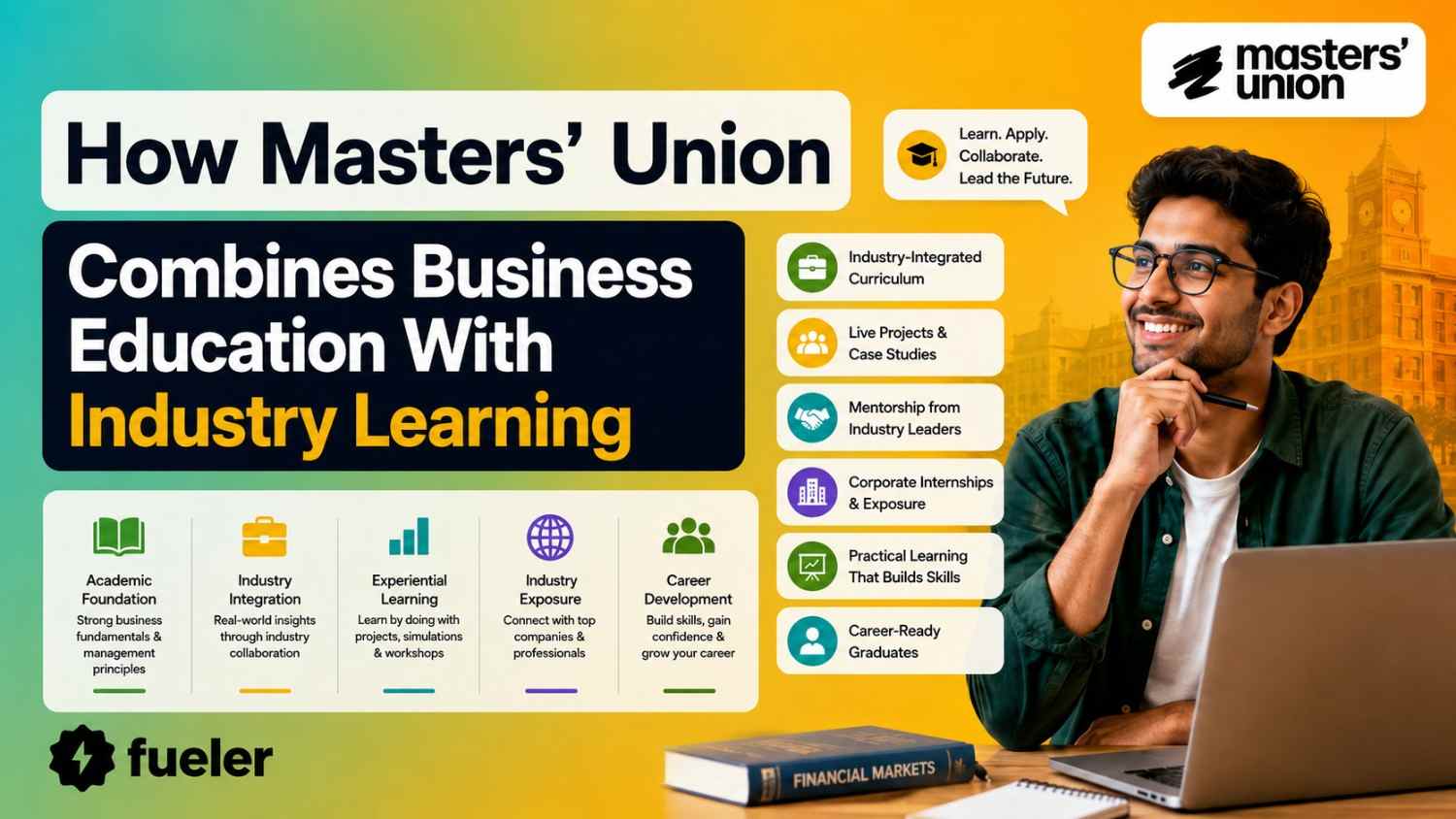
How Masters' Union Combines Business Education With Industry Learning

Riten Debnath
18 Aug, 2026
Last updated: August 2026
Over the past decade, I have watched the traditional higher education system struggle to keep pace with the startup ecosystem. Standard textbooks written years ago simply cannot teach a student how to run performance marketing campaigns, build modern software workflows, or navigate a fast-moving venture capital deal.
I’m Riten, founder of Fueler, a skills-first portfolio platform building the career infrastructure for 100 million creative professionals. Fueler connects talented individuals with companies through assignments, portfolios, and projects, not just resumes or CVs. Think of it as Dribbble/Behance for work samples combined with AngelList for hiring infrastructure.
Working directly with thousands of founders and operators has shown me that companies no longer care about degrees; they hire based on visible proof of work.
When Masters' Union launched in Gurugram, it caught my attention because it flipped the traditional business school framework on its head. Instead of academic professors, practitioners run the classes, and instead of writing theoretical case studies, students run real businesses.

Quick Answer Summary
- Who it is for: Aspiring founders, early-stage professionals, product managers, and students seeking a hands-on alternative to traditional MBA programs.
- Cost: Tuition fees for flagship programs range between ₹22 Lakhs to ₹37 Lakhs, excluding taxes, hostel, and mess charges.
- Key takeaway: The curriculum prioritizes proof of work, running live ventures, managing real budgets, and building portfolios over passive classroom lectures.
- Best suited for: Self-driven individuals who want access to tech founders, hands-on business execution, and immediate entry into fast-growth tech ecosystems like Bangalore or Gurgaon.
What is Masters' Union?
Masters' Union is a higher education institution designed to bridge the gap between academic theory and modern business execution. Located in DLF Cyberpark, Gurugram, it sits right in the middle of a massive corporate and startup hub.
In a standard university, you learn business by reading about how companies scaled decades ago. At Masters' Union, you get seed money to launch a real enterprise, market a product to real customers, and handle actual financial risk.
This practical approach matters because modern companies operate with tools, frameworks, and speeds that legacy university curricula fail to cover. By building real projects, students graduate with actual experience and proof of work rather than just a degree certificate.
Key Facts Table
Detailed Explanation
How Masters' Union Combines Business Education with Industry Learning comes down to four basic execution arms: practitioner faculty, live business challenges, student-run venture funds, and continuous portfolio building.
The Practitioner-Led Faculty Model
Traditional b-schools rely heavily on tenured professors who have spent decades in academia. Masters' Union replaces this with active business leaders.
Managing Directors, Chief Product Officers, Growth Leaders, and Venture Capitalists run the modules. They teach the exact strategies, software, and management frameworks they used earlier that same week in their own companies.
Because the instructors are active operators, the curriculum updates instantly. When new AI tools or growth tactics emerge in tech hubs like Bangalore, students learn them immediately, not three years later through a revised textbook.
Live Venture Initiation Programme
The core of business education happens through actual execution. Every student goes through the Venture Initiation Programme.
Students form small teams, receive seed capital, and must ideate, launch, and operate a live startup. They handle everything from registering a business and running digital ad campaigns to managing inventory and handling customer support.
This turns business education into a real game of survival. If your product fails to sell, you pivot. If your ads waste money, you fix your targeting. It teaches financial discipline, supply chain logistics, and customer acquisition better than any written test ever could.
Short-Term Live Execution Challenges
Beyond long-term startups, the curriculum includes rapid-fire business challenges. Two notable examples are the Dropshipping Challenge and the Creator Challenge.
In the Dropshipping Challenge, students get a minimal budget and a limited timeframe to set up an e-commerce storefront, source products, run performance marketing campaigns, and turn a net profit.
In the Creator Challenge, students build an audience from scratch across social platforms, creating content, driving distribution, and monetizing that attention. These micro-projects force students to build practical digital skills under real-time pressure.
Proof of Work and Portfolio Construction
At Fueler, we see every day how proof of work replaces traditional resumes. Masters' Union builds this philosophy directly into its educational model.
Instead of graduating with a list of grades, students leave with a public portfolio showcasing every live campaign run, product built, revenue generated, and pitch deck presented.
When recruiters interview these graduates, they do not just talk about theoretical knowledge. They examine actual dashboards, live revenue numbers, and real digital products.
How It Works
Phase 1: Core Foundation Modules
Students start with essential business fundamentals, including corporate finance, financial accounting, software tools, and business analytics.
Phase 2: The Dropshipping and Creator Challenges
Students build rapid execution skills by launching short-term digital businesses and public content brands to learn distribution and marketing hands-on.
Phase 3: The Venture Initiation Programme
Teams build a full-scale startup from scratch. They progress through idea validation, minimum viable product launch, go-to-market strategies, and revenue generation.
Phase 4: Industry Immersion
Students spend three months working inside established technology companies, high-growth startups, or venture capital firms to apply their skills in real corporate environments.
Phase 5: Student-Run Venture Capital Fund
Students evaluate real startups, conduct due diligence, write investment memos, and deploy capital from a dedicated student-managed fund.
Phase 6: Demo Day and Career Placement
The program finishes with Demo Day, where student founders pitch their ventures directly to top venture capitalists, angel investors, and hiring managers.
Benefits
- Direct Access to Active Founders: Learning from current CXOs means receiving direct mentorship from people who hire for top roles.
- Real Financial Management: Handling actual budgets teaches real unit economics, profit margins, and cash flow control.
- Visible Proof of Work: Students build a rich, verifiable portfolio of real projects that demonstrate competence far better than a standard resume.
- Immediate Placement in High-Growth Roles: Graduates step straight into strategic positions like Founder's Office, Product Manager, or Growth Marketer.
- Venture Capital Network: Direct exposure to angel investors and VC partners makes raising seed capital much easier for student founders.
Challenges / Limitations
- High Cost of Tuition: The overall cost of tuition, living expenses, and taxes represents a major financial commitment.
- High Intensity and Stress: Building a live startup alongside tight academic deadlines creates a very demanding workload.
- Uncertain Academic Recognition: It operates as a private, industry-led institution rather than a traditional state university issuing government-recognized degrees.
- Requires High Self-Drive: Passive learners who expect structured, spoon-fed textbook lectures will struggle in this environment.
Comparison Table
Fees / Cost
Understanding the full financial requirement is essential before applying:
- Tuition Fees: Flagship PGP-TBM tuition sits around ₹22 Lakhs to ₹37 Lakhs depending on program additions and intake year.
- Living Costs: Expect additional housing, mess, and lifestyle expenses in Gurugram ranging between ₹3 Lakhs to ₹5 Lakhs.
- Taxes: Government GST taxes apply on top of standard tuition fees.
- Scholarships: Merit-based and need-based scholarships are available for high performers in entrance exams like CAT, GMAT, or MU-BAAT.
- Return on Investment: Average placement packages historically range between ₹23 LPA to ₹33 LPA, making the financial recovery timeline competitive for active performers.
Career Opportunities
Graduates transition predominantly into high-growth startup ecosystems and tech firms.
Core Roles
- Founder's Office / Chief of Staff: Working directly alongside startup founders on high-priority strategic projects.
- Product Manager: Leading feature design, user experience, and roadmap execution for software products.
- Growth Marketing Manager: Managing customer acquisition budgets, performance ad channels, and retention funnels.
- Venture Capital Analyst: Evaluating early-stage business models, conducting market research, and writing investment memos.
- Business Operations Lead: Streamlining logistics, customer support, and internal operational workflows.
Salary Ranges and Top Recruiter Industries
Pay packages generally fall between ₹15 LPA and ₹35+ LPA, heavily influenced by prior work experience. Key hiring industries include Fintech, Consumer Tech, D2C Brands, SaaS, and Management Consulting.
Who Should Choose This?
- Individuals who want to launch their own business during their studies.
- Professionals looking to break into Product Management, Growth, or Founder's Office roles.
- People who learn best by building real projects rather than reading textbooks.
- Candidates seeking a strong startup and venture capital network in NCR and Bangalore.
- Professionals who value building a visible portfolio of work over acquiring a traditional degree.
Who Should Avoid This?
- Anyone expecting a relaxed, theoretical academic schedule.
- Candidates seeking a government-recognized master's degree for public sector jobs.
- People who get overwhelmed by high-pressure execution and tight deadlines.
- Students looking for a traditional campus life away from corporate business hubs.
Final Thoughts
I have spent years building Fueler to help professionals prove their skills through real work samples instead of flat resumes. Seeing institutions shift from pure theoretical instruction to real business execution is a positive development for the entire startup ecosystem.
Masters' Union offers a dynamic environment, but it requires high self-drive. If you enter expecting to sit in lectures and passively absorb information, you will struggle.
However, if you arrive ready to build, fail fast, manage budgets, and document your proof of work, it provides a fast route into modern business leadership.
Key Takeaways
- Active founders, CXOs, and VCs teach all modules instead of tenured professors.
- Students run live ventures with real money through the Venture Initiation Programme.
- Real-world micro-challenges teach performance marketing, dropshipping, and audience building.
- Graduates build visible portfolios showcasing real projects, revenue, and shipped software.
- Career outcomes focus heavily on Founder's Office, Product, and Growth roles in the tech sector.
- Total investment is high, making it essential to evaluate your personal drive and financial readiness before joining.

FAQs
What makes Masters' Union different from a traditional MBA?
Masters' Union uses practitioner faculty instead of academic professors and focuses on live startup execution rather than paper case studies. Students build real businesses, manage real ad budgets, and graduate with a portfolio of verified work samples.
Do students launch actual businesses during the program?
Yes, every student participates in the Venture Initiation Programme where they receive seed capital to build, launch, and scale a real business. They handle product development, marketing, and sales directly.
What entrance exams are accepted for admission?
Masters' Union accepts scores from valid CAT or GMAT exams, as well as its own dedicated entrance test called MU-BAAT. Shortlisted candidates then complete a personal interview round.
What key career roles do graduates step into?
Graduates primarily transition into strategic roles such as Founder's Office, Chief of Staff, Product Manager, Growth Marketer, and Venture Capital Analyst within high-growth technology companies and startups.
Is a traditional resume required to get hired from Masters' Union?
While resumes exist, recruiters focus heavily on student portfolios. Verified proof of work, like shipped products, active ad campaigns, and generated revenue, serves as the main hiring criterion.
Why 100,000+ professionals use Fueler
Fueler helps professionals showcase proof of work through projects, assignments, case studies, and achievements.
- Thousands of professionals use Fueler to create their digital portfolio
- Thousands of projects are published on Fueler. Check here
- Startups and Companies hire through proof of work on Fueler
- Used by freelancers, creators, marketers, video editors, writers, designers, and product managers
Our mission is to help the next 100 million professionals build a verified professional identity through proof of work
What should you do next?
You've read the article. Now turn your skills into proof of work and unlock more opportunities.
Build your proof of work portfolio
Create a clean portfolio with projects, assignments, resumes, and AI stack details that companies actually want to see.
Create your Fueler portfolio →Apply through assignments, not resumes
Stand out by solving real tasks from companies hiring on Fueler.
Explore assignments →Get discovered by companies
Make your work public and let recruiters discover your skills through actual projects instead of keywords.
Get discovered →
