How Companies Are Building AI Agent Teams

Riten Debnath
02 Apr, 2026
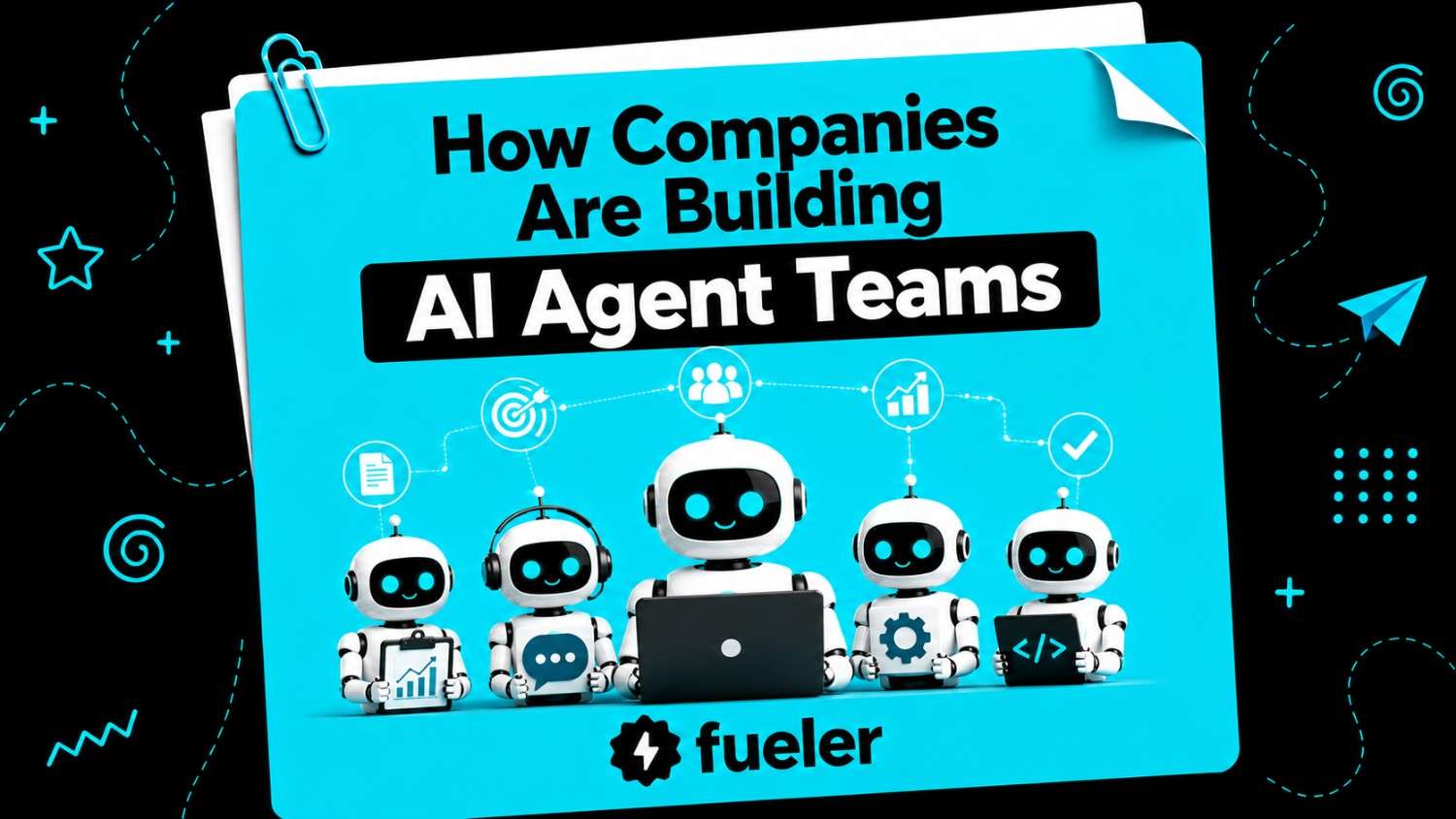
The era of just chatting with a bot is over, and the era of AI coworkers has officially arrived. Imagine a workplace where a digital project manager assigns tasks, a virtual researcher gathers data, and an automated editor polishes your drafts before you even wake up. This is not science fiction; it is how the most innovative companies are operating in 2026 by moving from single AI tools to entire "Agentic Workforces." Businesses are no longer looking for people who can just prompt an AI; they are looking for "Architects" who can build autonomous teams of agents that think, plan, and execute.
I’m Riten, founder of Fueler, a skills-first portfolio platform that connects talented individuals with companies through assignments, portfolios, and projects, not just resumes/CVs. Think Dribbble/Behance for work samples + AngelList for hiring infrastructure.
1. The Shift from Chatbots to Autonomous Agentic Workflows
For the past few years, the world has been stuck in the "chatbot" phase, where you ask a question and get a simple answer. In 2026, companies are moving toward agentic workflows where AI does not just talk, it acts on its own. An AI agent is fundamentally different because it has "agency," meaning it can break down a large, complex goal into smaller steps, choose the right digital tools for each step, and verify its own work. Instead of a human manually moving data from an email to a spreadsheet, an agent recognizes the incoming data, opens the spreadsheet, logs the info, and then pings the relevant team member on Slack to notify them of the update.
- Advanced Self-Planning and Reasoning Capabilities: Modern AI agents can take a vague goal like "Research competitors in the European EdTech space" and create their own step-by-step checklist, deciding which websites to scrape and what data points are actually valuable.
- Deep Tool Integration through Model Context Protocol: These systems use specialized protocols to connect directly with business software like Google Drive, HubSpot, or GitHub, allowing them to read and write files just like a human employee would in their daily workflow.
- Autonomous Looping and Error Correction: If an agent hits an error or a website block, it does not just stop and give up, it reasons through the mistake, identifies why it failed, and tries a different technical approach to solve the problem without human intervention.
- Sophisticated Human-in-the-Loop Checkpoints: Modern agentic workflows include strategic "waiting rooms" where the AI stages its completed work for a human manager to review and approve before it goes live or sends a final communication to a client.
Why it matters
This shift represents the transition from "AI as a tool" to "AI as a teammate." Companies building these teams are seeing 30% to 40% gains in operational productivity because they are finally eliminating the "glue work" that usually eats up a human's day. Understanding this architecture is the first step to staying relevant in a professional world where pure execution is increasingly automated by these tireless digital systems.
2. Multi-Agent Systems: Creating the Digital Org Chart
Single agents are powerful, but the real magic happens when companies build Multi-Agent Systems (MAS). This is exactly like a real company department: you have specialized roles that talk to each other to achieve a larger goal. For example, a marketing "agent team" might consist of a Strategist Agent, a Copywriter Agent, and a Compliance Agent. The Strategist creates the plan, the Copywriter executes the drafts based on that plan, and the Compliance Agent checks for legal or brand errors. They pass "messages" back and forth until the job is done perfectly without a human needing to manage every single interaction.
- Definition of Specialized Agentic Personas: Companies are creating specific "roles" for different AI instances to ensure they do not get overwhelmed by too many instructions, allowing each agent to become a "master" of one specific task like coding or proofreading.
- Seamless Agent-to-Agent (A2A) Communication: Organizations are developing advanced protocols that allow different AI models, such as GPT-5 and Claude 4, to collaborate and share data seamlessly in a unified digital workspace without losing context or information.
- Dynamic Conflict Resolution Modules: High-level "Manager Agents" are now being deployed to act as referees, deciding which sub-agent is correct when two different agents provide conflicting data or suggest different strategies for a project’s next steps.
- Unified Orchestration Layers for Governance: This involves building a central software "office" where these agents live, allowing managers to see exactly who is doing what and how much the entire digital department is costing in real-time.
Why it matters
Multi-agent systems allow companies to scale their output without scaling their human headcount in a linear way. By building a digital org chart, a small startup can behave like a Fortune 500 company, running complex, 24/7 operations with minimal human oversight. It allows for specialized excellence at a fraction of the traditional cost, making "agent orchestration" one of the most valuable professional skills for the year 2026.
3. Best Orchestration Platforms for Enterprise Agent Teams
Building an AI team from scratch is hard, which is why most companies are using dedicated orchestration platforms. These tools act as the "operating system" for AI agents, providing the security, connectivity, and monitoring needed to run them in a professional environment. These platforms allow non-technical managers to "hire" and "train" agents using simple natural language, making the technology accessible to every department from HR to Finance. By using these platforms, companies ensure that their AI agents stay on task and follow the specific rules of the organization.
- Vellum AI for Enterprise Development: A comprehensive platform designed for building, evaluating, and governing AI agents across entire corporate teams, providing detailed analytics on how well each agent is performing its specific business duties.
- Microsoft Power Automate with Copilot Studio: Deeply integrated into the Office 365 ecosystem, this is the perfect tool for companies already using Teams and Outlook that want to turn their existing data into actionable autonomous agents.
- AWS Bedrock AgentCore Services: A highly scalable and secure environment for developers to build agents that live on Amazon’s cloud infrastructure, offering the heavy-duty power needed for processing massive amounts of corporate data.
- Vertex AI Agent Builder by Google: Google’s flagship tool for creating low-code agents that leverage the latest Gemini models and real-time Google Search data to ensure the information provided is always up-to-date and accurate.
Pricing:
- Vellum: Offers a limited free tier for testing, with professional paid plans starting from $25 per month and custom pricing for large enterprise needs.
- Microsoft: Usually integrated into the Business Premium subscription, with standalone agent creation plans starting from $15 per user each month for small teams.
- AWS and Google Cloud: Both operate on a "Pay-as-you-go" model where you only pay for the specific amount of data processed and the number of times an agent is called.
Why it matters
Choosing the right platform is like choosing the right office space; it determines how well your agents can communicate and how secure your data stays. These tools provide the necessary "guardrails" that prevent AI from making expensive mistakes or leaking private data. They ensure that the AI agent team follows company policy and security protocols at all times, making the technology safe for real business use.
4. The Rise of the "AI Architect" and New Hiring Trends
As companies build these teams, the roles they are hiring for are changing rapidly. We are seeing a decline in "entry-level coordinators" and a massive surge in "AI Architects" or "Agentic Workflow Engineers." These professionals do not just write code; they understand deep business logic and know how to map it to an AI's specific capabilities. They are the ones who decide which agent handles which task and how to verify the quality of the output. In 2026, your "work samples" and portfolios matter more than your job title because companies need to see that you can actually build a working system.
- Deep Domain Expertise over General Skills: Understanding the specific "niche" like FinTech or Healthcare is now more important than just knowing how to code, as agents need a human with industry knowledge to set their goals correctly.
- Strategic Logic and Workflow Mapping: The ability to take a messy, unorganized human process and turn it into a clean, automated flowchart that an AI agent can follow without getting confused or making logical errors.
- Evaluation (Eval) and Quality Control Skills: Knowing how to rigorously test an agent's performance and "fire" or retrain it if it starts hallucinating or providing incorrect data to customers or internal team members.
- Hybrid Collaboration and Team Management: The skill of working alongside AI "coworkers" and knowing exactly when to intervene to provide a human touch and when to let the agent run on its own.
Why it matters
This change in hiring means that professionals need to prove their "system-thinking" skills through real-world evidence. It is no longer enough to simply say you "know AI," you have to show that you can build and manage a digital workforce from the ground up. This is a massive opportunity for proactive workers to leapfrog into high-paying leadership roles by becoming the "manager" of these new AI teams.
5. Integrating "Memory" and Custom Corporate Data
An AI agent team is only as good as the information it has access to. Companies are no longer using "general" AI that knows everything about the world but nothing about their business; they are grounding their agent teams in "Long-Term Memory" and custom internal databases. This is often done through a process called RAG (Retrieval-Augmented Generation). It means when your Customer Support Agent replies to a client, it is looking at your actual 2026 price list and your specific company refund policy, not just making things up based on its general training.
- Specialized Vector Databases for Knowledge: These act as a "digital brain" where a company’s entire history of documents, emails, and guides is stored so an AI agent can search and find answers in milliseconds.
- Persistent Contextual and Client Awareness: Agents that can remember a specific client's previous complaints or preferences from months ago, allowing them to provide a personalized service experience that feels human and attentive.
- Real-Time Data Syncing with Live Sources: Connecting agent teams to live web search or internal sales dashboards so they always have the "latest" facts and figures when making decisions or writing reports for management.
- Granular Data Privacy and Security Filters: Implementing systems that ensure agents do not accidentally share sensitive payroll info or private customer data between different departments while they are performing their tasks.
Why it matters
Memory turns a "smart tool" into a "knowledgeable employee" who understands the nuances of your business. When an agent team "knows" your company's history, tone of voice, and specific long-term goals, it becomes a true asset rather than a liability. This grounding in real, proprietary data is what makes AI agents reliable enough for mission-critical work in a professional environment.
6. Security and Governance: Managing the "Agentic Risk"
With great power comes the need for serious oversight and management. Companies building AI agent teams are obsessed with governance to prevent things from spiraling out of control. If an agent has the power to move money, access passwords, or send emails to thousands of people, there must be a "Kill Switch" and a clear set of rules. Governance modules act as the HR and Legal department for AI agents, ensuring they follow the law and do not behave in a way that could damage the company's reputation.
- Implementation of Hard Execution Guardrails: Setting strict limits on what an agent can do without human approval, such as a "spending cap" on how much money an agent can authorize for a refund or a software purchase.
- Comprehensive Audit Logs and Transparency: Creating a permanent record of every single "thought" and "action" an agent takes, so that if something goes wrong, the human team can trace back the logic and fix the root cause.
- Advanced Red-Teaming and Stress Testing: Hiring security experts to try and "trick" the agent teams into breaking rules, which helps the company build stronger defenses before the agents are deployed to the public.
- Identity and Access Management (IAM) for AI: Ensuring that each agent has its own unique digital ID and only has access to the specific folders and tools it needs to finish its assigned job.
Why it matters
Governance is the difference between a successful AI integration and a PR disaster. As agents become more autonomous, the risk of "rogue" behavior increases, making these security measures essential for any business. By building a secure environment, companies can give their AI agents more freedom to work, knowing that there are safety nets in place to catch any errors.
7. Scaling Operations with 24/7 Digital Workforces
One of the biggest advantages of building an AI agent team is the ability to operate 24 hours a day, 7 days a week, without fatigue. While human employees need sleep and breaks, an agentic team can process thousands of customer tickets, analyze market trends, and update website code in the middle of the night. This allows companies to serve global markets in different time zones with the same level of quality and speed, regardless of when the customer reaches out for help.
- Constant Monitoring and Real-Time Response: Agents can monitor social media or server health every second of the day, responding to issues or opportunities the moment they appear rather than waiting for a human to clock in.
- Massive Parallel Processing Capabilities: A single human can only do one task at a time, but an agent team can spawn "clones" of itself to handle 100 different tasks simultaneously during a busy launch or a holiday sale.
- Automated Reporting and Trend Analysis: While the team sleeps, agents can compile all the data from the previous day into a beautiful, easy-to-read report that is sitting in the CEO's inbox by 8:00 AM.
- Global Language and Cultural Translation: Agent teams can instantly translate their work into dozens of languages, allowing a small local business to communicate professionally with clients in Japan, Brazil, or France without hiring a translator.
Why it matters
Scaling used to be a slow and expensive process that involved hiring and training hundreds of people. In 2026, scaling is a technical setting. By utilizing a 24/7 digital workforce, companies can grow their revenue and impact at a speed that was previously impossible, giving them a massive competitive edge in a fast-moving global economy.
8. Measuring Success: The ROI of Agentic Teams
At the end of the day, companies are building these teams to improve their bottom line. Measuring the Return on Investment (ROI) of an AI agent team is different from measuring a human's performance. Instead of just looking at "hours worked," managers are looking at "outcomes achieved" and "cost per task." If an agent team can do the work of five people for the price of one software subscription, the ROI is clear, but companies also have to account for the time spent building and maintaining these complex systems.
- Reduction in Cost Per Resolution (CPR): Tracking how much cheaper it is to solve a customer problem or finish a project using an agent team compared to traditional human-only methods.
- Increase in Creative Throughput and Innovation: Measuring how much more "high-value" work the human team is able to do now that they are no longer stuck doing repetitive, boring administrative tasks.
- Accuracy and Quality Benchmarking Metrics: Comparing the error rates of AI agents against human employees to find the "sweet spot" where the AI is actually more reliable than a person.
- Employee Satisfaction and Retention Levels: Observing if the human staff is happier and more engaged because their workload has been reduced and they are focusing on more meaningful, strategic projects.
Why it matters
Having a clear way to measure success ensures that the move toward AI agents is actually helping the company rather than just being a "hype" trend. It allows leadership to double down on what works and cut what doesn't. When you can prove that an AI agent team is saving thousands of dollars and hundreds of hours, it becomes much easier to get the entire organization on board with the future of work.
How Fueler Helps You Thrive in the AI Agent Era
As companies continue to build these sophisticated AI agent teams, they are looking for a new kind of professional. They don't want to see a list of bullet points on a resume; they want to see the actual agentic workflows you have built and the systems you have managed. This is where Fueler comes into play. By using Fueler, you can create a high-impact portfolio that showcases your work samples, your logic maps, and the real-world results of your AI projects. It allows you to prove your value as an AI Architect by showing, not just telling, what you are capable of achieving in this new digital landscape.
Final Thoughts
Building an AI agent team is no longer a luxury for big tech companies; it is becoming a survival requirement for every business. The transition from simple chatbots to autonomous, multi-agent systems is changing how we define work, hiring, and productivity. As we move through 2026, the professionals who succeed will be those who embrace these digital teammates and learn to orchestrate them effectively. The future of the workplace is a collaborative dance between human creativity and AI execution, and the journey is just beginning.
FAQs
1. What are the best free AI agent tools for beginners in 2026?
While many professional platforms have costs, beginners can start with the free tiers of tools like Zapier Central, OpenAI’s GPT Builder, or open-source frameworks like LangChain if they have some basic coding knowledge. These tools allow you to experiment with "agency" without a large upfront investment.
2. How do I start building an AI agent team for my small business?
The best way to start is by identifying one repetitive task, like sorting customer emails or generating social media captions. Use a platform like Microsoft Copilot Studio or Vellum to create a single agent for that task, and then gradually add more agents as you become comfortable managing the technology.
3. Will AI agent teams replace human employees entirely?
No, but they will change what human employees do. While agents handle the execution and data processing, humans are needed to provide the vision, empathy, and strategic decision-making that AI still cannot replicate. The goal is to augment humans, not replace them.
4. How can I show my AI skills to recruiters without a traditional degree?
The most effective way is to build a portfolio on a platform like Fueler. Instead of a degree, show recruiters a video or a case study of an AI agent you built that solved a real problem. Real work samples are the "new degree" in the age of AI.
5. Are AI agent teams secure for sensitive company data?
Yes, provided you use enterprise-grade orchestration platforms like AWS Bedrock or Google Vertex AI. These platforms offer private "silos" for your data, ensuring that your company information is never used to train public AI models and stays within your control.
What is Fueler Portfolio?
Fueler is a career portfolio platform that helps companies find the best talent for their organization based on their proof of work. You can create your portfolio on Fueler. Thousands of freelancers around the world use Fueler to create their professional-looking portfolios and become financially independent. Discover inspiration for your portfolio
Sign up for free on Fueler or get in touch to learn more.

What should you do next?
You've read the article. Now turn your skills into proof of work and unlock more opportunities.
Build your proof of work portfolio
Create a clean portfolio with projects, assignments, resumes, and AI stack details that companies actually want to see.
Create your Fueler portfolio →Apply through assignments, not resumes
Stand out by solving real tasks from companies hiring on Fueler.
Explore assignments →Get discovered by companies
Make your work public and let recruiters discover your skills through actual projects instead of keywords.
Get discovered →
