Freelancing Roadmap for 2026: Everything You Need to Know

Riten Debnath
30 Dec, 2025
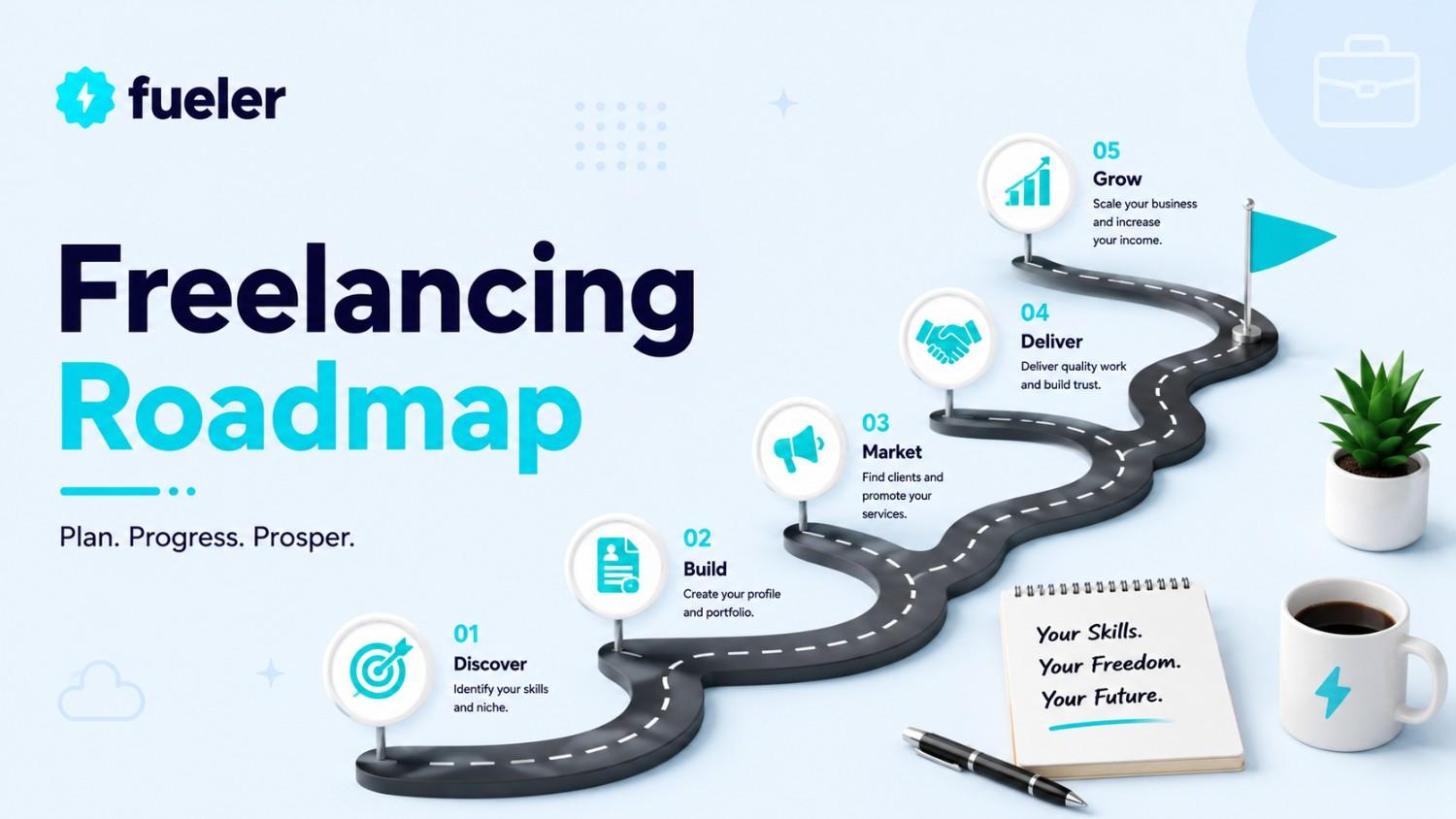
Introduction: The Golden Age of Indian Freelancing
The freelancing landscape in India is experiencing unprecedented growth. With over 15 million active freelancers and one in four global freelancers being Indian, the country has emerged as a powerhouse in the gig economy. As we approach 2026, the opportunities have never been more promising, but neither has the competition.
Whether you're a college student looking to earn extra income, a professional seeking work-life balance, or someone dreaming of building a location-independent career, this comprehensive roadmap will guide you through every step of your freelancing journey in 2026.
At Fueler, we've helped thousands of freelancers build compelling portfolios and land their dream clients. This guide combines industry insights, practical strategies, and real-world pricing benchmarks specific to the Indian market to help you succeed.
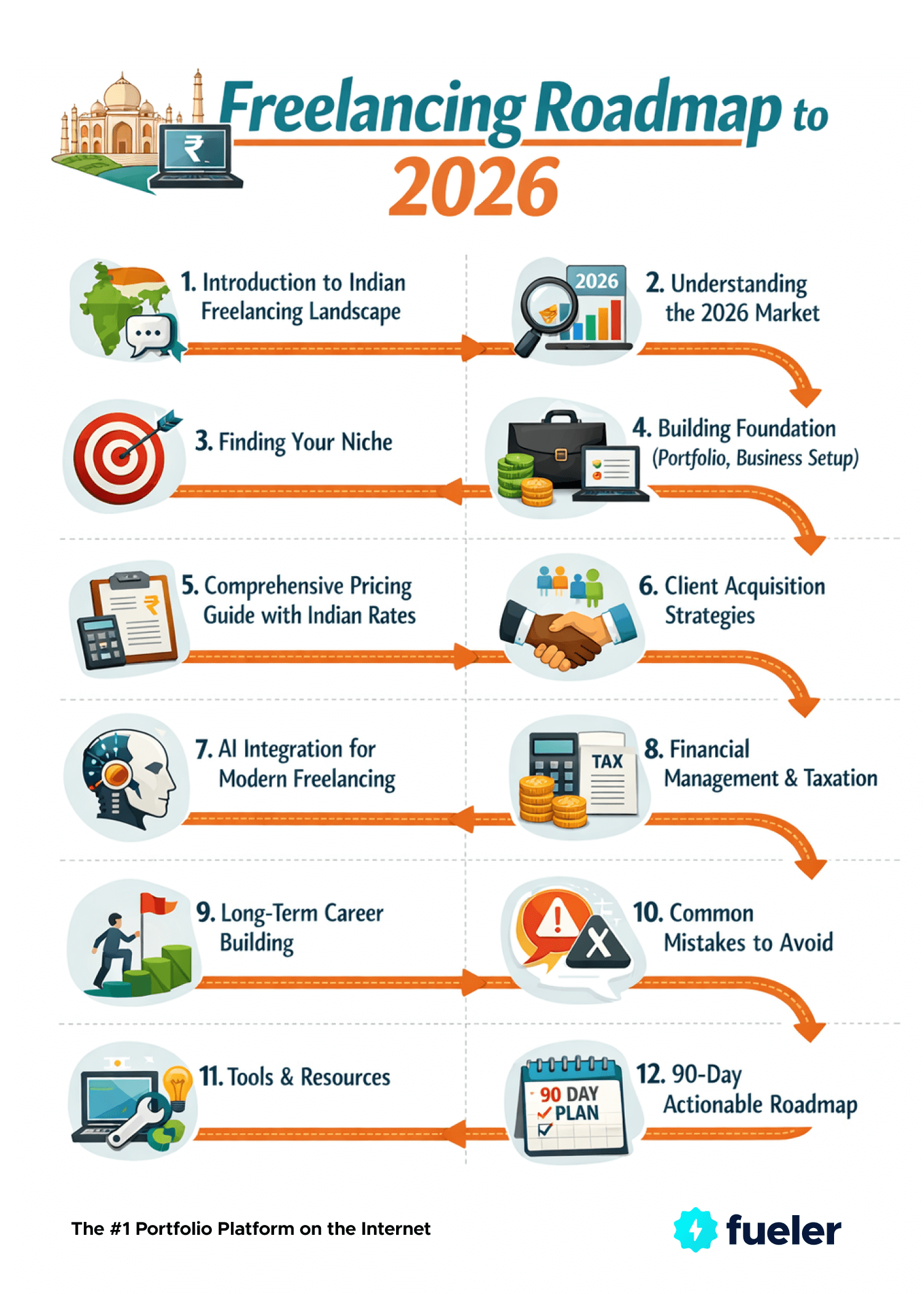
This roadmap is divided into 12 parts
Introduction to Indian freelancing landscape
Understanding the 2026 market
Finding your niche
Building foundation (portfolio, business setup)
Comprehensive pricing guide with Indian rates
Client acquisition strategies
AI integration for modern freelancing
Financial management and taxation
Long-term career building
Common mistakes to avoid
Tools and resources
90-day actionable roadmap
Fueler Freelancing Roadmap
Part 1: Understanding Freelancing in 2026
What is Freelancing?
Freelancing is working independently on a contract basis rather than being permanently employed by a single company. As a freelancer, you're your own boss; you choose your clients, set your rates, decide your work hours, and build your career on your terms.
The term "freelance" has fascinating origins. Historical evidence traces it back to 1809, where it originally described medieval mercenaries whose lances were available for hire to anyone who could afford them. Today, the concept remains similar: your skills are available to multiple clients rather than being bound to one employer.
Why 2026 is the Perfect Time to Start Freelancing
Several factors make 2026 an ideal year to begin your freelancing career:
1. Growing Market Demand
According to recent research, 48% of CEOs globally plan to increase freelance hiring. In India specifically, companies are increasingly turning to freelancers to fill skill gaps without the overhead costs of full-time employees.
2. AI-Powered Opportunities
Artificial intelligence is creating new freelance roles while making existing ones more efficient. Positions like AI content editors, prompt engineers, and AI trainers are emerging alongside traditional freelance services.
3. Remote Work Normalization
Post-pandemic, remote work has become standard practice. This shift has removed geographical barriers, allowing Indian freelancers to compete for international projects offering significantly higher rates.
4. Platform Maturity
Freelance platforms like Upwork, Fiverr, and Fueler have matured, making it easier than ever to find clients, manage projects, and build your reputation.
The Reality Check: Pros and Cons
Before diving in, it's essential to understand both sides of freelancing:
Advantages:
Freedom and Flexibility: Work from anywhere, set your own schedule, and choose projects that excite you
Higher Earning Potential: Once established, many freelancers earn more than traditional employees
Diverse Experience: Work across industries and projects, constantly learning new skills
Work-Life Balance: Design your career around your life, not the other way around
No Office Politics: Focus purely on delivering great work
Challenges:
Income Uncertainty: No guaranteed monthly salary; earnings can fluctuate
Self-Management: You handle everything taxes, invoicing, client relationships, and business development
No Traditional Benefits: No paid leave, health insurance, or retirement benefits from an employer
Isolation: Working alone can feel lonely without proactive networking
Feast or Famine: Projects may cluster, leading to intense work periods followed by quiet times
Part 2: Discovering Your Freelance Path
Step 1: Identify Your Marketable Skills
The first crucial step is understanding what you can offer the market. Your freelance services should sit at the intersection of three factors:
Skills you possess or can quickly learn
Services clients actively need
Work you genuinely enjoy doing
Popular Freelance Categories in India (2026):
Content Writing & Copywriting
Blog posts, website copy, email marketing, social media content, technical writing, SEO articles
Graphic Design
Logo design, brand identity, social media graphics, presentations, marketing materials, UI/UX design
Web Development
WordPress development, custom websites, e-commerce stores, web applications, landing pages
Digital Marketing
SEO optimization, social media management, Google Ads, email campaigns, content strategy
Video Editing
YouTube videos, promotional content, corporate videos, social media reels, podcast editing
Programming & Development
Mobile app development, software development, API integration, automation scripts
AI-Related Services (Emerging)
Prompt engineering, AI content generation, workflow automation, AI training and implementation
Consulting
Business strategy, career coaching, financial planning, specialized industry consulting
Step 2: Conduct Market Research
Before committing to a freelance niche, research the market thoroughly:
Search Freelance Platforms: Browse Upwork, Fiverr, and Freelancer.com to see what jobs are actively posted in your chosen field
Analyze Competition: Study profiles of successful freelancers in your niche. What skills do they highlight? How do they present their work?
Identify Demand Gaps: Look for underserved niches or emerging needs where competition is lower
Research Rate Ranges: Understand what clients are willing to pay for your services (more on this later)
Step 3: Fill Skill Gaps
Identified gaps between your current skills and market requirements? Here's how to bridge them:
Free Learning Resources:
YouTube tutorials for almost any skill
Google Digital Garage for digital marketing
freeCodeCamp for programming
Canva Design School for graphic design
HubSpot Academy for inbound marketing
Paid Courses (Worth the Investment):
Coursera and Udemy for structured courses
LinkedIn Learning for professional skills
Specialized platforms like Skillshare, Domestika, or Udacity
Practical Learning:
Work on personal projects to apply new skills
Offer free or discounted services to friends/small businesses for practice
Participate in online challenges or communities
Pro tip: Don't wait until you're "perfect" to start. Learn the fundamentals, build a few sample projects, and improve as you work with real clients.
Part 3: Building Your Freelance Foundation
Step 4: Create an Impressive Portfolio
Your portfolio is your most powerful sales tool. It's the proof that you can deliver results, not just promises. In 2026, clients hire based on demonstrated capability, not just listed skills.
What to Include in Your Portfolio:
Best Work Samples: 5-10 diverse projects showcasing your range and expertise
Project Context: For each piece, explain:
The problem or objective
Your approach and process
Tools and technologies used
Measurable results (increased engagement, sales, traffic, etc.)
Visual Presentation: Use high-quality images, mockups, or screenshots
Client Testimonials: Social proof builds immediate trust
Case Studies: Detailed breakdowns of 2-3 significant projects
Portfolio Solutions for Indian Freelancers:
Fueler (Recommended): Purpose-built for freelancers to showcase work samples and get hired based on proof of work. Thousands of Indian freelancers use Fueler to create professional portfolios
Behance: Excellent for designers and creative professionals
GitHub: Essential for developers to showcase code
Medium/Personal Blog: Great for writers to display published work
LinkedIn Featured Section: Utilize this free option to highlight your work
Don't Have Client Work Yet?
No problem. Create portfolio pieces through:
Personal projects solving real problems
Redesigns of existing websites or brands
Volunteering your skills for nonprofits
Contributing to open-source projects
Creating tutorial content demonstrating your expertise
Step 5: Set Up Your Business Infrastructure
Even as a solo freelancer, you're running a business. Set up these essentials:
Business Email
Create a professional email address (yourname@yourdomain.com or yourname@gmail.com; just keep it professional)
Social Media Presence
Establish profiles on relevant platforms:
LinkedIn: Essential for professional networking
Twitter/X: Great for tech and writing communities
Instagram: Valuable for designers and creative fields
Facebook Groups: Many freelance opportunities are shared here
Time Tracking & Invoicing
Use tools to manage your business efficiently:
Wave: Free invoicing for Indian freelancers
Trello: Project and task management
Toggl: Time tracking for hourly projects
Zoom/Google Meet: Client communications
GST Registration
In India, if your annual turnover exceeds ₹20 lakhs (₹10 lakhs for special category states), GST registration becomes mandatory. Consult a CA for guidance specific to your situation.
Part 4: Pricing Your Services in 2026
Understanding the Indian Freelance Market
One of the biggest challenges for Indian freelancers is pricing. Charge too low and you'll burn out working long hours for minimal income. Price too high and you might struggle to win clients, especially starting out.
According to 2025 market research, the average Indian freelancer charges ₹500-₹2,000 per hour, significantly lower than the global average of $26/hour (approximately ₹2,170/hour). However, this gap is narrowing as more Indian freelancers work with international clients and develop specialized skills.
2026 Rate Benchmarks for Indian Freelancers
Here are realistic rate ranges based on skill and experience level:
Content Writing & Copywriting:
Beginners: ₹0.50-₹1.50 per word or ₹500-₹800/hour
Intermediate: ₹1.50-₹3.00 per word or ₹1,000-₹2,000/hour
Experienced: ₹3.00-₹6.00 per word or ₹2,500+/hour
International rates: $30-$100 per article
Graphic Design:
Beginners: ₹300-₹600/hour or ₹500-₹1,500 per simple project
Intermediate: ₹700-₹1,500/hour or ₹2,000-₹5,000 per project
Experienced: ₹1,000-₹3,000/hour
Specialized (UI/UX, Branding): ₹2,000-₹4,500/hour
Web Development:
Beginners: ₹500-₹1,000/hour
Intermediate: ₹800-₹2,000/hour
Experienced: ₹1,500-₹4,000/hour
Specialized (AI, Blockchain): ₹2,000-₹6,000+/hour
Digital Marketing:
Beginners: ₹500-₹1,000/hour or ₹8,000-₹15,000/month retainer
Intermediate: ₹700-₹2,000/hour or ₹15,000-₹30,000/month
Experienced: ₹1,500-₹3,500/hour or ₹30,000-₹60,000+/month
Video Editing:
Beginners: ₹700-₹1,500/hour or ₹500-₹1,500 per short video
Intermediate: ₹1,500-₹2,500/hour
Experienced: ₹2,000-₹4,000/hour
Virtual Assistance:
Beginners: ₹300-₹600/hour or ₹10,000-₹20,000/month
Experienced: ₹800-₹1,500/hour or ₹25,000-₹50,000/month
Calculating Your Minimum Rate
Don't guess your rates. Use this formula to determine your baseline:
Step 1: Calculate Monthly Expenses
Personal expenses (rent, food, utilities): ₹25,000
Business expenses (internet, software, equipment): ₹5,000
Savings and emergency fund: ₹10,000
Total monthly need: ₹40,000
Step 2: Add Profit Margin
Add 20-40% for business growth and lean months:
₹40,000 + 30% = ₹52,000 minimum monthly income
Step 3: Calculate Billable Hours
If working full-time: 8 hours/day × 22 working days = 176 hours
But realistically, only 60-70% is billable (the rest goes to admin, marketing, etc.)
Real billable hours: 176 × 0.65 = 114 hours/month
Step 4: Determine Hourly Rate
₹52,000 ÷ 114 hours = ₹456/hour (minimum)
Step 5: Add Buffer for Taxes and Slow Periods
Add 15-20% buffer: ₹456 + 20% = ₹547/hour
Round up to: ₹550-₹600/hour minimum
This is your floor, not your ceiling. As you gain experience, specialize, and build your reputation, steadily increase rates.
Pricing Models: Which to Choose?
Best for: Ongoing projects, unclear scope, consulting work
Rate: Your calculated hourly rate
Pros: Fair for time-intensive work, easy to adjust scope
Cons: Penalizes efficiency, clients may micromanage hours
2. Project-Based Pricing
Best for: Clearly defined deliverables, beginners
Rate: Estimate hours needed × hourly rate, then quote total
Pros: Clients know total cost upfront, rewards efficiency
Cons: Scope creep can hurt profitability
3. Retainer Agreements
Best for: Ongoing relationships, steady income
Rate: Monthly fee for agreed-upon services
Pros: Predictable income, client loyalty
Cons: May lock you into less profitable arrangements
4. Value-Based Pricing
Best for: Experienced freelancers with proven ROI
Rate: Based on value delivered to client, not hours
Pros: Highest earning potential
Cons: Requires strong positioning and proven track record
Pro Tip: Start with project-based pricing as a beginner. It's easier to quote, manage expectations, and avoid the "why did this take so long" conversation. Transition to hourly or value-based pricing as you gain confidence.
Part 5: Finding Your First Clients
Strategy 1: Leverage Freelance Platforms
Top Platforms for Indian Freelancers:
Upwork
The largest freelance marketplace globally. Create a detailed profile, showcase your portfolio, and bid on relevant projects. Competition is high but so is the volume of quality opportunities.
Getting Started Tips:
Complete your profile 100%
Take skill tests relevant to your niche
Start with smaller projects to build reviews
Write customized proposals, not templates
Fiverr
Package-based platform where you create service "gigs" starting at ₹500 (though successful freelancers earn thousands per order). Great for building a passive client funnel.
Getting Started Tips:
Create 3-5 different gig packages (Basic, Standard, Premium)
Use high-quality gig images and videos
Start with competitive pricing, then increase as reviews build
Offer fast delivery initially to gain traction
Freelancer.com
Similar to Upwork with a contest feature where multiple freelancers compete for projects. Good for beginners to gain exposure.
Indian Platforms:
Truelancer: India-focused with local payment options
Naukri.com: Has a freelance section
WorkNHire: Growing Indian freelance marketplace
Fueler
While primarily a portfolio platform, Fueler helps you showcase work samples that attract direct client inquiries. Companies browse Fueler to find freelancers based on proven work, not just profiles.
Strategy 2: Network Strategically
Many high-paying clients never post on freelance platforms. They hire through referrals and networks.
LinkedIn Networking:
Optimize your profile with portfolio samples and clear service offerings
Connect with potential clients and industry peers
Share valuable content regularly (not just promotional posts)
Engage meaningfully on others' posts
Join and participate in relevant LinkedIn groups
Local Networking:
Attend industry meetups and conferences
Join coworking spaces to meet potential clients and collaborators
Participate in local business chambers or professional associations
Speak at events or run workshops in your expertise area
Online Communities:
Join Facebook groups for freelancers and your industry
Participate in Reddit communities (r/freelance, r/forhire)
Engage in Twitter/X discussions in your niche
Join Slack communities for your profession
Strategy 3: Cold Outreach
Proactive outreach can yield high-quality clients, but it requires skill and persistence.
Effective Cold Email Formula:
Subject: [Specific observation about their business]

Hi [Name],

I noticed [specific observation about their website/marketing/content]
and thought you might be interested in [specific improvement].

I'm a [your expertise] who has helped [type of clients] achieve
[specific results]. For example, [brief case study].

Would you be open to a 15-minute call to discuss how I could help
[specific outcome for their business]?

Best regards,
[Your name]
[Portfolio link]
Key Rules:
Research each recipient thoroughly
Personalize every message (no templates)
Focus on their needs, not your services
Keep it concise (under 150 words)
Include one clear call-to-action
Follow up 2-3 times with added value
Target List:
Small businesses in your area
Companies in industries you understand
Agencies that outsource work to freelancers
Startups actively hiring (check AngelList, ProductHunt)
Strategy 4: Content Marketing
Position yourself as an expert by creating valuable content:
Medium/Personal Blog:
Write articles about your industry, share case studies, offer tips. This demonstrates expertise and attracts inbound inquiries.
YouTube/Video Content:
Create tutorials, process videos, or industry commentary. Video content builds trust faster than text.
Social Media:
Share insights, behind-the-scenes content, and client wins. Consistency matters more than perfection.
Guest Posting:
Write for established publications in your industry to reach a wider audience and build credibility.
Part 6: Delivering Excellence and Growing
A. Managing Client Relationships
Communication Best Practices:
Respond to messages within 24 hours
Set clear expectations upfront (timeline, deliverables, revision policy)
Provide regular progress updates
Ask clarifying questions before starting work
Be honest about challenges or delays
Handling Revisions:
Define revision limits in your contract (e.g., "Includes 2 rounds of revisions"). Additional revisions should be charged separately.
Dealing with Difficult Clients:
Stay professional and document everything
Refer to your contract for disputes
Know when to walk away from toxic relationships
Don't let one bad experience derail your confidence
B. Project Management Systems
Use tools to stay organized:
Trello/Asana: Visual project boards
Notion: All-in-one workspace
Google Workspace: Shared docs and spreadsheets
Slack: Client communication channels
C. Building Long-Term Client Relationships
Going Beyond Expectations:
Deliver work early when possible
Suggest improvements proactively
Share relevant resources or opportunities
Remember important dates (product launches, etc.)
Upselling Services:
Once you've delivered great work, offer complementary services. A web developer might offer ongoing maintenance; a writer might suggest social media management.
Requesting Testimonials:
After successful projects, ask satisfied clients for testimonials. Make it easy by providing a template or specific questions.
D. Raising Your Rates
As you gain experience, gradually increase rates:
When to Raise Rates:
Every 6 months for the first 2 years
When your calendar is consistently full
After acquiring new specialized skills
When transitioning to higher-value services
When working with international clients
How Much to Increase:
Aim for 10-20% increases. Significant rate jumps can shock existing clients, so increase gradually while grandfathering loyal clients at current rates for a transition period.
Communicating Rate Changes:
Give existing clients advance notice (30-60 days). Frame it positively: "To continue delivering high-quality work and invest in my professional development, I'll be adjusting my rates beginning [date]."
Part 7: Leveraging AI in Your Freelance Business
AI Tools Transforming Freelancing in 2026
Artificial intelligence is revolutionizing how freelancers work. Smart freelancers use AI to work faster and deliver better results, not to replace their creativity.
Content Creation:
Jasper AI: Long-form content, blog posts, marketing copy (starting ₹830/month)
ChatGPT: Brainstorming, research, first drafts (₹830-1,660/month for Pro)
Writesonic: SEO-optimized content and ad copy
Grammarly GO: Writing enhancement and tone adjustment
Design & Visual Content:
Midjourney: AI-generated images from text prompts (starting ₹830/month)
Canva AI: Design templates with AI assistance (₹415-1,245/month)
Adobe Firefly: AI-powered creative tools
Runway ML: Video editing and generation (free and paid plans)
Productivity & Automation:
Zapier: Workflow automation connecting apps (₹830-2,490/month)
Superhuman: AI-powered email management
Reclaim.ai: Intelligent calendar scheduling
Otter.ai: Meeting transcription and summaries
Motion: AI-powered task scheduling
Notion AI: Smart workspace features (₹830/month)
Asana Intelligence: Project insights and automation
New AI-Powered Freelance Services
Offer these emerging services to command premium rates:
Prompt Engineering
Help businesses create effective prompts for AI tools. Rate: ₹1,500-₹3,000/hour
AI Content Generation Services
Use tools like Jasper to deliver content faster while maintaining quality. Increase your output without increasing hours.
Workflow Automation
Build automated systems using Zapier or Make.com for clients. Rate: ₹2,000-₹5,000/hour
AI Integration Consulting
Help businesses implement AI tools into their workflows. Rate: ₹2,500-₹5,000/hour
AI Training & Workshops
Teach teams how to use AI tools effectively. Rate: ₹5,000-₹15,000 per session
Staying Relevant in an AI-Driven Market
Skills That AI Can't Replace:
Strategic thinking and problem-solving
Creative ideation and concept development
Emotional intelligence and client relationships
Industry-specific expertise and context
Quality control and editorial judgment
Ethical considerations and nuance
How to AI-Proof Your Freelance Career:
Specialize in high-value, strategic work
Focus on client relationships and consultation
Use AI as your assistant, not your replacement
Continuously upskill in emerging technologies
Emphasize human creativity and strategic thinking
Build a personal brand that AI can't replicate
Part 8: Financial Management for Freelancers
A. Tracking Income and Expenses
Essential Financial Practices:
Separate Business and Personal Finances
Open a separate bank account for freelance income and expenses. This simplifies accounting and tax filing.
Track Every Transaction
Use tools like:
Wave: Free accounting software
Zoho Books: Comprehensive financial management
Excel/Google Sheets: Simple tracking
Khatabook: Popular Indian app for business tracking
Save for Taxes
Set aside 20-30% of each payment for income tax. Indian freelancers pay income tax on their net profit based on applicable tax slabs.
Build an Emergency Fund
Aim for 6 months of expenses saved. Freelancing income fluctuates, so this buffer provides security during slow periods.
B. Understanding Indian Freelance Taxation
Income Tax:
Freelance income is taxed under "Income from Business or Profession." You can claim business expenses (internet, software, equipment, etc.) as deductions.
GST Registration:
Required if annual turnover exceeds ₹20 lakhs (₹10 lakhs for special category states). GST rate varies by service but is typically 18%.
Tax Deductions:
Claim legitimate business expenses:
Office equipment and supplies
Internet and phone bills
Software subscriptions
Co-working space fees
Professional development courses
Marketing and advertising costs
Travel for business purposes
Pro Tip: Consult a Chartered Accountant (CA) specializing in freelance work. Their fee (₹5,000-₹15,000 annually) is tax-deductible and saves you much more in proper tax planning.
C. Invoicing Best Practices
Essential Invoice Elements:
Your business name and contact information
Client name and details
Unique invoice number
Date of issue and payment due date
Detailed description of services
Breakdown of charges
Total amount due
Payment methods accepted
Payment terms (e.g., "Due within 15 days")
GST details if applicable
Payment Terms:
New clients: 50% upfront, 50% upon completion
Established clients: Full payment within 15-30 days
Large projects: Milestone-based payments (e.g., 30%-40%-30%)
Retainer clients: Monthly payment at month start
Payment Methods:
Bank transfer (UPI, NEFT, IMPS)
PayPal (for international clients)
Wise (formerly TransferWise) for better international rates
Razorpay Payment Links (professional appearance)
D. Growing Your Income
Diversification Strategies:
Multiple Income Streams:
Active client work (hourly/project)
Retainer clients (steady monthly income)
Passive income (courses, templates, tools)
Affiliate marketing (recommend tools you use)
Teaching/mentoring other freelancers
Scaling Without More Hours:
Raise your rates regularly
Focus on higher-value projects
Use AI to increase output
Outsource or collaborate on larger projects
Create productized services (fixed scope and price)
Develop digital products (templates, guides, courses)
Part 9: Building Your Long-Term Freelance Career
A. Creating a Personal Brand
Your personal brand differentiates you in a crowded market. It's not just about a logo; it's about the reputation and perception you build.
Elements of Your Brand:
Expertise: What you're known for
Values: What you stand for
Personality: How you present yourself
Visual Identity: Colors, fonts, style
Voice: How you communicate
Building Your Brand:
Share your work regularly on social media
Write about your process and learnings
Contribute to industry conversations
Speak at events or host workshops
Help others without expecting immediate returns
Be consistent in your messaging and quality
B. Continuous Learning
The freelance market evolves rapidly. Staying current is non-negotiable.
What to Learn:
New tools and technologies in your field
Adjacent skills (e.g., writers learning SEO, designers learning code)
Business skills (sales, negotiation, project management)
Emerging trends (AI, automation, new platforms)
Industry-specific knowledge
Learning Resources:
Online courses (Coursera, Udemy, LinkedIn Learning)
Industry blogs and newsletters
YouTube tutorials
Podcasts during commutes
Books (schedule reading time)
Peer learning and mastermind groups
C. Transitioning from Part-Time to Full-Time
Many freelancers start part-time while employed. Here's how to make the leap:
Before Quitting Your Job:
Build a portfolio with real projects
Land 2-3 paying clients consistently
Save 6-12 months of expenses
Understand your business finances
Test your daily routine and productivity
Set up health insurance alternatives
Signs You're Ready:
Turning down freelance work because you're at capacity
Earning 50-75% of your salary from freelancing
Strong pipeline of potential clients
Clear understanding of your business model
Emotional and financial readiness for uncertainty
Making the Transition:
Give proper notice to your employer
Leave on good terms (they might become a client)
Block out 2-4 weeks to set up your business properly
Have a plan for your first 90 days
Join freelance communities for support
Part 10: Common Pitfalls and How to Avoid Them
Mistake 1: Underpricing Your Services
The Problem:
Many Indian freelancers charge too little, trying to compete on price. This leads to burnout, attracts low-quality clients, and perpetuates the cycle of undervaluation.
The Solution:
Use the rate calculation formula earlier in this guide
Position yourself on value, not just cost
Don't race to the bottom on price
Gradually increase rates as you gain confidence
Target clients who value quality over cheap labor
Mistake 2: No Written Contracts
The Problem:
Working without contracts leads to scope creep, payment disputes, and misunderstandings.
The Solution:
Always use a contract, even for small projects
Clearly define scope, timeline, payment terms, and revisions
Use templates (available on Fueler's resources or Bonsai)
Have contracts reviewed by a lawyer (one-time investment)
Mistake 3: Poor Time Management
The Problem:
Without structure, freelancers either overwork to burnout or procrastinate and miss deadlines.
The Solution:
Set regular working hours
Use time-blocking techniques
Track time on all projects
Schedule breaks and personal time
Use project management tools
Learn to say no to overcommitment
Mistake 4: Not Marketing Yourself
The Problem:
Talented freelancers struggle because they focus only on delivery, not client acquisition.
The Solution:
Dedicate 20-30% of time to marketing and networking
Maintain an updated portfolio (on Fueler or similar)
Post consistently on social media
Build relationships before you need clients
Create content showcasing your expertise
Mistake 5: Ignoring Difficult Conversations
The Problem:
Avoiding conversations about scope changes, payment delays, or revisions leads to resentment and unprofessional situations.
The Solution:
Address issues immediately and professionally
Document everything in writing
Refer to your contract for clarity
Practice difficult conversations
Know when to walk away from toxic clients
Part 11: Tools and Resources for 2026
I. Essential Freelancer Toolkit
A. Portfolio & Presentation Tools:
Fueler (showcase work samples)
Behance (design portfolio)
Notion (personal website)
Canva (presentations and graphics)
B. Communication Tools:
Zoom/Google Meet (video calls)
Slack (client messaging)
Loom (video messages)
Calendly (scheduling)
C. Project Management Tools:
Trello (visual task boards)
Asana (comprehensive project tracking)
ClickUp (all-in-one workspace)
Notion (flexible workspace)
D. Time & Productivity Tools:
Toggl (time tracking)
RescueTime (productivity analytics)
Forest (focus timer)
Clockify (free time tracking)
C. Financial Management Tools:
Wave (free invoicing and accounting)
Zoho Books (comprehensive accounting)
PayPal/Wise (international payments)
Razorpay (Indian payments)
D. Design & Creative Tools:
Canva (easy graphic design)
Figma (UI/UX design)
Adobe Creative Cloud (professional design suite)
Midjourney (AI image generation)
C. Writing & Content Tools:
Grammarly (writing assistant)
Hemingway Editor (readability)
Jasper AI (content generation)
SurferSEO (SEO optimization)
II. Indian Freelance Communities
A. Online Communities:
Fueler Community (portfolio and networking)
r/IndianFreelance (Reddit community)
IndianFreelancers (Facebook group)
Freelancers India (Facebook group)
LinkedIn Groups (various freelance communities)
B. Coworking Spaces (Networking):
91Springboard (multiple cities)
WeWork India
IndiQube
Awfis
CoWrks
III. Continuing Education
A. Recommended Courses:
Building Your Freelancing Career (CalArts on Coursera)
Freelance Business Bootcamp (Udemy)
The Complete Digital Marketing Course (Udemy)
Web Development Bootcamp (Udemy)
Graphic Design Masterclass (Udemy)
B. Books for Freelancers:
"The Freelancer's Bible" by Sara Horowitz
"The $100 Startup" by Chris Guillebeau
"Deep Work" by Cal Newport
"Company of One" by Paul Jarvis
"Million Dollar Consulting" by Alan Weiss
Part 12: Your 90-Day Action Plan
Month 1: Foundation Building (Days 1-30)
Week 1: Self-Assessment & Research
Day 1-2: Identify your skills and service offerings
Day 3-4: Research market demand and competition
Day 5-7: Study successful freelancers in your niche; create a list of target clients
Week 2: Portfolio Creation
Day 8-10: Create 3-5 sample projects if you don't have client work
Day 11-13: Set up your Fueler portfolio with compelling case studies
Day 14: Get feedback on portfolio from peers or mentors
Week 3: Business Setup
Day 15-16: Register on 2-3 freelance platforms (Upwork, Fiverr, etc.)
Day 17-18: Create professional profiles on LinkedIn and other relevant platforms
Day 19-20: Set up business email, invoicing system, and project management tools
Day 21: Calculate your minimum rates using the formula provided
Week 4: Market Entry
Day 22-24: Apply to 10-15 projects on freelance platforms
Day 25-27: Send 10 personalized cold outreach emails
Day 28-29: Post valuable content on LinkedIn and Twitter
Day 30: Join 3-5 relevant online communities and introduce yourself
Goal by End of Month 1: Have a complete portfolio, active profiles, and be actively bidding/reaching out to potential clients.
Month 2: Client Acquisition (Days 31-60)
Week 5: Aggressive Outreach
Apply to 5-10 projects daily on platforms
Send 5-7 cold emails daily
Engage with 10+ posts daily on LinkedIn
Share one valuable post/article per day
Week 6: First Projects
Land your first 1-2 paid projects (even if small)
Deliver exceptional work and exceed expectations
Document your process and results
Week 7: Testimonial Building
Complete first projects and request detailed testimonials
Update portfolio with real client work
Share success stories on social media
Week 8: Refine & Optimize
Analyze what's working in your outreach
Optimize proposals and portfolio based on feedback
Increase rates slightly for new proposals
Goal by End of Month 2: Complete 2-4 paid projects, have testimonials, and refined pitch.
Month 3: Scaling & Systematizing (Days 61-90)
Week 9: Build Pipeline
Continue daily outreach (should feel more natural now)
Focus on quality over quantity in applications
Start conversations with potential retainer clients
Week 10: Improve Operations
Refine your workflow and templates
Set up automated systems where possible
Create proposal and contract templates
Document your processes
Week 11: Expand Visibility
Write 2-3 blog posts or create video content
Guest post on relevant sites
Participate actively in communities
Attend 1-2 networking events (virtual or in-person)
Week 12: Evaluate & Plan
Review your progress: clients, income, learnings
Calculate your effective hourly rate
Set goals for next quarter
Plan rate increases and service improvements
Consider specializing further based on what's working
Goal by End of Month 3: Have steady project flow, clearer specialization, and pathway to ₹30,000-₹50,000 monthly income.
Conclusion: Your Freelancing Journey Starts Now
Freelancing in 2026 offers unprecedented opportunities for Indian professionals. With the right skills, strategic positioning, and consistent effort, you can build a thriving freelance career that offers both financial rewards and lifestyle freedom.
Remember these key principles:
Start Before You're Ready: You'll never feel 100% prepared. Begin with the skills you have and improve as you go.
Focus on Value: Position yourself based on the results you deliver, not just the hours you work.
Build Relationships: Your network is your net worth. Invest in genuine connections with clients, peers, and mentors.
Embrace Continuous Learning: The market evolves rapidly. Stay curious and adaptable.
Price Fairly: Charge rates that reflect your value and allow you to do your best work sustainably.
Leverage Technology: Use AI and automation to enhance your productivity, not replace your creativity.
Maintain Professionalism: Consistent quality, clear communication, and reliability build lasting reputations.
Think Long-Term: You're building a business, not just getting gigs. Make decisions that compound over time.
The journey from first client to thriving freelance business isn't always linear. You'll face rejection, difficult clients, and slow months. But with persistence, strategic thinking, and commitment to excellence, freelancing can provide the career flexibility and financial rewards you're seeking.
At Fueler, we've witnessed thousands of freelancers transform their careers by showcasing their work authentically and building trust with potential clients. Your portfolio is your most powerful asset, make it count.
The Indian freelancing market is booming, and 2026 is your year to claim your place in it. The roadmap is here. The tools are available. The opportunity is waiting.
The only question left is: when will you start?
About Fueler
Fueler helps freelancers and creators build proof-of-work portfolios that attract high-quality clients. Instead of just listing skills, Fueler enables you to showcase actual projects, explain your process, and demonstrate real results. Thousands of Indian freelancers use Fueler to stand out in a competitive market and win clients based on demonstrated capability, not just promises.
Start building your portfolio today at fueler.io
(This comprehensive guide is based on market research, industry insights, and the experiences of successful Indian freelancers. Rates and strategies may vary based on your specific circumstances, location, and niche. Always adapt these principles to your unique situation and continue learning as the freelance landscape evolves)
Why 100,000+ professionals use Fueler
Fueler helps professionals showcase proof of work through projects, assignments, case studies, and achievements.
Thousands of professionals use Fueler to create their digital portfolio
Thousands of projects are published on Fueler. Check here
Startups and Companies hire through proof of work on Fueler
Used by freelancers, creators, marketers, video editors, writers, designers, and product managers
Our mission is to help the next 100 million professionals build a verified professional identity through proof of work

What should you do next?
You've read the article. Now turn your skills into proof of work and unlock more opportunities.
Build your proof of work portfolio
Create a clean portfolio with projects, assignments, resumes, and AI stack details that companies actually want to see.
Create your Fueler portfolio →Apply through assignments, not resumes
Stand out by solving real tasks from companies hiring on Fueler.
Explore assignments →Get discovered by companies
Make your work public and let recruiters discover your skills through actual projects instead of keywords.
Get discovered →
