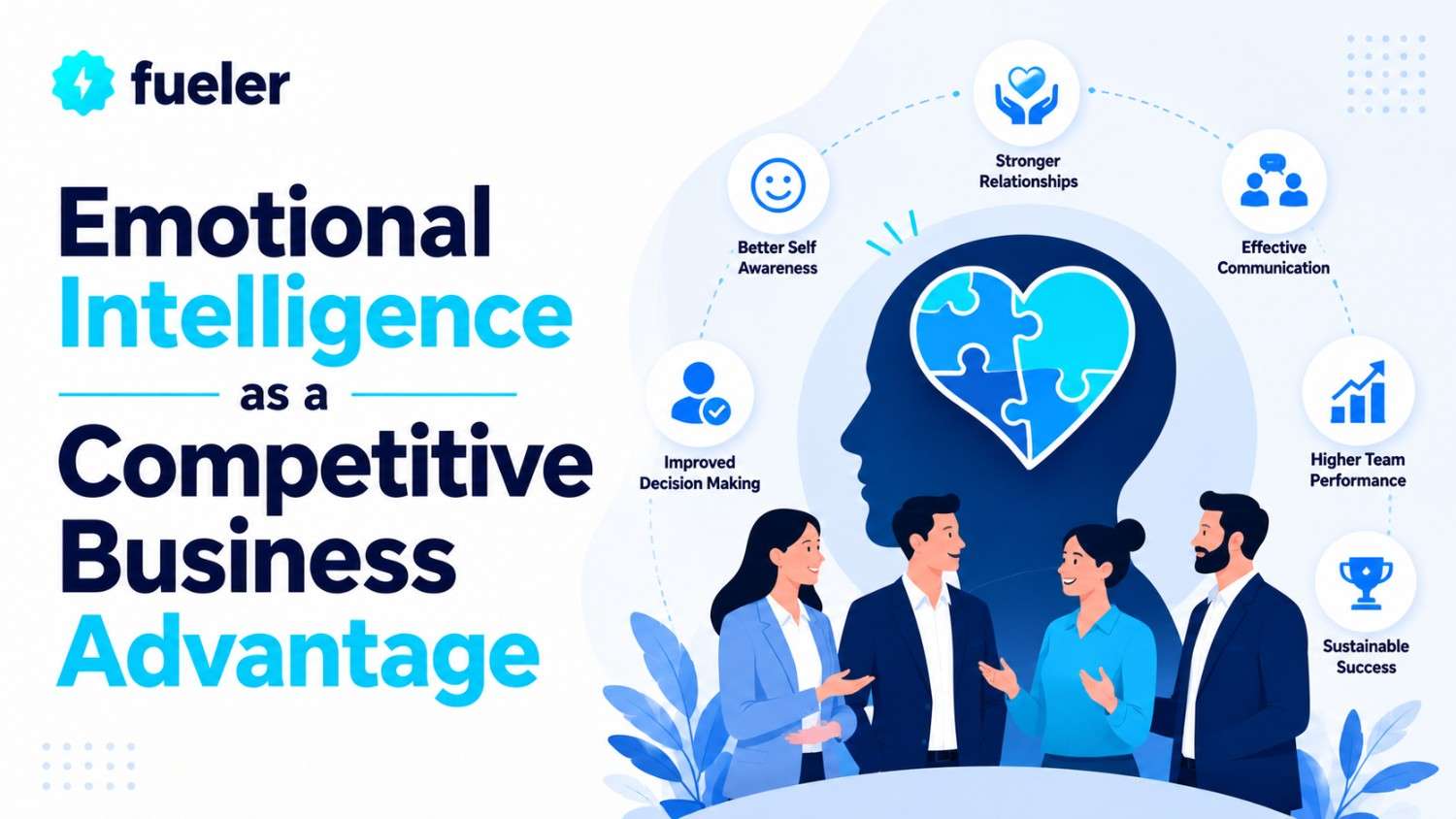
Emotional Intelligence as a Competitive Business Advantage

Riten Debnath
07 Jul, 2026
Last updated: July 2026
Most companies do not lose money because their people lack talent. They lose it in quieter ways: a manager reacts badly in a tense meeting, a team avoids honest feedback, a customer call goes sideways, or a high performer leaves because the culture feels exhausting.
That is why emotional intelligence has become a real business advantage in 2026, not a nice personality trait.
I’m Riten, founder of Fueler, a skills-first portfolio platform that connects talented individuals with companies through assignments, portfolios, and projects, not just resumes/CVs. Think Dribbble/Behance for work samples + AngelList for hiring infrastructure.
This article breaks down the full business case for emotional intelligence: what it is, why it matters now, where it shows up in real teams, how it affects hiring and retention, and how companies can build it without turning it into a corporate poster on a wall.
1. What emotional intelligence really means in business
Emotional intelligence, or EQ, is the ability to understand your own emotions, read other people accurately, and respond in a way that improves the situation instead of making it worse. In business, that affects everything from leadership and team communication to customer handling and conflict resolution.
The important thing is this: EQ is not about being “nice.” It is about being effective with people, especially when the stakes are high, the pace is fast, or the room is tense. That is exactly where weak leadership starts to show up.
- Emotional intelligence begins with self-awareness, which means noticing your own triggers before they spill into your tone, decisions, or body language. A leader who knows when they are stressed can pause before they send the message that turns a normal workday into a bad one.
- Self-regulation matters because emotional reactions spread quickly in a team. When a manager stays calm under pressure, the team usually stays more focused too. That does not mean suppressing emotion; it means not letting frustration become the company’s operating system.
- Empathy is not about agreeing with everyone. It is the ability to understand how someone else sees the problem, which helps leaders make better decisions, avoid blind spots, and communicate in ways people can actually hear.
- Social skills in business are not small talk. They include handling conflict, building trust, giving feedback, and keeping relationships strong enough that people collaborate instead of just coexisting in the same Slack channels.
- Motivation in EQ is the steady drive to keep going without turning every hard week into a drama. Leaders with good emotional intelligence usually recover faster, and that makes a real difference when teams are under pressure and decisions still need to get made.
Why It Matters
This matters because business performance is rarely only a systems problem. It is also a people problem, and EQ sits right in the middle of that.
It matters in 2026 because teams are more hybrid, AI is changing workflows, and emotional misreads happen faster when people are split across screens, locations, and time zones.
It also matters because customers feel emotional intelligence too. A calm, thoughtful response can save a relationship; a reactive one can damage trust in one call.
2. Why emotional intelligence became a competitive advantage
EQ became a competitive advantage because technical skill alone stopped being enough. Most teams now have access to similar tools, similar information, and similar automation options. What separates the stronger companies is how well their people work together under pressure.
That shift became sharper in 2026. As AI tools handle more repetitive work, the human side of business matters more, not less. The companies that win are often the ones where leaders can reduce friction, keep people aligned, and make hard conversations productive instead of draining.ayerhsmagazine+1
- When technical knowledge gets easier to access, human judgment becomes more valuable. AI can draft, summarize, and automate, but it cannot fully replace judgment, trust, or emotional awareness in a tense business moment.
- EQ gives leaders an edge in situations where rules are not enough. A missed deadline, a confused client, or a team conflict does not usually need a template first; it needs someone who can read the room and respond well.
- Emotional intelligence helps companies keep good people. Skilled employees often do not leave only because of pay; they leave because the work environment feels exhausting, dismissive, or chaotic, and EQ-heavy leadership reduces that kind of damage.
- High-EQ leaders usually make better people decisions. They know when to push, when to pause, when to listen, and when a problem is actually emotional strain hiding underneath a performance issue.
- Competitive advantage is not just about external growth. It is also internal speed. Teams with better trust and communication spend less time recovering from avoidable friction, which gives them more energy for actual work.
Why It Matters
This matters because the business environment in 2026 rewards teams that move smoothly, not just teams that move fast. Emotional intelligence helps reduce the hidden costs of poor communication and bad reactions.
It matters for hiring too. Companies are now more alert to whether a candidate can work with people, not just impress on a resume or in a technical interview.
It matters because as AI handles more routine tasks, the business advantage shifts toward the skills machines cannot fake: trust, judgment, empathy, and calm leadership.
3. How EQ affects leadership, trust, and culture
Emotional intelligence shows up most clearly in leadership. A manager with strong EQ does not just push people harder; they create a team environment where people feel safe enough to speak honestly and focused enough to do good work.
Culture is not built by slogans. It is built by repeated behavior. The way leaders respond to mistakes, disagreement, pressure, and bad news becomes the real culture whether anyone writes it down or not.
- Leaders with high EQ usually create better psychological safety. People are more willing to ask questions, raise concerns, and share incomplete ideas when they know they will not be embarrassed for speaking up.
- Trust grows when leaders are consistent. If a manager reacts calmly on Monday and sharply on Tuesday, the team starts managing the leader’s mood instead of doing their actual job, which is a terrible trade.
- EQ improves feedback quality. A leader who can give honest feedback without making someone feel small is far more useful than a leader who avoids hard conversations until the problem becomes bigger than it needed to be.
- Team culture becomes healthier when leaders notice stress early. Burnout often builds quietly, and emotionally aware managers catch the warning signs sooner because they pay attention to changes in energy, tone, and behavior.
- Culture is expensive when it is bad. High turnover, poor collaboration, and avoidable conflict all cost time and money, and emotional intelligence is one of the few leadership skills that directly reduces that waste.
Why It Matters
This matters because trust is not a soft extra. It is one of the fastest ways to improve execution quality and reduce team drag.
It matters in 2026 because hybrid work makes people easier to misread. A blunt message can land much harder over text than it would in a room, so EQ matters even more now.
For businesses, better culture usually means less churn, better retention, and smoother collaboration across teams that need to stay aligned.
4. EQ in customer experience and sales
Most companies talk about emotional intelligence as an internal leadership skill, but it also matters on the front lines. Customers can tell when a person is present, patient, and understanding versus when they are just reciting process like a tired robot in a headset.
In sales and customer support, EQ often decides whether a conversation becomes a solution or a problem. It affects how objections are handled, how complaints are de-escalated, and whether the customer feels respected enough to stay.
- Good salespeople with emotional intelligence listen before they pitch. They notice what the customer is worried about, what is unsaid, and what kind of language makes the conversation feel safe enough to continue.
- Support teams need EQ because most frustrated customers do not want a script first. They want to feel heard, and a calm response often solves half the problem before the technical fix even starts.
- In high-stakes deals, EQ helps build trust faster. People buy from people they believe understand their real situation, which is why tone, timing, and confidence matter almost as much as product features in many conversations.
- Emotional intelligence helps teams handle rejection better. Sales and client-facing work comes with a lot of “not now” and “not this time,” and a person who can stay steady through that usually performs better over time.
- A company with strong EQ at the customer edge tends to protect its reputation. One rude or careless interaction can travel far faster than a good one, so how people behave in moments of stress matters more than most teams admit.
Why It Matters
This matters because customer experience is often where business value is judged in plain language. People remember how a company made them feel almost as much as what it sold them.
It matters in 2026 because buyers expect faster replies, better service, and less friction. EQ helps teams meet those expectations without sounding mechanical.
It also matters for revenue. Better relationships usually mean higher retention, better referrals, and fewer preventable escalations.
5. EQ and better decision-making
Emotional intelligence is not only about feeling. It is also about thinking clearly when emotions are involved. That is one reason it matters so much in business decisions, especially when the pressure is high and the answer is not obvious.
A leader with EQ can separate useful concern from panic, useful disagreement from ego, and a temporary mood from a real pattern. That sounds simple, but it saves companies from a lot of expensive bad calls.
- Strong EQ improves judgment because leaders do not react to every problem as if it is a crisis. They can slow themselves down just enough to choose the right response instead of the loudest one.
- Emotional intelligence helps reduce groupthink. People are more likely to challenge weak ideas when leaders make disagreement feel normal and useful instead of risky or disrespectful.
- Good decision-makers notice the emotional side of data. Numbers matter, but so do morale, readiness, and timing, especially when rolling out changes that affect real people’s daily work.
- EQ supports change management. If a company is restructuring, adopting AI, or changing workflows, emotionally aware leaders know that people need context, not just instructions dropped into a meeting like a surprise package.
- Better decisions happen when leaders stay curious. Curiosity helps them ask why something feels off, who is affected, and what the downstream impact could be instead of rushing toward the first answer that sounds efficient.
Why It Matters
This matters because poor decisions are often emotional decisions wearing a business suit. EQ helps strip away the noise and get to the real issue.
It matters in 2026 because change is constant enough that leaders need both logic and human awareness to keep moving without breaking trust.
For business growth, better decisions mean fewer avoidable mistakes and stronger execution on the choices that really matter.
6. Why EQ matters more in hybrid and AI-heavy workplaces
Hybrid work changed how people read each other. AI changed how much work can be automated. Together, they made emotional intelligence more valuable because the remaining human interactions matter more than ever.
A screen hides a lot. Tone is harder to read, tension is easier to miss, and misunderstandings can sit quietly for days. In that environment, emotionally intelligent leaders become the glue that keeps teams from drifting apart.
- Hybrid teams need more deliberate communication because people no longer absorb context by sitting near each other. Emotionally aware leaders make their messages clearer, warmer, and more consistent across formats.
- AI speeds things up, but speed can expose bad habits. If a team already has weak communication or low trust, new tools will not fix that; they will simply help the problems appear faster.
- Remote and hybrid workers often need more reassurance, not less. A leader with EQ understands when silence means “I’m focused” versus “I’m confused and too tired to ask”.
- In AI-heavy workplaces, emotional intelligence protects the human parts of work. That includes coaching, customer empathy, conflict handling, and the messy moments where judgment still matters more than automation.
- The best leaders blend digital fluency with EQ. They understand the tools, but they do not let the tools erase the human layer that keeps teams coherent and customers loyal.
Why It Matters
This matters because the future workplace is not just more digital. It is also more emotionally demanding in quieter ways, because fewer signals are visible and more misunderstandings slip through.
It matters in 2026 because teams need leaders who can keep humans connected while the technology stack keeps getting louder.
For operations, this means less confusion, fewer unnecessary escalations, and smoother collaboration in distributed teams.
7. How companies can build emotional intelligence
EQ is trainable. That is the good news. It does not grow from inspirational posters or one workshop with sad jazz music in the background. It grows through practice, reflection, and honest feedback.
Companies that want EQ to become a real advantage have to treat it like a skill, not a slogan. That means building it into hiring, leadership development, feedback systems, and day-to-day management habits.
- Start with self-awareness training, because people cannot improve what they do not notice. Simple reflection practices, feedback loops, and manager check-ins help leaders spot patterns in their reactions before those patterns become a work problem.
- Train leaders to handle difficult conversations well. Role-playing feedback, conflict, and customer escalations is useful because real EQ is most visible when the conversation gets uncomfortable.
- Use 360-degree feedback carefully but seriously. People often behave very differently from how they think they behave, and structured feedback can reveal blind spots that self-assessment misses.
- Make EQ part of leadership hiring, not just development. A candidate who can explain their thinking, handle disagreement, and show self-control under pressure often brings more long-term value than someone with strong credentials but poor people skills.
- Measure the outcomes, not the vibes. Stronger engagement, better retention, better manager relationships, and smoother team execution are the signs that EQ is becoming real inside the company instead of staying on a workshop slide.
Why It Matters
This matters because businesses do not improve EQ by hoping people magically become wiser. They improve it by building habits and systems that reward better human behavior.
It matters in 2026 because leadership development is shifting toward human-centered skills that work alongside AI, not against it.
For growth, this creates stronger managers, more stable teams, and a better chance of keeping top performers long enough to matter.
8. The cost of low emotional intelligence
Low emotional intelligence is expensive. It creates avoidable stress, weakens trust, damages retention, and makes ordinary problems feel bigger than they need to be.
The damage is often subtle at first. A sharp tone here, a dismissed concern there, one employee who stops speaking up, one manager who keeps overreacting, and suddenly the team is not just busy; it is emotionally defensive.
- Low EQ often shows up as poor listening. People interrupt, assume, or respond too fast, which makes others feel unheard and reduces the quality of the actual decision being made.
- It also creates communication fear. If people believe honesty will be punished, they start saying less, which means leaders get less truth and more polite nonsense, and nobody improves from that.
- Weak emotional intelligence increases turnover risk. Talented people rarely stay in environments where stress is managed badly and simple conversations turn into unnecessary friction.
- It can damage client relationships just as quickly as internal ones. A careless reply, defensive tone, or lack of empathy can make a customer feel dismissed, even when the underlying product or service is fine.
- Low EQ slows execution because teams spend more time handling misunderstandings and morale issues. In many companies, the hidden tax is not obvious in the P&L, but it definitely shows up in missed deadlines and tired people.
Why It Matters
This matters because low EQ does not stay local. It spreads into culture, customer experience, and leadership credibility very quickly.
It matters in 2026 because teams have less patience for managers who create unnecessary emotional load when the work is already hard enough.
For business outcomes, the cost shows up in churn, rework, lost trust, and slower execution.
How Does This Connect to Building a Strong Career or Portfolio?
Emotional intelligence becomes powerful when people can see it in action, not just hear about it in interviews. Showing how you handled conflict, improved collaboration, or supported a team through a hard situation is proof of work, and that is why documenting these moments matters.
Modern hiring values outcomes, judgment, and people skills more than polished self-description. A visible record of your work makes your credibility much stronger, whether that is through case studies, project notes, or a portfolio on Fueler.
Final Thoughts
Emotional intelligence is no longer a “good to have” skill hidden in the background of business.
It affects leadership, culture, sales, customer experience, hiring, and the speed at which teams can recover from stress.
The companies that treat EQ seriously will usually make better decisions with less friction.
The people who build it into their daily work will stand out more, especially as AI handles more routine tasks.
In 2026, the advantage belongs to leaders and teams who can stay human without becoming slow.
That balance is hard, but it is also where the real edge sits.
FAQs
1. What is emotional intelligence in business?
Emotional intelligence in business is the ability to understand emotions, manage your reactions, and respond well to other people. It helps with leadership, teamwork, customer handling, and decision-making.
2. Why is emotional intelligence a competitive advantage in 2026?
Because many technical tools are becoming easier to access, the human skills that AI cannot replace, such as trust, empathy, and judgment, matter more. Companies with stronger EQ usually handle change and conflict better.
3. Can emotional intelligence be learned?
Yes. EQ improves through self-awareness, feedback, practice, and better communication habits. It is not fixed, and companies can build it through leadership training and daily behavior.
4. How does emotional intelligence improve team performance?
It reduces conflict, improves communication, and creates psychological safety. When people feel heard and respected, they usually share problems earlier and work together more effectively.
5. Does emotional intelligence matter in remote teams?
Yes, even more. Remote and hybrid teams rely heavily on tone, clarity, and trust because fewer in-person cues are available. Emotional intelligence helps prevent misunderstandings and keeps teams connected.
Why 100,000+ professionals use Fueler
Fueler helps professionals showcase proof of work through projects, assignments, case studies, and achievements.
- Thousands of professionals use Fueler to create their digital portfolio
- Thousands of projects are published on Fueler. Check here
- Startups and Companies hire through proof of work on Fueler
- Used by freelancers, creators, marketers, video editors, writers, designers, and product managers
Our mission is to help the next 100 million professionals build a verified professional identity through proof of work

What should you do next?
You've read the article. Now turn your skills into proof of work and unlock more opportunities.
Build your proof of work portfolio
Create a clean portfolio with projects, assignments, resumes, and AI stack details that companies actually want to see.
Create your Fueler portfolio →Apply through assignments, not resumes
Stand out by solving real tasks from companies hiring on Fueler.
Explore assignments →Get discovered by companies
Make your work public and let recruiters discover your skills through actual projects instead of keywords.
Get discovered →
