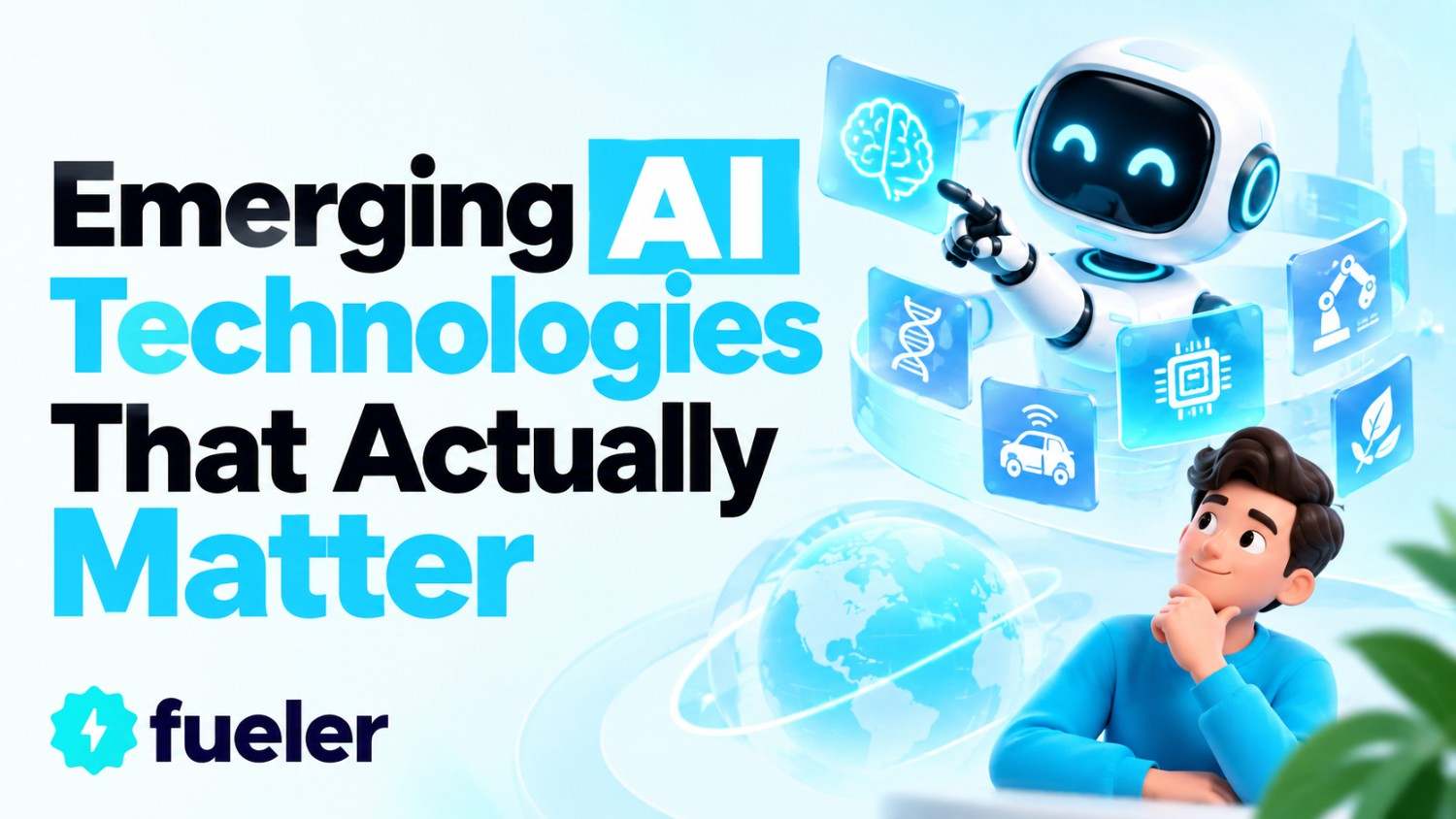
8 Emerging AI Technologies That Actually Matter

Riten Debnath
17 May, 2026
Last updated: May 2026
The honeymoon phase with artificial intelligence is officially over. In 2026, the tech world has shifted entirely toward production-first architecture, where enterprise leaders are aggressively dismantling experimental pilots and demanding clear, quarterly proof of impact. The tools dominating the corporate ecosystem today are not shiny science experiments designed for casual chatting; they are robust, foundational advancements built to solve deep operational friction, handle messy real-world data, and execute complex business goals autonomously.
I’m Riten, founder of Fueler, a skills-first portfolio platform that connects talented individuals with companies through assignments, portfolios, and projects, not just resumes/CVs. Think Dribbble/Behance for work samples + AngelList for hiring infrastructure.
1. Agentic AI and Autonomous Digital Coworkers
The shift from reactive chatbots to proactive, agentic systems represents the defining enterprise transition of 2026. Instead of waiting idly for human prompts, these autonomous digital coworkers independently orchestrate multi-step business workflows from end to end.
- Autonomous Multi-Step Workflow Execution: These intelligent systems take high-level corporate objectives, independently break them down into sequential tasks, call external software APIs, and execute complex multi-platform processes from start to finish without requiring human intervention at every single milestone.
- Self-Healing Code and Logic Correction: When an active agent encounters an unhandled software exception, a broken database link, or a system timeout, it runs real-time comparative logic to bypass the bottleneck, fix the internal error path, and keep the critical business operation moving forward.
- Proactive System Analysis and Alerting: Rather than sitting completely idle until a human types a command, these digital workers continuously monitor live corporate performance metrics, automatically launching background administrative updates or data transfers the split second they detect an operational mismatch.
- Cross Application Software Tool Interoperability: Modern agentic systems natively log into entirely separate enterprise platforms, fluidly passing data variables between internal databases, legacy customer relationship managers, and modern financial tracking software exactly like an experienced human employee would.
- Dynamic Human Escalation and Checkpoints: Built-in systemic guardrails allow these agents to manage operations autonomously while automatically pausing high-stakes workflows to cleanly present the historical project context and request a human supervisor's approval whenever an explicit financial or legal threshold is crossed.
Why it matters
Agentic AI changes the fundamental nature of work by shifting the human role from tedious execution to high-level system supervision. Organizations deploying these autonomous networks can scale their daily operational output exponentially, drastically reducing administrative overhead and eliminating costly human communication bottlenecks.
2. Intent-Driven Software Development and Repository Intelligence
Software engineering has fundamentally evolved from manually writing code syntax to articulating high-level architectural intent. Modern development systems analyze entire code repositories simultaneously to understand deep system relationships and maintain application stability.
- Context Rich Entire Codebase Comprehension: Modern development platforms scan deep into centralized software repositories, instantly mapping complex file dependencies, tracking variable heritages, and understanding the overarching business logic of an enterprise application rather than just analyzing isolated code snippets.
- Autonomous Full Stack Feature Assembly: Software engineers can state their final product objectives in plain English, allowing the repository intelligence system to write the frontend user interface, construct the backend server routing logic, and structure corresponding database schemas simultaneously.
- Automated System Level Regression Testing: The technology automatically generates and executes thousands of isolated test scripts with every single codebase modification, pinpointing hidden structural flaws, memory leaks, and performance bottlenecks long before updates hit production servers.
- Continuous Vulnerability Patching and Auditing: Real-time repository monitoring tools constantly scan live applications for newly discovered security flaws, autonomously drafting, testing, and deploying verified software patches to cloud systems without causing a single second of user disruption.
- Legacy System Translation and Modernization: Organizations use intelligent repository tools to seamlessly translate outdated, high-maintenance programming languages into modern, hyper-efficient frameworks, saving technical teams thousands of hours of manual rewriting and planning.
Why it matters
This technology drastically compresses product development lifecycles, allowing small teams to launch complex features in days rather than months. As software becomes self-assembling and self-healing, the competitive edge hinges entirely on system thinking and governance rather than manual syntax typing.
3. Multimodal Integration and Cross-Modal Analysis
The modern data landscape has advanced past text processing to embrace systems that process text, audio, video, and sensor data concurrently. This allows software to comprehend the real world exactly how a human worker does.
- Simultaneous Diverse Data Stream Ingestion: Multimodal systems process plain text inputs, vocal frequencies, structural charts, live camera feeds, and physical sensor data concurrently, creating a unified and highly contextual understanding of complex corporate operational scenarios.
- Visual Interface and Document Comprehension: Software applications read hand-written notes, interpret dense financial graphs, and fluidly navigate through unformatted, legacy user interfaces without requiring engineers to build custom data extraction models or APIs.
- Direct Native Voice Analysis and Processing: Systems evaluate spoken consumer interactions directly at the audio layer without converting the speech to text first, allowing the software to capture subtle emotional nuances, hesitation, and true user intent.
- Cross-Modal Asset Translation and Generation: A single automated system can take a highly dense, hundred-page technical text manual as an input and instantly output a corresponding instructional video, interactive slide deck, and translated audio summary.
- Physical Quality Assurance Environment Mapping: In industrial environments, multimodal tools combine live video streams with hardware sensor readouts to spot minute product defects on assembly lines, instantly flagging structural anomalies that are invisible to the naked human eye.
Why it matters
Multimodal integration unlocks automation opportunities in complex fields like medical diagnostics, visual quality control, and advanced customer relations. By bridging the gap between disconnected data types, businesses can eliminate manual data-entry steps and make highly accurate, contextual decisions instantly.
4. Industry Specific Vertical Models
The market has firmly rejected generic AI models that know a little bit about everything but not enough about specific professional rules. Corporations are pivoting heavily toward specialized models trained exclusively on highly regulated data. As organizations adopt these specialized AI systems, addressing the shadow ai governance gap becomes essential to ensure that unauthorized AI usage does not introduce compliance risks or weaken oversight across regulated environments.
- Hyper Focused Proprietary Industrial Data Training: Technical models are built using exclusive, specialized datasets like engineering schematics, local legal case histories, or molecular formulations, ensuring absolute task precision and preventing generic public model hallucinations.
- High Precision Regulatory Compliance Mapping: Vertical legal systems automatically scan evolving international trade regulations, immediately updating internal corporate workflows to prevent costly compliance violations, government sanctions, and corporate lawsuits.
- Streamlined Clinical Healthcare Documentation: Specialized medical models securely document patient-physician conversations in real time, mapping the discussion directly to electronic health records while offering highly accurate, evidence-based treatment summaries for doctor review.
- Advanced Financial Risk Assessment Architecture: Specialized banking systems analyze massive, real-time transaction streams, instantly flagging complex, microscopic patterns of digital cybercrime and credit risks that generalized software suites miss entirely.
- Predictive Industrial Supply Chain Optimization: Heavy manufacturing sectors deploy custom vertical models that understand specific production constraints, machinery tolerances, and raw material logistics, optimizing warehouse schedules to prevent costly operational downtime.
Why it matters
Vertical models provide the absolute precision that enterprise operations demand, moving technology past simple content creation into high-stakes decision making. Businesses using these purpose-built frameworks secure highly reliable outputs while operating safely within their strict legal frameworks.
5. Model Agnostic Enterprise Architecture
Smart engineering teams are refusing to lock their core business operations into a single artificial intelligence model vendor. Modern applications use flexible routing layers to shift computing workloads dynamically based on real-time needs.
- Dynamic Request Routing and Optimization: Corporate software applications automatically evaluate incoming technical tasks, routing basic data entry to ultra-cheap models while saving highly complex logical problems for advanced reasoning engines to control costs.
- Complete Elimination of Vendor Lock-In: By building modular, adaptable software frameworks, companies can swap out their underlying technology providers in minutes, preventing external corporations from dictating their internal operating overhead.
- Real Time API Cost Mitigation Protocols: Internal enterprise systems constantly monitor transaction fees across different infrastructure providers, automatically shifting computational workloads to the lowest-priced option to maintain absolute budget control.
- Multi-Provider Failover and System Redundancy: If a major global technology infrastructure experiences an unexpected cloud outage, model-agnostic corporate systems instantly redirect their live traffic to an alternative provider to ensure zero business disruption.
- Localized Small Language Model Deployment: Engineering teams are deploying highly compressed, open-source models directly onto internal corporate servers to handle routine tasks locally, using large commercial clouds exclusively for high-level reasoning.
Why it matters
Embracing a model-agnostic architecture protects an organization from external market volatility, sudden API price hikes, and unexpected system outages. Maintaining complete control over where and how data is processed ensures that your business infrastructure remains highly resilient and cost-effective.
6. Process Intelligence and Unstructured Data Parsing
Since over eighty percent of corporate data lives in messy formats like emails and PDFs, companies are investing heavily in process intelligence. These systems organize and validate information before it ever enters an automated workflow.
- Systematic Structuring of Chaos Rich Corporate Data: Specialized processing software automatically extracts critical metrics from unformatted documents, turning disorganized text files into clean, readable database tables for automated systems to ingest safely.
- Deep Visual Mapping of Internal Workflows: Process intelligence systems actively track how employees move across separate business applications, creating clear visual maps that highlight operational friction, employee bottlenecks, and prime automation opportunities.
- Automated Line Item Extraction and Validation: Software tools scan complex commercial shipping invoices, automatically cross-referencing prices, quantities, and tracking numbers against internal purchase orders before approving financial payouts.
- Proactive Prevention of System Logic Hallucinations: By ensuring that all data inputs are thoroughly cleaned, formatted, and verified beforehand, corporations can run advanced automated reasoning engines safely without risking unpredictable outputs.
- Continuous Operational Auditing and Clean Data Feeds: Automated monitoring tools constantly audit internal corporate data flows, instantly flagging duplicated entries, outdated profiles, or broken database links to keep the company's information ecosystem perfect.
Why it matters
Process intelligence is the foundational bedrock of successful automation because it solves the classic problem of bad data causing bad results. Companies that prioritize structuring their internal data assets build a massive competitive advantage, ensuring their automated systems execute high-stakes business decisions with absolute precision.
7. Collaborative Human Augmentation Frameworks
The narrative around automation has shifted entirely away from replacing human workforces to focus heavily on collaboration. Modern systems focus on building clear interfaces where humans handle creative direction while software handles data weight.
- Interactive Supervisor System Control Dashboards: Operations managers utilize centralized control panels to monitor active automated systems, track project completion percentages, view audit logs, and instantly adjust operational permissions with a single click.
- Contextual Communication Escalation Protocols: When an automated system encounters an ambiguous customer situation or an emotionally charged query, it smoothly transfers the entire historical context to a human representative to prevent user friction.
- Real Time Workforce Feedback Loops: Human workers can edit an automated system's output mid-workflow, and the software immediately adapts its logic based on that correction, learning specific user preferences without needing custom code.
- Shared Biological and Digital Workspace Environments: Digital collaboration spaces allow human professionals and autonomous agents to co-edit project files, brainstorm strategies, and manage tracking boards side-by-side, creating a unified team dynamic.
- Ethical and Regulatory System Boundary Enforcement: Organizations implement strict operational boundaries that completely prevent automated systems from finalizing legal contracts, medical diagnoses, or major capital expenditures without explicit human sign-off.
Why it matters
Perfecting human-agent collaboration ensures that businesses retain complete control over their automated systems while maximizing their daily output. Organizations that master this balance avoid the risks of unchecked automation, ensuring high-quality control while keeping their human workforce engaged in high-value strategic thinking.
8. Sovereign Cloud and Localized Edge Computing
To counter data leaks and meet changing international laws, enterprises are moving their automation systems out of public clouds. Processing data locally on internal hardware ensures maximum security and zero transmission latency.
- Zero Latency Localized Data Processing: Because proprietary information does not need to travel to external cloud data centers and back, local edge devices process data instantly, making them ideal for robotics and manufacturing.
- Offline Operational System Resilience: Localized tech stacks allow inventory systems, smart machinery, and automated workflows to run smoothly during complete internet outages, ensuring total business continuity in remote or unstable environments.
- Drastic Cloud API Cost Reductions: Running models locally on enterprise hardware eliminates expensive external API call fees and data transmission costs, allowing companies to scale their automation workflows indefinitely without facing soaring software bills.
- On-Premise Data Sovereignty and Security: Highly regulated industries like banking, healthcare, and defense keep their proprietary data completely within their physical buildings, ensuring zero exposure to public cloud leaks or third-party storage risks.
- Hyper-Efficient Model Optimization and Compression: Modern local setups use highly compressed software engines designed specifically to deliver enterprise-grade accuracy while running on standard, cost-effective workplace hardware components.
Why it matters
Moving automation to the edge democratizes advanced technology by making it faster, cheaper, and safer. Organizations operating in remote sectors, manufacturing, or highly confidential industries can finally embrace autonomous systems without worrying about internet reliability, high API costs, or data exposure.
How does this connect to Building a Strong Career or Portfolio?
As corporations restructure their entire operations around production discipline, the modern job market is changing fast. Employers are no longer looking to hire people to copy-paste data, write basic boilerplate code, or manage routine spreadsheets. The modern corporate ecosystem wants professionals who can step into high-level oversight roles, design process intelligence, and manage automated architectures effectively.
To catch the attention of top-tier companies, relying on a traditional resume is a losing strategy. A flat piece of paper listing generic past job descriptions tells an employer absolutely nothing about your actual ability to manage modern, data-driven systems.
This is why we built Fueler. You can use Fueler to launch a highly professional, skills-first portfolio completely for free. It allows you to organize your best work samples, host detailed case studies of your assignments, and cleanly present your verified proof of work, making it incredibly easy to stand out and land high-paying roles based entirely on your actual talent.
Final Thoughts
The real story of technology in 2026 is about the disciplined march toward measurable, real-world value. The companies winning the market right now are those that have dismantled their chaotic, experimental pilot projects and unified their operations under robust, highly secure, and model-agnostic frameworks. For ambitious professionals, this systemic corporate shift represents an incredible opportunity to redefine the trajectory of your career. By mastering process intelligence, prioritizing clear data governance, and consistently publishing your real-world work samples for the world to see, you can confidently secure your place at the very forefront of the modern digital economy.
Frequently Asked Questions
What makes an AI technology "emerging" in the corporate world of 2026?
An AI technology is considered emerging today when it successfully transitions from a simple conversational interface to an active, architectural execution system. The focus has entirely shifted away from tools that simply generate text toward robust software frameworks that can plan, reason, audit data, and operate autonomously within complex enterprise environments.
How do agentic AI systems handle errors without human intervention?
Agentic AI systems handle errors by utilizing built-in self-correcting logic and multi-agent cross-checking protocols. When a digital coworker hits a broken database link or an unhandled software exception, it automatically runs comparative pathways, consults internal alternative routes, and implements background fixes to keep the broader business workflow moving without crashing.
Why is a model-agnostic architecture important for business budget control?
A model-agnostic architecture is critical because it introduces a dynamic routing layer that evaluates incoming tasks in real time, sending simple data entry to ultra-cheap models while saving expensive reasoning engines for complex problems. This prevents companies from getting locked into a single tech vendor, allowing them to instantly shift workloads to whoever offers the best market price.
What is the purpose of process intelligence in modern automation?
The primary purpose of process intelligence is to systematically clean, structure, and validate disorganized corporate information before it ever touches a core automation system. By converting chaotic, unformatted files like emails, phone logs, and PDFs into highly structured data tables, companies completely eliminate the risk of system hallucinations and catastrophic logic errors.
Why should I use a skills portfolio instead of a resume to get hired in 2026?
A resume only lists historical job titles and generic descriptions, which fail to prove your actual competency in a tech-driven market. A public skills portfolio provides immediate, undeniable proof of your talent by showcasing the actual automation workflows, case studies, assignments, and functional project architectures you have successfully designed and executed.
What is Fueler Portfolio?
Fueler is a career portfolio platform that helps companies find the best talent for their organization based on their proof of work. You can create your portfolio on Fueler. Thousands of freelancers around the world use Fueler to create their professional-looking portfolios and become financially independent. Discover inspiration for your portfolio
Sign up for free on Fueler or get in touch to learn more.

What should you do next?
You've read the article. Now turn your skills into proof of work and unlock more opportunities.
Build your proof of work portfolio
Create a clean portfolio with projects, assignments, resumes, and AI stack details that companies actually want to see.
Create your Fueler portfolio →Apply through assignments, not resumes
Stand out by solving real tasks from companies hiring on Fueler.
Explore assignments →Get discovered by companies
Make your work public and let recruiters discover your skills through actual projects instead of keywords.
Get discovered →
