Dribbble vs Fueler: Which Platform Should You Choose?

Riten Debnath
11 Jul, 2026
Last updated: July 2026
The traditional job application system is completely broken. Spraying a million generic, auto-generated PDFs at automated applicant tracking systems (ATS) just results in your application disappearing into a black hole. On the other side of the screen, hiring managers are drowning in a sea of identical resumes and highly polished, hyper-curated portfolios that often hide who actually did the real work.
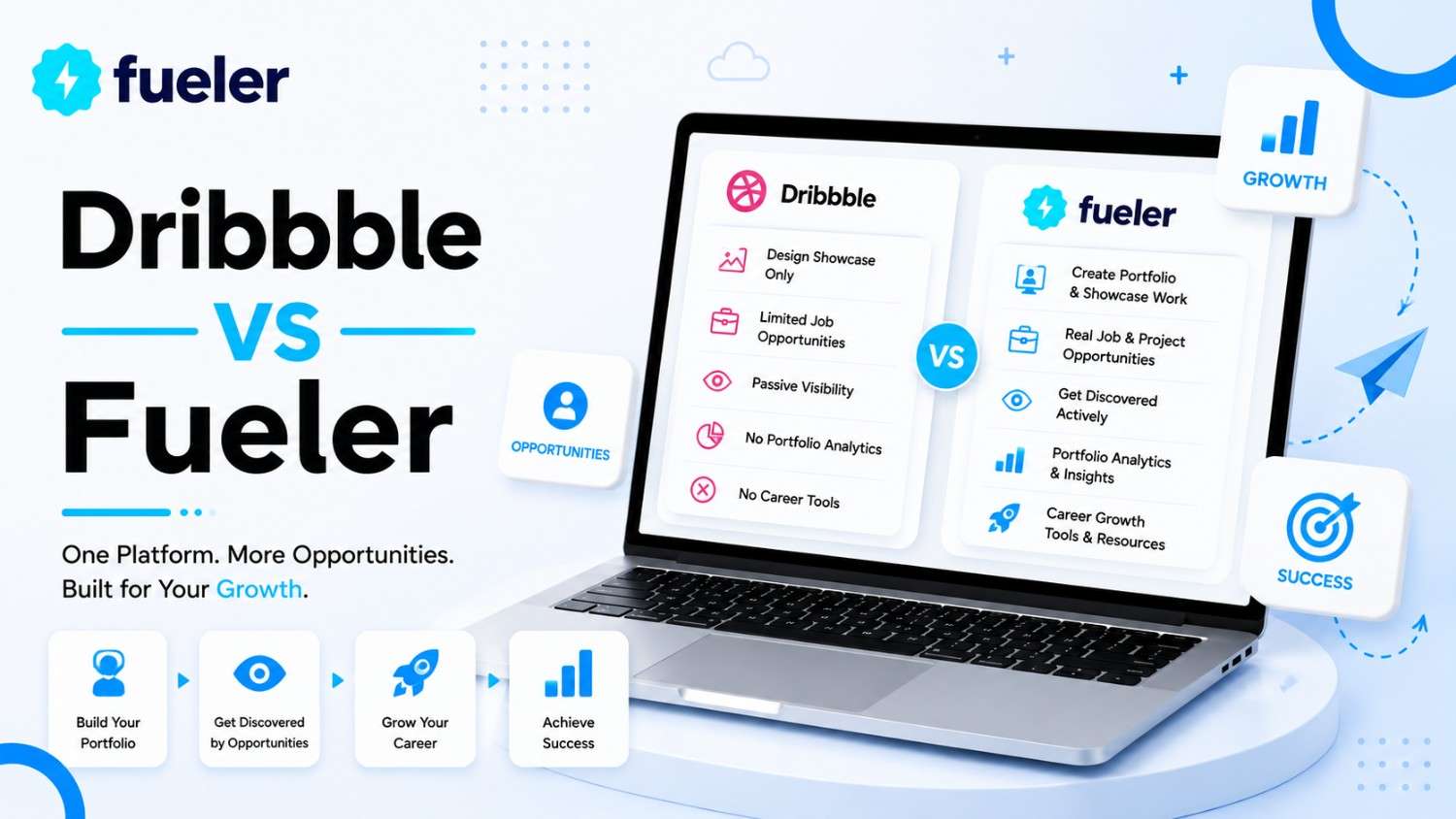
If you are a modern digital professional trying to figure out where to stake your claim on the internet, you are looking at a crossroads between two completely different worlds: Dribbble, the historic internet playground for visual inspiration, and Fueler, a modern engine built entirely around verified execution.
I’m Riten, founder of Fueler, a skills-first portfolio platform that connects talented individuals with companies through assignments, portfolios, and projects, not just resumes/CVs. Think Dribbble/Behance for work samples + AngelList for hiring infrastructure.
If your career lives or dies based entirely on a gorgeous $800 \times 600$ pixel thumbnail, you already know where to go. But if your actual professional value lies in things that can't be easily captured in a pretty picture, like complex codebases, deep UX user flows, conversions, strategic copy, or full-stack products, forcing your work into a traditional design grid is like bringing a knife to a laser fight.
Understanding Dribbble: The Global Playground for Designers
Founded as an invite-only community for digital artists, Dribbble evolved into a central node of the global design ecosystem. Its core unit of value is the Shot, an image container built to showcase visual design work.
Dribbble was explicitly architected to solve the problem of visual inspiration and community peer review. It serves as a live, highly fluid mood board for the world’s UI, UX, graphic, and motion designers.
Where Dribbble Excels
- High-Volume Visual Traffic: For pure visual creatives, Dribbble offers an unmatched volume of active daily visitors searching specifically for aesthetic assets and design patterns.
- The Inbound "Halo Effect": High engagement on a Shot can push it to the popular feed, creating an immediate influx of freelance inquiries and visual design leads.
- Community Critique and Networking: The platform is built around designer-to-designer interaction, making it an excellent space for receiving feedback on specific micro-interactions, color palettes, and typographic hierarchies.
- Integrated Job Board: Dribbble features an active marketplace where global brands specifically seek top-tier visual talent.
The Structural Boundaries of Dribbble
Because Dribbble optimizes heavily for the immediate visual impact of a single asset, it inherently struggles with non-visual or deeply strategic deliverables. A backend development architecture, an end-to-end UX research framework, a technical documentation strategy, or a content marketing funnel cannot be cleanly communicated within the constraints of a standard visual grid.
Furthermore, the platform's social dynamics can occasionally lean toward aesthetic trends rather than functional, conversion-oriented, or real-world product engineering metrics.
Understanding Fueler: The Proof-of-Work Ecosystem
Fueler was built from the ground up to address a different challenge: the monetization and validation of multi-disciplinary work.
Fueler shifts the core unit of professional value from the aesthetic artifact to the Proof-of-Work (PoW) project ledger. It acts as a public career portfolio designed to document the full lifecycle of a professional’s output, regardless of whether that output is a Figma file, a GitHub repository, a Notion strategy document, or a live production URL.
Where Fueler Excels
- Multi-Disciplinary Flexibility: Fueler allows professionals to showcase work that spans multiple media- text, code, system architecture, data models, and visual design under a single, unified profile.
- Verifiable Execution via Vouches: Projects on Fueler can be co-authored and validated by peers, managers, or clients, creating an integrated trust layer that verifies who actually performed the work.
- Assignment-Based Funnels: The platform bridges the gap between showcasing talent and securing work by integrating assignment-oriented opportunities, allowing companies to discover talent based on practical execution.
- Zero-Maintenance, Public Portfolios: Designed as a clean, no-code personal brand engine, it prioritizes fast project documentation with native analytics, SEO optimization, and direct discoverability by technical and non-technical recruiters alike.
The Structural Boundaries of Fueler
Fueler is explicitly not a social network built for casual browsing or aesthetic peer feedback. It does not feature a global community feed optimized for scrolling through design concepts or liking micro-interactions. If your primary goal is to find daily aesthetic inspiration or get design feedback from fellow creatives, Fueler’s infrastructure is not built for that specific behavioral loop.
Feature-by-Feature Deep Dive
Evaluating these platforms requires looking past their interfaces to see how their underlying features impact your career visibility, discovery by search engines, and overall professional workflow.
1. Project Documentation and Case Studies
A portfolio is only as strong as its ability to communicate the depth of a project.
- Dribbble: Focuses on the visual asset. While Pro users can attach rich media, text descriptions, and link to case studies, the platform's presentation layout prioritizes the image container. The text description is secondary to the file upload itself.
- Fueler: Treats the project description as an interactive case study. Every piece of work can house live project links, code repositories, structural breakdowns, metrics, and role definitions. This enables multi-disciplinary professionals to explain how a project was built, what tools were used, and the direct business outcomes achieved.
2. Proof of Work and Verification Metrics
In an era where digital content can be easily replicated or generated, proving ownership of a project has become a critical requirement for recruiters.
- Dribbble: Relies heavily on community trust and watermarks. While users can flag stolen work, there is no native structural mechanism to programmatically verify that a specific user was the sole engineer or designer behind a given layout.
- Fueler: Implements a native, collaborative validation layer known as Vouches. When you publish a project, you can add co-authors, collaborators, or clients. These stakeholders can vouch for the authenticity of the project, turning your portfolio into a verified ledger of career execution. This helps professionals understand how to build a portfolio that actually gets you clients by injecting verifiable trust directly into their work samples.
3. Discoverability: Algorithmic Feeds vs. Search Engines
How potential clients or recruiters land on your profile determines its long-term return on investment.
- Dribbble: Relies on an internal discovery loop. To get noticed, you must optimize for the platform's internal algorithm, which values consistent daily uploads, collections, saves, and likes. It acts as an active ecosystem that requires ongoing social maintenance to remain visible.
- Fueler: Functions as a decentralized personal landing page. Every profile is built to be indexed effectively by search engines. Rather than competing for likes within an internal feed, Fueler provides clean on-page technical structures, clean canonical URLs, and structured metadata. This setup ensures that your work is discoverable by recruiters using external search engines or generative discovery tools.
4. Customization and Maintenance Overhead
The amount of time required to keep your portfolio modern and reflective of your current skillset impacts your productivity.
- Dribbble: Requires custom graphic asset preparation for every upload. Even if you write a long script or design a massive web app, you must compress that work into an exact aspect-ratio thumbnail to present it cleanly on the platform grid.
- Fueler: Operates as a no-code portfolio profile. You can drop live links, embed project documents, and sync external assets in a few clicks. The platform manages the visual presentation automatically, reducing the design overhead needed to keep your documentation up to date.
Objective Comparison Matrix
Real-World Use Cases
To see where these platforms deliver the highest returns, let's examine how distinct professional profiles navigate each ecosystem.
Persona A: The Pure UI/UX Visual Designer
Consider a designer specializing in high-fidelity mobile application interfaces, complex micro-interactions, and custom icon sets.
For this professional, Dribbble acts as a powerful portfolio choice. Their primary goal is to catch the eye of creative directors who think in pure visual patterns. The designer relies on high daily traffic volumes to generate inbound design system leads. Because their output is entirely visual, the platform's thumbnail-first grid directly matches their natural work style.
Persona B: The Full-Stack Product Builder
Now consider a professional who bridges the gap between engineering and user experience, someone who runs competitive audits, builds user flows, drafts database schemas, and writes clean React code.
[The Product Workflow Challenge]
User Research Documents (Notion) ➔ Wireframes (Figma) ➔ Codebase (GitHub) ➔ Live Demo (Vercel)
Trying to squeeze cross-functional workflow into a single $800 \times 600$ pixel static image container leaves out the most valuable parts of the work. On Fueler, this professional can link their live application, document their technical stack, tag the content marketer who wrote the copy, and receive a verified vouch from the engineering manager.
This multi-dimensional layout mirrors the collaborative nature of modern product development, making it an excellent match for professionals showcasing real-world projects. It provides a clean framework for understanding why a Fueler portfolio is becoming the new resume for knowledge workers.
Persona C: The Modern Growth Marketer & Content Strategist
A content marketer or SEO specialist creates value through distribution strategies, conversion funnels, and written assets.
For these non-visual fields, Dribbble provides limited infrastructure. A text-driven strategy or data spreadsheet cannot be cleanly displayed as an illustration asset. Using a platform designed for content writer portfolios allows these professionals to showcase actual live published URLs, track user engagement analytics on their case studies, and organize their portfolio by specific marketing disciplines.
Strategic Selection: Who Should Choose What?
Your choice between these platforms depends on your specific discipline, target audience, and long-term career goals.
Choose Dribbble If:
- Your core professional asset is high-fidelity visual output that can be evaluated in under three seconds.
- You want to participate actively in a creative community, trade design feedback, and track global aesthetic trends.
- Your primary lead generation funnel relies on visual search terms inside a design-specific ecosystem.
- You have the bandwidth to format, export, and polish specialized presentation shots for every project milestone.
Choose Fueler If:
- Your work is context-driven and requires text explanations, live links, code repositories, or multi-platform data embeds.
- You want to build a verified track record where clients and co-creators can vouch for your contributions.
- You prefer a low-maintenance portfolio that indexes well on search engines without requiring social media engagement loops.
- You want to participate in assignment-based hiring models where your skills are evaluated through execution rather than static resumes.
The Future of Portfolios: The Skills-First Shift
The global hiring architecture is changing. As standard resume screening platforms become saturated with identical, auto-generated PDF applications, traditional evaluation methods are losing their effectiveness.
Traditional Funnel: Resume Drop ➔ Keyword Screening ➔ Arbitrary Screening Call
Skills-First Funnel: Proof-of-Work Verification ➔ Real-World Task Assignment ➔ Contextual Hiring
The portfolio is evolving from a static gallery into an active proof-of-work dashboard. Tomorrow's successful professionals will not rely on a list of skills typed into a text document; they will point to an immutable index of verified work.
Whether you choose the visual social model of Dribbble or the verified project infrastructure of Fueler, your focus should remain on building a clear, accessible record of your execution.
Frequently Asked Questions
Can I use Fueler and Dribbble together?
Yes. Many designers use Dribbble as their top-of-funnel discovery engine for quick visual assets, while linking to Fueler to host their comprehensive case studies, live production sites, and verified client endorsements.
Does Fueler support video formatting for motion designers or video editors?
Yes. Fueler natively handles rich media embeds, allowing you to showcase live video links, interactive files, and multimedia assets directly alongside your case studies. This makes it straightforward to build out specialized video editor portfolio examples that get interviews.
How does Fueler verify that a project belongs to me?
Fueler uses a collaborative feature called Vouches. By tagging clients, managers, or teammates on a project, they can verify your work. This creates a public layer of trust that authenticates your specific role in the project.
Is Fueler purely for designers, or can developers and writers use it too?
Fueler is designed for multi-disciplinary professionals. Its system handles code repositories, live web applications, marketing data sheets, and written documents, making it a viable option for anyone looking to build a clean proof-of-work portfolio.
How do search engines handle Fueler profiles compared to Dribbble?
Dribbble optimizes for its internal discovery engine, prioritizing user interaction inside its own app. Fueler focuses on external technical SEO, providing structured profiles that index cleanly on external search engines so recruiters can discover your work directly.
Why 100,000+ professionals use Fueler
Fueler helps professionals showcase proof of work through projects, assignments, case studies, and achievements.
- Thousands of professionals use Fueler to create their digital portfolio
- Thousands of projects are published on Fueler. Check here
- Startups and Companies hire through proof of work on Fueler
- Used by freelancers, creators, marketers, video editors, writers, designers, and product managers
Our mission is to help the next 100 million professionals build a verified professional identity through proof of work

What should you do next?
You've read the article. Now turn your skills into proof of work and unlock more opportunities.
Build your proof of work portfolio
Create a clean portfolio with projects, assignments, resumes, and AI stack details that companies actually want to see.
Create your Fueler portfolio →Apply through assignments, not resumes
Stand out by solving real tasks from companies hiring on Fueler.
Explore assignments →Get discovered by companies
Make your work public and let recruiters discover your skills through actual projects instead of keywords.
Get discovered →
