Canva Portfolio vs Fueler: Which Platform Is Better?

Riten Debnath
08 Jul, 2026
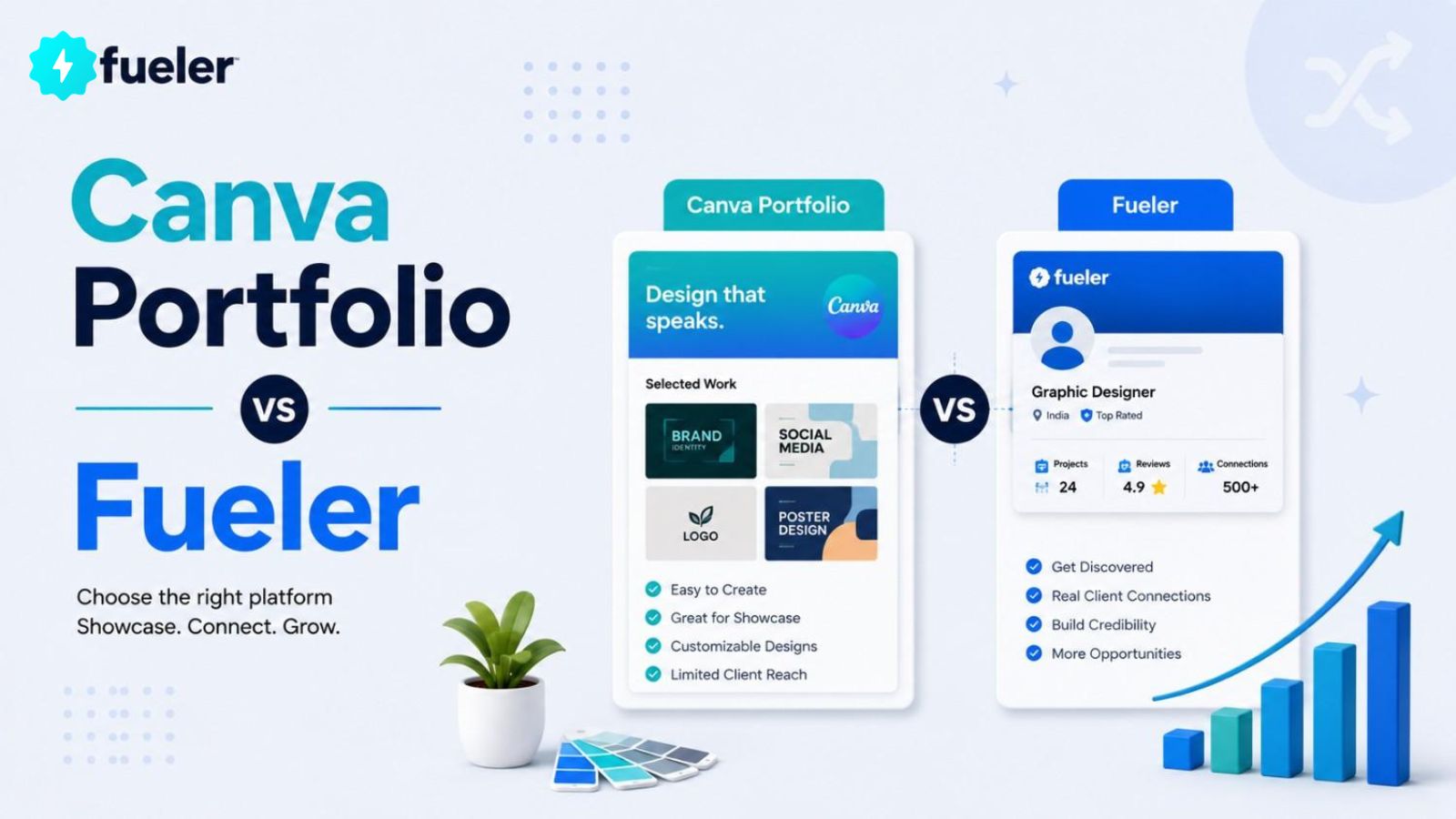
Let’s be honest: the traditional resume is dying. Sending a static, two-page PDF of bullet points into a black hole of corporate applicant tracking systems feels like a relic of the past. Today, hiring managers are completely overwhelmed by generic applications, inflated LinkedIn profiles, and AI-generated cover letters. They don’t just want to read what you claim you can do, they want to see undeniable proof of what you’ve actually built.
This brings us to a massive shift in how we show up online, and a question I see professionals wrestling with constantly: Canva Portfolio vs Fueler.
Look, Canva is brilliant. If you need to spin up a gorgeous, highly customized visual deck or a quick scrolling microsite, its drag-and-drop freedom is completely unmatched. But does a beautiful layout actually translate to consistent inbound client leads, automated recruiter discovery, and long-term career growth?
I’m Riten, founder of Fueler, a skills-first portfolio platform that connects talented individuals with companies through assignments, portfolios, and projects, not just resumes/CVs. Think Dribbble/Behance for work samples + AngelList for hiring infrastructure.
Understanding Canva Portfolio: The King of Visual Customization
To understand where Canva Portfolio wins, you have to look at what it was born to do: democratize design. When Canva expanded into micro-websites and portfolios, they brought that exact same "blank canvas" philosophy with them. A Canva portfolio is essentially an interactive slide deck or a beautiful single-page layout hosted on the web with zero coding required.
If your primary value proposition is visual arrangement, if you are a graphic designer, brand stylist, slide deck specialist, or presentation artist, Canva is an incredible playground. You aren’t forced into rigid columns or predefined text boxes. If you can dream up a visual layout, you can drag and drop it into existence in a matter of minutes.
Where Canva Excels
- Absolute Design Freedom: Total control over fonts, custom spatial layouts, colors, graphics, and smooth web animations.
- Zero Learning Curve: Millions of people already use Canva every day. Turning an existing presentation or pitch deck into a live web link takes exactly one click.
- Massive Asset Library: Instant access to millions of stock elements, icons, photos, and multimedia embeds right inside your editor.
- Rapid Turning of Decks to Links: Perfect for when you need a highly stylized, single-use visual deck to accompany a manual proposal or sales pitch.
If you are sending a direct link to a client who already knows who you are, and your sole goal is to wow them with beautiful, polished presentation design, Canva handles the job flawlessly.
The Invisible Limitations of Canva in a Skills-First Market
While Canva is fantastic for surface-level design, it runs into some pretty steep structural walls when you try to use it as a long-term career engine. At its core, a Canva website is a flat visual document published to the web. It lacks the deep, relational data architecture that modern hiring pipelines and discovery algorithms look for.
The biggest hurdle is the lack of structured skill extraction. When you upload a project image or write text inside a Canva container, search engines and automated platforms see a flat design layer. There is no automated system to categorize your work into specific technical competencies.
Furthermore, Canva portfolios don’t have a built-in distribution network. Once you hit publish, the entire burden of getting eyeballs on your work is on you. You have to manually paste that link into cold emails, update your social profiles, and pitch yourself everywhere. The platform itself doesn’t have an internal ecosystem of recruiters or active company assignment boards searching for talent.
Finally, trust validation is completely manual. Anyone can drop a text block onto a Canva page and claim they grew a company's revenue by 400%. In an era where trust is incredibly hard to find, self-reported visual claims are facing lower conversion rates. There's no native way to verify that project, tag co-creators, or allow third-party clients to drop verified endorsements directly onto your actual asset log.
Decoding Fueler: The Hub for Verifiable Proof of Work
Fueler represents a completely different philosophy. We didn't build Fueler to compete with design software. We built it to solve a major bottleneck: how talent gets discovered and trusted. Instead of forcing you to spend hours playing web designer and messing with margins, Fueler gives you a clean, structured profile built entirely around aggregating your real-world outcomes.
This is what we call a proof of work portfolio. On Fueler, your portfolio isn't a static collection of images; it's a living, searchable ledger of individual project case studies, published pieces, shipped products, and live campaigns.
The Core Pillars of Fueler
- Assignment-Based Hiring: We integrate your portfolio directly with an active marketplace. You don't just build a profile and hope for the best; you use your verified profile to apply directly for live company assignments, turning your past work into an active application passport.
- Structured Case Studies: The platform guides you away from vague summaries and prompts you to show the exact problem you faced, your specific operational contribution, and the measurable business metrics you achieved.
- Native Skill Validation: Fueler automatically organizes your work by technical competencies, creating a clean, no-code public profile that instantly communicates your stack to both human eyes and discovery tools.
- Built-in Trust via Vouches: To solve the credibility problem, we built "Vouches." Clients, managers, and collaborators can digitally sign off on specific projects, creating an immutable layer of proof that removes hiring anxiety for your next client or employer.
Fueler shifts your portfolio from a passive presentation layer to an active utility. It is engineered specifically for knowledge workers like writers, developers, marketers, SEOs, and product managers whose value is measured by operational results and project execution rather than aesthetic layout design.
Canva Portfolio vs Fueler: Feature-by-Feature Evaluation
Let’s look at how these two platforms perform across the critical categories that dictate actual career velocity and project conversion.
1. Portfolio Purpose and Core Philosophy
Canva Portfolio is a design-first tool. Its ultimate goal is to make your content look visually stunning and uniform. It treats the portfolio as a digital canvas or a multi-page presentation booklet.
Fueler is a hiring-first tool. Its ultimate goal is to prove your competence as quickly and undeniably as possible to build a solid foundation for personal branding and attract high-value opportunities.
2. Search Engine Optimization (SEO) and Discovery
Canva websites use complex, script-heavy layers to maintain absolute design layouts. While Google can index them, they rarely rank for deep, long-tail technical keywords because they lack clean semantic HTML structures and robust metadata controls.
Fueler profiles are built on hyper-clean, performance-optimized code frameworks that ensure lightning-fast loading times. More importantly, Fueler profiles are highly structured to display cleanly within generative AI search tools, making your work discoverable to recruiters using next-generation AI platforms.
3. Trust Verification and Social Proof
On a Canva portfolio, testimonials must be manually typed out as a text box. While visually appealing, these quotes are entirely unverified and can be easily fabricated, reducing their overall trust weight in high-stakes hiring scenarios.
Fueler introduces a robust validation mechanism called "Vouches." When you complete a project, your client or collaborator can digitally sign off on that specific piece of work. This link remains anchored to your live profile, providing concrete evidence that your case study represents genuine, executed work.
4. Direct Monetization and Career Pipelines
Canva has no internal career pipeline. It does not possess a job board, an assignment marketplace, or a talent directory. It is an isolated asset; you must bring your own audience and build your own pipeline from scratch.
Fueler bridges the gap between showcasing work and earning income. The platform features an active ecosystem of live corporate assignments, freelance briefs, and recruiter discovery portals. Your profile functions as a persistent application passport, allowing you to secure paid work directly through your documented portfolio pieces.
The Strategic Comparison Matrix
The table below breaks down the structural differences between these two ecosystems, allowing you to map their capabilities directly to your career goals.
Real-World Scenarios: Persona-Based Deployments
To understand how these differences manifest in practice, let us analyze two distinct professional paths and see how selecting the right tool impacts their real-world outcomes.
Scenario A: The Growth-Focused SEO Specialist
Let us look at a professional whose primary value lies in technical strategy, data interpretation, and search architecture. If an SEO specialist builds a portfolio on Canva, they face immediate structural hurdles. They can design a beautiful slide deck showing traffic graphs, but they cannot easily make their portfolio rank for local search queries or technical key phrases because Canva websites lack deep semantic optimization.
Furthermore, a recruiter reviewing an SEO specialist's portfolio wants to click out to live URLs, inspect backlink profiles, and verify that the specialist was the actual person who drove those organic results.
When this professional switches to Fueler, the entire narrative changes. They can document each specific campaign as an independent piece of work, clearly mapping out the initial crawl errors, the keyword architecture they deployed, and the final traffic metrics.
By linking verified client vouches to those case studies, they build immediate trust. The clean architecture allows them to display a high-performance profile that can be effortlessly indexed by modern search tools, ensuring they show up when companies search for technical optimization experts.
Scenario B: The Visual Brand Identity Designer
Now let us look at a professional whose core product is pure visual asset creation such as a brand identity designer specializing in logo creation, corporate color palettes, and typographic styling sheets. For this individual, the spatial arrangement of their portfolio is itself a critical piece of proof of work. They need to control exactly how whitespace frames an image, how elements transition as a user scrolls, and how various graphic files fit together on a page.
For this persona, Canva Portfolio provides an ideal ecosystem. It gives them the exact design software tools they need to turn their artistic vision into an interactive web experience without wrestling with web development code.
They do not need structured data fields or automated input forms; they need a clean canvas that shows off their eye for composition. In this specific use case, Canva’s visual-first custom environments outperform structured data platforms.
Strategic Selection: Who Should Choose Which Platform?
Choosing the right platform comes down to identifying your core professional value. Your portfolio should match the way your target audience evaluates talent.
Choose Canva Portfolio If:
- Your primary career output is inherently visual, graphic-heavy, or presentation-driven.
- You need to rapidly build a temporary, highly stylized digital deck to support a manual sales pitch or client presentation.
- You want absolute control over every pixel, font, background gradient, and layout structure on your page.
- You already possess a robust, self-sustaining inbound marketing funnel and only need a clean page to host your visual files.
Choose Fueler If:
- Your value is measured by operational outcomes, clear strategic execution, and trackable business metrics.
- You want to avoid the time-consuming chore of website design and prefer a clean profile that is ready to use instantly.
- You want your portfolio to actively generate new business through a live marketplace with real corporate assignments.
- You understand how modern hiring works and want to focus heavily on a proof of work portfolio to skip the traditional resume filtering systems entirely.
- You are navigating a highly competitive field and need verified social proof through peer and client validation to stand out.
The Evolving Landscape of Digital Hiring
The days of the static, self-reported portfolio are drawing to a close. As machine learning models and automated recruitment software become a standard part of human resource operations, the way talent is surfaced is changing fast. Recruiters no longer have the time to manually open hundreds of standalone custom websites, decipher unique navigation menus, and guess whether the claims made on a page are accurate.
The future belongs to standardized, high-trust data systems. Hiring teams are looking for platforms that let them filter candidates instantly by verified skills, read structured project case studies, and see direct proof of competency before jumping on an introductory call. Building a modern profile requires shifting from a simple visual gallery to a comprehensive professional asset log.
Whether you choose the visual-first freedom of Canva or the career-centric trust engine of Fueler, your main goal should remain the same: remove all friction for the person trying to hire you. If your work speaks through design, show it beautifully. But if your work speaks through results, protect your career by documenting it clearly, proving its authenticity, and placing it where opportunities are actively being distributed.
Key Takeaways
- Philosophical Split: Canva Portfolio focuses entirely on visual layout and absolute design freedom, while Fueler concentrates on verifiable project outcomes and systematic skill tracking.
- Trust Mechanics: Canva relies on unverified self-reported text blocks. Fueler introduces a built-in trust layer using "Vouches" that let clients and peers validate specific projects.
- Inbound Opportunities: Canva functions as an isolated digital asset requiring manual distribution. Fueler includes a live assignment marketplace that turns your portfolio into an active income generator.
- Algorithmic Value: Fueler profiles use clean semantic structures optimized for discovery by modern search tools, whereas Canva's complex layouts can complicate deep content indexing.
FAQ's
Can I connect a custom domain to both Canva Portfolios and Fueler?
Yes. Both platforms allow you to replace their default web subdomains with your own custom domain name, ensuring you can maintain a clean, branded web presence.
Is Fueler entirely free to use for documenting my proof of work?
Fueler offers a robust free tier that allows professionals to build a comprehensive profile, upload their core projects, and apply for opportunities. This makes it an accessible choice for individuals focusing on freelancing and growing their careers.
Which platform is better for an absolute beginner with no design experience?
Fueler requires far less effort for beginners. It provides a clean, pre-structured profile layout where you simply fill in form fields and upload your work details. Canva gives you a blank canvas, which offers great design freedom but requires an eye for layout and composition to create a truly professional result.
Can I embed live links and digital assets inside my Fueler projects?
Yes. Fueler is designed to support rich case studies. You can seamlessly embed live website links, development repositories, documents, and multimedia files to give viewers clear visibility into your actual work.
Do recruiters prefer structured profiles over highly customized websites?
In fast-paced corporate environments, recruiters value clear, scannable information. A structured profile that highlights verified skills, clear metrics, and trusted vouchers allows a hiring manager to evaluate your fit in under a minute, avoiding the confusion of complex custom site navigations.
Why 100,000+ professionals use Fueler
Fueler helps professionals showcase proof of work through projects, assignments, case studies, and achievements.
- Thousands of professionals use Fueler to create their digital portfolio
- Thousands of projects are published on Fueler. Check here
- Startups and Companies hire through proof of work on Fueler
- Used by freelancers, creators, marketers, video editors, writers, designers, and product managers
Our mission is to help the next 100 million professionals build a verified professional identity through proof of work

What should you do next?
You've read the article. Now turn your skills into proof of work and unlock more opportunities.
Build your proof of work portfolio
Create a clean portfolio with projects, assignments, resumes, and AI stack details that companies actually want to see.
Create your Fueler portfolio →Apply through assignments, not resumes
Stand out by solving real tasks from companies hiring on Fueler.
Explore assignments →Get discovered by companies
Make your work public and let recruiters discover your skills through actual projects instead of keywords.
Get discovered →
