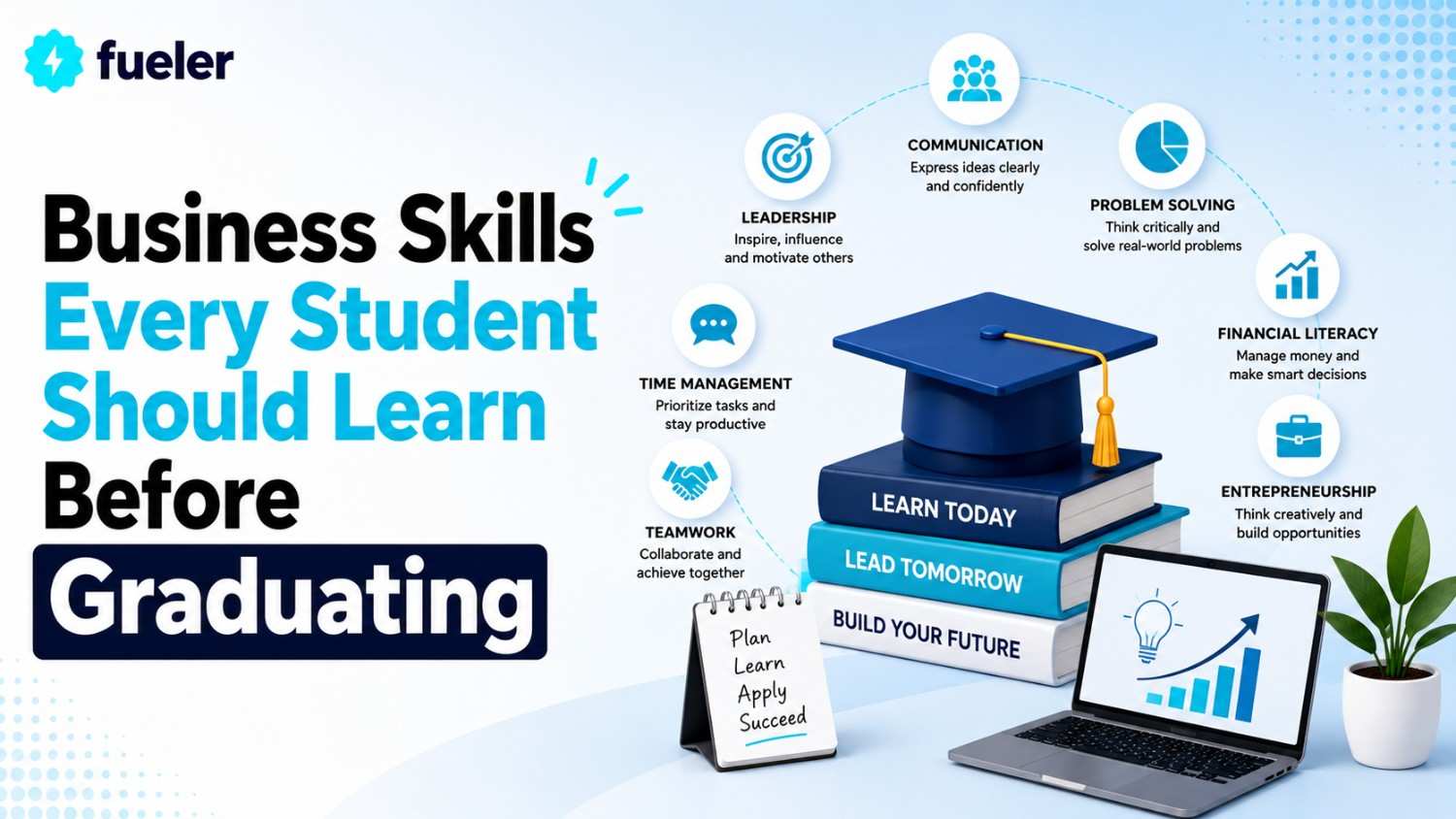
Business Skills Every Student Should Learn Before Graduating

Riten Debnath
23 Jul, 2026
Last updated: July 2026
Graduating from college used to feel like crossing a finish line. You turned in your final thesis, collected your degree, and submitted resumes to dozens of company job portals. Today, that playbook is completely broken. Thousands of ambitious graduates enter the workforce every semester with high GPAs, only to find that traditional academic credentials no longer guarantee career entry.
I’m Riten, founder of Fueler, a skills-first portfolio platform building the career infrastructure for 100 million creative professionals. Fueler connects talented individuals with companies through assignments, portfolios, and projects, not just resumes or CVs. Think of it as Dribbble/Behance for work samples combined with AngelList for hiring infrastructure.
In this article, you will learn the exact practical business skills that separate thriving early-career professionals from those struggling to land interviews.
We will cover 8 essential business capabilities every student needs before walking across the graduation stage, along with actionable steps to master them.

1. Applied AI Literacy and Intelligent Workflow Automation
Knowing how to type a prompt into a chatbot is no longer a distinct technical advantage. Modern organizations expect new hires to build operational workflows that combine artificial intelligence with daily business software.
Applied literacy means understanding how to use intelligent tools as operational co-pilots. Instead of spending days writing routine reports or manually categorizing data, smart students build automated pipelines that handle administrative tasks, freeing up energy for high-level strategy.
- Prompt engineering structures complex operational inputs: Drafting clear, context-rich prompts ensures AI tools output accurate research summaries and structured data instead of generic responses. Students who master contextual instructions save dozens of work hours each week.
- Workflow integration connects disparate software systems: Linking automated models with spreadsheets, project boards, and email platforms creates self-sustaining business processes. This eliminates repetitive data entry and ensures real-time operational syncing.
- Information verification guards against machine errors: AI systems can hallucinate false facts or outdated statistics. Learning how to cross-reference automated outputs against reliable primary sources protects business accuracy and prevents costly mistakes.
- Task delegation accelerates execution velocity: Knowing precisely which assignments to delegate to automated tools and which require deep human judgment allows professionals to ship projects faster without sacrificing quality.
- Ethical tool usage protects company data integrity: Understanding data privacy rules ensures sensitive company information isn't exposed to public model training sets. Following security guidelines protects corporate IP while driving digital transformation.
Why It Matters
In modern entry-level roles, companies hire for immediate execution capacity. Mastering AI-driven automation allows a fresh graduate to deliver the operational output of a senior team member from day one.
2. Practical Data Translation and Business Storytelling
Raw numbers, chaotic spreadsheets, and analytics dashboards are useless without a clear narrative. Employers are flooded with data; what they desperately lack are team members who can extract actionable strategic insights from that data.
Data translation bridges the gap between technical analytics and executive decision-making. Students who can transform raw numbers into clear narrative presentations become invaluable assets in any corporate department.
- Metric isolation identifies core performance drivers: Learning to filter out vanity metrics helps teams focus on key indicators like customer acquisition cost, retention rates, and net profit margins.
- Data visualization simplifies complex business trends: Transforming raw database rows into clean, readable charts allows managers to grasp strategic shifts instantly during high-stakes meetings.
- Contextual narrative construction turns numbers into action: Framing data points around real business challenges helps stakeholders understand why a metric moved, not just that it moved.
- Predictive interpretation guides future resource investments: Using historical baseline data to forecast quarterly trends enables teams to allocate budget and headcount proactively.
- Stakeholder-tailored reporting adapts to different audiences: Communicating technical metrics simply to non-technical executives ensures project proposals get budget approval without back-and-forth friction.
Why It Matters
Data fluency is a universal language across marketing, finance, product, and operations. The ability to translate numbers into compelling business stories turns technical execution into visible leadership potential.
3. Commercial Awareness and Financial Literacy
Many students graduate without knowing how companies actually make, keep, and spend money. Academic degrees often focus on theoretical frameworks, leaving graduates unprepared for the economic realities of corporate operations.
Commercial awareness means understanding business models, unit economics, and profit drivers. When you evaluate every project through the lens of revenue generation or cost reduction, your work aligns directly with executive priorities.
- P&L statement comprehension reveals financial health: Understanding how income, operating expenses, and gross margins interact allows early-career hires to propose cost-effective project budgets.
- Unit economics evaluation determines project viability: Analyzing whether the revenue generated by a single customer exceeds the cost to acquire them prevents businesses from scaling unprofitable ideas.
- Cash flow forecasting prevents operational bottlenecks: Tracking incoming payments against outgoing expenses ensures projects remain solvent and operational milestones are met on schedule.
- Value-proposition mapping aligns features with revenue: Connecting daily tasks directly to customer willingness-to-pay ensures engineering and marketing efforts build real bottom-line value.
- Competitor cost-structure analysis uncovers market gaps: Studying how rivals price their products and manage overhead highlights opportunities to capture market share through leaner operations.
Why It Matters
Every business decision eventually comes down to financial performance. Demonstrating strong commercial awareness shows managers that you understand business realities and can be trusted with budget ownership.
4. Asynchronous Communication and Professional Writing
The workplace has fundamentally shifted toward hybrid, remote, and distributed team structures. In this environment, your written communication is your workplace identity. Long, confusing emails and vague chat messages slow down execution and frustrate colleagues.
Mastering asynchronous writing means delivering complete context, clear expectations, and actionable next steps in as few words as possible. It ensures projects move forward across different time zones without requiring constant live meetings.
- BLUF (Bottom Line Up Front) formatting speeds up reading: Putting core requests or key takeaways in the very first sentence allows busy managers to make quick decisions without scrolling through fluff.
- Contextual documentation eliminates back-and-forth messaging: Writing complete project updates with clear background links reduces unnecessary clarification calls and keeps teams moving asynchronously.
- Tone calibration builds professional rapport online: Balancing directness with empathy in text channels prevents misunderstandings and builds strong remote working relationships.
- Action-oriented copywriting drives team accountability: Ending communications with explicit owners, clear deliverables, and firm deadlines ensures project tasks don't slip through the cracks.
- Synthesis of complex ideas creates concise briefings: Distilling two-hour strategy discussions into crisp, bulleted action items keeps cross-functional partners aligned on core objectives.
Why It Matters
Clear writing reflects clear thinking. Professionals who communicate concisely in asynchronous channels stand out immediately, driving faster project execution and earning leadership trust.
5. High-Stakes Project Management and Agile Execution
Ideas are cheap; execution is everything. Many students excel at taking exams with fixed syllabi but struggle when handed open-ended business objectives that lack step-by-step instructions.
Project management is the art of breaking chaotic goals into structured execution phases, managing constraints, and delivering finished work on time. Learning project frameworks prepares you to lead cross-functional initiatives confidently.
- Scope definition prevents project creep: Establishing strict boundaries around project deliverables keeps teams focused on core objectives and prevents deadline delays.
- Milestone tracking maintains momentum: Breaking major quarterly goals into weekly sprints ensures progress remains visible and potential blockers are caught early.
- Risk identification mitigates operational friction: Anticipating supply chain delays, technical bugs, or resource constraints allows teams to build backup contingency plans.
- Resource coordination optimizes team capacity: Assigning tasks based on individual strengths and bandwidth balances team workload and prevents employee burnout.
- Post-mortem analysis drives continuous improvement: Reviewing finished projects systematically highlights process flaws, enabling teams to refine their workflows for future execution cycles.
Why It Matters
Graduates who can take a vague instruction like "organize our user conference" and build a structured project plan instantly become indispensable execution leads.
6. Strategic Cold Outreach and Relationship Building
Relying solely on online job applications is one of the least effective ways to launch a career. The most lucrative professional opportunities, partnerships, and mentorships live in the hidden job market accessed through direct relationship building.
Networking isn't about collecting business cards or spamming people on social media. It is about identifying shared interests, offering immediate value, and cultivating authentic professional connections over time.
- Value-first outreach opens executive doors: Reaching out with a thoughtful piece of research, a bug fix, or a creative product suggestion gets attention far faster than asking for a job.
- Personalized research demonstrates genuine interest: Customizing messages around a prospect's recent podcast appearance or company milestone proves you value their time and work.
- Concise pitch structures respect busy schedules: Keeping initial outreach under 150 words with a low-friction call to action increases response rates dramatically.
- Systematic follow-up systems maintain connection cadence: Politely checking in after a week or two demonstrates professional persistence without feeling pushy.
- Relationship stewardship builds long-term career capital: Sending quick updates on how you implemented advice creates lasting professional relationships that pay off for decades.
Why It Matters
Your technical skills get you considered, but your professional network creates non-linear career opportunities. Learning how to build relationships opens doors that formal degrees cannot.
7. Problem Reframing and Critical Thinking Under Uncertainty
In university, problems usually come with clear instructions and pre-packaged data sets. In the real business world, problems are messy, ambiguous, and missing key information.
Critical thinking is the ability to break down ambiguous challenges, question underlying assumptions, and make sound decisions despite uncertainty. It prevents teams from spending thousands of dollars solving the wrong problem.
- First-principles analysis deconstructs complex challenges: Stripping a business problem down to its fundamental truths prevents reliance on outdated industry assumptions.
- Root-cause investigation uncovers hidden drivers: Using frameworks like the "5 Whys" identifies core systemic issues rather than repeatedly patching surface-level symptoms.
- Decision-tree modeling evaluates strategic trade-offs: Mapping out potential outcomes visually helps teams weigh risks against rewards before committing resources.
- Bias mitigation protects strategic decision quality: Recognizing cognitive traps like confirmation bias or sunk cost fallacy ensures choices are based on objective evidence.
- Hypothesis testing accelerates iteration speed: Running small, cheap experiments validates strategic assumptions before deploying full campaign budgets.
Why It Matters
Automated systems easily handle linear, repetitive tasks. Human professionals stand out by navigating ambiguity, questioning assumptions, and solving unstructured business problems.
8. Persuasive Presentation and Public Speaking
You can possess the most brilliant analytical insight in the world, but if you cannot pitch it convincingly to colleagues and stakeholders, it will die in a document.
Public speaking is not limited to keynote speeches on stage. It happens every time you present a project update, pitch an idea to your manager, or run a team meeting. Masterful presentation turns personal expertise into organizational buy-in.
- Audience analysis shapes message delivery: Tailoring pitch depth to the specific priorities of executives, clients, or engineers keeps stakeholders engaged.
- Narrative arc structures keep listeners attentive: Organizing business presentations with a clear problem, conflict, and solution framework maintains audience focus from start to finish.
- Visual slide minimalist design supports spoken words: Using clean, uncrowded slide layouts ensures audience attention remains focused on your verbal presentation.
- Objection handling turns skepticism into alignment: Anticipating critical questions and addressing potential risks calmly builds confidence across executive teams.
- Vocal presence and body language project authority: Controlling pace, tone, and eye contact ensures your ideas are received with confidence and respect.
Why It Matters
Persuasive speaking amplifies every other skill you possess. Graduates who present ideas clearly and handle tough questions calmly advance into leadership roles faster than their peers.
How Does This Connect to Building a Strong Career or Portfolio?
Mastering business skills is only half the battle; the real challenge is proving to employers that you can apply them in real-world scenarios. Text resumes claim skills, but proof of work proves capability. Documenting real projects, strategy breakdowns, and assignments shows hiring managers your actual problem-solving process. On Fueler, students showcase completed projects, market research teardowns, and workflow automation systems directly to prospective founders and hiring teams, helping them stand out and get hired based on tangible execution.
Final Thoughts
The gap between university academics and modern workforce expectations is wider than ever, but it presents a massive opportunity for proactive students. By intentionally building practical skills like AI automation, data translation, and clear asynchronous communication, you position yourself far ahead of typical graduates. Focus on building real projects, documenting your process, and letting your execution speak for itself as you launch your career.

Frequently Asked Questions (FAQs)
What business skills should students learn before graduating?
Students should master applied AI literacy, data translation, commercial awareness, asynchronous writing, project management, relationship building, problem reframing, and public speaking. These core capabilities turn theoretical knowledge into immediate workplace execution.
How can students build business skills without corporate work experience?
Build real projects independently. Automate a local business workflow, publish market research teardowns, manage student organization budgets, or pitch strategic growth plans to early-stage founders. Documenting these efforts creates verifiable proof of work.
Why is data translation important for non-technical graduates?
Data drives every modern business decision. Non-technical graduates who can pull actionable story insights from raw dashboards bridge the gap between analytics teams and executive managers, making them highly valuable cross-functional leaders.
How does AI literacy impact entry-level job prospects?
AI literacy transforms new hires into high-output execution leads. Graduates who build automated research pipelines and workflow automations complete routine administrative tasks faster, allowing them to take on high-impact strategic responsibilities immediately.
How do I show proof of business execution to hiring managers?
Replace plain text resumes with an interactive portfolio showcasing actual projects. Share real campaign results, automation scripts, financial models, and strategic tear-downs on platforms like Fueler to give employers clear visibility into your capabilities.
Why 100,000+ professionals use Fueler
Fueler helps professionals showcase proof of work through projects, assignments, case studies, and achievements.
- Thousands of professionals use Fueler to create their digital portfolio
- Thousands of projects are published on Fueler. Check here
- Startups and Companies hire through proof of work on Fueler
- Used by freelancers, creators, marketers, video editors, writers, designers, and product managers
Our mission is to help the next 100 million professionals build a verified professional identity through proof of work
What should you do next?
You've read the article. Now turn your skills into proof of work and unlock more opportunities.
Build your proof of work portfolio
Create a clean portfolio with projects, assignments, resumes, and AI stack details that companies actually want to see.
Create your Fueler portfolio →Apply through assignments, not resumes
Stand out by solving real tasks from companies hiring on Fueler.
Explore assignments →Get discovered by companies
Make your work public and let recruiters discover your skills through actual projects instead of keywords.
Get discovered →
