Best Ways to Get Hired Without a Resume in 2026

Riten Debnath
30 Dec, 2025
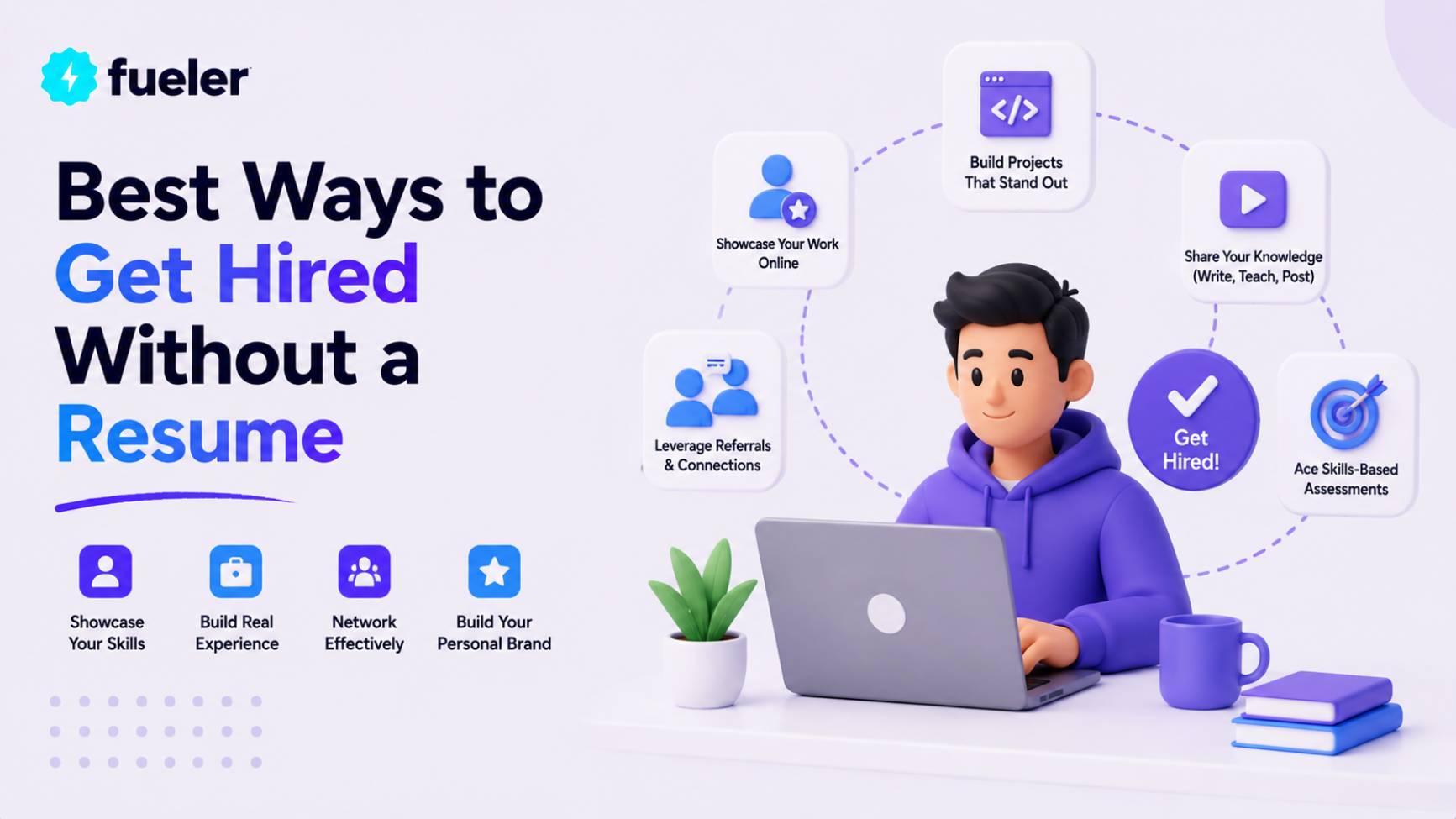
The era of the "one-page PDF" is officially over. In 2026, hiring managers are no longer spending their time scanning bullet points on a resume to see where you went to school or what your job title was three years ago. Instead, they are looking for proof of competence. Companies are shifting toward "Proof of Work" models because they want to see what you can actually build, write, or design before they ever hop on an interview call. If you want to land a high-paying job today, you need to stop telling people what you can do and start showing them through real-world evidence and tangible results.
I’m Riten, founder of Fueler - a skills-first portfolio platform that connects talented individuals with companies through assignments, portfolios, and projects, not just resumes/CVs. Think Dribbble/Behance for work samples + AngelList for hiring infrastructure.
Build a Public Proof of Work Portfolio
In 2026, your portfolio is your reputation. A proof of work portfolio is a curated collection of projects that demonstrate your ability to solve specific problems in a real-world environment. Unlike a resume, which is simply a list of claims, a portfolio serves as a living library of evidence. Whether you are a developer, a marketer, or a product manager, documenting your process is the secret to standing out. You should include the initial problem, the specific steps you took to solve it, the tools you used, and the final outcome. This transparency builds immediate trust with recruiters who are tired of exaggerated resumes and want to see actual results.
- Comprehensive Case Study Breakdowns: Go beyond just showing a final image or link by explaining the deep logic, research, and strategy that guided your project from the initial brainstorming phase to the final execution.
- Interactive and Live Project Access: Provide direct and clickable links to functional websites, published industry articles, or active code repositories so that recruiters can personally verify the quality and performance of your output.
- Detailed Process Documentation: Include "behind-the-scenes" content such as early wireframes, rough drafts, or logic flowcharts to prove that the work is authentically yours and to show how you handle revisions and pivots.
- Video Walkthroughs and Narratives: Record short screen-share presentations where you talk through your decision-making process, explaining why you chose specific tools or methods to solve the unique challenges of the project.
- Collaborative Context and Roles: Clearly define your specific contributions within team-oriented projects to demonstrate your ability to communicate with others, manage shared deadlines, and thrive within a modern corporate hierarchy.
Why it matters: This approach is essential because it eliminates the guesswork for the employer during the early stages of hiring. When a hiring manager can see your actual output, the risk of hiring the "wrong" person drops significantly. It allows you to compete based on your actual talent rather than how well you can format a document or where you graduated from.
Leverage Assignment-Based Hiring Platforms
Many modern companies have replaced the initial phone screening with a "Paid Task" or a "Trial Assignment" to save time and find better talent. Platforms that focus on assignment-based hiring allow you to apply for a role by completing a specific challenge related to the daily tasks of the job. This is the most meritocratic way to get hired because it focuses entirely on the quality of the delivery. It removes biases related to age, location, or background and places the emphasis on your ability to meet a deadline and follow instructions. It is a win-win for both the candidate and the company.
- Simulated Real-World Job Challenges: Engage in tasks that are designed by the actual hiring team to mimic the exact problems you would be expected to solve on your first week of the job, ensuring a perfect skill match.
- Compensated Work Trial Opportunities: Utilize platforms that advocate for your time by requiring companies to pay you for the trial assignments you complete, turning the job hunt into a source of freelance income.
- Actionable Professional Feedback Loops: Gain access to expert critiques and technical evaluations of your work even if the company does not hire you, allowing you to improve your skills for the next big opportunity.
- Merit-Based Skill Leaderboards: Showcase your ability to outperform other applicants in high-stakes challenges, which helps you gain organic visibility from top-tier companies looking for the highest performers in a specific niche.
- Verification of Technical Competence: Earn digital badges or verified status marks that prove you have successfully completed complex assignments, which acts as a far more powerful endorsement than a simple list of skills.
Why it matters: Assignment-based hiring is the ultimate shortcut for someone with high skills but a "weak" traditional resume. It gives you a platform to prove you are more capable than someone with years of experience who might not be able to execute modern tasks. By focusing on the work, you bypass the gatekeepers who only look for specific keywords in a CV.
Master the Art of Building in Public
Social media has transformed from a place for networking into a powerful engine for inbound job opportunities. Building in public involves sharing your learning journey, your small wins, and even your failures on platforms like X, LinkedIn, or specialized niche communities. By consistently posting about the projects you are working on, you create a digital trail that recruiters can follow. This method turns your career growth into a story that people want to be part of. Instead of chasing companies, you attract them by showing that you are an active, curious, and productive professional.
- Consistent Learning Log Updates: Regularly share what you are learning and how you are overcoming specific technical hurdles, which demonstrates a high level of curiosity and a commitment to continuous self-improvement.
- Project Milestone Announcements: Celebrate the completion of different phases of your work to show that you are capable of starting a project and seeing it through to the end, which is a trait highly valued by managers.
- Strategic Knowledge Sharing: Write short threads or posts explaining a new tool or technique you discovered, positioning yourself as a helpful expert and a thought leader within your specific professional community.
- Engaging with Industry Peers: Actively comment on and contribute to the projects of others in your field, which helps you build a network of advocates who can recommend you for "hidden" roles that are never posted.
- Visual Progress Reports: Use images, gifs, or short clips of your work-in-progress to provide visual proof of your activity, making your profile stand out in a crowded feed of text-only status updates.
Why it matters: Building in public creates a "magnet effect" for your career. When you share your work consistently, you are no longer just another name in a database, you are a person with a visible track record. This builds immense social proof and often leads to job offers that never require an official application.
Focus on High-Intent Networking in Niche Communities
Traditional job boards are becoming overcrowded and noisy, leading many professionals to seek opportunities in niche communities. Platforms like Discord, Slack groups, and private industry forums are where the real conversations happen. In these spaces, you can interact directly with decision-makers and founders without the barrier of a formal application. By providing value first through helpful comments or sharing resources, you build a "soft reputation" that makes people want to hire you. It is about being a helpful participant in a community rather than just a job seeker looking for a paycheck.
- Direct Access to Decision Makers: Engage in real-time conversations with CTOs, Head of Products, and Founders who often post "help wanted" messages in these communities before going to a job board.
- Early Access to Hidden Job Markets: Discover roles that are in the early stages of being defined, giving you the chance to shape the job description based on your unique skill set.
- Resource Sharing and Contributions: Share valuable tools, templates, or insights that solve problems for others, establishing yourself as a high-value member whose skills are evident through your contributions.
- Industry-Specific Knowledge Exchange: Stay updated on the latest trends and specific toolstacks used by top companies, allowing you to tailor your proof of work to match their current needs.
- Vouched-For Referrals: Build genuine relationships that lead to internal referrals, which are far more likely to get you an interview than a cold application through a standard career portal.
Why it matters: Networking in niche communities bypasses the "Resume Black Hole" entirely. It allows you to build trust through repeated interactions over time. When a role opens up, the hiring manager will remember you as the person who contributed value, making the resume irrelevant to the hiring decision.
Create "Proof of Work" Experiments for Target Companies
One of the most effective ways to get hired by a specific company is to solve one of their problems before they even ask you to. This involves identifying a small friction point in their product, marketing, or operations and creating a solution as a "gift." For example, if you are a designer, you could redesign a clunky landing page. If you are a developer, you could build a small tool that integrates with their API. This proactive approach shows that you are already thinking about their business and that you have the technical skills to execute a solution.
- Targeted Problem Identification: Spend time researching a company to find a specific, manageable problem that you can solve with your current skills to prove your immediate utility.
- High-Quality Solution Delivery: Build a small but polished version of a solution, such as a feature prototype or a sample marketing campaign, and send it directly to the relevant department head.
- Clear Value Propositions: Accompany your work with a brief explanation of how your solution improves their user experience, saves them money, or increases their conversion rates.
- Demonstration of Initiative: Show that you do not need constant supervision or detailed instructions to find ways to be useful to the company, which is a rare and highly prized trait.
- Custom-Tailored Skill Showcases: Instead of a generic portfolio, this work is specifically built for them, making it impossible for them to ignore your application compared to hundreds of generic ones.
Why it matters: This strategy turns the hiring process on its head. Instead of asking for a job, you are providing value upfront. It serves as a live demonstration of your skills in their specific context, which is the most powerful "resume" you could ever provide. It proves you understand their brand and their challenges.
Master Technical Communication Through Content Creation
In a remote-first world, your ability to communicate your ideas is just as important as your technical skill. By creating content such as technical blogs, video tutorials, or industry newsletters you prove that you can explain complex concepts clearly. This is a massive signal to hiring managers that you will be a great teammate who can document their work and help others grow. Content creation is a long-term play that builds your personal brand and establishes you as an authority in your field, making companies come to you.
- Educational Technical Blogging: Write long-form articles that explain how you solved a specific technical challenge, showing your ability to document and teach complex workflows.
- Video Tutorials and Demos: Create short, high-quality videos showing your screen as you build something, which proves your technical proficiency and your verbal communication skills simultaneously.
- Curated Industry Newsletters: Build a following by curating the best news and tools in your niche, showing that you are deeply plugged into the industry and have a great eye for quality.
- Open Source Documentation: Contribute to the documentation of popular open-source projects, which shows you can write for a wide audience and understand how to follow professional standards.
- Thought Leadership on Platforms: Share your unique opinions on the future of your industry, proving that you are a strategic thinker who looks beyond just the daily tasks of the job.
Why it matters: Content creation acts as an "always-on" interview. It demonstrates your communication skills, your depth of knowledge, and your passion for your craft. For many roles, being a great communicator is the tie-breaker, and having a library of content proves you have that skill in abundance.
Become an Expert in Specialized AI Workflows
By 2026, knowing how to use AI is no longer a "bonus" skill, it is a requirement. However, simply knowing how to use a chatbot is not enough. To get hired without a resume, you need to show that you have mastered specialized AI-assisted workflows that make you significantly more productive than a traditional worker. Whether it is using AI for rapid prototyping, automated data analysis, or advanced content generation, showing that you can leverage these tools to deliver higher quality work in less time is a major selling point.
- AI-Assisted Development Workflows: Show how you use AI to write tests, refactor code, and speed up the development cycle while maintaining high standards of quality and security.
- Advanced Prompt Engineering Skills: Demonstrate your ability to craft complex prompts that yield consistent, high-value business results, turning AI into a reliable teammate rather than a toy.
- Automation and Tool Integration: Build custom workflows that connect different AI tools to automate repetitive tasks, proving you can save a company significant time and money.
- AI-Powered Data Insights: Use AI to analyze large datasets and extract actionable business insights that would be difficult or time-consuming for a human to find manually.
- Creative AI Implementation: For designers and writers, show how you use AI to brainstorm and iterate on ideas faster without losing the "human touch" that makes work effective.
Why it matters: Companies are looking for "Force Multipliers" people who can do the work of three people by using the right tools. By proving you are an expert in AI workflows, you position yourself as a future-proof hire. This technical edge is a far better indicator of success than any degree or previous job title.
How Fueler Helps You Showcase Your Best Work
While the strategies above are powerful, you need a central place to organize all this evidence. This is where Fueler comes in. Instead of sending a boring resume, you can send a Fueler profile that acts as a comprehensive "Proof of Work" engine. It allows you to document your assignments, categorize your projects, and show off the specific skills you used for each one. Fueler is designed specifically for the professional who wants to be judged by their craft rather than their credentials, making it the perfect partner for the resume-free job market of 2026.
Final Thoughts
Transitioning to a resume-free hiring process might feel intimidating at first, but it is the most rewarding way to build a career. By focusing on portfolios, assignments, and building in public, you take control of your professional narrative. You are no longer waiting for permission to be seen, you are creating your own opportunities through the sheer quality of your work. As the world moves toward 2026, those who can prove their value will always be in higher demand than those who can only describe it on a piece of paper.
Frequently Asked Questions
How to get hired without a resume in 2026?
To get hired without a resume, you must focus on building a strong digital portfolio, completing trial assignments on skills-based platforms, and documenting your work publicly on social media to attract recruiters through your proof of work.
What are the best portfolio platforms for proof of work?
The best platforms are those that allow you to show deep case studies and actual work samples, such as Fueler for general professionals, GitHub for developers, or Dribbble for designers.
Do companies really hire based on assignments?
Yes, an increasing number of modern tech and creative companies use paid or unpaid assignments to test a candidate's actual ability before looking at their employment history or educational background to ensure a high-quality hire.
How can I prove my skills if I have no work experience?
You can prove your skills by creating "ghost projects" or "spec work," which involves finding an existing problem for a company and solving it publicly to show how you would handle the role if you were already on their team.
Is building in public better than traditional networking?
Building in public is a form of "active networking" where your work does the talking for you, often resulting in higher-quality job offers because the employer already has visual and technical proof of what you are capable of achieving.
What is Fueler Portfolio?
Fueler is a career portfolio platform that helps companies find the best talent for their organization based on their proof of work.
You can create your portfolio on Fueler, thousands of freelancers around the world use Fueler to create their professional-looking portfolios and become financially independent. Discover inspiration for your portfolio
Sign up for free on Fueler or get in touch to learn more.
What should you do next?
You've read the article. Now turn your skills into proof of work and unlock more opportunities.
Build your proof of work portfolio
Create a clean portfolio with projects, assignments, resumes, and AI stack details that companies actually want to see.
Create your Fueler portfolio →Apply through assignments, not resumes
Stand out by solving real tasks from companies hiring on Fueler.
Explore assignments →Get discovered by companies
Make your work public and let recruiters discover your skills through actual projects instead of keywords.
Get discovered →
