Best Technology Trends Shaping the US Market in 2026

Riten Debnath
15 Jan, 2026
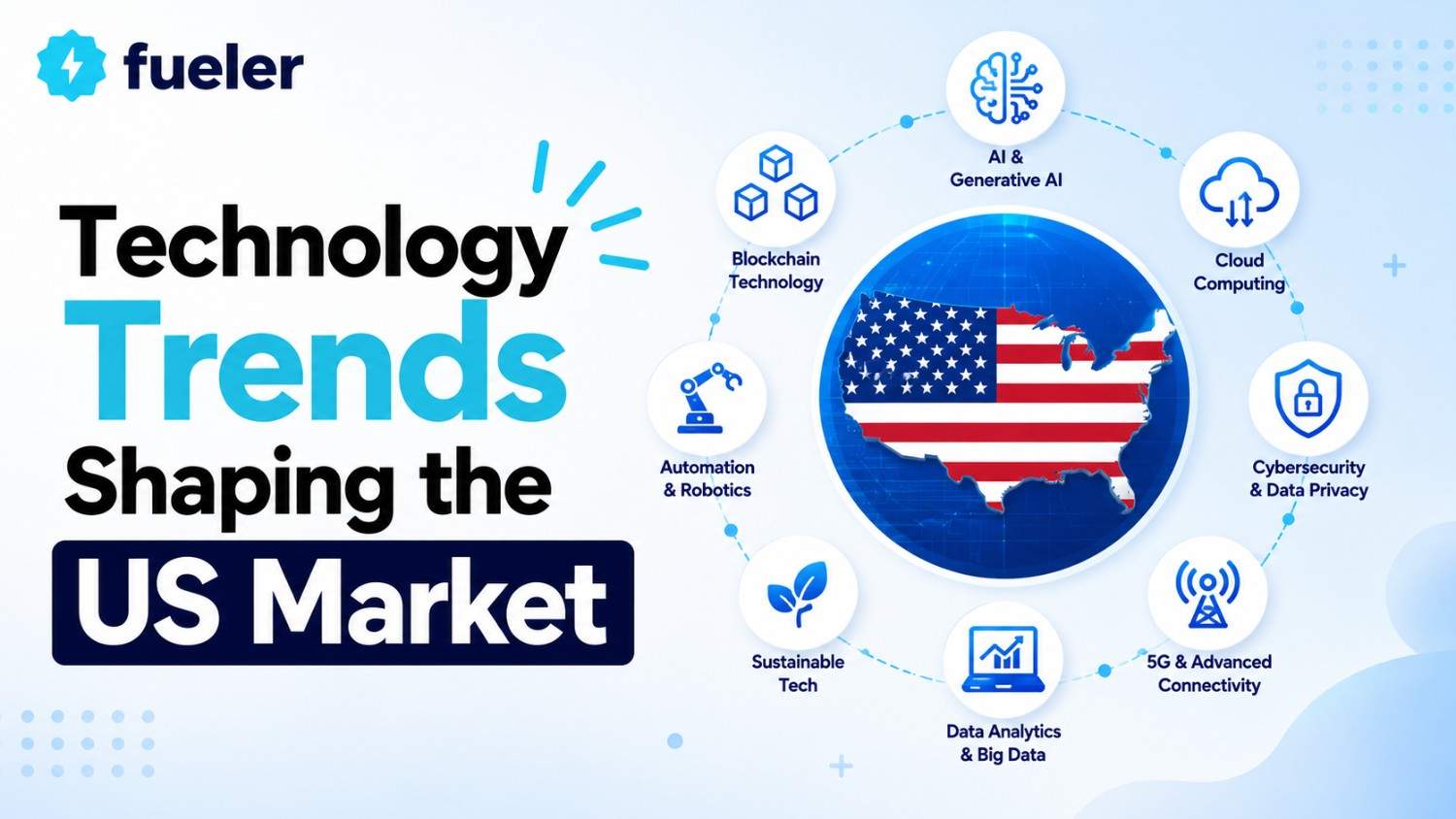
The speed of technological evolution in the United States has reached a fever pitch as we move through 2026. What was considered "experimental" just a year ago is now the baseline for any company hoping to survive in a hyper-competitive economy. From the rise of autonomous agents that manage entire departments to the urgent shift toward water-positive data centers, the trends of 2026 are not just about "new gadgets," they are about a fundamental restructuring of how Americans work, consume, and interact with the physical world.
I’m Riten, the founder of Fueler - a skills-first portfolio platform that connects talented individuals with companies through assignments, portfolios, and projects, not just resumes/CVs. Think Dribbble/Behance for work samples + AngelList for hiring infrastructure.
1. The Era of Agentic AI and Autonomous Workflows
In 2026, the US market has moved past simple chatbots to "Agentic AI," which are systems capable of planning, executing, and correcting their own tasks without constant human prompting. These agents do not just answer questions; they interact with your software stack to book meetings, negotiate with vendors, and even manage supply chain logistics. For US businesses, this means a shift from AI as a "search tool" to AI as a "digital colleague" that can handle end-to-end business processes, significantly reducing the overhead costs of routine operations.
- Self-Correcting Task Execution: Unlike earlier models, 2026 agents can identify when they have made a mistake in a workflow, backtrack to the previous step, and try a different approach until the goal is achieved without human intervention.
- Multi-Tool Orchestration: These agents can log into your CRM, pull data into a spreadsheet, analyze it using Python, and then draft a personalized outreach campaign in your email marketing tool, all within a single unified command sequence.
- Goal-Oriented Reasoning: Instead of following rigid "if-then" scripts, agentic systems are given high-level objectives, such as "reduce customer churn by 10%," and they independently determine the best series of actions to take to reach that specific outcome.
- Proactive Decision Making: Agents in 2026 are increasingly used to monitor live data streams and make split-second decisions, such as pausing an ad campaign if the conversion rate drops or ordering more inventory before a predicted spike in demand.
- Reduced Latency with Edge Agents: Localized AI agents now run directly on professional devices like laptops and tablets, allowing for faster processing and better data privacy by keeping sensitive company information on the device rather than the cloud.
Why it matters:
Agentic AI allows US teams to scale their output exponentially without increasing their headcount. It shifts the human role from "doing the work" to "orchestrating the agents," which is the most critical competitive advantage for professionals and businesses in 2026.
2. Sustainable Computing and Water-Positive Data Centers
As the demand for AI computation has skyrocketed, the environmental impact of massive data centers has become a top-tier political and economic issue in the United States. In 2026, "Green Tech" is no longer a corporate social responsibility checkbox but a core operational requirement driven by water scarcity and rising energy costs. US tech giants are now racing to implement "water-positive" strategies, where data centers return more water to local communities than they consume for cooling, leading to a surge in specialized cooling technologies.
- Closed-Loop Liquid Cooling: Advanced data centers have shifted away from evaporative water cooling to closed-loop systems that use specialized synthetic fluids to move heat away from high-powered AI chips with virtually zero water loss.
- Heat Re-utilization Programs: In cooler US climates, the massive heat generated by server farms is being redirected into municipal heating systems for nearby homes or used to power industrial greenhouses, turning a waste product into a revenue stream.
- Renewable Energy Microgrids: To avoid straining the national grid, data centers are increasingly building their own dedicated solar and wind farms, often paired with massive battery storage to ensure 24/7 carbon-neutral operation regardless of weather conditions.
- AI-Optimized Energy Management: Sophisticated algorithms now predict server loads in real-time and shift processing power to different geographic locations where renewable energy is currently cheapest and most abundant, such as the windy plains or sunny deserts.
- Biodiversity-Focused Site Design: New US data center regulations now incentivize companies to design their physical campuses as "eco-hubs" that include native landscaping and water filtration systems that actively improve the local groundwater quality and surrounding ecosystem.
Why it matters:
Sustainability is now a financial imperative. Companies that fail to adopt these green technologies face higher utility costs, stricter government penalties, and pushback from environmentally conscious US consumers, making eco-efficiency a key marker of long-term business viability.
3. The Rise of Domain-Specific Language Models (DSLMs)
The "one-size-fits-all" approach of general AI models is being replaced in the US by Domain-Specific Language Models that are trained on highly specialized industry data. Whether it is a model specifically for US contract law, medical diagnostic imaging, or architectural structural analysis, these DSLMs provide higher accuracy and lower "hallucination" rates than general models. This trend is allowing mid-sized American firms to compete with giants by using specialized AI that understands the nuances of their specific niche.
- Precision-Tuned Accuracy: DSLMs are trained on proprietary industry datasets, ensuring that the terminology, compliance standards, and historical contexts they provide are 100% accurate for that specific professional field or industry sector.
- Reduced Hallucinations in High-Stakes Roles: Because these models operate within a narrower "knowledge boundary," they are far less likely to generate false information, which is critical for US industries like healthcare, legal services, and structural engineering.
- On-Premise Deployment Options: Many US firms are now deploying these smaller, specialized models on their own private servers to ensure that their trade secrets and sensitive client data never leave the company's secure internal network.
- Industry-Specific Compliance Built-In: These models are often pre-programmed with relevant US regulations, such as HIPAA for medical tools or SEC guidelines for finance, automatically flagging potential violations during the content generation process.
- Cost-Effective Inference: Smaller, specialized models require significantly less computing power than giant general-purpose models, making it much more affordable for small American businesses to run their own custom AI assistants 24/7.
Why it matters:
Generic AI is becoming a commodity, but specialized knowledge is where the value lies. For US professionals, the ability to work with and fine-tune these niche models is becoming a prerequisite for high-paying roles in specialized sectors.
4. Hyper-Personalization through Predictive Customer Experiences
Marketing in the US has shifted from "reacting to behavior" to "predicting intent" using real-time data streams. In 2026, customers expect brands to know what they need before they even search for it, leading to the rise of predictive customer experience (CX) platforms. These tools analyze thousands of data points from weather patterns to social media sentiment to deliver a unique version of a website or a custom product offer to every single visitor in real-time.
- Generative Content at Scale: AI now creates unique images, videos, and copy for every single user based on their past interactions, ensuring that no two customers see the exact same advertisement or landing page during their journey.
- Predictive Inventory Routing: Using complex behavioral models, US retailers are now shipping products to regional hubs before a customer even places an order, enabling true "same-hour" delivery in major metropolitan areas like New York or LA.
- Sentiment-Driven Support: Customer service platforms can now detect a user's frustration level through their typing speed or tone of voice, automatically escalating high-priority cases to human supervisors before the customer even asks to speak to one.
- Dynamic Pricing Models: Prices for services like travel or insurance now fluctuate in milliseconds based on real-time supply, demand, and individual risk profiles, allowing US businesses to maximize their profit margins while staying competitive.
- Virtual Try-On and Spatial Commerce: AR and VR technologies have become so realistic that US consumers can "place" a piece of furniture in their room or "try on" a suit with perfect fit accuracy, drastically reducing return rates for e-commerce.
Why it matters:
In a crowded US market, the brand that provides the most frictionless and personal experience wins. Predictive CX allows companies to build deeper loyalty by making the customer feel understood on an individual level, which is a major driver of lifetime value.
5. Decentralized Work Hubs and the "Office Renaissance."
The debate over remote vs. office work has settled into a unique middle ground in 2026: the rise of decentralized work hubs. Instead of a single massive headquarters, US companies are investing in smaller, high-tech satellite offices located in suburban areas where their employees actually live. These hubs provide the social and collaborative benefits of an office without the soul-crushing commute, creating a "renaissance" of professional spaces designed specifically for deep work and high-level team collaboration.
- Geographic Flexibility without Isolation: Employees can choose the hub closest to their home, allowing them to collaborate in person with colleagues from different departments while avoiding the multi-hour commute into a major city center like Chicago or San Francisco.
- Smart Space Optimization: Hubs use IoT sensors to track which rooms are most popular and automatically adjust lighting, temperature, and even the "white noise" levels to create the most productive environment for the people present that day.
- Integrated VR Meeting Pods: For those who cannot make it to a physical hub, specialized pods allow in-office workers to interact with remote colleagues in a "shared" virtual space that feels much more natural than a standard video call.
- Community-Centric Networking: These smaller offices often share space with other non-competing businesses, fostering a diverse community of professionals that encourages the cross-pollination of ideas and local networking opportunities within a town.
- Focus-First Architecture: Modern hubs prioritize "Quiet Zones" and soundproof booths over open-office floor plans, recognizing that the primary value of the office in 2026 is providing a space for distraction-free work that is hard to find at home.
Why it matters:
The "Great Return to Office" failed because it didn't offer a better experience than home. By decentralizing, US companies are attracting top talent who demand both professional social interaction and the personal freedom to live outside of expensive urban centers.
6. Cyber Resilience and Autonomous Defense Systems
With AI being used by hackers to create more sophisticated attacks, the US cybersecurity landscape has shifted from "protection" to "cyber resilience." In 2026, companies assume they will be breached and focus on autonomous defense systems that can detect, isolate, and repair a compromised system in milliseconds without human help. This "Self-Healing Infrastructure" is the only way to protect the massive, interconnected data networks that power the modern American economy.
- Real-Time Threat Hunting: AI security agents constantly scan the network for "deviant behavior," such as a user accessing a file they usually don't, and can instantly lock down that account before a single byte of data is stolen or corrupted.
- Automated Patch Deployment: Systems now identify their own vulnerabilities and write their own security patches to fix them, ensuring that a "Zero-Day" exploit is closed before a hacker can even find it across the company's digital footprint.
- Deception Technology (Honey-farms): Defensive systems automatically spin up "fake" data servers to lure hackers away from the real assets, allowing security teams to observe the attacker's methods in a safe environment while they prepare a counter-response.
- Biometric Identity Fabrics: US firms are moving away from passwords entirely, using "Continuous Authentication" that monitors a user's typing rhythm, voice patterns, and facial features throughout their entire session to ensure the user is who they say they are.
- Immutable Backups and Rapid Recovery: Data is now automatically backed up in "Write-Once-Read-Many" (WORM) formats that cannot be deleted or encrypted by ransomware, allowing a company to reset its entire system to its pre-attack state in minutes.
Why it matters:
A single major cyberattack can bankrupt a company in 2026. Cyber resilience ensures that even if a breach occurs, the business remains operational and the data remains safe, which is the ultimate form of brand protection in the digital age.
7. Intelligent Physical Automation and Humanoid Robotics
Physical AI has moved from the warehouse floor into the broader US service economy. In 2026, we are seeing the first widespread deployment of "General Purpose Robots" that can perform various tasks from stocking grocery shelves to assisting in hospital wards. These robots are powered by the same advanced AI as chatbots, allowing them to understand natural language instructions and adapt to messy, unpredictable human environments in real-time.
- Context-Aware Navigation: Modern robots can navigate through crowded US shopping malls or busy hospital hallways by predicting the movements of people and obstacles, ensuring they never bump into a person or get stuck in a corner.
- Natural Language Command Processing: You can tell a robot to "go find the blue box in the breakroom and bring it to the front desk," and it can visualize the task, find the object, and execute the delivery without any pre-programming of the route.
- Collaborative "Cobot" Workflows: Robots are designed to work safely side-by-side with humans, automatically slowing down or stopping if a person gets too close, and even learning new tasks by simply watching a human demonstrate the movement once.
- Haptic Precision for Delicate Tasks: Advanced "hands" on these robots can now handle fragile items like eggs or medical supplies with the same dexterity as a human, opening up roles in food service and laboratory management that were previously impossible.
- Modular Task Kits: Companies can now "download" new skills for their robots, such as switching from a security patrol mode to a floor cleaning mode, by simply updating the software and attaching a new specialized tool to the robot's arm.
Why it matters:
Labor shortages in the US service sector are driving this trend. Physical automation allows businesses to maintain high levels of service and production even when they cannot find enough human workers, while freeing up humans for roles that require empathy and complex problem-solving.
8. Quantum-Ready Cryptography and Early Advantage
While full-scale quantum computers are still in development, the "Quantum Threat" is already shaping US tech policy in 2026. Forward-thinking companies are now implementing "Quantum-Ready" cryptography to protect their data from future "Harvest Now, Decrypt Later" attacks. Additionally, some US firms are already using early quantum processors via the cloud to solve incredibly complex optimization problems in logistics and drug discovery that would take classical computers decades to finish.
- Post-Quantum Cryptography (PQC) Migration: US government agencies and top-tier banks are actively moving their most sensitive data into new encryption formats that are mathematically proven to be resistant to the processing power of future quantum computers.
- Quantum-Inspired Optimization: Using classical hardware that mimics quantum logic, US logistics firms are optimizing delivery routes across thousands of trucks in real-time, saving millions of dollars in fuel and time that standard algorithms couldn't find.
- Accelerated Molecular Modeling: Pharmaceutical companies in the US are using early quantum simulations to model how new drugs interact with human proteins at an atomic level, cutting the time for early-stage drug discovery from years down to just months.
- Cloud-Based Quantum Access: Small startups can now "rent" time on a quantum processor through providers like IBM or Amazon, allowing them to experiment with quantum algorithms without needing to own or maintain the multi-million dollar hardware themselves.
- Hybrid Quantum-Classical Workflows: Most 2026 applications use a "Hybrid" model, where a classical computer handles 99% of the app's logic but offloads the most difficult math problems to a quantum processor for a massive speed boost.
Why it matters:
Quantum computing will be the ultimate "disrupter." Companies that prepare now by securing their data and experimenting with quantum algorithms will have a massive head start when the technology hits its full maturity in the coming years.
9. The Digital Provenance and Trust Economy
In a world filled with AI-generated "deepfakes" and synthetic content, "Digital Provenance" has become a major trend in the US. By 2026, consumers and businesses are demanding proof that the images they see, the news they read, and the data they use are genuine. This has led to the widespread adoption of "Content Credentials, "a digital nutrition label for media that shows exactly who created a file and whether it was modified by AI.
- Cryptographic Content Labeling: Major US media outlets and social platforms now use "Manifests" that are embedded into image and video files, tracking every edit and ensuring the viewer can verify the original source with a single click.
- AI-Generated Watermarking Standards: New US laws require that any content significantly altered or created by AI must include an invisible digital watermark that remains detectable even if the file is cropped, compressed, or re-recorded.
- Blockchain-Based Identity Verification: To fight "bot accounts," US professional networks are using decentralized identity systems that allow individuals to prove they are a real person without revealing their sensitive personal information to the platform.
- Real-Time Deepfake Detection Tools: Businesses now use specialized software during video calls to verify that the person on the other end is a live human and not a high-quality AI avatar being used for social engineering or corporate espionage.
- Verified Data Sourcing for AI: Companies are increasingly prioritizing "Human-Generated Only" datasets to train their AI, as data produced by other AIs has been shown to cause "model collapse" and a decline in the quality of the outputs over time.
Why it matters:
Trust is the currency of the future. In 2026, the US businesses that can prove their authenticity and protect their customers from misinformation will win the "trust war" and build a much more resilient brand in a skeptical marketplace.
10. Bio-Digital Convergence and Health-Tech Integration
The final major trend of 2026 is the blurring line between our digital tools and our biological health. Wearable technology in the US has moved beyond counting steps to "Biometric Intelligence," where your watch or ring can predict if you are getting sick days before you feel symptoms. This data is being integrated directly into our work lives, with "Well-being Platforms" that suggest breaks or focus periods based on your real-time stress levels and heart rate variability.
- Predictive Health Monitoring: Continuous glucose monitors and advanced sensors now provide real-time feedback on how your diet and sleep affect your professional focus, allowing US workers to "tune" their bodies for peak mental performance.
- Stress-Responsive Digital Workspaces: Productivity tools can now sync with your wearable device to automatically turn on "Do Not Disturb" mode or suggest a five-minute breathing exercise if they detect your cortisol levels are spiking.
- Bio-Acoustic Analysis for Mental Health: New AI tools can analyze the subtle changes in a person's voice during a meeting to detect signs of burnout or depression, allowing managers to offer support before it leads to a total breakdown.
- Smart Nutraceuticals and Personalized Diets: Apps now use your genetic data and blood markers to recommend specific supplements or meals that are custom-designed to improve your cognitive function and long-term brain health based on your daily workload.
- Virtual Reality Exposure Therapy: US companies are increasingly offering VR-based mental health benefits, where employees can use immersive environments to practice public speaking or manage work-related anxiety in a safe, controlled setting.
Why it matters:
A healthy workforce is a productive workforce. By integrating health data into the professional environment, US companies are reducing absenteeism and burnout while helping their employees achieve a level of sustained performance that was previously impossible.
Stand Out in the Skills-First Economy with Fueler
As these trends reshape the US market, the way you present your value to employers must also evolve. This is exactly why I built Fueler. In an age where AI can write a perfect resume, companies no longer trust a piece of paper. They want to see what you have actually built whether it is a custom AI agent, a sustainable project plan, or a predictive marketing campaign. Fueler provides the platform for you to host your work samples and projects, making it easy for US-based recruiters to see the proof of your skills in action.
Final Thoughts
The technology trends of 2026 are not just a list of new features; they represent a fundamental shift toward a more intelligent, sustainable, and human-centric economy. For US professionals, the key to success is not in resisting these changes, but in becoming the person who knows how to orchestrate them. Whether you are using Agentic AI to run your workflows or focusing on the Trust Economy to protect your brand, the future belongs to those who can prove their expertise through high-quality work and evidence-based skills.
Frequently Asked Questions
Will Agentic AI replace my job in the US by the end of 2026?
Agentic AI is more likely to replace "tasks" than entire "jobs." While routine administrative work is being automated, the demand for professionals who can manage these agents, set strategic goals, and handle complex human relationships is actually increasing across the United States.
How can I prove my skills if I don't have a traditional tech degree?
In 2026, the US market is shifting toward "skills-first" hiring. Platforms like Fueler allow you to showcase actual work samples, assignments, and projects that prove your competency in specific tools or trends, which many recruiters now value more than a traditional college degree.
Is my data safe with the rise of AI-driven cyber threats?
While threats are increasing, the rise of "Cyber Resilience" and autonomous defense systems means that most modern US platforms are more secure than ever. However, individuals should prioritize using tools that offer "Post-Quantum Cryptography" and biometric authentication for the highest level of personal data protection.
What is the most important skill to learn for the 2026 US job market?
The most valuable skill is "AI Orchestration", the ability to use various AI tools and agents to achieve a complex goal. This combines technical literacy with high-level strategic thinking, ensuring that you remain a vital part of the value chain regardless of how advanced the technology becomes.
Are these technology trends only relevant to big US tech companies?
Absolutely not. Because of the rise of affordable, cloud-based tools and specialized AI models (DSLMs), even small businesses in local US communities can now use these trends to automate their operations, reach new customers, and compete with national brands on a much more level playing field.
What is Fueler Portfolio?
Fueler is a career portfolio platform that helps companies find the best talent for their organization based on their proof of work. You can create your portfolio on Fueler. Thousands of freelancers around the world use Fueler to create their professional-looking portfolios and become financially independent. Discover inspiration for your portfolio
Sign up for free on Fueler or get in touch to learn more.

What should you do next?
You've read the article. Now turn your skills into proof of work and unlock more opportunities.
Build your proof of work portfolio
Create a clean portfolio with projects, assignments, resumes, and AI stack details that companies actually want to see.
Create your Fueler portfolio →Apply through assignments, not resumes
Stand out by solving real tasks from companies hiring on Fueler.
Explore assignments →Get discovered by companies
Make your work public and let recruiters discover your skills through actual projects instead of keywords.
Get discovered →
