Best Technology Shifts Changing the US Economy in 2026

Riten Debnath
19 Jan, 2026
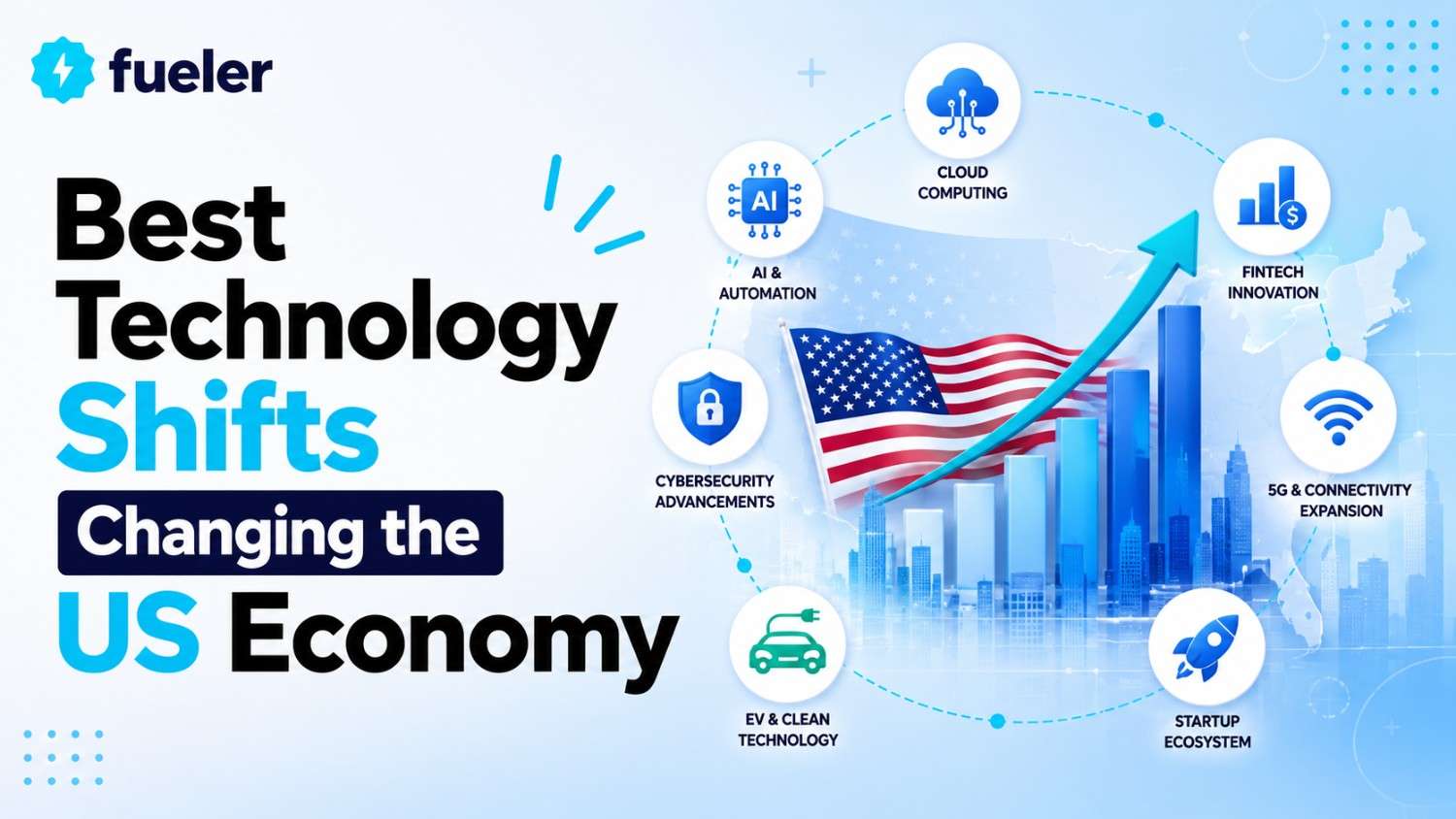
The American economic engine is no longer just fueled by oil and steel; it is being completely reprogrammed by autonomous systems and intelligent infrastructure. As we enter 2026, the shift from basic automation to "Agentic Autonomy" has reached a tipping point, fundamentally altering how value is created across every state in the union. We are witnessing a transition where technology does not just assist humans but actively participates in decision-making, physical labor, and energy management. For any professional or business owner, understanding these shifts is the difference between leading the market and being left behind in a pre-AI era.
I’m Riten, founder of Fueler, a skills-first portfolio platform that connects talented individuals with companies through assignments, portfolios, and projects, not just resumes/CVs. Think Dribbble/Behance for work samples + AngelList for hiring infrastructure.
1. The Rise of Agentic AI and Autonomous Workflows
The most significant shift in 2026 is the move from "Generative AI," which simply writes text or creates images, to "Agentic AI," which actually executes complex tasks. Unlike the early chatbots of years past, these systems can now access secure APIs, manage corporate budgets, and coordinate with other specialized AI agents to complete multi-step business processes without constant human prompting. This technology is effectively closing the gap between thinking and doing, allowing businesses to scale operations with a fractional increase in headcount while maintaining 24/7 output across global time zones.
- Advanced Multimodal Reasoning Capabilities: Modern agents can process video feeds, live audio, and massive text datasets simultaneously to understand deep context and make real-time decisions in unpredictable business environments.
- Autonomous Self-Correction and Troubleshooting: If an agent encounters a technical error while booking travel or managing a complex supply chain, it can now troubleshoot the issue and find an alternative path autonomously without needing a human to reset the process.
- Deep API Orchestration and Integration: These intelligent systems can log into your CRM, project management software, and banking apps to move data and execute financial transactions exactly as a high-level human professional would.
- Contextual Long-term Memory and Learning: Agents now retain context across months of interactions, allowing them to learn your specific business preferences and adapt to your unique brand voice or internal operational style over time.
- Collaborative Agent Swarms for Production: Multiple specialized agents can now work together in a "swarm" architecture where one acts as a researcher, another as a technical writer, and a third as a legal editor for seamless, high-speed production.
Why it matters
This shift is redefining productivity in the US by moving the human role from "doer" to "orchestrator." Companies that adopt agentic workflows are seeing a massive reduction in operational overhead, which is forcing a re-evaluation of white-collar job descriptions and career paths across the country.
2. Humanoid Robotics and General Purpose Automation
Labor shortages in the US have accelerated the deployment of general-purpose humanoid robots on factory floors and in fulfillment centers. Unlike stationary robotic arms that can only do one thing, these new machines are designed with "human-level" dexterity and can navigate environments originally built for people. Powered by the same transformer models as modern AI, these robots learn tasks through observation rather than rigid programming, making them versatile assets for dynamic supply chains that need to change daily.
- End-to-End Neural Control Systems: Robots are now trained using vision-based systems that allow them to mimic human movements and handle delicate or irregular objects with incredible precision and adaptable grace.
- Natural Language Voice Command Interfaces: Workers on the warehouse floor can now give verbal instructions to robots, such as "organize these pallets by weight," without needing to write a single line of code or use a terminal.
- Hot-Swappable Tasking and Skill Sets: A single humanoid robot can be moved from a packing station to a quality control line and "learn" the new task in a matter of minutes via instant cloud-based software updates.
- Real-time Spatial Path Planning: Integrated LiDAR and AI allow these robots to safely weave through busy, high-traffic warehouses alongside human coworkers without causing any accidents or bottlenecks in production.
- Total Cost of Ownership Parity: The cost to lease a humanoid robot has finally dropped below the cost of human labor for repetitive, low-skill 24/7 shifts, making the reshoring of American manufacturing a financial reality.
Why it matters
This shift is reshoring manufacturing to the US by reducing the reliance on cheap overseas labor. By automating the most dangerous and repetitive tasks, American factories are becoming more efficient and significantly safer for the remaining specialized human workforce.
3. The Commercialization of Quantum-Classical Hybrids
Quantum computing has officially moved out of the laboratory and into the data center as a commercial "accelerator" for the US economy. In 2026, we are seeing the rise of hybrid architectures where traditional supercomputers offload specific, highly complex mathematical problems to quantum processors. This is particularly impactful for the US pharmaceutical and logistics sectors, where "impossible" optimization problems are now being solved in minutes rather than years of manual calculation.
- Quantum-as-a-Service Cloud Accessibility: Leading tech providers now offer cloud-based access to quantum processors, making high-level computation affordable for mid-sized firms that previously could never access this level of power.
- Post-Quantum Cryptography and Security: With the potential threat of quantum decryption, the US economy is undergoing a massive shift toward quantum-resistant security standards to protect all national, financial, and personal data.
- High-Fidelity Molecular and Chemical Simulation: Biotech companies are using quantum hybrids to simulate drug interactions at an atomic level, which drastically shortens the time and money needed for expensive clinical trials.
- Global Logistics and Route Optimization: Shipping and airline giants are utilizing quantum annealing to solve complex "traveling salesman" problems for thousands of vehicles simultaneously, saving billions in fuel and time.
- Energy-Efficient Compute for AI Training: Quantum processors can perform specific high-dimensional calculations using a fraction of the electricity required by traditional GPU clusters, lowering the carbon footprint of the tech sector.
Why it matters
Quantum technology is providing a "scientific advantage" that allows US companies to innovate at speeds previously hindered by classical computing limits. This shift ensures the US remains at the forefront of global materials science, medicine, and financial modeling.
4. Software-Defined Power and Smart Grids
The US energy sector is shifting toward a decentralized model known as "Software-Defined Power." As the country moves toward diverse energy sources, the grid must become smart enough to handle the intermittent nature of wind and solar. This technological shift is creating a new "Energy Economy" where data is just as important as the electricity itself, allowing for a more resilient, self-healing, and cheaper power supply for all American citizens.
- AI-Driven Predictive Grid Balancing: Machine learning models now predict local energy usage patterns and weather shifts to prevent blackouts before they happen by automatically rerouting power across the country.
- Decentralized Peer-to-Peer Energy Markets: New platforms allow homeowners with solar panels and batteries to sell their excess electricity back to the grid or directly to their neighbors in a secure, automated system.
- Vehicle-to-Grid (V2G) Battery Integration: The rising fleet of electric vehicles can now act as mobile batteries, feeding power back into the grid during peak hours to stabilize the national energy supply during high demand.
- Grid-Edge Intelligence and Sensors: Smart transformers and IoT sensors can now detect line breaks or equipment faults instantly, reducing the time needed for utility repairs from several days to just a few hours.
- Real-time Carbon Tracking Transparency: Advanced software now allows businesses to track their exact carbon footprint in real-time, ensuring they meet new US environmental regulations while optimizing for energy efficiency.
Why it matters
A stable and cheap energy supply is the foundation of any strong economy. By digitizing the grid, the US is ensuring that its transition to modern energy actually lowers costs for small businesses and improves national security against physical and cyber threats.
5. Spatial Computing in Industrial Training
Spatial computing has moved from the world of gaming into the core of US industrial education and workforce development. In 2026, companies are using "Digital Twins" and augmented reality to train workers in high-stakes environments like surgery, aircraft maintenance, and hazardous waste management without any physical risk. This shift is dramatically shortening the learning curve for specialized technical roles that used to take years to master.
- Immersive 3D Training Simulations: New hires can practice complex mechanical repairs in a high-fidelity virtual environment that mimics their real-world workspace with 100% accuracy and zero material waste.
- Remote Expert Augmented Assistance: A technician in a rural area can wear an AR headset and have a world-class expert "see" what they see in real-time and draw instructions directly in their field of vision.
- Digital Twin Synchronization and Overlays: Factories now have live digital versions of their machines that show real-time performance data and internal temperatures overlaid directly onto the physical hardware via AR lenses.
- Haptic Feedback for Tactile Learning: Modern training suits and gloves now provide physical sensations, allowing surgeons or mechanics to "feel" the resistance of a virtual tool or part during a simulation.
- Safe-to-Fail Virtual Environments: Workers can make "catastrophic" mistakes in a virtual setting, learning exactly what went wrong without damaging expensive equipment or risking their lives in the process.
Why it matters
The US is currently facing a "skills gap" in highly technical fields. Spatial computing allows for a faster, safer, and more effective way to upskill the American workforce to meet the demands of a high-tech economy without the traditional costs of trade schools.
In this fast-moving landscape, the best way to prove you can navigate these shifts is to show what you've built. At Fueler, we help you create a dynamic, evidence-based portfolio that showcases your actual projects, whether they are AI-automated workflows or complex 3D designs. Instead of just listing "AI" as a skill on a resume, you can use Fueler to show companies the exact results you've achieved, making you an undeniable candidate in the 2026 job market.
Final Thoughts
The shifts we are seeing in 2026 are not just about "new gadgets," they represent a fundamental rewiring of how the United States operates. From the way we generate power to the way we build software and manufacture goods, intelligence is being embedded into every layer of the economy. For professionals, the goal is no longer just to work hard, but to work "smart" by leveraging these autonomous and intelligent systems. Those who master the "orchestration" of these technologies will be the leaders of the next decade.
FAQs
1. What is the most important skill for the US economy in 2026?
The most valuable skill is "Prompt Engineering and Workflow Orchestration." This involves knowing how to direct AI agents and autonomous tools to complete complex projects. As the economy shifts toward automation, the ability to manage a "digital workforce" is becoming more important than performing the manual tasks yourself.
2. How are these technological shifts affecting traditional jobs in America?
While some repetitive roles are being replaced by robotics and AI, many more are being "augmented." For example, a doctor might use AI for faster diagnosis, or a factory worker might manage a fleet of robots. The focus is shifting from manual execution to high-level supervision and creative problem-solving.
3. Is the shift to a smart grid going to make electricity cheaper?
In the long run, yes. By using AI to balance the grid and allowing for decentralized energy (like home solar), the US is reducing the need for expensive, massive power plants. Smart grids also reduce waste and prevent costly blackouts, which saves the economy billions of dollars annually.
4. Can small businesses benefit from quantum computing right now?
Small businesses can access quantum power through the cloud for specific tasks like high-level data encryption or complex logistics optimization. While you don't need a quantum computer for daily tasks, specialized startups in the US are already using "Quantum-as-a-Service" to gain a competitive edge in research.
5. Why is a "skills-first" portfolio better than a resume in 2026?
With AI able to generate perfect-looking resumes for anyone, employers no longer trust text on a page. They want to see "Proof of Work." A portfolio that shows actual projects, videos of you solving problems, and links to live tools you've built provides the transparency needed in a high-tech hiring market.
What is Fueler Portfolio?
Fueler is a career portfolio platform that helps companies find the best talent for their organization based on their proof of work. You can create your portfolio on Fueler. Thousands of freelancers around the world use Fueler to create their professional-looking portfolios and become financially independent. Discover inspiration for your portfolio
Sign up for free on Fueler or get in touch to learn more.

What should you do next?
You've read the article. Now turn your skills into proof of work and unlock more opportunities.
Build your proof of work portfolio
Create a clean portfolio with projects, assignments, resumes, and AI stack details that companies actually want to see.
Create your Fueler portfolio →Apply through assignments, not resumes
Stand out by solving real tasks from companies hiring on Fueler.
Explore assignments →Get discovered by companies
Make your work public and let recruiters discover your skills through actual projects instead of keywords.
Get discovered →
