Best Startup Failures in the USA and Lessons Learned

Riten Debnath
25 Nov, 2025
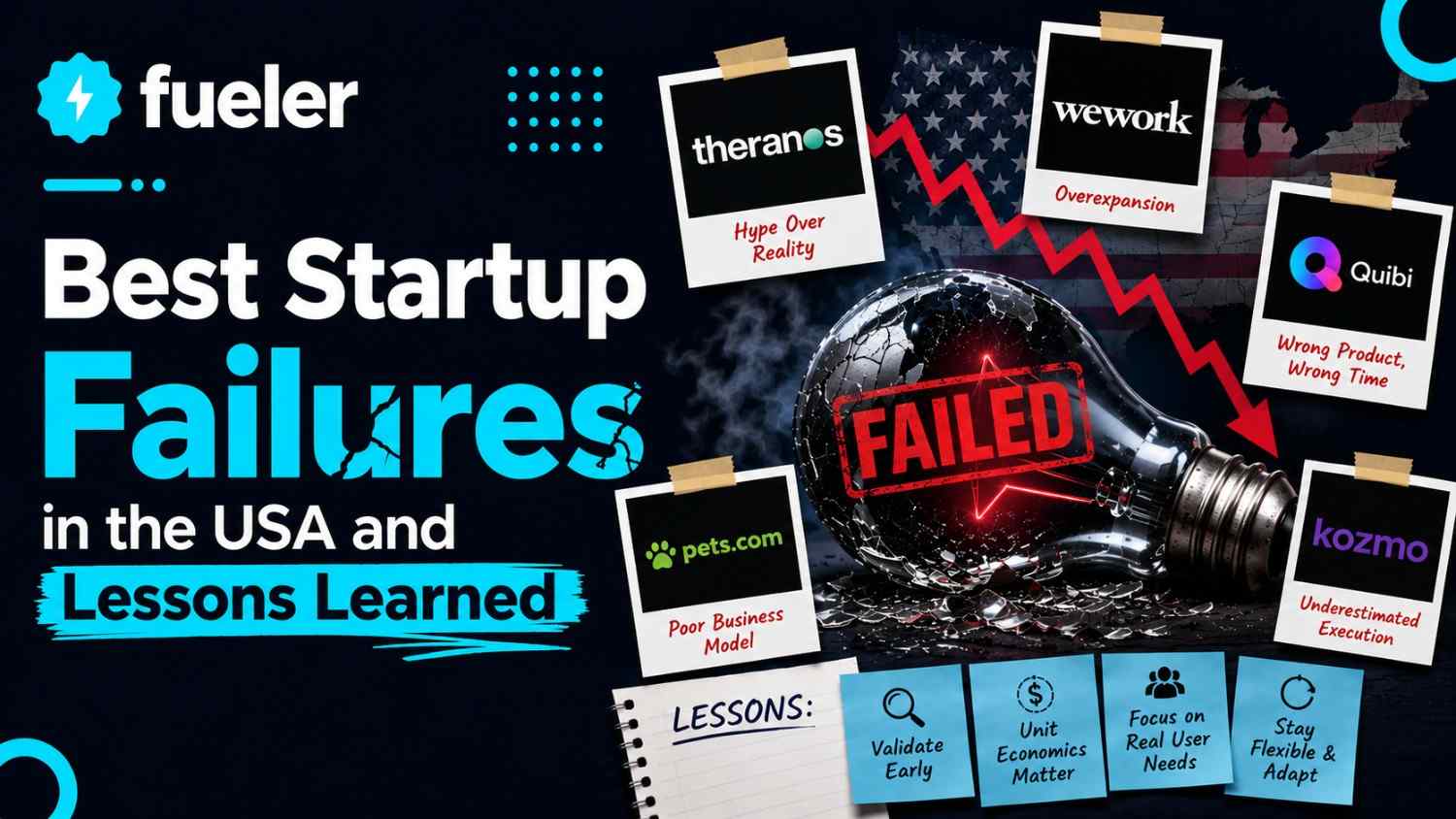
The Harsh Truth About Startup Dreams
Every entrepreneur dreams of becoming the next unicorn, building a billion-dollar venture that changes the world. But in Silicon Valley and across the USA, behind every success like Airbnb or Uber, there are dozens of failures that vanish from headlines within months. Some of these companies raised hundreds of millions, attracted top founders, yet collapsed under their own weight.
I’m Riten, founder of Fueler - a skills-first portfolio platform that connects talented individuals with companies through assignments, portfolios, and projects not just resumes/CVs. Think Dribbble/Behance for work samples + AngelList for hiring infrastructure
Why Do Startups Fail in the USA?
Despite being the most resource-rich ecosystem for entrepreneurs, the United States has a staggering 90% startup failure rate. According to CB Insights and PitchBook reports till 2025, the biggest reasons are surprisingly consistent across industries.
- Lack of product-market fit: Startups sometimes chase ambitious ideas but forget customer basics. If the market does not need your product deeply enough, you may never hit traction. Theranos was revolutionary on paper but irrelevant in practice.
- Broken business models: Companies like MoviePass offered services where the cost per customer was higher than their revenue. No growth can fix a model this flawed.
- Too much burn, too little return: Startups often spend heavily on ads, offices, and staff before building self-sustaining revenue streams. This creates a cash crisis within 2–3 years.
- Toxic leadership & culture: CEO behavior has killed billion-dollar firms (WeWork lost $40+ billion valuation after Adam Neumann’s poor governance).
- Bad timing & competition: Many startups launch too early for the market (Pets.com before e-commerce logistics matured) or too late against fast-moving rivals (Jawbone losing to Apple & Fitbit).
- Overfunding & hype trap: Raising huge funding can force unhealthy scaling. Once investors demand returns, weak startups break under expectations.
Why it matters: Understanding these failure patterns helps founders and professionals avoid falling into the same traps. It’s not about funding. It’s about validation, sustainability, and discipline.
Theranos – The $9 Billion Health-Tech Mirage
Theranos promised a future where a single drop of blood could reveal dozens of health indicators. But in reality, its machines were unreliable, false, and even dangerous.
- A billion-dollar narrative without proof: Elizabeth Holmes positioned herself as the female Steve Jobs, raising $700+ million while sidestepping validation. Investors poured in based on her image and vision, not real tech.
- Deceptive medical claims: Theranos made partnerships with Walgreens and Safeway, putting patients at risk with inaccurate results.
- Toxic work environment: Whistleblowers were silenced or forced into secrecy agreements. Internal dissent was punished.
- The collapse: By 2018, federal regulators banned Holmes from operating labs. In 2022, she was convicted of fraud, turning Theranos into Silicon Valley’s darkest cautionary tale.
Why it matters: Theranos shows credibility beats charisma. In health-tech especially, dishonesty destroys lives, not just companies.
Quibi – Billions Burned on a Failed Idea
Quibi launched boldly in April 2020 with $1.75 billion in investor money, backed by Hollywood moguls Jeffrey Katzenberg and Meg Whitman. Its promise: 10-minute “quick bites” of premium content for mobile phones.
- Wrong product, wrong time: Users already had TikTok, YouTube, and Instagram for free, while Quibi asked them to pay. Plus, launching during the pandemic backfired people suddenly had time for long-form content, not quick clips.
- No value differentiation: Aside from celebrity partnerships, there was no standout feature that made users switch apps.
- Locked on one device: Subscribers could not watch Quibi content on TVs or laptops, which was a huge limitation compared to Netflix or Hulu.
- Shutdown in 6 months: By October 2020, Quibi sold off its content library and shut operations, one of the fastest billion-dollar collapses ever.
Why it matters: Quibi shows funding ≠ product-market fit. If real users don’t want it, no amount of celebrity names or ads can save it.
WeWork – From $47 Billion to Bankruptcy
WeWork was the darling of Silicon Valley, valued at $47 billion for redefining co-working. By 2019, its IPO attempt revealed massive flaws, and in October 2023, the company filed for Chapter 11 bankruptcy.
- Aggressive expansion without core profitability: WeWork signed massive office leases worldwide without a stable revenue model.
- Founder meltdown: Adam Neumann’s extravagant lifestyle, questionable leadership practices, and scandals destroyed investor confidence.
- Dependence on SoftBank bailout: The Japanese firm poured billions to keep WeWork alive, but eventually abandoned the money sink.
- IPO embarrassment: The IPO paperwork exposed $1.9 billion in losses in 2018 alone, collapsing valuation from $47 billion to $8 billion in weeks.
Why it matters: WeWork shows culture and governance matter as much as scaling. Without solid numbers to back a vision, investor money vanishes like smoke.
Jawbone – The Billion-Dollar Hardware Flop
Jawbone was once a pioneer in Bluetooth speakers and wearable fitness trackers. But after raising $930 million, it declared liquidation in 2017.
- First-mover but slow to innovate: Established early dominance in wearables but failed to match Fitbit’s frequent updates or Apple’s ecosystem integrations.
- Recurring technical issues: Customers reported batteries overheating, devices breaking, and inaccurate tracking, eroding brand trust.
- Heavy reliance on investor capital: Despite enormous funding, sales underperformed repeatedly while expenses soared.
- Competitive wipeout: Fitbit built a brand around simple tracking and Apple built lifestyle ecosystems, pushing Jawbone out of the game.
Why it matters: Innovation has to be consistent. Being first isn’t enough staying relevant is everything.
Pets.com – The Dot-Com Mascot of Failure
Pets.com is synonymous with the dot-com bubble crash of 2000. Its sock puppet mascot became famous, but fame didn’t equal profits.
- Poor unit economics: Shipping heavy pet food cost more than the selling price, leaving negative margins on each sale.
- Overspending on marketing: Despite making just $619K in revenue, Pets.com spent over $39 million on advertising campaigns, including a Super Bowl ad.
- Market too early: US logistics and consumer confidence in online shopping were immature, leading to delivery delays and skepticism around buying online.
- Collapse in two years: Founded in 1998, public in 1999, bankrupt by late 2000 one of the fastest fall-to-fail cycles.
Why it matters: Pets.com proves that timing and fundamentals matter more than hype.
MoviePass – Too Good To Be True
MoviePass amazed everyone in 2017 when it announced unlimited movie screenings for just $9.95 per month. Millions subscribed almost overnight.
- Unsustainable model: The cost of a single ticket exceeded subscription fees, meaning heavy users drained the company with every visit.
- Reliance on data monetization fantasy: Leadership believed data resale to studios would offset losses, but studios never valued that information highly.
- Operational chaos: At its peak, MoviePass ran out of cash to reimburse theaters, leaving customers stranded.
- Collapse by 2019: From being "the Netflix of cinema" to bankruptcy, MoviePass burned through $68 million per month at its peak.
Why it matters: MoviePass is the definition of "bad math kills startups". If the unit economics are broken, scale only makes losses bigger.
Friendster – The Social Media Pioneer That Faded
Friendster was founded in 2002, three years before Facebook. At its height, it had 100 million registered users, but by 2006 it had lost relevance.
- Performance problems: The platform constantly crashed and slowed during peak growth, frustrating users.
- Lack of innovation: Facebook quickly copied and improved features, leaving Friendster outdated.
- Leadership missteps: Instead of adapting, Friendster focused on chasing acquisitions, eventually selling itself to a Malaysian company.
- Fade into obscurity: While Facebook and MySpace boomed, Friendster discontinued social networking by 2011.
Why it matters: Friendster shows execution beats being first. Early adoption means nothing if you don’t keep evolving.
Common Patterns in Startup Failures
Looking across Theranos, Quibi, WeWork, Jawbone, Pets.com, MoviePass, and Friendster, a few repeating mistakes stand out.
- Overfunded startups miscalculate discipline: Billions cannot fix products people don’t need.
- Weak leadership topples giants: Toxic cultures, reckless CEOs, or fraud wipe out even golden valuations.
- Sustainability beats hype: Strategies driven by PR campaigns collapse when business models lack strong margins.
- Timing can make or break success: Too early (Pets.com) or too late (Friendster) crush even good products.
How Fueler Connects to These Lessons
Just like investors demand proof before betting on startups, clients today want proof before hiring freelancers. That’s why Fueler helps professionals build credibility by showcasing real work samples and projects. A strong portfolio builds trust instantly avoiding the hype cycle and cutting straight to proof, just like resilient startups do.
Final Thoughts
The USA’s biggest startup failures prove an essential truth: success is never about just raising millions or chasing viral hype. It’s about solving meaningful problems, creating transparent systems, and evolving with time. For founders and freelancers alike, the lesson is simple: credibility and proof win over buzz and overselling every single time.
FAQs
1. What is the biggest startup failure in US history?
Theranos is widely considered the biggest due to its $9B valuation and massive fraud in health-tech.
2. How many US startups fail yearly?
Around 90% of startups fail overall, and 70% collapse within 10 years of creation.
3. Why did WeWork fail despite billions in backing?
WeWork grew too fast without profitability, had toxic leadership, and suffered a failed IPO that exposed unsustainable finances.
4. What startups represent dot-com failures?
Pets.com is the most iconic, collapsing in under 2 years during the dot-com bubble of the early 2000s.
5. What can freelancers learn from startup failures?
Proof and trust matter most. Just like startups must validate products with customers, freelancers must validate skills with portfolios and real samples.
What is Fueler Portfolio?
Fueler is a career portfolio platform that helps companies find the best talent for their organization based on their proof of work. You can create your portfolio on Fueler, thousands of freelancers around the world use Fueler to create their professional-looking portfolios and become financially independent. Discover inspiration for your portfolio
Sign up for free on Fueler or get in touch to learn more.

What should you do next?
You've read the article. Now turn your skills into proof of work and unlock more opportunities.
Build your proof of work portfolio
Create a clean portfolio with projects, assignments, resumes, and AI stack details that companies actually want to see.
Create your Fueler portfolio →Apply through assignments, not resumes
Stand out by solving real tasks from companies hiring on Fueler.
Explore assignments →Get discovered by companies
Make your work public and let recruiters discover your skills through actual projects instead of keywords.
Get discovered →
