Best Professional Tech Tools Used in the USA in 2026

Riten Debnath
18 Jan, 2026
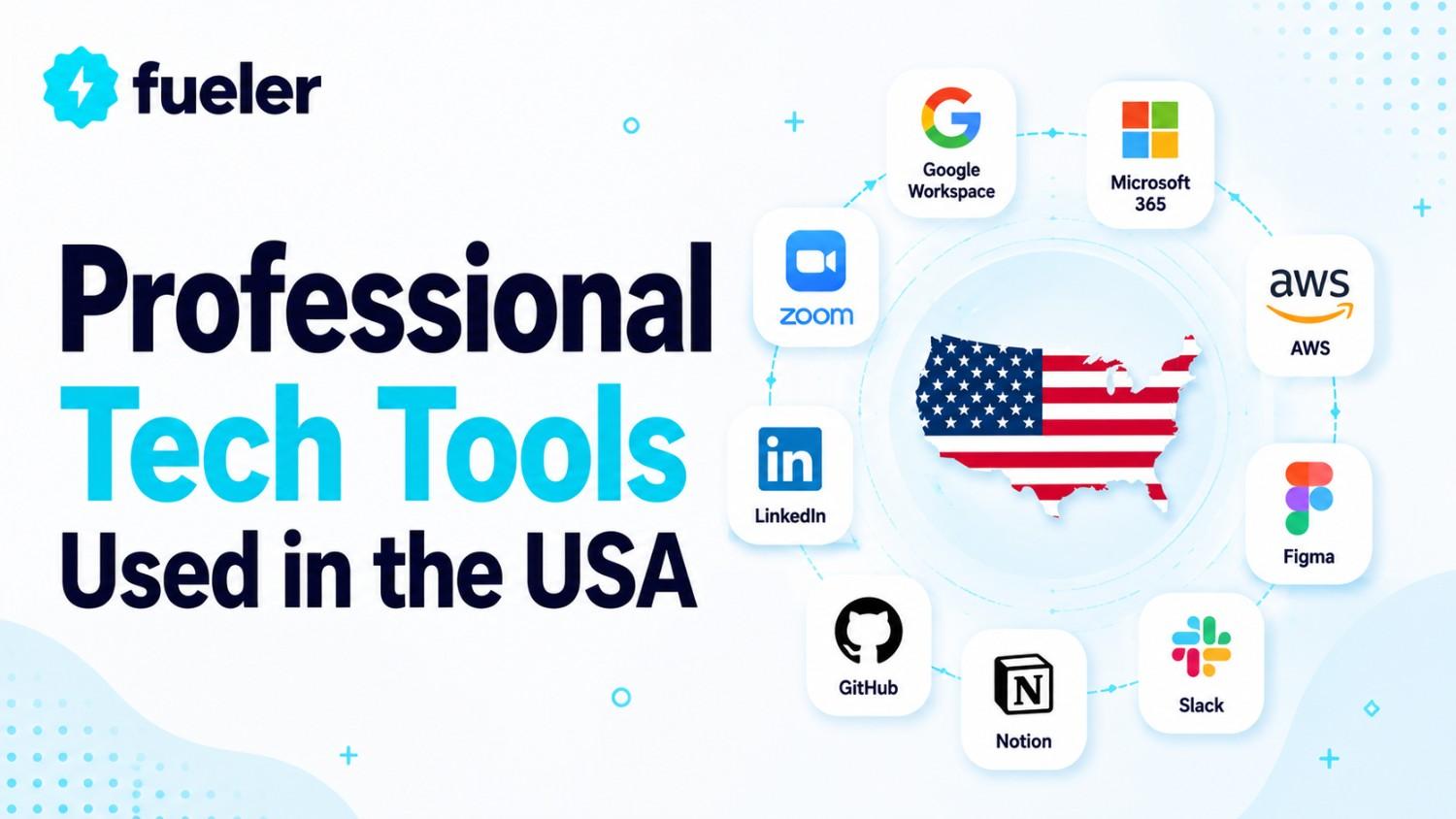
In the competitive landscape of 2026, the American workforce has shifted away from generalist software toward specialized, high-performance platforms that serve as force multipliers. For professionals in the US, the "tech stack" is no longer just a collection of apps but a strategic infrastructure that dictates one’s ability to manage complex data, automate repetitive logic, and communicate with global teams. Mastering these specific tools is the key to unlocking higher-value output and staying ahead in industries where digital literacy is the new baseline for career advancement.
I’m Riten, founder of Fueler, a skills-first portfolio platform that connects talented individuals with companies through assignments, portfolios, and projects, not just resumes/CVs. Think Dribbble/Behance for work samples + AngelList for hiring infrastructure.
1. Notion: The Universal Workspace for US Knowledge Workers
Notion has effectively replaced traditional documentation and fragmented note-taking apps for the modern US professional by offering a modular, all-in-one workspace. It functions as a flexible "digital brain" where individuals and teams can build custom wikis, track complex projects via relational databases, and maintain a single source of truth for all operational knowledge. The platform’s ability to adapt to any workflow, from a simple task list to a comprehensive company operating syste,m makes it an indispensable tool for those who prioritize organizational clarity and long-term data management.
- Advanced Relational Databases: Notion allows you to link different sets of information, such as connecting a client database to a project timeline, ensuring that every task is grounded in the broader context of your professional goals and client needs.
- Integrated Notion AI Assistant: The built-in AI serves as a writing and research partner that can summarize thousands of words in seconds, draft project briefs from rough bullet points, and extract specific action items from disorganized meeting notes with a single prompt.
- Modular Page Architecture: Everything in Notion is a "block," meaning you can effortlessly drag and drop text, images, code snippets, and embedded videos to create highly visual and interactive documents that feel more like modern websites than static pages.
- Real-Time Multiplayer Collaboration: Teams can work together on the same document simultaneously, utilizing granular permission settings to control who can view, comment, or edit, which is critical for maintaining security and alignment in hybrid US work environments.
- Extensive Global Template Ecosystem: Users have access to a massive library of community-vetted templates for CRM systems, content calendars, and engineering roadmaps, allowing you to deploy world-class organizational systems without having to build them from scratch.
Pricing:
- Free Plan: Offers unlimited blocks for individuals, a 7-day page history, and allows you to invite up to 10 guests for basic collaboration on specific pages.
- Plus Plan: $10 per user/month (billed annually), which removes the block limit for teams, adds a 30-day page history, and increases the guest limit to 100 people for growing startups.
- Business Plan: $15 per user/month (billed annually), providing SAML-based Single Sign-On (SSO), private teamspaces for sensitive departments, and 90 days of version history for better data security.
- Notion AI Add-on: Available for an additional $10 per user/month, this enables the full suite of generative AI tools across all plan tiers to accelerate your writing and brainstorming workflows.
2. Slack: The Communication Hub for High-Performance US Teams
Slack remains the definitive platform for workplace communication in the USA by moving team dialogue out of isolated email threads and into organized, searchable channels. In 2026, it serves as the "central nervous system" for organizations, integrating with virtually every other professional tool to provide real-time updates on everything from sales closed to code deployments. By facilitating rapid, informal communication through "Huddles" and AI-powered summaries, Slack reduces the need for scheduled meetings and keeps the pulse of the company accessible to every team member.
- Channel-Based Communication Logic: By organizing conversations by project, department, or office location, Slack ensures that information remains searchable and that new hires can quickly catch up on historical decisions without needing a formal briefing.
- Slack AI Summarization Tools: The platform’s native AI can scan hours of missed messages to provide a personalized digest of the most important mentions and updates, allowing busy professionals to prioritize their responses based on urgency and relevance.
- Automated Workflow Builder: This no-code feature empowers non-technical users to create custom automations, such as automatically posting a celebratory message to the team channel whenever a new contract is signed in a connected CRM.
- Slack Connect for External Partners: US professionals can bridge the gap between organizations by inviting clients, vendors, or agencies into shared secure channels, enabling seamless cross-company collaboration that feels as fast as internal chat.
- Real-Time Video and Audio Huddles: Huddles provide a low-friction way for hybrid teams to jump into a quick brainstorming session with screen-sharing and multi-person whiteboarding, effectively mimicking the spontaneity of a physical office environment.
Pricing:
- Free Plan: Best for small teams or testing, providing access to 90 days of message and file history alongside 10 third-party app integrations.
- Pro Plan: $7.25 per user/month (billed annually), unlocking the full message history, unlimited integrations, and advanced Huddle features for professional small-to-medium businesses.
- Business+ Plan: $12.50 per user/month (billed annually), adding SAML SSO, data exports for legal compliance, and a 99.99% uptime guarantee for larger organizations requiring high reliability.
- Enterprise Grid: Custom pricing designed for massive US corporations that need centralized administration, HIPAA compliance, and the ability to manage thousands of users across multiple interconnected workspaces.
3. ClickUp: The "Everything App" for Streamlining US Operations
ClickUp has rapidly become a favorite for high-growth US startups because of its ambitious goal to replace a dozen disconnected productivity tools with one unified environment. It combines task management, document creation, goal tracking, and team chat into a single interface, significantly reducing the "toggle tax" caused by switching between different software. Its extreme customizability allows every department, from Human Resources to Software Engineering to build a workspace that exactly matches their unique operational requirements and reporting needs.
- Highly Flexible View Options: ClickUp allows you to visualize the same project data through multiple "lenses," including Gantt charts for timelines, Kanban boards for agile sprints, and Workload views to monitor team capacity and prevent burnout.
- ClickUp Brain (Integrated AI): This advanced AI engine acts as a personal assistant that can answer questions about your entire workspace, draft project updates based on task progress, and even generate sub-tasks from a high-level goal description.
- Unified Docs and Task Relationships: Unlike other platforms, ClickUp allows you to embed live, interactive tasks directly inside your procedural documents, ensuring that your Standard Operating Procedures (SOPs) are always linked to the actual work being performed.
- Custom Field and Status Architecture: You can add specific data points such as budget, priority, or drop-down labelsto any task, allowing you to turn your project management tool into a lightweight CRM or a specialized asset tracker for your industry.
- Native Time Tracking and Estimates: The platform includes robust tools for logging work hours and setting time estimates, which is vital for US agencies and consultants who need to report accurately on billable hours and project profitability.
Pricing:
- Free Forever Plan: Includes unlimited tasks and team members with 100MB of storage, making it one of the most generous free tiers available for individual professionals and small teams.
- Unlimited Plan: $7 per user/month (billed annually), which removes all storage limits and unlocks advanced features like Gantt charts, custom fields, and unlimited integrations for growing teams.
- Business Plan: $12 per user/month (billed annually), adding Google SSO, advanced dashboard reporting, and more complex automation capabilities for established US businesses.
- ClickUp AI Add-on: Available for $7 per user/month on any paid plan, providing access to "ClickUp Brain" to automate your documentation and task management processes.
4. Airtable: The Data Operating System for US Creatives and Managers
Airtable bridges the gap between a simple spreadsheet and a complex database, allowing US teams to manage sophisticated data sets like video production schedules or marketing budgetswith an intuitive, visual interface. It is highly valued for its "linked records" feature, which ensures that information is entered once and then updated everywhere it appears, maintaining perfect data integrity across the entire organization. By empowering non-technical users to build their own custom business applications, Airtable has become the backbone for many innovation-led companies in the US.
- Relational Data Integrity: Airtable’s ability to link records across different tables ensures that your "Client" data is perfectly synced with your "Project" data, eliminating the errors and duplicates common in traditional spreadsheet environments.
- No-Code Interface Designer: You can build custom, professional-looking dashboards for your team that display only the most relevant data, allowing stakeholders to interact with complex information without getting overwhelmed by the underlying database.
- Powerful Automation Engine: The platform allows you to set up multi-step triggers, such as automatically sending a personalized email to a lead once they are marked as "Qualified" or updating a social media calendar when an asset is approved.
- Multimedia Field Support: Unlike Excel, Airtable handles rich media such as high-resolution images, video files, and barcodes as native data types, making it the perfect tool for creative agencies and logistics-heavy operations.
- Dynamic View Customization: Individual team members can save their own filtered views of the data (such as a "My Tasks" view or a "This Month's Budget" view) without affecting how the rest of the team sees or interacts with the information.
Pricing:
- Free Plan: Allows for unlimited bases with up to 1,000 records per base and basic automation features, making it ideal for individuals managing small-scale data projects.
- Team Plan: $20 per user/month (billed annually), increasing the record limit to 50,000 per base and providing 25,000 automation runs per month for professional departments.
- Business Plan: $45 per user/month (billed annually), which adds SAML SSO, verified data views, and advanced administrative controls for companies with strict data governance needs.
- Enterprise Scale: Custom pricing for large organizations requiring up to 500,000 records per base, dedicated customer success support, and enterprise-grade security audits like SOC 2.
5. Canva: The Design Engine for US Marketing and Communications
Canva has democratized professional design in the US by providing a drag-and-drop interface that allows anyone to create high-quality visual content without years of specialized training. It is the go-to platform for marketing teams, HR professionals, and entrepreneurs who need to produce social media graphics, presentations, and brand assets at high velocity. With its 2026 "Magic Studio" updates, Canva has integrated sophisticated AI tools that can generate images, remove backgrounds, and even translate entire designs with a single click.
- Magic Studio AI Integration: This suite of tools allows users to generate custom high-resolution images from text prompts, expand the edges of a photo using AI, and automatically resize a single design for a dozen different social media platforms instantly.
- Centralized Brand Kits: US businesses can store their official logos, color palettes, and fonts in a shared kit, ensuring that every piece of content produced by the team stays perfectly aligned with the company’s visual identity.
- Collaborative Real-Time Editing: Multiple team members can work on a presentation or graphic at the same time, leaving comments and making edits in a "multiplayer" environment that speeds up the creative approval process.
- Extensive Premium Asset Library: Pro and Business users gain access to millions of stock photos, videos, and graphics, eliminating the need for expensive third-party subscriptions and simplifying the content creation workflow.
- Direct Social Media Scheduling: Canva allows you to design and schedule your posts directly to platforms like LinkedIn, Instagram, and Twitter, turning your design tool into a comprehensive social media management hub.
Pricing:
- Canva Free: Provides access to thousands of templates and basic design tools, suitable for individuals or students who only need occasional visual content.
- Canva Pro: $120 per year for one person, unlocking the full Magic Studio AI suite, the entire premium asset library, and advanced brand management features.
- Canva Business (Teams): Starting at $100 per year per person (billed annually), this plan is designed for collaborative environments with advanced team controls and shared brand kits.
- Canva Enterprise: Custom pricing for large organizations that require single sign-on (SSO), advanced security controls, and dedicated support for brand consistency across hundreds of users.
Leverage These Tools to Build Your Proof of Work
Using these professional tech tools is only the first step; real career growth happens when you show the world what you’ve built with them. In the American market, employers are increasingly looking for tangible evidence of your skills. This is where Fueler comes into play. By documenting your projects whether it's a Notion-based operating system you built or a high-converting marketing campaign designed in Canva, you create a "Proof of Work" portfolio that speaks louder than a traditional resume.
Fueler allows you to link your achievements to the specific tools you used, proving to potential clients and employers that you aren't just "familiar" with technology, but that you can use it to drive real business results. Start building your digital footprint today by showcasing your best work on Fueler and connecting with the US-based companies that value execution over credentials.
Final Thoughts
As we move through 2026, the definition of professional excellence in the US is being rewritten by those who treat their tech stack as a strategic asset. The tools we’ve discussed from Notion’s knowledge management to Zapier’s automationare no longer optional "add-ons" but the very foundation upon which successful careers are built. In an era where AI is "eating software" and shifting the focus from manual coding to the expression of intent, your ability to orchestrate these intelligent systems will be your greatest competitive advantage.
The goal is not just to use these tools, but to master them in a way that produces visible, measurable impact. By moving from a passive user to an active builder, you demonstrate the "Intelligent Ops" mindset that modern US enterprises are looking for. Remember that in a digital-first economy, your career is a collection of the problems you’ve solved and the systems you’ve optimized. Use these tools to push the boundaries of your output, and let your work speak for itself.
FAQs
How do I decide which tool to master first if I am just starting my US career?
If you are at the beginning of your professional journey, I highly recommend starting with Notion. In 2026, organizational clarity is the baseline for all high-level work, and Notion teaches you how to structure information, manage projects, and use AI-assisted drafting in one interface. Once you have mastered the ability to organize your own "digital brain," moving into more specialized tools like Airtable for data or Figma for design becomes much more intuitive because you already understand the logic of modular workspaces.
Is it worth paying for "Pro" versions of these tools as an individual?
In the US market, the small monthly investment for a "Pro" or "Plus" plant typically ranging from $7 to $12is almost always worth the cost for the productivity gains alone. Paid tiers often unlock critical features like unlimited version history, advanced AI credits, and larger file uploads that allow you to work without technical friction. Think of these subscriptions not as an expense, but as a professional utility, similar to a high-speed internet connection, that enables you to produce a higher quality of "Proof of Work" for your portfolio.
How is AI changing the way we use these traditional productivity tools in 2026?
AI has shifted these tools from being static "containers" for your work to being active "collaborators." In 2026, tools like ClickUp and Slack don't just store your messages or tasks; they summarize them, predict potential bottlenecks, and even draft responses or project plans for you. This means your role is evolving from "doer" to "editor" and "orchestrator," where your value lies in your ability to provide the right prompts, verify AI outputs for accuracy, and make high-level strategic decisions based on the data these tools provide.
Will mastering these tools help me if I want to transition into a remote or hybrid role?
Mastering these platforms is actually the most effective way to prove you are "remote-ready" to US employers. Since tools like Miro, Slack, and Figma are designed for real-time multiplayer collaboration, being highly proficient in them shows a hiring manager that you can communicate and execute effectively without being in a physical office. When you showcase a project on Fueler that was built entirely within a collaborative digital ecosystem, you are providing direct evidence that you can thrive in the hybrid work culture that dominates the 2026 professional landscape.
How often should I update the "Proof of Work" in my Fueler portfolio?
You should treat your Fueler portfolio as a "living document" that evolves alongside your skill set. A good rule of thumb is to add a new project or update an existing one every time you reach a major milestone or master a new feature within your tech stack. In the fast-moving US tech scene, a portfolio that hasn't been updated in six months can look stagnant; by regularly adding new "Proof of Work," you signal to the market that you are an active learner who is staying current with the latest platform updates and industry trends.
What is Fueler Portfolio?
Fueler is a career portfolio platform that helps companies find the best talent for their organization based on their proof of work. You can create your portfolio on Fueler. Thousands of freelancers around the world use Fueler to create their professional-looking portfolios and become financially independent. Discover inspiration for your portfolio
Sign up for free on Fueler or get in touch to learn more.

What should you do next?
You've read the article. Now turn your skills into proof of work and unlock more opportunities.
Build your proof of work portfolio
Create a clean portfolio with projects, assignments, resumes, and AI stack details that companies actually want to see.
Create your Fueler portfolio →Apply through assignments, not resumes
Stand out by solving real tasks from companies hiring on Fueler.
Explore assignments →Get discovered by companies
Make your work public and let recruiters discover your skills through actual projects instead of keywords.
Get discovered →
