Best 10 Job-Oriented Courses with High Hiring Demand (2026)

Riten Debnath
17 Feb, 2026
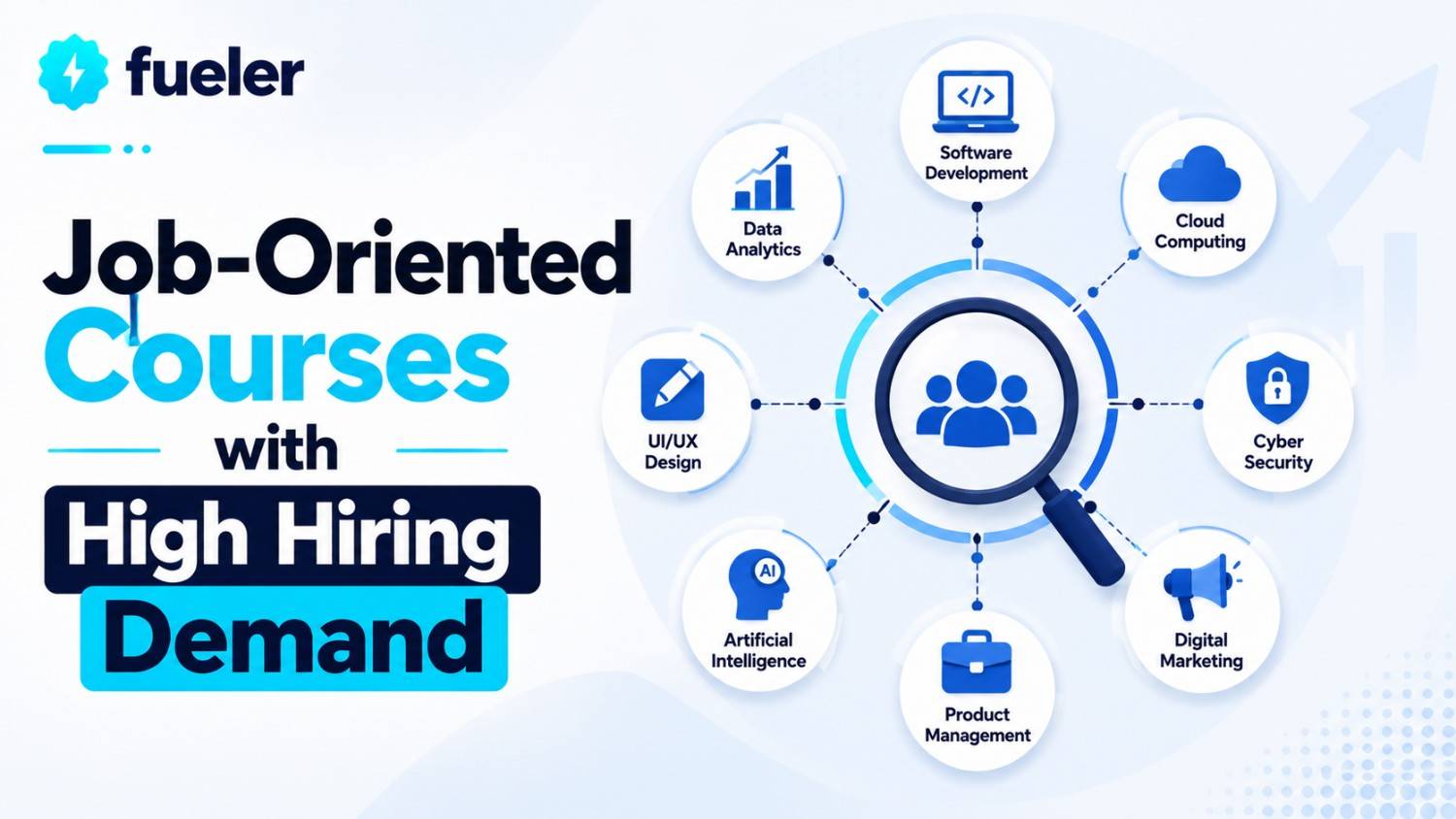
The job market in 2026 has officially moved past the "degree-only" era. Today, hiring managers in the USA and globally are prioritizing skill-density over institutional names. As industries rapidly integrate Agentic AI, decentralized finance, and sustainable engineering, the gap between traditional education and industry requirements has widened. To stay competitive, you need specialized training that focuses on high-impact output and measurable results.
I’m Riten, founder of Fueler, a skills-first portfolio platform that connects talented individuals with companies through assignments, portfolios, and projects, not just resumes/CVs. Think Dribbble/Behance for work samples + AngelList for hiring infrastructure.
1. Agentic AI & Autonomous Systems Engineering (MIT Professional Education)
In 2026, the focus has shifted from simple chatbots to Agentic AI, which are systems capable of planning, reasoning, and executing complex workflows independently without constant human prompting. This course is at the absolute forefront of the tech boom, teaching you how to build AI agents that don't just answer questions but actually perform tasks like managing supply chains or automating software testing. Companies are desperate for engineers who can move beyond basic prompt engineering into the architecture of autonomous digital workforces.
- Architecting Multi-Agent Frameworks and Orchestration: You will learn to design sophisticated environments where multiple AI agents collaborate to solve complex problems, utilizing frameworks like LangGraph and AutoGen to create autonomous "crews" that handle specific business operations from start to finish.
- Prompt Logic and Reasoning Flow Design: This goes deep into the structured logic required to guide Large Language Models through multi-step tasks, ensuring high reliability and significantly reducing "hallucinations" in critical business applications like legal research, medical diagnostics, or financial auditing.
- Integration with Enterprise APIs and Tool Use: Master the technical skill of connecting AI agents to real-world data sources and software tools, allowing the AI to take physical or digital actions such as sending emails, updating CRMs, or executing trades based on processed information.
- AI Safety, Ethics, and Governance Guardrails: In a world of autonomous agents, safety is paramount, so you will learn to implement robust guardrails, audit trails, and human-in-the-loop checks to ensure AI behavior remains within strict legal and ethical boundaries.
- Deployment and Scalability for Global Production: Learn the DevOps of AI, focusing on how to deploy these agentic models in cloud environments like AWS or Azure while managing latency, cost optimization, and high-volume performance for millions of global users.
Why it matters:
The "Agentic Era" is the biggest shift in computing since the birth of the internet. This course matters because it places you in the most in-demand niche of 2026the elite group of people who build the "brains" of modern enterprise automation, commanding some of the highest salaries in tech.
2. Advanced Cybersecurity & AI-Driven Defense (SANS Institute)
As AI makes cyberattacks more sophisticated, the demand for AI-driven defense has skyrocketed, making traditional security methods obsolete. This course focuses on using machine learning to detect zero-day threats and automating incident response at speeds that human teams simply cannot match. Organizations are currently facing a massive shortage of professionals who can defend cloud-native infrastructures against automated, high-speed hacking attempts that use generative AI to bypass security.
- AI-Enhanced Threat Hunting and Detection: You will learn to build and deploy machine learning models that monitor network traffic in real-time, identifying anomalous patterns and subtle "low and slow" attacks that traditional rule-based firewalls would completely miss.
- Cloud-Native Security and DevSecOps Integration: Master the art of integrating security directly into the software development lifecycle, ensuring that every line of code is automatically scanned for vulnerabilities and misconfigurations before it ever hits a live production server.
- Automated Penetration Testing and Red Teaming: Engage in advanced simulations where you play the role of a sophisticated hacker to find "holes" in a company's armor, using both manual techniques and automated AI exploitation frameworks to test defenses.
- Incident Response and Digital Forensic Analysis: Learn the high-pressure skills of "digital firefighting," including how to contain a massive data breach, recover lost assets, and perform deep-dive forensics to understand exactly how a system was compromised.
- Global Regulatory Compliance and Data Privacy: With laws like GDPR and CCPA evolving rapidly, you’ll learn to build security architectures that satisfy complex legal requirements, protecting both the company’s data and its legal standing in the global market.
Why it matters:
Data is the most valuable asset in 2026, and protecting it is a non-negotiable priority for every CEO. This course matters because it gives you a "recession-proof" skill set in an industry that literally cannot afford to stop hiring, regardless of the economic climate.
3. Full-Stack Data Science & Predictive Analytics (Berkeley Exec Ed)
"Data is the new oil" was the mantra of 2010; in 2026, Data is the engine that runs every successful corporation. This course teaches you to be a "Full-Stack" practitioner, someone who can clean messy data, build predictive models, and then deploy those models into a live production environment. Companies no longer want just "analysts" who make charts, they want "scientists" who can build self-learning systems that predict customer behavior or market trends.
- Advanced Python and SQL for Data Engineering: You will master the "heavy lifting" of data, learning how to build robust pipelines that ingest, clean, and organize massive datasets from diverse sources like social media, IoT sensors, and financial markets.
- Machine Learning Model Development and Tuning: Dive deep into supervised and unsupervised learning, mastering algorithms like Random Forests, Gradient Boosting, and Neural Networks to solve real-world problems like churn prediction or fraud detection.
- Data Storytelling and Executive Visualization: Learn how to translate complex statistical findings into compelling visual stories using tools like Power BI and Tableau, ensuring that your insights lead to actual business decisions at the leadership level.
- Predictive Analytics for Business Strategy: Focus on the "forward-looking" side of data, using time-series forecasting and econometric modeling to predict future market shifts, allowing your company to pivot before the competition does.
- Model Deployment and MLOps Frameworks: This module teaches you how to take a model out of a notebook and put it into the real world, managing version control, monitoring performance, and ensuring the model stays accurate over time.
Why it matters:
This course matters because it moves you from a back-office support role into a front-line strategic role. In 2026, the people who can accurately predict the future using data are the ones who are promoted to leadership positions and given the most influence.
4. Blockchain & Decentralized Finance (DeFi) Solutions (Cornell University)
Despite the volatility of early crypto years, 2026 has seen the maturation of Enterprise Blockchain and Decentralized Finance. This course covers the technical and strategic aspects of building decentralized applications (dApps) and managing digital assets. Major financial institutions and supply chain companies are actively hiring experts who can leverage distributed ledger technology to reduce costs and increase transparency.
- Smart Contract Development and Security: You will learn to write secure, audited smart contracts in languages like Solidity, ensuring that decentralized agreements execute perfectly without the risk of expensive bugs or malicious hacks.
- DeFi Protocol Architecture and Tokenomics: Explore the inner workings of decentralized exchanges, lending platforms, and yield aggregators, learning how to design sustainable economic models for new digital assets and financial products.
- Enterprise Blockchain for Supply Chain: Master the use of private and hybrid blockchains to track goods across global borders, providing an immutable record of origin and handling that is required by modern ESG regulations.
- Digital Identity and Self-Sovereign Data: Learn how to build decentralized identity systems that allow users to own their own data while still complying with "Know Your Customer" (KYC) and Anti-Money Laundering (AML) laws.
- Web3 Integration and User Experience: This module focuses on the "bridge" between traditional web applications and the blockchain, teaching you how to create user-friendly interfaces that make decentralized technology accessible to the average person.
Why it matters:
Blockchain is the future of global financial "plumbing." This course matters because it prepares you for the massive migration of traditional finance onto the blockchain, a transition that is currently creating thousands of high-paying jobs in the banking and fintech sectors.
5. Sustainability & ESG Management for Professionals (Stanford LEAD)
In 2026, Sustainability is no longer a PR move, it is a legal and financial requirement. This course teaches you how to manage Environmental, Social, and Governance (ESG) criteria for large organizations. Companies are hiring ESG managers to ensure they comply with new carbon tax laws and to appeal to a new generation of "conscious" investors who only put money into ethical businesses.
- Carbon Accounting and Net-Zero Strategy: You will learn the technical frameworks for measuring a company’s carbon footprint across its entire value chain and designing a realistic, data-backed roadmap to reach net-zero emissions.
- Circular Economy and Sustainable Operations: Master the principles of "waste-to-wealth," learning how to redesign manufacturing and supply chain processes to minimize environmental impact while actually increasing operational efficiency and reducing costs.
- ESG Reporting and Global Compliance: Learn to navigate the complex world of global sustainability reporting standards (like SASB and TCFD), ensuring your company’s ESG disclosures are accurate, transparent, and legally compliant.
- Social Impact and Diversity Leadership: This module focuses on the "Social" in ESG, teaching you how to build inclusive corporate cultures and community engagement programs that improve employee retention and brand reputation.
- Green Finance and Impact Investing: Explore how to attract "green capital" by aligning your business goals with the requirements of impact investors and sustainable development goals (SDGs) set by international organizations.
Why it matters:
ESG is the fastest-growing department in the corporate world. This course matters because it gives you the specialized knowledge to lead a company’s "Green Transformation," making you a critical asset to any firm looking to survive in a climate-conscious 2026 economy.
6. Digital Product Management (Product School)
The role of the Product Manager has become more complex as products now involve AI, hardware, and software. This course focuses on the "Full-Cycle" of product management, from initial market research and prototyping to launch and post-launch optimization. Hiring demand is massive for PMs who can speak the language of engineers, designers, and customers simultaneously to build products people actually love.
- Customer Discovery and Market Validation: You will learn how to conduct deep-dive interviews and market analysis to find the "unmet needs" of your target audience before a single line of code is ever written for the product.
- Agile Development and Roadmap Strategy: Master the art of the product roadmap, learning how to prioritize features based on ROI and business impact while managing the daily "sprints" of a high-performance development team.
- UI/UX Fundamentals for Product Leaders: While you don't need to be a designer, this module teaches you the psychological principles of good design, ensuring you can guide your team toward creating intuitive and engaging user experiences.
- Product Analytics and Growth Hacking: Learn how to use data to track user behavior, identify friction points in the customer journey, and run experiments that drive rapid user acquisition and long-term retention for the product.
- Stakeholder Management and Soft Skills: This section focuses on the "political" side of the job, teaching you how to build consensus among different departments and present your product vision to executive leadership with confidence.
Why it matters:
Product Managers are the "mini-CEOs" of their products. This course matters because it provides the cross-functional skills required to lead a team through the chaos of building something new, a skill set that remains one of the most consistently in-demand in the global economy.
7. Cloud Architect & Cloud-Native Engineering (Google Cloud/Coursera)
With 95% of businesses operating in the cloud by 2026, the demand for Cloud Architects has never been higher. This course teaches you how to design, build, and manage scalable cloud infrastructures. It focuses on "Cloud-Native" development, meaning you learn to build apps specifically for the cloud, utilizing microservices and serverless architectures to maximize speed and minimize costs.
- Designing Scalable Infrastructure: You will learn to architect systems that can handle millions of users by using load balancing, auto-scaling, and global content delivery networks (CDNs) to ensure 99.99% uptime for your applications.
- Containerization with Docker and Kubernetes: Master the art of "packaging" software into containers, allowing it to run consistently across any environment, and using Kubernetes to orchestrate these containers at an enterprise scale.
- Serverless Computing and Microservices: Explore the future of development where you don't manage servers at all, focusing instead on writing small, modular "functions" that execute in response to events, drastically reducing operational overhead.
- Cloud Cost Management and Optimization: In 2026, "FinOps" is critical; you will learn how to monitor cloud spending and optimize resource usage to ensure your company isn't wasting millions on unused or inefficient cloud capacity.
- Hybrid and Multi-Cloud Strategy: Learn how to manage environments that span across different providers (like AWS, Azure, and Google Cloud), ensuring data portability and preventing "vendor lock-in" for your organization.
Why it matters:
The cloud is the foundation of the modern world. This course matters because it gives you the technical keys to the digital kingdom, allowing you to design the infrastructure that makes every other tech trend (like AI and Blockchain) possible.
8. UX/UI Design & Human-Computer Interaction (Interaction Design Foundation)
In 2026, a "pretty" app is not enough; it has to be psychologically frictionless. This course focuses on the intersection of design, psychology, and technology. It teaches you how to build interfaces that feel natural to the human brain, whether it's for a mobile app, a virtual reality headset, or a voice-controlled AI assistant. High-end designers are in massive demand to make complex technology accessible to everyone.
- User Research and Persona Development: You will learn how to conduct scientific user testing to understand the "mental models" of your audience, ensuring your design aligns with how they actually think and behave in the real world.
- Information Architecture and Wireframing: Master the structural side of design, learning how to organize complex information in a way that is easy to navigate, creating the "blueprints" for a successful digital experience.
- Interactive Prototyping and Motion Design: Learn to use tools like Figma and Principle to build high-fidelity, interactive prototypes that allow you to test and refine the "feel" of an app before it ever goes into production.
- Accessibility and Inclusive Design Standards: This module ensures your designs are usable by everyone, including people with disabilities, which is not only an ethical requirement but a legal one in many jurisdictions by 2026.
- Design Systems and Scalable Components: Learn how to build a "language" of reusable design components that allow large teams to build consistent, high-quality interfaces across hundreds of different products and platforms.
Why it matters:
Good design is good business. This course matters because it teaches you to be the advocate for the user, a role that is increasingly critical as technology becomes more complex and the "human" element becomes the ultimate competitive advantage.
9. Growth Marketing & Performance Analytics (CXL)
Traditional "brand marketing" is dying in 2026; Growth Marketing has taken its place. This course teaches you how to use data, psychology, and rapid experimentation to acquire and retain customers. It focuses on the "full funnel," from awareness to referral, teaching you how to find the most efficient ways to grow a business without wasting millions on ineffective advertising.
- The Growth Experimentation Framework: You will learn how to run hundreds of small experiments across different channels (search, social, email) to find the "hidden levers" that drive exponential user growth and revenue for your company.
- Advanced Retention and Lifecycle Marketing: Focus on the most important part of growthkeeping the customers you already have by building automated email and in-app messaging sequences that drive long-term loyalty and upsells.
- Conversion Rate Optimization (CRO): Master the art of the "A/B test," learning how to tweak headlines, colors, and layouts to turn more website visitors into paying customers, directly increasing the ROI of every marketing dollar.
- Performance Tracking and Attribution Modeling: Learn how to prove which marketing campaigns are actually working by using advanced tracking tools to follow a customer’s journey across multiple devices and touchpoints over several months.
- Content Strategy for SEO and Virality: This module teaches you how to create content that doesn't just rank on search engines but actually gets shared, building a "viral loop" that brings in new customers for free.
Why it matters:
In 2026, companies only care about growth. This course matters because it turns you into a "growth engine" for any business, providing you with a data-backed skill set that is directly linked to the company’s bottom line and financial success.
10. Supply Chain Management & Logistics 4.0 (Georgia Tech)
Global trade in 2026 is a mess of disruptions, and companies are hiring Logistics 4.0 experts to fix it. This course teaches you how to use AI, IoT, and real-time data to build resilient supply chains that can survive pandemics, wars, and climate disasters. It is a high-stakes, high-demand field that is critical for the survival of every manufacturing and retail company on the planet.
- Digital Twin Technology for Supply Chains: You will learn how to build a "digital replica" of your entire supply chain, allowing you to run simulations and predict how a disruption in one part of the world will impact your deliveries elsewhere.
- IoT and Real-Time Tracking Integration: Master the use of sensors and satellite tracking to monitor the temperature, location, and condition of goods in transit, ensuring that quality is maintained and theft is minimized.
- Warehouse Automation and Robotics: Explore the future of logistics where robots handle the picking, packing, and sorting, learning how to manage these automated systems to increase speed and reduce human error in the warehouse.
- Demand Forecasting and Inventory Optimization: Use machine learning to predict exactly how much stock you need and where you need it, preventing the "out of stock" issues that cost companies billions in lost sales every year.
- Sustainability and "Green" Logistics: This module focuses on reducing the environmental impact of shipping, learning how to optimize routes and packaging to lower carbon emissions while still meeting tight delivery deadlines.
Why it matters:
The world stops if the supply chain stops. This course matters because it places you at the center of the global economy, giving you the power to manage the flow of goods that keep society functioning in an increasingly volatile and unpredictable 2026 world.
Final Thoughts
The job market of 2026 is brutal for those without specific, high-demand skills, but it is a land of opportunity for those who invest in themselves. These 10 courses represent the absolute best ROI for your time and money right now. However, remember that the course is only 50% of the battle. The other 50% is building a Proof of Work. Use what you learn in these courses to build real projects, and then showcase those projects on Fueler. When you can show a recruiter exactly what you built, you no longer have to "sell" yourself; your work does it for you.
FAQs
1. Which course has the highest starting salary in 2026?
Currently, Agentic AI & Autonomous Systems Engineering and Cloud Architecture command the highest starting salaries, often exceeding $150,000 in major US tech hubs due to the extreme shortage of qualified talent in these specialized fields.
2. Can I take these courses without a background in coding?
Many of these courses, such as Product Management, ESG Management, and UX Design, do not require extensive coding knowledge. However, for the AI and Cloud courses, a basic understanding of Python or logic-based thinking is highly recommended to succeed.
3. Are online certificates really respected by top-tier employers?
Yes, but only if they are from reputable institutions (like Stanford, MIT, or Google) and are backed by a strong portfolio. In 2026, employers care much more about what you can do than where you went to school, so your projects are your real credentials.
4. How long does it take to complete most of these specialized courses?
Most of these professional certifications are designed for working adults and typically take between 3 and 6 months to complete, depending on whether you are studying full-time or part-time on the weekends.
5. What is the best way to choose between these 10 courses?
Look for the intersection of your natural interests and the market demand. If you love data and math, choose Data Science. If you love building things and leading people, choose Product Management. The best career is one where your skills and passions are aligned.
What is Fueler Portfolio?
Fueler is a career portfolio platform that helps companies find the best talent for their organization based on their proof of work. You can create your portfolio on Fueler. Thousands of freelancers around the world use Fueler to create their professional-looking portfolios and become financially independent. Discover inspiration for your portfolio
Sign up for free on Fueler or get in touch to learn more.

What should you do next?
You've read the article. Now turn your skills into proof of work and unlock more opportunities.
Build your proof of work portfolio
Create a clean portfolio with projects, assignments, resumes, and AI stack details that companies actually want to see.
Create your Fueler portfolio →Apply through assignments, not resumes
Stand out by solving real tasks from companies hiring on Fueler.
Explore assignments →Get discovered by companies
Make your work public and let recruiters discover your skills through actual projects instead of keywords.
Get discovered →
