Best Emerging Tech Platforms in the US in 2026

Riten Debnath
15 Jan, 2026
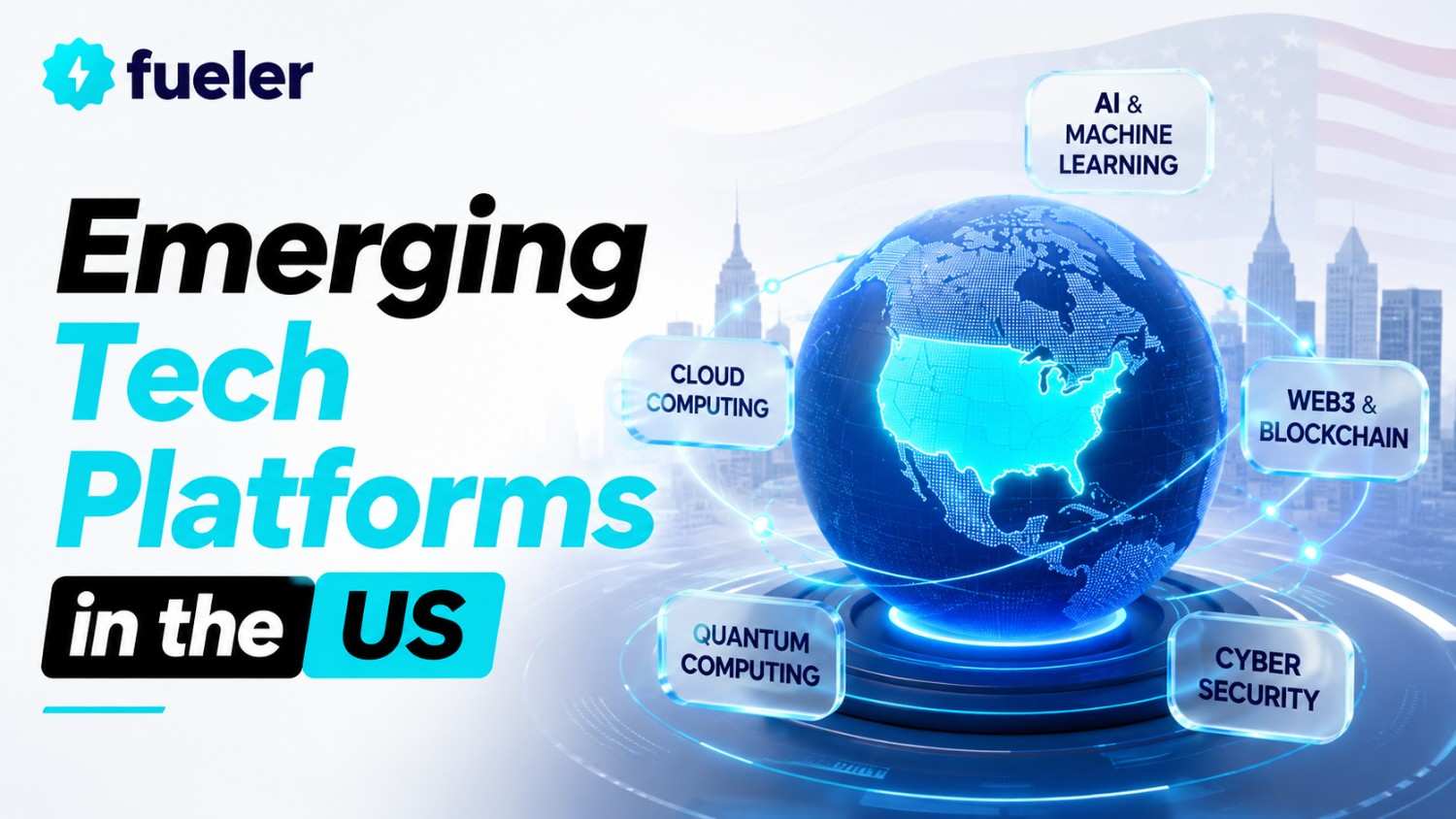
The year 2026 has ushered in a "Second Wave" of digital transformation in the United States, moving past basic automation into the realm of Agentic Intelligence and Sovereign Infrastructure. While standard tools like Slack and Excel remain, the competitive edge for US businesses now lies in platforms that can autonomously execute complex tasks, protect proprietary data in localized "sovereign" clouds, and bridge the gap between digital intent and physical action. Emerging platforms in the US are currently focusing on specialized, high-stakes environments from automated legal workspaces to high-fidelity digital twins of supply chains. These solutions are redefining efficiency by allowing human workers to act as "orchestrators" rather than manual operators.
I’m Riten, the founder of Fueler - a skills-first portfolio platform that connects talented individuals with companies through assignments, portfolios, and projects, not just resumes/CVs. Think Dribbble/Behance for work samples + AngelList for hiring infrastructure.
1. Vellum AI (Enterprise Agent Orchestration)
Vellum AI has rapidly emerged as the premier US platform for companies looking to move beyond simple chatbots and into the world of Autonomous AI Agents. In 2026, it will serve as a central "command center" where enterprise teams can build, test, and deploy agents that handle end-to-end workflows like automated claims processing or complex procurement cycles. The platform is specifically designed for the US market's strict security requirements, offering a "No-Code Agent Builder" alongside robust SDKs for deeper engineering integration. It allows businesses to stitch together multiple large language models while maintaining a unified audit trail of every decision the AI makes.
- Autonomous Workflow Execution: Unlike traditional bots that only answer questions, Vellum agents can be granted "tool-use" capabilities, allowing them to log into external software, update records, and trigger cross-platform actions independently.
- Integrated Evaluation Frameworks: The platform provides built-in "Evals" that allow US firms to test their agents against thousands of edge cases before deployment, ensuring that the AI adheres to company policy and logic.
- Multi-Model Versioning and Governance: Vellum enables teams to switch between frontier models (like GPT-5 or Claude 4) or even proprietary small language models (SLMs) without breaking the underlying workflow or losing historical data.
- End-to-End Observability: US enterprises use the "Observability" suite to track exactly how much each AI interaction costs and to identify where an agent might be stalling or hallucinating in a production environment.
- Collaborative Shared Canvas: The platform features a visual workspace where developers and non-technical business leaders can co-design the "prompt logic," ensuring that the AI’s behavior aligns perfectly with real-world business goals.
Pricing: * Starter Plan: Begins at $25.00 per month for early-stage teams prototyping their first agents.
- Team Edition: Approximately $250.00 per month, adding advanced evaluation tools and team collaboration features.
- Enterprise Custom: Tiered pricing typically starting at $2,500.00 per month for full-scale deployments with on-premise or hybrid cloud options.
2. Rappit (AI-Native Low-Code Platform)
Rappit has gained significant traction among US mid-market companies as a disruptive alternative to traditional, "legacy" low-code builders. By 2026, it will have become famous for its Intent-Driven Development, where business analysts describe a new application's function in plain English, and Rappit autonomously generates the database schema, UI components, and API integrations. This "Self-Assembling" software model allows US firms to build custom internal tools in hours rather than months, effectively eliminating the IT backlog that plagues many American corporations. It is the leading platform for turning unique business ideas into functional, scalable software without a massive engineering budget.
- Natural Language Application Generation: Users can simply type, "Build an inventory management app that alerts the warehouse manager when stock is low," and Rappit will construct the entire infrastructure instantly.
- Adaptive AI UI Components: The platform generates interfaces that learn from user behavior, automatically reorganizing buttons and data views to prioritize the information that specific employees use most frequently during their workday.
- Seamless Legacy Integration: Rappit excels at "wrapping" around older US systems (like SAP or Oracle databases), allowing companies to modernize their user experience without having to undergo a risky "rip and replace" migration.
- Embedded AI Logic Nodes: Developers can drop "AI Brains" into any workflow, enabling the app to perform real-time tasks like sentiment analysis on customer feedback or fraud detection on expense reports within the app itself.
- Sovereign Cloud Deployment: To meet US data residency laws, Rappit offers one-click deployment to private or sovereign cloud environments, ensuring that sensitive application data never leaves the organization's controlled perimeter.
Pricing:
- Professional: Starts at $15.00 per user/month, targeted at small businesses building their first 2–3 custom applications.
- Business Growth: $40.00 per user/month, which includes unlimited app building and advanced AI-assisted testing tools.
- Enterprise Elite: Custom volume-based pricing, usually requiring a consultation for high-performance needs and specialized security protocols.
3. LawVu (The AI-Powered Legal Workspace)
LawVu has become the essential "Operating System" for in-house legal departments across the United States, particularly as the demand for rapid contract review has spiked. In 2026, it utilizes specialized legal AI to act as a first-pass reviewer for every contract, instantly flagging clauses that deviate from "Company Gold Standards." This platform is popular because it consolidates matter management, contract lifecycle management (CLM), and spend management into a single, highly secure portal. For US legal teams, it is the primary tool for reducing the "legal bottleneck" and allowing lawyers to focus on high-value strategic advice rather than administrative paperwork.
- Intelligent Contract Triage: Every incoming document is automatically scanned and categorized by risk level, ensuring that the legal team prioritizes the most critical agreements while lower-risk NDAs are handled by automated workflows.
- Matter Management with AI Insights: The platform tracks every legal project across the company, using predictive analytics to estimate the time and external counsel budget required for complex litigation or mergers and acquisitions.
- Dynamic Clause Library: US legal departments use LawVu to maintain a centralized "Truth" for all legal language, allowing non-legal teams to generate pre-approved contracts using a simple self-service wizard.
- Integrated Outside Counsel Management: The platform provides a portal for external law firms to submit invoices and update statuses, allowing US GCs to track exactly where their legal spend is going in real-time.
- Automated Compliance Mapping: In 2026, LawVu has introduced a feature that automatically cross-references new US state-level regulations (like privacy laws) against existing company policies to flag potential areas of non-compliance.
Pricing:
- Legal Essentials: Starts around $2,500.00 annually for small, specialized legal teams needing basic matter and contract management.
- Corporate Professional: Typically $15,000.00 to $25,000.00 annually, designed for mid-sized US legal departments with high document volume.
- Enterprise Platform: Custom annual contracts for large US corporations with global compliance needs and dozens of internal users.
4. Agility Robotics (Polyfunctional Industrial Automation)
While most tech platforms are purely digital, Agility Robotics has emerged as a critical "physical platform" for US logistics and manufacturing firms in 2026. Their flagship robot, Digit, is now a common sight in American warehouses, working alongside human employees to move pallets, unload trailers, and organize shelves. What makes it a "platform" is its AI-driven orchestration layer, which allows fleet managers to update the robot's skills through the cloud, much like a software update. For US companies facing severe labor shortages in "heavy-lifting" roles, this platform provides a scalable, reliable way to automate the most physically taxing parts of their operations.
- Human-Centric Design: Unlike stationary robotic arms, Digit is bipedal and designed to navigate human environments, meaning US companies don't have to redesign their existing warehouse layouts to accommodate the technology.
- Cloud-Based Fleet Orchestration: Managers use a centralized dashboard to track the performance and battery life of their robots, allowing them to redirect "robotic labor" to different parts of the facility as demand shifts.
- Generative AI Learning: In 2026, these robots use "Simulation-to-Reality" (Sim2Real) learning, where they practice new tasks in a virtual environment millions of times before attempting them on the actual warehouse floor.
- Safe Human-Machine Collaboration: Agility’s platform includes advanced sensor suites that allow robots to detect and stop for humans instantly, making them the safest "collaborative robots" (cobots) currently available in the US market.
- Standardized API for Logistics: The platform integrates directly with major Warehouse Management Systems (WMS), allowing the robots to receive "pick and pack" orders just like a human worker would via a digital tablet or headset.
Pricing:
- Robotics-as-a-Service (RaaS): Most US firms prefer the subscription model, which ranges from $5,000.00 to $8,000.00 per robot/month, covering maintenance and all software updates.
- Direct Purchase: Starts around $200,000.00 per unit for the hardware, plus an annual "Intelligence License" fee for the cloud-based AI services.
5. Palantir AIP (Artificial Intelligence Platform)
Palantir has moved from a secretive government tool to a mainstream enterprise necessity in the US through its Artificial Intelligence Platform (AIP). In 2026, AIP will be used by major US airlines, healthcare providers, and manufacturers to build "Operating Systems for the Modern Enterprise." It allows companies to feed their most sensitive data into a secure environment where AI agents can analyze it to find hidden efficiencies, such as predicting when a specific aircraft part will fail or identifying where a supply chain will break down. For US executives, AIP is the ultimate tool for "Data-to-Decision" speed, providing a level of tactical clarity that was previously impossible.
- Dynamic Digital Twins: AIP creates a living, breathing model of your entire company’s data, allowing you to ask questions like, "If we lose this supplier in Ohio, how will it impact our deliveries in California next month?"
- Actionable Agent Workflows: The platform doesn't just show data; it allows users to build agents that can take action, such as automatically re-routing shipments or notifying customers of a delay based on the AI's findings.
- AIP Bootcamps for Rapid Value: Palantir is famous in the US for its "Bootcamp" model, where they help a company go from "raw data" to a functional AI use case in as little as 5 days.
- Granular Governance and Security: Because of its history in defense, Palantir’s AIP offers the most advanced security controls in the market, allowing US firms to control exactly who (or what AI) can see specific pieces of data.
- Natural Language Logic Editor: Users can write the logic for their AI agents in plain English, while the platform handles the complex data engineering and "Foundry" ontology needed to make that logic work at scale.
Pricing:
- AIP Tier 1: Primarily for mid-market firms, starting at roughly $5,000.00 to $10.000.00 per month for access to core "Bootcamp" features and basic data integration.
- Enterprise Unlimited: Custom pricing for Fortune 500 companies, often involving multi-million dollar annual contracts that include dedicated support and full platform-wide deployment.
6. Climeworks (Industrial Carbon Capture Solutions)
As US sustainability mandates tighten in 2026, Climeworks has become the leading "Green Tech" platform for American corporations aiming for Net-Zero. Unlike traditional offsets, which can be difficult to verify, Climeworks provides Direct Air Capture (DAC), literally sucking CO2 out of the sky and storing it permanently underground. US companies like Microsoft and Stripe use this platform to "subscribe" to carbon removal, providing them with high-fidelity, auditable proof of their environmental impact. It is the gold standard for American firms that view sustainability not just as a PR exercise, but as a core pillar of their 2026 operational strategy.
- Verified Carbon Removal: Every ton of CO2 removed is tracked and certified, providing US companies with an immutable record they can use in their annual ESG (Environmental, Social, and Governance) reports.
- Scalable Removal Subscriptions: Small US startups and massive conglomerates alike can participate by buying "removal credits" that directly fund the construction of massive carbon-capture facilities like "Orca" and "Mammoth."
- Permanent Sequestration: Through partnerships like Carbfix, the CO2 captured is turned into stone underground within two years, ensuring it can never escape back into the atmosphere and cause future climate issues.
- Energy-Efficient Geothermal Power: The platform’s newest facilities run entirely on renewable geothermal energy, ensuring that the process of removing carbon doesn't create more carbon in the first place.
- Corporate Climate Hub: Climeworks provides an online dashboard for its US clients to track their removal progress, download certificates, and share their impact stories with stakeholders and customers.
Pricing:
- Individual/Small Business: Starts at $30.00 per month for a basic removal subscription (roughly covering a few hundred kilograms of CO2 annually).
- Enterprise Bulk: Priced per ton, currently ranging from $600.00 to $1,000.00 per ton, with prices expected to drop as more facilities come online in the late 2020s.
7. Fortanix (Confidential Computing & Data Security)
Fortanix has emerged as a critical platform for US companies that need to process highly sensitive data, like medical records or financial transactions, in the cloud without ever exposing it. In 2026, their Confidential Computing platform ensures that data is encrypted not just while "at rest" or "in transit," but also while "in use" by a computer processor. This technology has become the standard for US healthcare and banking firms that want to use AI to analyze private data without risking a data breach or violating HIPAA and GDPR regulations. It effectively creates a "secure vault" for the most valuable data in an American organization's tech stack.
- Data-In-Use Encryption: Fortanix uses hardware-level security (like Intel SGX) to ensure that even a malicious cloud provider or an unauthorized admin cannot see the raw data while it’s being processed.
- Unified Key Management System (UKMS): The platform allows US firms to manage all their encryption keys across different cloud providers (AWS, Azure, Google) in one single, centralized, and auditable location.
- Confidential AI Training: Healthcare companies use Fortanix to train AI models on patient data from multiple hospitals without the hospitals ever having to share their raw data with each other or the AI company.
- Tokenization as a Service: For US e-commerce firms, Fortanix provides "Tokenization" that replaces sensitive credit card numbers with meaningless tokens, drastically reducing the risk and scope of a potential cyber attack.
- Zero-Trust Security Framework: The platform operates on a "never trust, always verify" model, ensuring that every request for data access is authenticated and authorized at multiple levels before being granted.
Pricing:
- Standard SaaS: Starts around $500.00 per month for small-to-midsize US firms needing cloud-based key management.
- Enterprise Hardware/Hybrid: Typically requires a custom quote, often starting at $50,000.00 annually for large-scale confidential computing environments and specialized hardware.
8. Vellum AI (Enterprise Agent Orchestration)
Snowflake has evolved in 2026 from a simple data warehouse into the AI Data Cloud, a comprehensive platform where US companies build and run their entire AI infrastructure directly on top of their data. Instead of moving massive amounts of data to an AI model, Snowflake brings the models to the data through its "Cortex" AI service. This is a game-changer for US enterprises because it keeps their most valuable assettheir datacompletely secure while allowing them to build "Retrieval-Augmented Generation" (RAG) apps that answer customer questions with 100% accuracy based on their internal documents.
- Snowflake Cortex AI: This is a managed service that gives US users access to leading AI models (like Llama 3 or Mistral) directly inside the Snowflake environment using simple SQL-like commands.
- Snowpark for Python/AI: Developers can write AI code in Python and run it directly inside Snowflake’s secure perimeter, ensuring high performance and data security without needing to manage separate servers.
- Native Document AI: The platform can automatically "read" millions of company PDFs, emails, and invoices, turning that unstructured information into structured data that can be used for financial reporting or customer service.
- Data Clean Rooms: US marketers use Snowflake to "collate" their customer data with data from partners (like retail media networks) in a secure way that allows for analysis without either party seeing the other's raw customer information.
- Marketplace for AI Models: US firms can browse a marketplace to find and "rent" specialized AI models for their industry, such as a model specifically trained on US medical billing codes or real estate valuation data.
Pricing:
- Consumption-Based: Snowflake operates on a "credit" system where you only pay for what you use. Typical mid-sized US companies spend between $1,500.00 and $5,000.00 per month.
- Enterprise Tiers: Large organizations often commit to annual "pre-purchases" of credits, ranging from $50,000.00 to over $1,000,000.00, depending on the volume of AI training and data storage.
Final Thoughts
The common thread among the Best Emerging Tech Platforms in the US is the unification of intelligence and security. In 2026, the American business landscape is no longer about which company has the most data; it's about which company has the most actionable intelligence built on a foundation of unshakeable trust. Whether it's a robot in a warehouse or an AI agent in a law firm, these tools are designed to amplify human capability while protecting the proprietary knowledge that makes each US company unique. As we move further into this "Agentic Era," the companies that thrive will be those that view these platforms not just as software, but as the core architectural backbone of their entire organization.
Frequently Asked Questions (FAQs)
1. What is "Agentic AI" and why is it trending in the US for 2026?
"Agentic AI" refers to systems that don't just generate text, but can plan, reason, and take action autonomously. In 2026, this is trending because US businesses are realizing that simple "chatbots" aren't enough to drive real ROI. They need "agents" that can actually do the work like processing a refund, updating a supply chain order, or drafting a legal motion without constant human hand-holding.
2. Is "Confidential Computing" only for banks and hospitals?
While healthcare and finance were early adopters, Confidential Computing is becoming a standard for any US company that values its IP (Intellectual Property). If you are using AI to analyze your "secret sauce" formulas, customer lists, or proprietary designs, you need a platform like Fortanix to ensure that even your cloud provider can't see what you're doing.
3. Are these emerging platforms too expensive for small US startups?
Surprisingly, no. Most of these platforms (like Vellum AI or Rappit) offer "Starter" or "Developer" tiers that are very affordable. The strategy in 2026 is for these platforms to "land and expand, "making it easy for a small team to build something amazing for under $100/month, knowing that as they scale, their usage (and the platform's revenue) will grow alongside them.
4. How do I choose between a "Humanoid Robot" and traditional automation?
Traditional automation is best for "fixed" tasks, like a conveyor belt moving a box in a straight line. Humanoid platforms like Digit are for "dynamic" tasks: moving boxes from a truck to a pallet, navigating around spilled items, or stepping over a curb. If your warehouse or facility was built for humans, a humanoid platform is often easier and cheaper to deploy than rebuilding the whole building for traditional robots.
5. What is the biggest risk when adopting these "Emerging" platforms?
The biggest risk in 2026 is "Model Lock-in." If you build your entire business on a platform that only uses one specific AI model, you'll be in trouble if a much better, cheaper model is released next month. Always choose platforms (like Vellum or Snowflake) that are "model-agnostic," meaning they let you swap the underlying AI as the market continues to evolve.
What is Fueler Portfolio?
Fueler is a career portfolio platform that helps companies find the best talent for their organization based on their proof of work. You can create your portfolio on Fueler. Thousands of freelancers around the world use Fueler to create their professional-looking portfolios and become financially independent. Discover inspiration for your portfolio
Sign up for free on Fueler or get in touch to learn more.

What should you do next?
You've read the article. Now turn your skills into proof of work and unlock more opportunities.
Build your proof of work portfolio
Create a clean portfolio with projects, assignments, resumes, and AI stack details that companies actually want to see.
Create your Fueler portfolio →Apply through assignments, not resumes
Stand out by solving real tasks from companies hiring on Fueler.
Explore assignments →Get discovered by companies
Make your work public and let recruiters discover your skills through actual projects instead of keywords.
Get discovered →
