Best 12 Data Analytics Courses in the USA in 2026

Riten Debnath
18 Feb, 2026
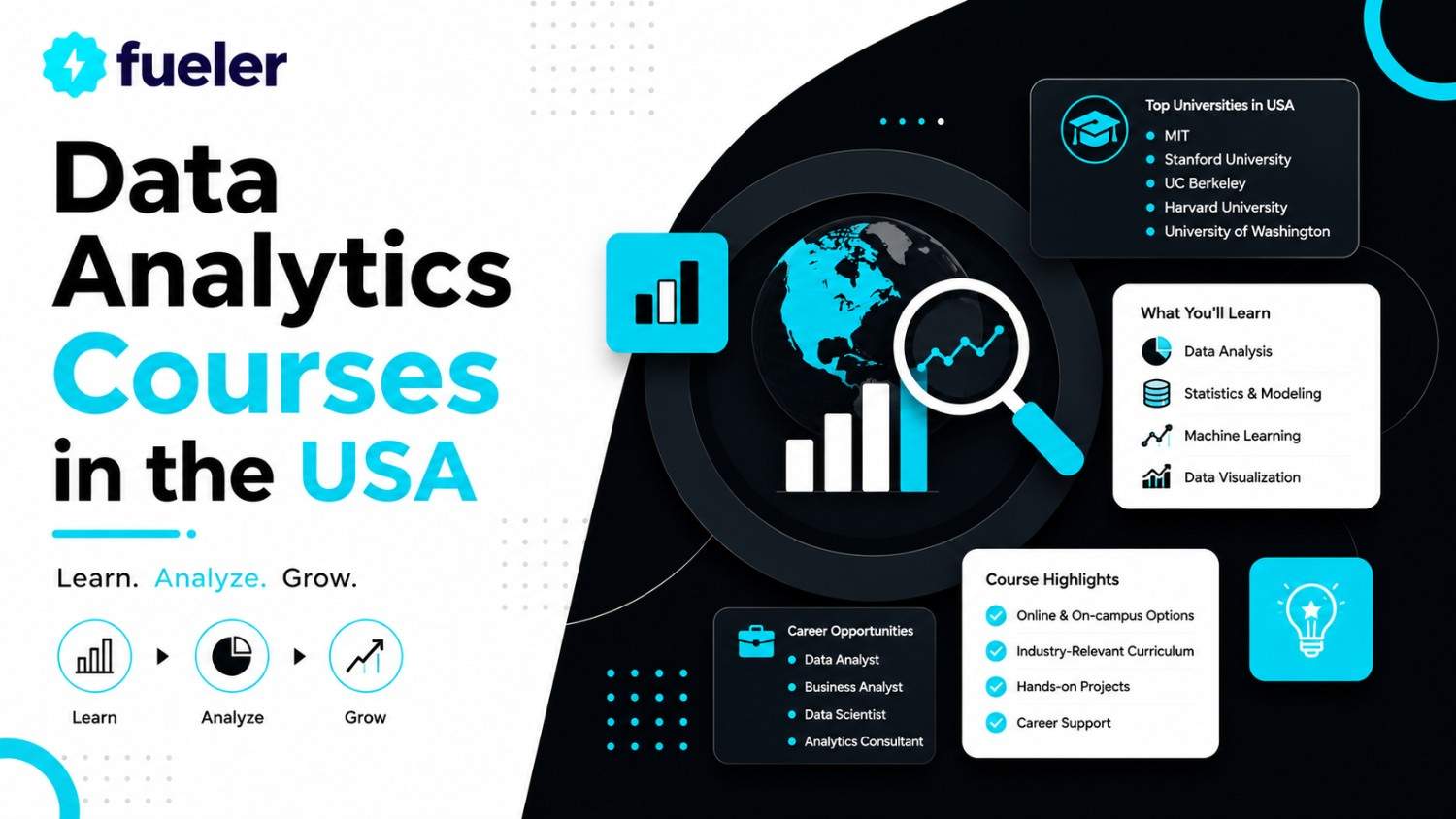
In the current business landscape of 2026, data is no longer just a byproduct of business; it is the primary fuel that drives every strategic move a company makes. From predicting global supply chain shifts to understanding the micro-behaviors of a single customer, the ability to translate raw numbers into a clear, actionable narrative is the most valuable skill a professional can possess. As traditional data entry roles vanish due to automation, the demand for high-level analysts who can oversee AI models and provide human context to complex datasets has reached an all-time high.
I’m Riten, founder of Fueler, a skills-first portfolio platform that connects talented individuals with companies through assignments, portfolios, and projects, not just resumes/CVs. Think Dribbble/Behance for work samples + AngelList for hiring infrastructure.
1. MIT Sloan: Applied Data Science Program
This program from MIT is widely regarded as the most rigorous technical certification for professionals looking to lead in the data space. It focuses on the intersection of data science and business management, ensuring that you don't just learn how to run models, but how to use them to solve high-stakes business problems. In 2026, the curriculum was updated to include a massive module on "Generative AI for Data Extraction," teaching students how to use LLMs to clean and structure messy, unstructured data sets in seconds.
- Advanced Machine Learning Frameworks: You will dive deep into supervised and unsupervised learning models, specifically focusing on how to build predictive engines that can forecast market volatility and consumer demand with a level of precision that was impossible just a few years ago.
- Neural Networks and Deep Learning: The course provides an intensive look at the architecture of neural networks, teaching you how to design and train models for image recognition, sentiment analysis, and complex pattern detection within massive, multi-terabyte datasets that define modern global enterprises.
- Data Visualization for Decision Makers: You will learn to move beyond basic charts and master the art of "Strategic Storytelling," using tools like Tableau and Python-based libraries to create interactive dashboards that allow executives to "see" the future of their business through data.
- Ethical Data Governance and Privacy: MIT places a heavy emphasis on the "Human Side" of data, teaching you how to navigate the complex legal landscape of data privacy while ensuring your models are free from the algorithmic biases that can lead to costly PR disasters or legal liabilities.
- Real-World Capstone Project: For your final evaluation, you will work with actual data from a Fortune 500 company to solve a live business challenge, providing you with a high-level "Proof of Work" that you can immediately showcase to potential employers or board members.
Why it matters:
MIT is the global gold standard for technical excellence. Completing this program signals to the world that you have the intellectual depth to manage the most complex data infrastructures and the strategic vision to turn that data into a massive competitive advantage.
2. Harvard University: Business Analytics Program
Harvard’s approach to data analytics is built around their world-famous "Case Method," which forces students to step into the shoes of a CEO and make decisions based on conflicting data sets. This program is designed for executives and managers who need to understand the "What" and the "Why" behind the numbers. It is a collaborative, high-energy program that brings together leaders from every industry to discuss how data is transforming everything from healthcare to high-frequency trading in the year 2026.
- Quantitative Managerial Economics: You will learn to use economic models to interpret market signals, teaching you how to differentiate between "noise" and "actual trends" in a world where we are constantly bombarded with more information than we can process.
- Predictive Modeling and Forecasting: The curriculum focuses on time-series analysis and regression models, providing you with a mathematical toolkit to predict future sales, inventory needs, and even the potential success of a new product launch before it hits the market.
- Data-Driven Leadership and Culture: A unique module focuses on how to build a "Data-First" culture within your organization, teaching you the soft skills required to convince traditional teams to trust the models and embrace a more scientific approach to their daily work.
- SQL and Relational Databases: Even at an executive level, Harvard ensures you understand the "plumbing" of data, teaching you how to write complex SQL queries to pull exactly the information you need from a database without waiting for the IT department to help you.
- Strategic Allocation of Data Resources: You will learn a framework for deciding which data projects are worth the investment and which are likely to fail, helping you manage your department's R&D budget with a level of precision that maximizes long-term ROI.
Why it matters:
Harvard focuses on the "Leadership" of data. It is the best choice for those who want to move into a Chief Data Officer (CDO) or CMO role, as it provides the high-level perspective required to manage entire departments of data scientists and analysts.
3. University of California, Berkeley: Data Science Professional Certificate
Berkeley’s program, offered through the Haas School of Business and the College of Engineering, is perfect for the "T-shaped" professional who wants a mix of deep technical skill and broad business knowledge. It is one of the most hands-on programs in the USA, requiring students to spend hundreds of hours writing code in Python and R. In 2026, Berkeley has introduced a "Full-Stack Analytics" model, where students are taught how to build the data pipelines that feed the AI models they create.
- Python and R for Data Analysis: You will master the two most important programming languages in the data world, learning how to use libraries like Pandas, NumPy, and Scikit-Learn to perform complex statistical analysis and build automated data cleaning scripts that save your team weeks of manual work.
- Big Data Engineering with Spark: This module teaches you how to handle datasets that are too large for a single computer, using distributed computing frameworks like Apache Spark to process millions of transactions in real-time for high-volume retail or finance environments.
- Natural Language Processing (NLP): You will explore how to use AI to "read" and understand human language, allowing you to perform sentiment analysis on social media or automatically summarize thousands of legal documents to find hidden risks or opportunities.
- Experimental Design and A/B Testing: The course teaches you the "Scientific Method" of business, showing you how to design rigorous experiments that prove which marketing messages, product features, or pricing strategies actually drive the most growth for your company.
- Cloud-Based Data Architectures: Berkeley ensures you are ready for the modern era by teaching you how to deploy your models on the cloud (AWS, Azure, Google Cloud), ensuring that your analytics solutions are scalable, secure, and accessible from anywhere in the world.
Why it matters:
Berkeley is at the heart of the tech revolution. This certificate is ideal for professionals who want to work for high-growth tech firms or startups, as it proves you have the "Hard Skills" required to contribute to a technical team from day one.
4. Columbia University: Applied Analytics MS (Executive Format)
Located in New York City, Columbia’s program is uniquely attuned to the worlds of finance, media, and global retail. This executive-format Master’s degree is designed for working professionals who want to deepen their analytical skills without leaving their careers. It places a massive emphasis on "Organizational Strategy," teaching you how to use data to optimize internal processes and external marketing efforts in the hyper-competitive NYC business environment of 2026.
- Financial Analytics and Modeling: You will learn to use data to optimize capital allocation, manage risk in volatile markets, and predict the financial health of potential partners or acquisition targets with a level of accuracy that traditional accounting simply cannot match.
- Customer Analytics and CRM Integration: This module focuses on the "Individual Customer," teaching you how to use AI to predict "Churn," "Lifetime Value," and the "Next Best Action" for every person in your database, creating a hyper-personalized experience that drives loyalty.
- Operations and Supply Chain Analytics: You will explore how to use data to optimize global logistics, using predictive models to anticipate shipping delays, manage inventory levels across multiple warehouses, and reduce waste in the manufacturing process.
- Visualizing Complex Data for Boards: Columbia provides advanced training in data visualization, teaching you how to present complex technical findings to a Board of Directors in a way that is clear, compelling, and leads to immediate strategic action.
- AI and Machine Learning for Business: The course provides a rigorous foundation in the latest machine learning techniques, specifically focusing on how these models can be applied to "Traditional" industries like insurance, banking, and luxury retail to drive innovation.
Why it matters:
Columbia is the bridge between Wall Street and Data Science. If you work in a high-stakes corporate environment where every decision is measured in millions of dollars, this program provides the "Analytical Armor" you need to lead with total confidence.
5. University of Chicago (Booth): Advanced Marketing Analytics
Chicago Booth is world-renowned for its quantitative approach to business, and their marketing analytics program is no different. It is designed for the "Modern Marketer" who needs to justify every dollar of their budget with hard data. The 2026 curriculum focuses on "Incrementality," teaching students how to prove which marketing actions actually caused a sale and which were just a waste of money, a critical skill as marketing budgets face increased scrutiny.
- Advanced Econometric Modeling: You will utilize complex statistical models to understand the "Causal Relationship" between your marketing spend and your final revenue, allowing you to prove the value of your work to even the most skeptical CFO.
- Pricing Strategy and Optimization: This module teaches you how to use data to set the perfect price for your products in real-time, accounting for competitor moves, customer demand shifts, and even the psychological biases that influence how people perceive value.
- Bayesian Statistics for Marketing: You will explore "Bayesian" methods for data analysis, which allow you to update your predictions as new data comes in, creating a "Living Model" of your business that becomes more accurate every single day.
- Digital Attribution in a Privacy-First World: Learn how to track the customer journey across multiple devices and channels without using invasive cookies, using AI-driven attribution models to understand exactly how your ads contribute to the final purchase.
- Automated Lead Scoring and Nurturing: You will build systems that automatically identify your "Hottest Leads" and determine the exact right time to reach out to them, ensuring that your sales team is only focusing their energy on the customers most likely to convert.
Why it matters:
In 2026, "Gut Feeling" is no longer an acceptable strategy in marketing. Booth’s program turns you into a "Marketing Scientist," capable of running a department where every move is backed by rigorous mathematical evidence and a clear path to profitability.
6. Wharton School (UPenn): Business Analytics Specialization
Wharton’s program is perfect for those who want a comprehensive overview of how data affects every pillar of a business, from HR to Finance to Operations. It is a highly flexible program that allows you to tailor your learning to your specific career goals. In 2026, Wharton integrated a "People Analytics" module, teaching leaders how to use data to optimize hiring, employee retention, and team performance, which is now a major trend in corporate America.
- People Analytics and Talent Management: You will learn to use data to identify the traits of your most successful employees, allowing you to hire more effectively and predict which team members are at risk of leaving before they even start looking for a new job.
- Accounting and Financial Statement Analysis: The course provides a deep dive into "Forensic Accounting" with data, teaching you how to spot anomalies and hidden risks in financial statements that traditional audits might miss, protecting your company from fraud.
- Supply Chain and Operations Excellence: You will master the math of the supply chain, learning how to use linear programming and simulation models to find the "Optimum" way to move goods and services around the globe at the lowest possible cost.
- Marketing Analytics and Growth Hacking: This module teaches you how to use data to drive rapid growth, using viral coefficients and cohort analysis to identify the "Viral Loops" that can turn a small product into a global sensation in a matter of months.
- Strategic Business Simulation: The program concludes with a massive, multi-day business simulation where you compete against other students to run a company using the data models you’ve built throughout the course, testing your skills in a high-pressure environment.
Why it matters:
Wharton provides the "Full Picture." This is the best course for an entrepreneur or a General Manager who needs to understand how data flows through an entire organization and how to use it to drive cross-functional excellence.
7. NYU Stern: MS in Business Analytics
NYU Stern’s program is designed for "Global Professionals" who want to understand how data is used in the world’s most international business hubs. It features modules in NYC, London, and Shanghai, providing a unique look at how data privacy and consumer behavior differ across cultures. In 2026, the program places a special emphasis on "FinTech and Blockchain Analytics," preparing you for the next wave of financial innovation that is currently disrupting the banking world.
- Global Data Privacy and Policy: You will learn to navigate the different data laws across the US, EU, and Asia, ensuring that your global analytics projects are legally compliant and culturally sensitive in every market where you operate.
- FinTech and Decentralized Finance (DeFi): The course explores the data behind the "New Finance," teaching you how to analyze blockchain transactions and use AI to predict shifts in the cryptocurrency and digital asset markets with professional-grade accuracy.
- Real-Time Data Streams and IoT: You will learn to manage data from the "Internet of Things," such as sensors in retail stores or smart devices in homes, allowing you to build real-time responsive marketing and operations systems that react to the world instantly.
- Strategic Management of Big Data: This module focuses on the "Management" of tech teams, teaching you how to hire, lead, and communicate with data scientists and engineers to ensure that your technical projects are actually aligned with your business goals.
- Sustainability and ESG Analytics: Learn how to use data to track your company's "Environmental, Social, and Governance" goals, providing the transparent reporting that modern investors and consumers demand from every major brand in 2026.
Why it matters:
NYU Stern is for the "International Business Leader." If your career takes you across borders and into the worlds of high-finance and emerging tech, this program provides the global perspective and technical specialized knowledge you need to thrive.
8. Carnegie Mellon (Heinz College): Business Intelligence & Data Analytics
Carnegie Mellon is a powerhouse in the world of computer science, and their Heinz College program is the "Technical Peak" for business professionals. This is a very deep dive into math and code. It is designed for those who want to be "Principal Analysts", the people who are actually building the custom models that a company uses to beat its competition. In 2026, they will have a massive focus on "Explainable AI" (XAI), teaching you how to make your complex models understandable to non-technical human beings.
- Advanced Statistical Programming in R: You will move beyond basic scripts and learn to build professional-grade software for data analysis, ensuring that your code is clean, efficient, and capable of being integrated into a company's core technology stack.
- Data Mining and Knowledge Discovery: The course teaches you the "Art of Discovery," showing you how to find hidden patterns and relationships in massive datasets that can lead to entirely new business models or product categories that nobody else has seen.
- Explainable AI (XAI) Frameworks: You will learn to peel back the "Black Box" of AI, using specialized tools to explain why a model made a certain decision, which is critical for gaining the trust of regulators, executives, and customers in high-stakes industries.
- Database Management and System Design: This module teaches you how to design the actual "Architecture" of a data system, ensuring that your company's data is stored in a way that is fast, secure, and easy to access for every department in the organization.
- Optimization and Decision Modeling: You will master the math of "Decision Science," learning how to use linear and integer programming to find the best possible solution to a complex problem, whether it's scheduling employees or designing a delivery route.
Why it matters:
CMU is for the "Hardcore Technical Leader." This program is widely respected in the tech and engineering industries, proving that you have the same level of technical skill as a computer scientist, but with the business sense of a top-tier MBA.
9. Stanford GSB: Data-Driven Decision Making
Stanford’s program is deeply rooted in the Silicon Valley culture of "Design Thinking" and "Rapid Iteration." It is designed for founders and product leaders who want to use data to build better products and more successful startups. In 2026, the curriculum focuses heavily on "Product-Led Growth" (PLG), teaching you how to use data from your own software or app to drive customer acquisition and retention without traditional advertising.
- Product Analytics and User Behavior: You will learn to use data from your app or website to understand exactly how users are interacting with your product, allowing you to find the "Friction Points" where people get stuck and fix them to improve conversion.
- Growth Accounting and Cohort Analysis: This module teaches you the "Math of Startups," showing you how to calculate your "Burn Rate," "LTV/CAC Ratio," and "Virality" to ensure that your business is on a sustainable path to profitability and scale.
- Lean Analytics for Startups: You will learn how to find the "One Metric That Matters" for your specific stage of growth, helping you ignore the "Vanity Metrics" and focus your entire team's energy on the one data point that actually drives the business forward.
- Automated Product Experimentation: Learn how to set up an "Experimentation Engine" within your product, allowing you to run hundreds of A/B tests on every button, headline, and feature simultaneously to find the "Optimum" version of your software.
- The Silicon Valley Ecosystem: The program provides unique access to the world's top venture capitalists and founders, giving you a front-row seat to how the most successful data-driven companies in the world are being built from the ground up in 2026.
Why it matters:
If you want to build a startup or work as a Product Manager in tech, Stanford is the place to be. It teaches you how to use data not just to "Analyze" the world, but to "Build" a new one.
10. Northwestern (McCormick): MS in Machine Learning and Data Science
Northwestern’s McCormick School of Engineering offers a program that is perfectly balanced between the "Business" and the "Engineering" of data. It is a highly collaborative program where students work in teams to solve real problems for partner companies like Google, Boeing, and Nike. In 2026, the program added a module on "Collaborative AI," teaching you how to build systems where humans and machines work together in a synergistic loop to solve problems.
- Machine Learning Engineering: You will learn to build the actual "Engines" of AI, moving from simple models to complex systems that can learn from their own mistakes and improve their performance over time without human intervention.
- Team-Based Data Consulting: Throughout the program, you will work as a "Data Consultant" for a real company, learning how to manage a technical project, handle client expectations, and deliver a final product that actually solves a business problem.
- Collaborative AI System Design: This module explores how to design interfaces where AI provides "Suggestions" to humans, and humans provide "Feedback" to the AI, creating a powerful team that is more effective than either a human or a machine alone.
- Visualizing Dynamic Data Streams: You will learn to create "Real-Time Visualizations" that change as new data comes in, allowing managers to monitor the health of their business in real-time and react to problems before they become crises.
- Professional Communication for Technical Leads: McCormick places a massive emphasis on "Soft Skills," teaching you how to lead technical teams and communicate your findings to non-technical audiences in a way that is clear, persuasive, and professional.
Why it matters:
Northwestern is known for its "Collaborative Spirit." This program is ideal for those who want to lead teams or work in high-stakes consulting, as it teaches you how to bridge the gap between "The Lab" and "The Boardroom."
11. University of Michigan (Ross): Business Analytics Certificate
Michigan Ross is famous for its "Action-Based Learning" approach. This program is designed for professionals who want to apply their skills to "Traditional" industries like manufacturing, retail, and healthcare. In 2026, they have a massive focus on "Sustainability and Resource Analytics," teaching you how to use data to reduce a company's carbon footprint and improve its social impact while still driving record profits.
- Action-Based Learning Projects: You will participate in a Multidisciplinary Action Project (MAP) where you spend several weeks at a company site solving a real-world data problem, gaining the kind of "Proof of Work" that you simply can't get in a classroom.
- Sustainability and ESG Reporting: Learn to use data to measure a company's impact on the world, providing the transparent "Environmental, Social, and Governance" reporting that is now mandatory for every major corporation in the 2026 economy.
- Operations and Logistics Optimization: You will master the analytics of "Physical Things," learning how to optimize a manufacturing line, a warehouse layout, or a delivery network to maximize efficiency and minimize waste in a resource-constrained world.
- Healthcare and MedTech Analytics: This module explores the specialized world of healthcare data, teaching you how to use AI to improve patient outcomes, manage hospital resources, and drive innovation in the fast-growing MedTech sector.
- Leadership in the Age of AI: Ross teaches you how to lead with "Empathy and Intelligence," helping you manage the human transition to an AI-powered world while ensuring that your company remains profitable, ethical, and respected by the community.
Why it matters:
Ross is for the "Pragmatic Leader." If you want to use data to solve "Real World" problems in the industries that keep the world running like healthcare and manufacturing this is the most practical and respected program you can find.
12. Duke University (Fuqua): Master of Quantitative Management (MQM)
Duke’s MQM program is specifically built for "Early-Career Professionals" who want to gain a high-level analytical edge. It is a fast-paced, 10-month program that focuses on "Practical Intelligence." In 2026, Duke specialized in "Marketing and Media Analytics," making it the go-to program for those who want to work in the high-stakes world of digital advertising, streaming media, and entertainment.
- Quantitative Marketing and Media: You will learn to use data to understand consumer behavior in the "Streaming Era," helping you decide which movies to greenlight, which shows to promote, and how to price your subscription services for maximum growth.
- Data-Driven Strategy and Planning: The course provides a rigorous foundation in "Strategic Thinking," teaching you how to use data to identify market shifts early and position your company to take advantage of them before your competitors even know what's happening.
- Advanced Data Visualization for Media: You will master the art of "Visual Storytelling" for the entertainment industry, learning how to create compelling data-backed narratives that help creative teams and executives make better decisions about their content.
- Leading with Data in High-Pressure Environments: Duke places a major emphasis on "Teamwork and Leadership," preparing you to lead high-stakes analytical teams in the fast-paced and often volatile worlds of media, tech, and digital advertising.
- Capstone Media Industry Project: You will spend the final weeks of the program working on a real project for a media giant like Netflix, Disney, or Spotify, giving you an "Industry-Leading" case study that you can use to launch your career in the entertainment world.
Why it matters:
Duke MQM is the fastest way to get a "Master-Level" analytical education from a top-tier university. It is the perfect choice for high-potential professionals who want to gain a massive competitive advantage and launch their career at a world-leading brand or agency.
Showcase Your Data Skills on Fueler
Once you have earned your certification from one of these world-class institutes, the next challenge is proving your value to an employer. In 2026, a certificate alone is not enough; recruiters want to see your Proof of Work.
This is where Fueler becomes your secret weapon. Instead of just listing "Data Analyst" on your resume, you can use Fueler to build a visual, skills-first portfolio. You can upload the Python models you built at MIT, the financial forecasts you created at Columbia, or the marketing dashboards you designed at Chicago Booth. It’s like a GitHub for business intelligence. By showcasing your actual projects and assignments, you prove your talent to hiring managers before they even talk to you, ensuring that you get hired for what you can actually do.
Final Thoughts
Data Analytics in 2026 is the ultimate "Superpower" for the modern professional. Whether you choose the technical rigor of Carnegie Mellon or the strategic leadership of Harvard, you are gaining a skill set that is in desperate demand across every sector of the global economy. The key is to never stop learning; the tools will change, but the ability to think critically and translate numbers into action will always be the most valuable asset you have. Start your journey today, build your proof of work, and position yourself at the very top of the future of work.
FAQs
1. Do I need a background in math to take these courses?
While you don't need a PhD in math, most of these programs require a solid understanding of Algebra and basic Statistics. If you are a beginner, many of the programs offer "Bridge" courses that will get you up to speed on the mathematical foundations you need before the core curriculum starts.
2. What is the average salary for a Data Analyst in 2026?
The demand is extremely high, and salaries reflect that. Entry-level analysts with a top-tier certification typically start between $85,000 and $110,000. Senior Data Scientists or Lead Analysts at major tech or finance firms frequently see total compensation packages ranging from $180,000 to $300,000+.
3. Can I learn these skills for free?
You can certainly learn "Hard Skills" like Python and SQLfor free using online tutorials. However, the value of these top-tier university programs lies in the Strategic Frameworks, Faculty Mentorship, and the Elite Network of peers you will build. For high-level leadership roles, the brand name and the network are often as valuable as the skills themselves.
4. How long do these professional certifications typically take?
Professional certificates for working adults usually take between 4 and 9 months to complete, depending on whether you are studying full-time or part-time. Full Master’s programs (like those at Columbia or Duke) typically take between 10 months and 2 years.
5. What is the most important data tool to learn in 2026?
While tools change, Python has firmly established itself as the "Language of Data" for 2026. It is versatile, powerful, and used by every major tech company in the world. If you pair Python with a strong understanding of SQL for database management and Tableau for visualization, you will have the most sought-after technical stack in the industry.
What is Fueler Portfolio?
Fueler is a career portfolio platform that helps companies find the best talent for their organization based on their proof of work. You can create your portfolio on Fueler. Thousands of freelancers around the world use Fueler to create their professional-looking portfolios and become financially independent. Discover inspiration for your portfolio
Sign up for free on Fueler or get in touch to learn more.

What should you do next?
You've read the article. Now turn your skills into proof of work and unlock more opportunities.
Build your proof of work portfolio
Create a clean portfolio with projects, assignments, resumes, and AI stack details that companies actually want to see.
Create your Fueler portfolio →Apply through assignments, not resumes
Stand out by solving real tasks from companies hiring on Fueler.
Explore assignments →Get discovered by companies
Make your work public and let recruiters discover your skills through actual projects instead of keywords.
Get discovered →
