15 Best Coworking Spaces for Freelancers in Mumbai in 2026

Riten Debnath
18 Sep, 2026
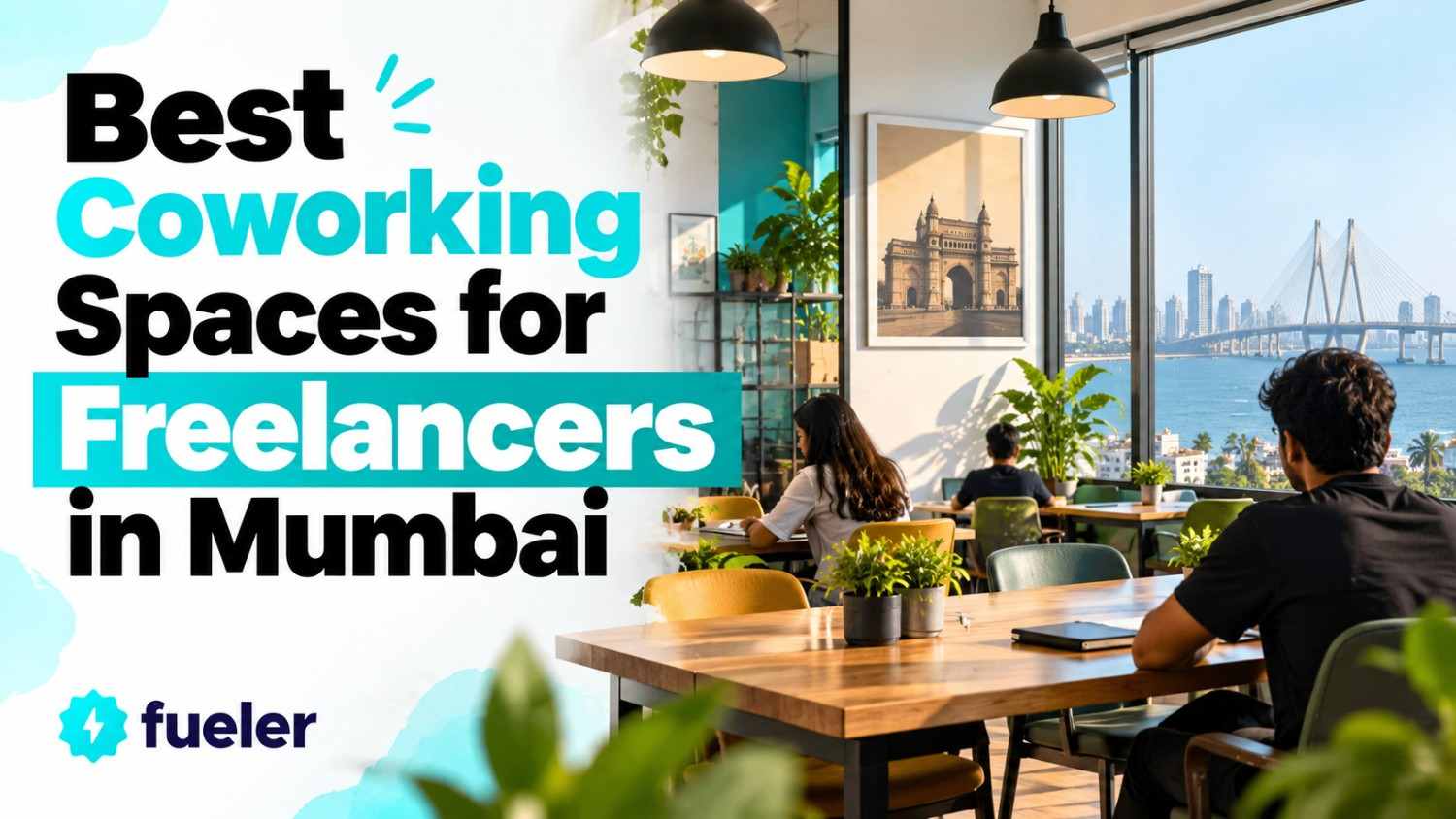
Mumbai is one of those cities where your workspace can affect your freelance business more than you expect.
A desk in the wrong part of the city can add hours to your week. A cheap workspace without meeting rooms can make client calls difficult. And a beautiful coworking space is not automatically useful if you never meet anyone who could become a client, collaborator, or referral partner.
That is why choosing among coworking spaces Mumbai freelancers can be a little different from choosing a normal office.
Freelancers need flexibility, reliable internet, reasonable pricing, professional meeting facilities, and access to people who are actually building businesses. Mumbai has all of these, but they are spread across very different neighbourhoods and coworking communities.
I’m Riten, founder of Fueler, a skills-first portfolio platform building the career infrastructure for 100 million creative professionals. Fueler connects talented individuals with companies through assignments, portfolios, and projects, not just resumes or CVs. Think of it as Dribbble/Behance for work samples combined with AngelList for hiring infrastructure.
15 Coworking Spaces Mumbai Freelancers Can Explore
1. WeWork
WeWork has one of the largest recognizable coworking footprints in Mumbai, with centres across locations such as BKC, Andheri East, Vikhroli, Powai, and other major business districts. Its Mumbai offering includes coworking memberships, day passes, meeting rooms, private offices, and even studios for shoots and podcast recordings.
For freelancers, the important part is flexibility. You can use the workspace as a professional base without necessarily behaving like a conventional office tenant.
Good for: Consultants, designers, developers, marketers, remote professionals, client-facing freelancers.
2. 91springboard
91springboard has built its reputation around coworking and startup communities, making it particularly relevant for freelancers who care about meeting founders and other independent professionals.
Its Mumbai presence includes locations such as BKC and Andheri East, while current 2026 workspace guides place its monthly pricing broadly around the ₹10,000 to ₹13,000 range depending on the membership and location.
The community angle can matter if your freelance work depends heavily on referrals.
Good for: Freelancers, startup consultants, designers, developers, marketers.
3. Awfis
Awfis has one of the broadest coworking footprints across the Mumbai metropolitan region. Current listings show locations across Andheri, Dadar, Vashi, Powai, Ghatkopar, Thane, and other areas.
That makes it useful for freelancers who care more about accessibility and flexibility than being part of a niche creative community.
Pricing varies considerably by centre and seat type, with current market guides placing Awfis options across a broad ₹5,000 to ₹25,000 monthly range.
Good for: Remote workers, freelancers, consultants, small teams.
4. Innov8
Innov8 has multiple Mumbai centres across Andheri East, Lower Parel, Ghatkopar, BKC, Thane, and Navi Mumbai. Its current Mumbai listings show flexi passes as well as dedicated desks and private cabins.
For freelancers, one advantage is that you can evaluate the workspace without immediately treating it as your permanent office. Current listings show flexi passes around ₹499 per day at several Mumbai locations, while monthly dedicated desks vary substantially by centre.
Good for: Freelancers who want to test before committing, consultants, designers, startup professionals.
5. CoWrks
CoWrks operates in several Mumbai business areas and has a more polished, corporate-oriented workspace environment.
It can be useful for freelancers who regularly work with agencies, larger companies, or clients who expect professional meeting infrastructure.
Current 2026 market guides place CoWrks pricing broadly around ₹9,000 to ₹17,000 per seat per month depending on location and format.
Good for: Designers, consultants, agency freelancers, remote professionals.
6. IndiQube
IndiQube has Mumbai locations including Powai and Jogeshwari, with a stronger technology and business-oriented audience in several centres.
Current workspace listings identify IndiQube Arena in Jogeshwari East and IndiQube Lakeview in Powai among Mumbai's coworking options.
For freelancers who work with technology companies or startups, the surrounding professional ecosystem can be more important than having a trendy coworking interior.
Good for: Developers, product professionals, consultants, startup freelancers.
7. The Executive Centre
The Executive Centre has seven locations listed in Mumbai, including BKC and Worli, and focuses more heavily on premium flexible offices, coworking, meeting rooms, and business services.
This is a different proposition from a budget-oriented freelancer desk.
If you regularly meet senior clients, conduct formal presentations, or need a premium business environment, the additional cost can be part of the value calculation.
Good for: Consultants, senior freelancers, financial professionals, client-facing professionals.
8. Dextrus
Dextrus has locations in Mumbai's business districts and is positioned around flexible workspaces for businesses and independent professionals.
Its Lower Parel presence puts it inside one of Mumbai's major commercial corridors, where freelancers can potentially be close to media, consulting, advertising, and corporate clients.
Good for: Consultants, creative freelancers, agencies, startup professionals.
9. DevX
DevX has a presence in Andheri East, making it relevant for freelancers working around the airport, IT parks, startups, and business services.
Current coworking listings include DevX Dynasty Business Park in Andheri East, with flexible workspace formats available.
For freelancers, Andheri East can be a practical middle ground when client work takes you across different parts of Mumbai.
Good for: Developers, marketers, consultants, startup freelancers.
10. The Boardroom
The Boardroom in Andheri West is an independent coworking option with a more local character than the largest national operators.
Its Andheri West location can be useful for freelancers who live around Andheri, Lokhandwala, Versova, Juhu, or nearby neighbourhoods and want to avoid crossing the city for a desk.
Good for: Designers, writers, marketers, consultants, independent professionals.
11. WorkWise
WorkWise has a presence in Lower Parel and is another option for freelancers who need a central business location.
Lower Parel has become an important office corridor between South Mumbai and the western suburbs, with a mix of established companies, agencies, startups, media businesses, and professional services.
Good for: Consultants, designers, marketers, agency freelancers.
12. The Founders Coworks
The Founders Coworks in Powai is particularly relevant for freelancers who want to be around startup and entrepreneurial communities.
Current listings place it among the coworking options in Powai, with day-pass information available through Mumbai workspace marketplaces.
For a freelancer, the value here is not simply a place to sit. It is the possibility of being around founders who may eventually become clients, collaborators, or referral sources.
Good for: Startup consultants, developers, marketers, product freelancers.
13. Community Coworks
Community Coworks in Andheri West is another independent option worth exploring if community is an important part of your coworking decision.
Current Mumbai listings show it among the available Andheri West coworking spaces, with flexible access options.
The name itself points toward an important distinction: freelancers often benefit more from a space where people actually interact than from an office where everyone sits silently with headphones.
Good for: Freelancers, consultants, creators, designers.
14. Teloz Spaces
Teloz Spaces has locations in areas including Goregaon and Malad, giving western-suburb freelancers more local options.
Current workspace listings show Teloz Spaces locations around Synergy Business Park and Malad, with monthly pricing positioned below many premium BKC alternatives.
For freelancers, this is a useful reminder that you do not necessarily need to pay a BKC premium to have a professional workspace.
Good for: Freelancers, remote workers, small teams, consultants.
15. Smartworks
Smartworks operates flexible workspaces in Mumbai, including locations around Andheri East and Marol.
It is more oriented toward structured professional workspace than a small creative studio, which can work well for freelancers who occasionally need private offices, meeting rooms, and reliable business infrastructure.
Current Mumbai listings include Smartworks Fleet House in Andheri East.
Good for: Consultants, remote professionals, developers, small agencies.
What Does a Freelancer Actually Pay?
Coworking prices in Mumbai can look confusing because there is no single "coworking price."
You might see a hot desk, flexi pass, dedicated desk, private cabin, or day pass. Two spaces in the same neighbourhood can also have very different pricing because of the building, amenities, community, and access model.
Current September 2026 data shows just how wide the difference can be. Median monthly seat prices are around ₹22,999 in Bandra East, ₹22,800 in BKC, ₹20,000 in Lower Parel, ₹15,000 in Powai, ₹14,500 in Goregaon, and ₹12,999 in Andheri.
The cheapest option is not automatically the most economical one. If you need to buy additional meeting-room hours, travel farther, or frequently work from cafés because your desk is uncomfortable, the lower membership price may disappear quickly.
Think About Community Before You Think About Coffee
Freelancers often choose coworking because working alone becomes repetitive.
But community only has economic value if it is relevant to your work.
If you are a graphic designer looking for startup clients, a room full of other designers may be friendly but not necessarily useful for client acquisition.
A coworking community containing founders, marketers, developers, recruiters, agency owners, consultants, and small-business operators can create more potential referral paths.
That does not mean you should walk around pitching everyone.
Instead, become familiar with the people around you.
Someone may eventually say:
"Our startup needs a designer."
Or:
"Do you know someone who can help us with SEO?"
Or:
"We need a developer for a small project."
That is where coworking can become more valuable than a desk at home.
Networking Value Depends on Your Freelance Niche
Different freelancers should look for different communities.
The important point is that your coworking community should overlap with the market you want to serve.
Mumbai Freelancers Should Not Ignore Day Passes
If you have never used coworking before, I would not immediately sign a six-month contract.
Test the space.
Current Mumbai listings show a large number of day-pass and flexible-access options. For example, Innov8 lists flexi passes around ₹499 per day at several centres, while other Mumbai workspaces offer different day-pass pricing depending on location and amenities.
Use a day pass on a normal working day.
Not a Sunday.
Not a quiet holiday.
Go when the workspace is busy.
Take your client calls. Work for several hours. Check the internet. Sit in the actual desk area. Try the meeting room. See whether you can concentrate.
Then decide.
The Real Cost Is More Than Your Monthly Membership
Suppose a coworking space costs ₹10,000 per month.
That sounds reasonable until you add:
- Daily commuting
- Food and coffee
- Meeting-room charges
- Printing
- Additional access fees
- Occasional private-room bookings
- Time spent travelling
Now compare that with a ₹15,000 workspace that is ten minutes from home and includes meeting-room credits.
The second option may actually cost less in total.
For freelancers, I recommend thinking about total working cost, not just the advertised seat price.
Mumbai's current pricing data reinforces how important this is because prices vary substantially between neighbourhoods.
Your Portfolio Should Be Ready Before You Start Networking
This is where I think many freelancers miss an opportunity.
A coworking space can put you around potential clients.
But when someone asks:
"What kind of work do you do?"
you should have something better than a verbal answer.
Send them your portfolio.
Your portfolio does not need 50 projects. It needs relevant proof.
For designers, that could mean five strong case studies. For developers, it could mean three substantial projects. For writers, it could mean published articles and campaign examples. For marketers, it could mean campaigns, experiments, dashboards, and measurable outcomes.
If you are building your first portfolio, How Designers Create Their Portfolio on Fueler explains how to structure projects and make them easier for clients to evaluate.
You can also read How to Build a Portfolio Using Fueler in 2026 if you want a broader approach.
Five Fueler Profiles Freelancers Can Learn From
I prefer looking at portfolios through the lens of the work being demonstrated rather than treating profiles as a list of qualifications.
Here are five Fueler profiles from different professional categories that illustrate the range of work freelancers can document.
Susmitadey, Graphic Designer
Graphic designers can make their portfolio much more useful by showing the problem behind each project, their role, the visual decisions they made, and the final execution.
Shanks, Product Designer
Product designers can use case studies to demonstrate more than interface aesthetics. Showing the problem, research, iterations, user flows, and final solution helps clients understand the thinking behind the work.
Deepak Sengar, SEO and Performance Marketer
For marketing freelancers, the strongest portfolio evidence often comes from campaigns, strategies, experiments, and measurable outcomes. Where client confidentiality allows it, results make the work much easier to evaluate.
Karthikeyan, Content Writer
A writer's portfolio should make the quality and range of writing immediately visible. Instead of simply listing content writing as a skill, show the actual articles, campaigns, research, or other work.
Akshay, Developer
Developers can use project portfolios to show applications, websites, technical experiments, and other work they have built. This is particularly useful when freelance clients need evidence of practical implementation rather than just a list of programming languages.
These profiles are examples of how different professionals can document their work. Location, availability, and project fit should always be confirmed separately.
How Freelancers Can Turn Coworking Into a Client Acquisition Channel
Do not treat coworking like a networking conference.
You do not need to introduce yourself to 30 people on your first day.
Instead, become a familiar face.
Work from the same area consistently. Talk to people naturally. Join relevant community events. Ask what other members are working on. Offer useful introductions when you can.
Then make sure people know what you do.
For example:
A freelance designer might say, "I mostly work with early-stage brands on identity and social design."
A developer might say, "I help startups build their first web product."
A copywriter might say, "I mostly write landing pages and long-form content for SaaS companies."
That is much more useful than saying, "I'm a freelancer."
Specificity makes referrals easier.
Use Mumbai's Coworking Ecosystem Differently at Different Career Stages
A freelancer earning their first ₹30,000 per month should not necessarily choose the same workspace as someone earning ₹2 lakh per month.
Your workspace should evolve with your business.
Early Stage
Prioritize affordability, reliable internet, and flexibility.
A day pass or flexi membership may make more sense than a premium dedicated desk.
Growing Freelancer
Once you are working consistently, consider a dedicated desk if it improves your productivity and gives you a professional base for meetings.
Established Freelancer
At this stage, meeting rooms, privacy, business address, community, and client experience become more important.
Freelancer Building an Agency
You may eventually need cabins or small private offices. At this point, a workspace that can let you expand without moving locations becomes useful.
What I Would Check Before Paying
Before signing up, ask the coworking operator these questions:
Is the membership truly flexible?
Ask about notice periods, lock-in periods, deposits, and cancellation terms.
How many meeting-room hours are included?
A cheap desk can become expensive if every client meeting costs extra.
What happens during peak hours?
Some hot-desk models work differently when the workspace is busy.
Can I receive clients here?
This matters much more to freelancers than it does to remote employees.
Is there power backup?
Mumbai's monsoon and power interruptions make this worth asking.
How good is the internet in practice?
Do not rely only on the operator's advertised speed.
Who actually works here?
Ask what kinds of freelancers, startups, and companies use the space.
That last question can tell you more about the networking potential than the community section on the website.
A Practical Freelancer Coworking Budget
Instead of deciding your budget from the advertised monthly price, calculate how many working days you actually need.
For example, if you only need a coworking space eight days a month, a flexible pass can make more sense than a full monthly membership.
If you work there 20 to 22 days a month, a dedicated desk may become economically reasonable.
The right membership is the one that matches your actual usage, not the one that looks cheapest on a price comparison page.
Build a Freelancer Routine Around the Space
A coworking membership becomes more valuable when it creates structure.
I would divide the week into different purposes.
Monday: Deep work and project planning.
Tuesday: Client work and calls.
Wednesday: Networking and community.
Thursday: Deep work and portfolio development.
Friday: Client follow-ups, invoices, proposals, and business development.
You do not have to follow this exact schedule.
The idea is to stop thinking of coworking as simply "somewhere I work."
It can become the physical base for your freelance business.
Key Takeaways
- Location is one of the biggest factors when choosing coworking spaces Mumbai freelancers can use. BKC, Lower Parel, Andheri, Powai, Goregaon, Navi Mumbai, and Thane serve different professional ecosystems.
- Pricing varies significantly across Mumbai. September 2026 data shows median seat prices ranging from roughly ₹12,999 in Andheri to ₹22,800 in BKC.
- Flexible memberships can make sense for freelancers who do not need a desk every day. Innov8, WeWork, and other operators offer day or flexible access options.
- Community matters when it overlaps with your target clients. A freelancer should look for founders, marketers, agencies, developers, and businesses relevant to their niche.
- Do not judge a workspace only by its interiors. Test Wi-Fi, meeting rooms, noise, seating, power backup, access hours, and actual community activity.
- The cheapest desk is not always the lowest-cost option. Add commute, meeting rooms, food, and other working expenses before comparing memberships.
- Your portfolio should be ready before networking. Coworking can increase your professional interactions, but proof of work gives those conversations a reason to continue.
- Test before committing. A few day passes can tell you more about a space than a polished tour.
Final Thoughts
I think the biggest mistake freelancers can make with coworking is treating it as a lifestyle purchase.
A nice desk, good coffee, attractive interiors, and a strong brand can be useful. But they are not the reason a coworking membership should exist in your freelance business.
The real question is whether the workspace helps you work better, meet relevant people, meet clients professionally, and build your business.
For one freelancer, that could mean a ₹500-ish day pass a few times a month. For another, it could mean a dedicated desk close to home. Someone working with corporate clients may value BKC or Lower Parel. A developer working with startups may get more value from Powai. Someone living in Andheri may have no reason to travel across Mumbai at all.
There is no universal answer.
What matters is matching the workspace to the business you are actually building.
And when you do meet someone who could become a client, collaborator, or referral partner, make sure you have your work ready to show.
That is one reason I believe so strongly in proof-of-work portfolios. Your resume can tell someone what you claim to do. Your portfolio can show them what you have actually done.
If you are a designer, Fueler's guide for Indian designers can help you think about what to showcase. And if you want to build a portfolio specifically for freelance work, this guide to using Fueler to get freelance clients is a useful starting point.
A coworking space can put you in the room.
Your work is what gives people a reason to remember you.
Frequently Asked Questions
1. What are the best coworking spaces Mumbai freelancers can use in 2026?
There is no single coworking space that works for every freelancer. WeWork, 91springboard, Awfis, Innov8, CoWrks, IndiQube, The Executive Centre, and several independent spaces offer different combinations of pricing, locations, flexibility, meeting facilities, and community. The right choice depends on your freelance niche, commute, budget, and working frequency.
2. How much does coworking cost for freelancers in Mumbai?
Coworking prices vary considerably by neighbourhood and membership type. Current September 2026 data shows median seat prices of around ₹12,999 in Andheri, ₹15,000 in Powai, ₹20,000 in Lower Parel, and ₹22,800 in BKC. Day passes and flexi memberships can be considerably different from dedicated-desk pricing.
3. Which Mumbai areas are good for freelance professionals?
Andheri works well for professionals connected to media, entertainment, technology, and startups. Powai has a strong technology and startup ecosystem. Lower Parel works well for central Mumbai access and corporate, media, and agency work. BKC is useful for corporate and financial clients, while Goregaon, Malad, Vashi, and Thane can be more practical for freelancers living in the suburbs.
4. Are coworking spaces useful for getting freelance clients?
They can be, particularly when the coworking community overlaps with your target market. A designer may benefit from being around founders and marketers, while a developer may prefer startup and product communities. However, coworking does not guarantee clients. Freelancers still need a clear service offering, strong portfolio, professional communication, and consistent follow-up.
5. Should freelancers choose a day pass or monthly coworking membership?
It depends on how frequently you work from the space. If you only need a workspace a few days each month, day passes or flexible memberships can be more economical. If you work from the space most weekdays, compare a dedicated or hot desk against the total cost of daily passes. Always include commuting and meeting-room costs in the calculation.
Why 100,000+ professionals use Fueler
Fueler helps professionals showcase proof of work through projects, assignments, case studies, and achievements.
- Thousands of professionals use Fueler to create their digital portfolio
- Thousands of projects are published on Fueler. Check here
- Startups and Companies hire through proof of work on Fueler
- Used by freelancers, creators, marketers, video editors, writers, designers, and product managers
Our mission is to help the next 100 million professionals build a verified professional identity through proof of work

What should you do next?
You've read the article. Now turn your skills into proof of work and unlock more opportunities.
Build your proof of work portfolio
Create a clean portfolio with projects, assignments, resumes, and AI stack details that companies actually want to see.
Create your Fueler portfolio →Apply through assignments, not resumes
Stand out by solving real tasks from companies hiring on Fueler.
Explore assignments →Get discovered by companies
Make your work public and let recruiters discover your skills through actual projects instead of keywords.
Get discovered →
