15 Best Coworking Spaces for Freelancers in Delhi NCR in 2026

Riten Debnath
19 Sep, 2026
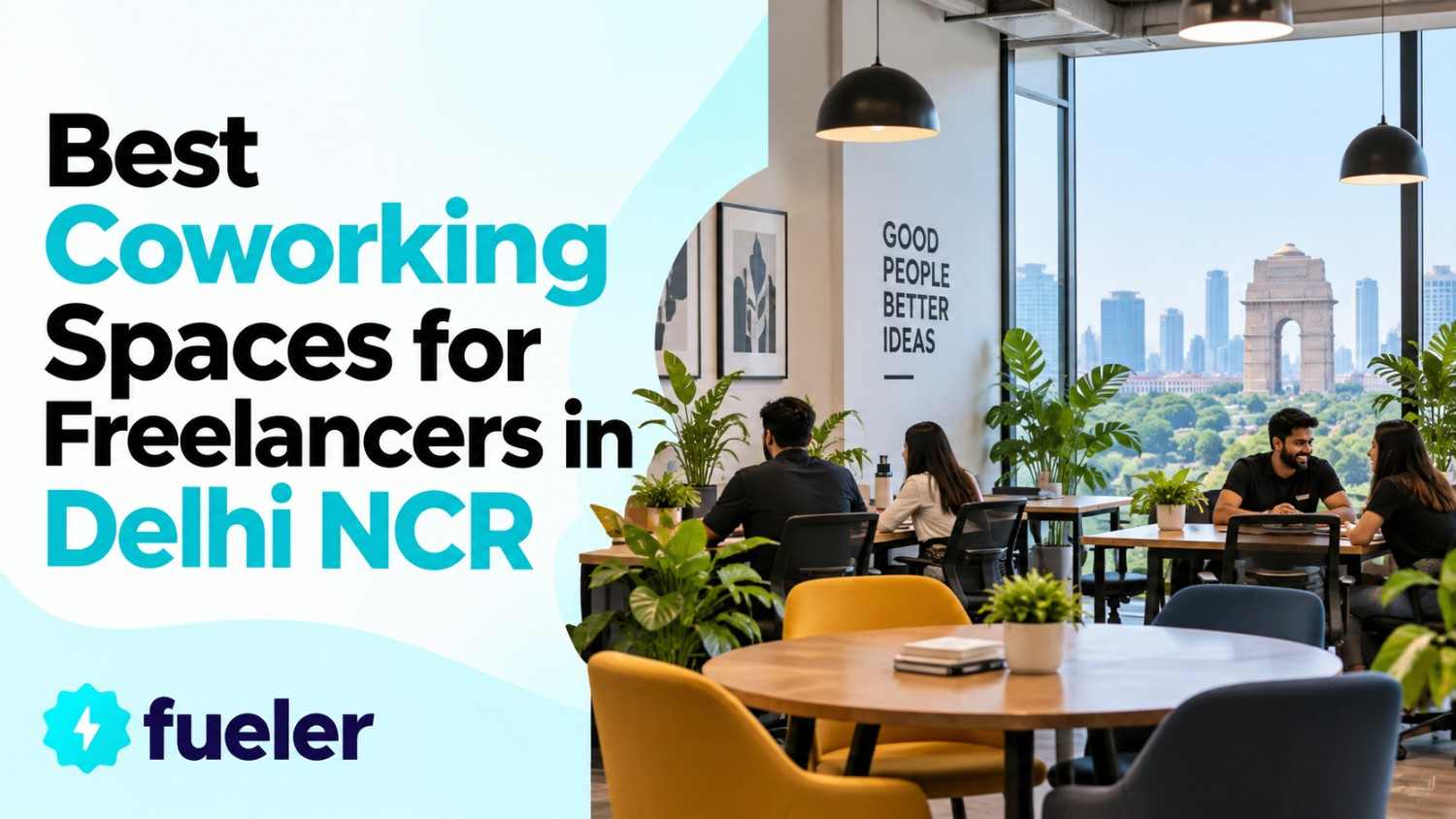
Delhi NCR has a very different work culture from cities where most businesses are concentrated in one technology corridor. Delhi has agencies, media companies, D2C brands, consultants, government-facing businesses, and creative professionals. Gurugram has startups, SaaS companies, fintech firms, consulting businesses, and large corporate teams. Noida brings another strong mix of technology, IT services, media, and growing businesses.
That mix makes Delhi NCR useful for freelancers because your next project can come from very different kinds of companies. A designer might work with a D2C brand in Delhi, a developer might find a startup client in Gurugram, and a content writer might work with a SaaS company in Noida.
I’m Riten, founder of Fueler, a skills-first portfolio platform building the career infrastructure for 100 million creative professionals. Fueler connects talented individuals with companies through assignments, portfolios, and projects, not just resumes or CVs. Think of it as Dribbble/Behance for work samples combined with AngelList for hiring infrastructure.
Before you start looking for a desk, it helps to have your work ready to show. A career portfolio can give a potential client a much clearer idea of what you actually do. If you are new to freelancing, How to Build Proof of Work Portfolio With Fueler can help you turn projects into something you can share. You can also read How Freelancers Can Use Proof of Work to Win High-Ticket Clients if you want your portfolio to communicate business value instead of just listing skills.
For a freelancer, a coworking space is not only about getting away from home. It can become a place to work consistently, meet other professionals, take client calls, and slowly build the kind of network that can lead to referrals.
Start With the Part of Delhi NCR You Actually Want to Work From
Delhi NCR is too spread out to choose a coworking space only because the workspace looks good.
If you live in South Delhi and most of your clients are in Gurugram, you need to think about whether that commute makes sense several times a week. The same applies to someone living in Noida who is considering a workspace in central Delhi.
The region has several strong coworking clusters. Delhi has options around Connaught Place, Nehru Place, Saket, Aerocity, Jhandewalan, and South Delhi. Gurugram has dense workspace activity around Cyber City, Golf Course Road, Sector 44, MG Road, Udyog Vihar, and other business districts. Noida has major clusters around Sector 62, Sector 63, Sector 1, Sector 2, and the Noida Expressway.
Current 2026 market data also shows that Delhi NCR's coworking supply is spread across several micro-markets rather than being concentrated in one location. Delhi's larger clusters include Saket, Connaught Place, and Nehru Place, while Gurugram and Noida have their own major business corridors.
For a freelancer, that is actually useful. You can choose a workspace based on where you live and where your clients are instead of automatically travelling to the most famous business district.
15 Coworking Spaces for Freelancers in Delhi NCR
1. 91springboard
91springboard is a useful starting point if you want a coworking space where freelancers are not the only independent professionals around you. Its Delhi network includes locations such as Nehru Place, Jhandewalan, Mohan Estate, Saket, and other business areas, while the wider NCR network extends into Gurugram and Noida.
What makes it relevant to freelancers is the combination of flexible workspaces and community activity. 91springboard offers day passes and meeting-room bookings, and its membership includes access to networking events, learning activities, and other community programmes.
That gives a freelancer more than one way to use the membership. You can come in for focused work when you need it, but you can also use events and the wider community to meet founders, professionals, and other independent workers.
Best suited to: Freelancers, designers, developers, writers, marketers, consultants, and startup professionals.
Networking angle: Startup, freelancer, and cross-functional professional connections.
2. WeWork
WeWork makes sense for freelancers who do not want to commit to one rigid way of working. Its Delhi offering includes day passes, meeting rooms, flexible access, monthly memberships, and private offices.
That flexibility is useful when your schedule changes from month to month. You may spend one week working from home, another week meeting clients across Delhi, and another week needing a professional place for several full working days.
The other advantage is location. WeWork has centres across Delhi NCR, so freelancers can choose a workspace closer to the work they are actually doing rather than treating one centre as their permanent base. WeWork India currently lists 79 centres across eight cities, including Delhi, Gurgaon, and Noida.
Best suited to: Freelancers with changing schedules, consultants, designers, developers, marketers, and remote professionals.
Networking angle: Depends on the centre, but the larger member base creates cross-industry connections.
3. Innov8
Innov8 is worth considering if you want a more polished coworking environment while still keeping some flexibility in how you use it.
For freelancers who regularly meet clients, the difference can be noticeable. A professional meeting room and a proper reception area are useful when your work involves presentations, consultations, or project discussions.
I would especially consider Innov8 if your freelance work has moved beyond occasional projects and you are starting to treat freelancing like a business. At that stage, your workspace becomes part of the experience you provide to clients.
Best suited to: Consultants, designers, developers, marketers, agency freelancers, and client-facing professionals.
Networking angle: Business and professional connections.
4. Awfis
Awfis is more useful for freelancers who care about having multiple workspace choices than finding one highly specialised community.
The operator has a broad presence across Delhi NCR, which matters because your freelance business may not stay within one neighbourhood. A client meeting in Gurugram should not automatically mean that you need to spend the entire day travelling there from a Delhi workspace.
For freelancers who are still building their client base, this flexibility can be practical. You can choose where to work based on the project instead of paying for a premium address that you rarely use.
Best suited to: Remote professionals, freelancers, consultants, small teams, and independent professionals.
Networking angle: Varies by centre and the businesses operating around it.
5. Spring House
Spring House is particularly interesting for freelancers because it has built a network across Delhi, Gurugram, and Noida rather than concentrating only on one business district. Its current locations include areas such as Saket, Janakpuri, Naraina, Golf Course Road, Sector 44, MG Road, Sohna Road, and Noida Sector 62.
That spread changes how you can think about coworking. Instead of asking which centre is the most impressive, you can ask which one fits your weekly routine.
Spring House also offers open seats, private cabins, day access, meeting rooms, event spaces, and virtual offices. Its Gurugram locations include networking events and community facilities, while its Noida Sector 62 centre includes features such as telephone booths, an amphitheatre, café, terrace, and boardrooms.
Best suited to: Freelancers, consultants, startups, remote professionals, and small businesses.
Networking angle: Local business community with cross-location access.
6. The Office Pass
The Office Pass takes a more neighbourhood-based approach, which can be a better fit for freelancers who dislike long commutes.
Its model is designed around Delhi NCR locations that are closer to residential and business neighbourhoods. The company specifically offers regular and flexi memberships, and freelancers can currently start with a three-day free pass before deciding whether to continue.
This is useful because you can test the workspace under normal working conditions instead of deciding from a short tour.
The flexi membership is also relevant if you do not need a desk every day. You can use the space when working from home becomes distracting, when you have client calls, or when you simply need a more structured working day.
Best suited to: Freelancers, solopreneurs, remote workers, and professionals who prefer neighbourhood workspaces.
Networking angle: Local and small-business connections.
7. The Circle.Work
The Circle.Work is interesting for freelancers because its Gurugram locations sit close to some of the city's startup and business activity. Its current locations include Millennium City Centre, Golf Course Road, Sushant Lok, Golf Course Extension, M3M Broadway, and Jasola in Delhi.
The community is not just an idea in the branding. The Circle describes its events as a way to bring professionals together, and its workspace includes meeting rooms, event areas, collaboration spaces, and dedicated and private membership options.
The pricing also gives freelancers a way to enter without immediately taking a permanent desk. The Circle currently lists day passes from ₹499, hot desks from ₹7,999 per month, and dedicated desks from ₹9,999 per month, with prices varying by location.
For someone working with startups, founders, consultants, or growing businesses in Gurugram, the member environment may be more important than having the largest desk.
Best suited to: Startup-focused freelancers, designers, developers, marketers, consultants, and founders.
Networking angle: Startup and business community.
8. Smartworks
Smartworks is a better fit for freelancers whose work has started moving toward corporate clients.
The reason is simple. Not every freelancer needs a creative or highly social coworking environment. If you are a technology consultant, financial analyst, corporate trainer, designer working with large organisations, or independent business consultant, a structured office environment can be more useful.
Noida and Gurugram are particularly relevant because both have large corporate and technology ecosystems. The workspace can function as a professional base for meetings while still giving you the flexibility of a managed office environment.
Best suited to: Corporate-facing freelancers, consultants, developers, analysts, and small agencies.
Networking angle: Corporate and business connections.
9. COWRKS
COWRKS has six listed Delhi NCR centres across Delhi, Gurugram, and Noida, including Aerocity, Cybercity, Golf Course Road, Sector 21 Gurugram, and Sector 62 and 135 in Noida. It also offers day passes, meeting rooms, event spaces, virtual offices, and flexible workspace options.
The locations are useful for freelancers who work with larger companies because they put you close to established commercial districts rather than only startup neighbourhoods.
For example, someone who regularly works with corporate teams in Cyber City may get more practical value from being nearby than from choosing a cheaper workspace somewhere else in NCR.
Best suited to: Consultants, agency freelancers, corporate-facing designers, developers, and growing freelance teams.
Networking angle: Business and corporate ecosystem.
10. Nukleus
Nukleus stands out because of how clearly it publishes its location and pricing structure. It currently operates centres across Delhi, Noida, and Gurgaon, with Delhi locations in Connaught Place, Janpath, and Saket. Its listed Delhi desk prices start at ₹10,000 per month, while some Noida desks start at ₹5,500.
For freelancers, that transparency makes comparison easier. You can look at the neighbourhood first and then see whether the membership fits your budget.
The month-to-month model is also useful for freelancers whose income is not perfectly predictable. Nukleus states that members can change seats as their teams change, while day passes and meeting rooms are also available separately.
Best suited to: Freelancers, consultants, developers, startups, and small teams.
Networking angle: Professional and business community.
11. Skootr
Skootr is worth considering if you want a workspace in a business-heavy part of Delhi NCR.
Its Skootr Circle location in Connaught Place, for example, offers a 17,050 sq. ft. workspace with 262 seats, conference and meeting rooms, lounge areas, wellness facilities, and round-the-clock access. Skootr also has a Gurugram location in Sector 24.
For a freelancer, the CP location can be particularly practical if your client meetings are spread across central Delhi. You can work from a professional environment without having to move between cafés and client offices throughout the day.
Best suited to: Consultants, marketers, designers, founders, and freelancers with frequent client meetings.
Networking angle: Central Delhi business network.
12. Incuspaze
Incuspaze is more relevant to freelancers who have started thinking beyond a single desk.
The company operates managed and flexible workspaces across India and has been expanding its footprint in 2026. Its recent growth has been driven partly by demand from enterprises, GCCs, and high-growth businesses that want flexible office infrastructure.
For a freelancer moving toward a small agency, this distinction matters. You may begin with one desk and eventually need a cabin, more seats, meeting space, or a more formal office setup.
Best suited to: Established freelancers, consultants, small agencies, startups, and growing teams.
Networking angle: Business and enterprise ecosystem.
13. AltF Coworking
AltF is another Delhi NCR operator worth checking when you want a practical workspace rather than a highly specialised creative community.
It appears across the Delhi NCR flex-workspace market, with a significant presence in Delhi and Gurugram. Current 2026 market data lists AltF among the larger operators by advertised workspace inventory.
For a freelancer, I would look at the individual centre rather than judging the brand as a whole. The important questions are whether the location works for you, who else works there, and whether the meeting and access facilities match your work.
Best suited to: Freelancers, consultants, startups, agencies, and remote professionals.
Networking angle: Local business and professional connections.
14. Ministry of New
Ministry of New is a different kind of option for freelancers who care about the social side of independent work.
Instead of choosing a space only for the number of desks or meeting rooms, this kind of environment makes more sense when you enjoy working around other independent professionals and want your workday to include conversations and informal connections.
That can be useful for designers, writers, photographers, strategists, and other creative professionals whose work often comes through relationships rather than formal job applications.
Best suited to: Designers, writers, photographers, creative strategists, consultants, and independent professionals.
Networking angle: Creative and independent-professional community.
15. The Office Pass, Noida
I am including The Office Pass again here because its Noida presence illustrates an important point about Delhi NCR: sometimes the most useful workspace is not the one with the biggest brand.
The Office Pass offers neighbourhood coworking across Delhi NCR, including Noida, and its model includes both regular and flexi memberships. It also offers a three-day free trial, which is particularly useful if you are unsure whether you will actually use a coworking space consistently.
For a freelancer living or working around Noida, the convenience of staying within the local business ecosystem can outweigh the appeal of travelling into central Delhi or Gurugram.
Best suited to: Noida-based freelancers, remote workers, consultants, and small businesses.
Networking angle: Local startup and SME community.
Delhi NCR Coworking by Freelancer Type
Rather than asking which workspace is universally better, I would start with the kind of freelance work you are trying to build.
The important thing is to match the people around you with the clients you want to work with. A freelancer does not necessarily need a community full of people in the same profession. Sometimes a designer gets more value from sitting around founders and marketers than from sitting next to twenty other designers.
The Freelancer Advantage: Delhi NCR Gives You Different Client Markets
One reason I find Delhi NCR interesting for freelancers is that you can move between different business ecosystems without changing cities completely.
Gurugram can be useful if you want startup, SaaS, fintech, consulting, and corporate work. Noida can be more relevant to technology, IT services, media, and growing digital businesses. Delhi gives you access to agencies, consumer brands, professional services, media, and a much wider range of independent businesses.
That means your coworking decision can also be a client-acquisition decision.
If you are a freelance designer trying to work with startups, sitting in a community around founders and product teams can create useful conversations. If you are a content writer looking for SaaS clients, a Gurugram or Noida business community may be more relevant than a purely creative workspace.
You do not need every person around you to become a client. You need to be in an environment where the right kind of conversations can happen naturally.
Five Fueler Profiles to Explore for Different Freelancer Paths
A coworking community becomes more useful when you can explain your work clearly. These five Fueler profiles show different types of professional work that can be presented through a portfolio.
Arya Kapoor, Content Strategist
A content strategist can use a portfolio to show campaigns, content systems, editorial thinking, and the reasoning behind a strategy. This is more useful to a client than simply saying that you have experience in content marketing.
Keshav Creates, Graphic Designer
A graphic designer should make the actual design work easy to evaluate. Brand identities, social campaigns, visual systems, presentations, and other relevant projects can help a potential client understand the kind of work you can handle.
Prantik Seal, Developer
Developers can use project-based portfolios to show what they have built instead of relying only on a list of programming languages. Applications, websites, experiments, and technical projects can all become useful proof of work.
Sayak Moulic, SEO and Performance Marketer
For SEO and performance marketers, the strongest portfolio examples usually explain the problem, the strategy, the work completed, and the outcome. Where client confidentiality allows it, metrics can make the case study much stronger.
Snedan Francis, Product Designer
Product designers can make their work easier to understand by documenting the problem, research, design decisions, iterations, and final interface. The process shows how the designer thinks, not just what the final screen looks like.
How to Network Without Turning Your Coworking Space Into a Sales Floor
The easiest way to make coworking useful is to stop trying to network all the time.
Become a regular first. When people see you working in the same place every week, conversations become easier. You can ask what someone is building, discuss a problem they are facing, or simply have a normal conversation during a break.
Pay attention to complementary skills as well. A designer can build useful relationships with developers, marketers, founders, and content strategists. A writer can connect with SEO professionals, designers, and startup founders. A developer can meet product managers, designers, and business consultants who may need technical help.
The relationship does not have to begin with a pitch.
If an opportunity appears later, you can share a relevant proof-of-work portfolio instead of sending a generic "I am a freelancer" message.
What Should Freelancers Check Before Joining?
Take a trial day whenever possible and work on an actual project rather than simply walking around the workspace.
Test the internet during your normal working hours. Take a video call. Sit in the area where you would normally work and see whether the noise level is manageable. If you regularly meet clients, check how easy it is to book a meeting room and whether visitors can enter without creating a complicated process.
Then ask about the membership itself. Find out whether there is a lock-in period, how much notice is required to cancel, what meeting-room credits are included, whether printing costs extra, and whether you can access other locations.
The community deserves the same attention.
Ask who normally works there. Are there founders, agencies, developers, marketers, consultants, or other freelancers? Do people actually attend events? Are members open to collaboration?
A workspace can have excellent interiors and still be the wrong environment for your freelance business.
Pricing: Look at the Full Cost, Not Just the Desk
Coworking prices across Delhi NCR vary considerably by location and membership type.
For example, 91springboard currently lists Delhi options such as open flexi seats from ₹9,500 at Nehru Place and Jhandewalan, while Mohan Estate has an open flexi option listed at ₹7,300. It also lists part-time options at these centres.
Nukleus currently lists Delhi desks starting at ₹10,000 per month, with some Noida options starting at ₹5,500 and Gurgaon options from ₹8,500.
The Circle currently lists day passes from ₹499 and hot desks from ₹7,999 per month, with location-based variation.
These numbers are useful as reference points, but freelancers should not compare only the membership price.
Add your commute, food, meeting-room usage, printing, additional access, and any other recurring costs.
A ₹7,000 desk that takes 90 minutes to reach may cost you more in time and travel than a ₹10,000 desk that is fifteen minutes away.
A 30-Day Coworking Experiment for Freelancers
If you are unsure whether coworking will actually improve your freelance career, treat your first month as an experiment.
Week 1 should be about testing. Try two or three spaces that are realistically accessible from where you live. Work for several hours instead of taking a quick tour, and compare noise, internet, seating, commute, and meeting facilities.
Week 2 should be about productivity. Use the space for your real freelance work. Work on proposals, client projects, writing, design, development, or whatever you normally do. See whether the environment helps you get more done.
Week 3 should be about people. Attend one community event or simply start talking to regular members. Learn what they do and what kind of businesses they work with.
Week 4 should be about business value. Look at whether you made useful connections, whether your productivity improved, and whether the workspace was worth the money and travel.
At the end of the month, you should have a much clearer answer than you would get from a one-hour tour.
Key Takeaways
- Delhi NCR has different coworking ecosystems across Delhi, Gurugram, and Noida, so location should come before the workspace brand.
- Gurugram can be useful for freelancers targeting startups, SaaS companies, fintech businesses, consulting firms, and corporate clients.
- Noida offers strong access to technology, IT services, media, and growing digital businesses.
- Delhi has a broader mix of agencies, creative businesses, consumer brands, consultants, and professional services.
- 91springboard, Spring House, WeWork, Awfis, and other larger operators are useful when location flexibility matters.
- The Circle.Work, Ministry of New, and community-oriented spaces can be more relevant when relationships and professional interactions are an important part of your freelance strategy.
- The Office Pass is worth considering if you want a neighbourhood workspace rather than commuting to a major business district every day.
- Pricing should be compared alongside commute, meeting-room costs, access hours, and other working expenses.
- Your portfolio should be ready before you start networking because it gives potential clients something concrete to evaluate.
- A trial day is often more useful than a polished workspace tour.
Final Thoughts
Delhi NCR works well for freelancers because it does not have one single professional ecosystem.
You can work with a startup in Gurugram, a media company in Delhi, an IT business in Noida, an agency in South Delhi, or a small business somewhere in the wider NCR region. That variety gives freelancers room to change their niche as their careers develop.
So I would not choose a coworking space simply because it has the nicest interiors or the biggest community.
Start with your location. Then think about the kind of clients you want. After that, look at the people who already work there. Only then should you compare pricing and amenities.
If you are a freelancer, your workspace should make your work easier and your professional network stronger.
But there is another part of the equation that is easy to forget.
When you meet someone who could become a client, collaborator, or referral partner, you need to show them what you can actually do.
That is why I keep coming back to proof of work.
A resume tells someone what you have done. A portfolio can show them.
If you are starting from scratch, How to Build Proof of Work Portfolio With Fueler is a useful place to begin. If you already have projects, How to Use Fueler to Showcase Proof of Work and Get Clients can help you think about how to present them.
The coworking space can give you the room.
The relationships can create the opportunity.
Your work is what gives people a reason to remember you.
Frequently Asked Questions
1. What are the best coworking spaces for freelancers in Delhi NCR?
There is no single coworking space that works for every freelancer. 91springboard, WeWork, Innov8, Awfis, Spring House, The Office Pass, The Circle.Work, COWRKS, and Nukleus all offer different combinations of location, flexibility, pricing, and community. Your choice should depend on where you live, what kind of clients you want, how often you need a desk, and whether you need regular client meetings.
2. How much does coworking cost for freelancers in Delhi NCR?
Prices vary significantly between Delhi, Gurugram, and Noida and also depend on whether you choose a day pass, flexi seat, dedicated desk, or private cabin. Current listings show examples such as 91springboard flexi seats from ₹7,300 in Mohan Estate, Nukleus desks from ₹5,500 in Noida, and The Circle.Work hot desks from ₹7,999 per month. These are current listed starting prices and can change by location and plan.
3. Which is better for freelancers, Delhi, Gurugram, or Noida?
It depends on your target clients. Delhi has a broad mix of agencies, media, consumer businesses, consultants, and creative professionals. Gurugram has a strong startup, SaaS, fintech, consulting, and corporate ecosystem. Noida has a large technology, IT services, media, and digital-business presence. Your commute should also be a major part of the decision.
4. Can freelancers get clients through coworking spaces?
Coworking can help freelancers build relationships with founders, marketers, developers, consultants, agencies, and other professionals who may eventually become clients or referral partners. It does not guarantee freelance work. The strongest approach is to become a regular member, understand what people around you are building, and have relevant proof of work ready when a genuine opportunity appears.
5. Should freelancers choose a day pass or monthly coworking membership?
A day pass can make sense if you only need a workspace occasionally. A flexi membership can work if you need several days each month, while a dedicated desk becomes more reasonable when you work from the space most weekdays. Some operators, including The Office Pass, also offer trial access, which can help you test the workspace before committing.
Why 100,000+ professionals use Fueler
Fueler helps professionals showcase proof of work through projects, assignments, case studies, and achievements.
- Thousands of professionals use Fueler to create their digital portfolio
- Thousands of projects are published on Fueler. Check here
- Startups and Companies hire through proof of work on Fueler
- Used by freelancers, creators, marketers, video editors, writers, designers, and product managers
Our mission is to help the next 100 million professionals build a verified professional identity through proof of work

What should you do next?
You've read the article. Now turn your skills into proof of work and unlock more opportunities.
Build your proof of work portfolio
Create a clean portfolio with projects, assignments, resumes, and AI stack details that companies actually want to see.
Create your Fueler portfolio →Apply through assignments, not resumes
Stand out by solving real tasks from companies hiring on Fueler.
Explore assignments →Get discovered by companies
Make your work public and let recruiters discover your skills through actual projects instead of keywords.
Get discovered →
