Best AI Use Cases for US Fintech Startups

Riten Debnath
28 Nov, 2025
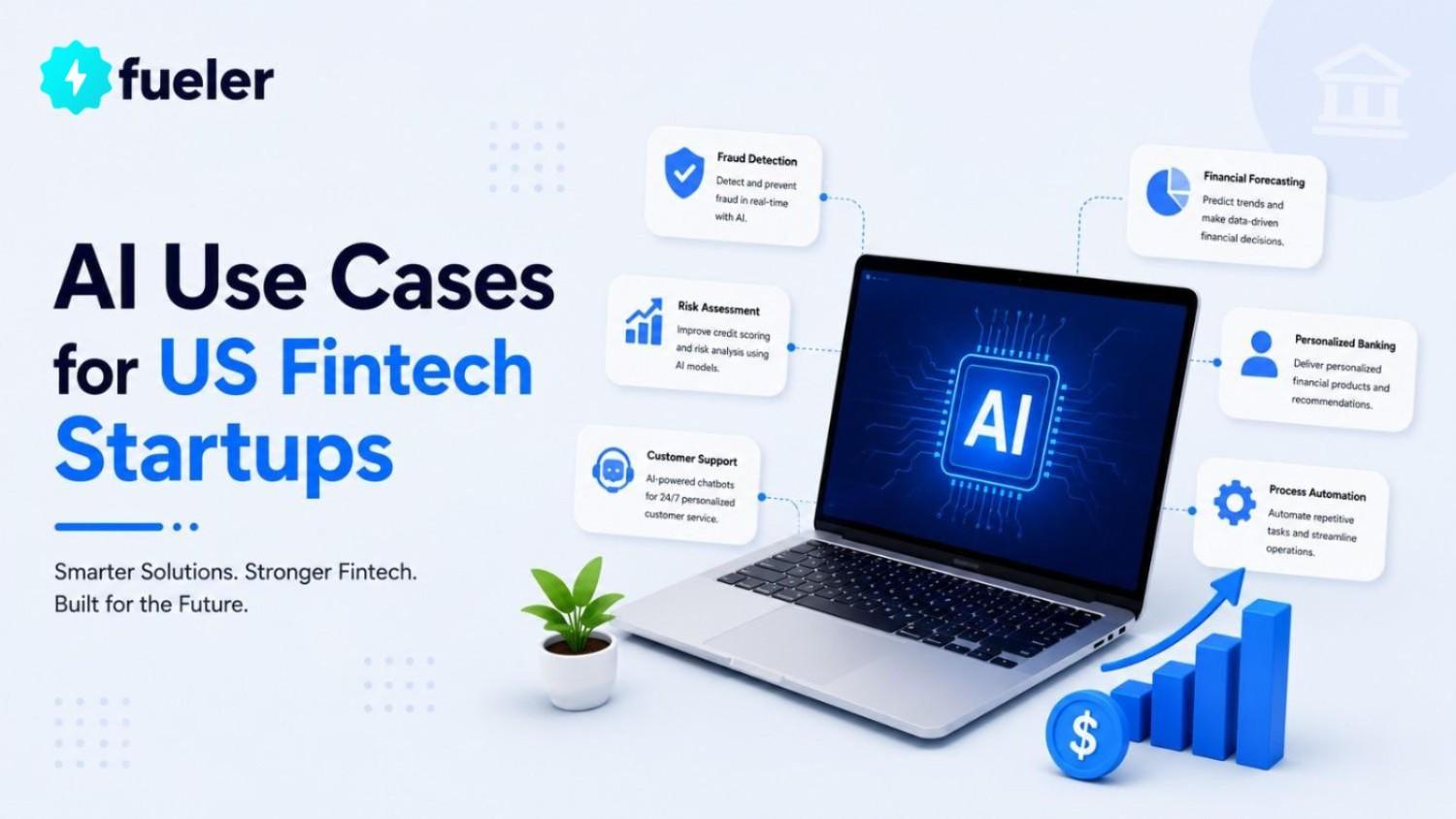
Transforming Fintech with AI: The Strategic Edge for US Startups
In 2025, the fintech landscape is being reshaped by artificial intelligence, decisively changing how startups operate, compete, and innovate. AI offers US fintech startups unprecedented capabilities from preventing fraud and streamlining compliance to personalizing customer experiences and forecasting market risks. Beyond hype, these technologies are rapidly becoming essential tools for survival and growth in an ultra-competitive finance market. This article dives deep into the most impactful AI use cases driving fintech transformation now, providing detailed examples and insights entrepreneurs can leverage to lead in the digital finance revolution.
I’m Riten, founder of Fueler - a skills-first portfolio platform that connects talented individuals with companies through assignments, portfolios, and projects not just resumes/CVs. Think Dribbble/Behance for work samples + AngelList for hiring infrastructure
1. Protecting Against Growing Fraud with Advanced AI Detection Systems
Financial fraud represents a billion-dollar threat yearly. US fintech startups harness AI to detect and stop fraud in real time, beyond conventional manual or rules-based systems.
In-Depth Use Case: Darktrace
- Darktrace uses unsupervised machine learning that mimics an immune system, learning normal transaction patterns for each user and constantly adapting to new threats.
- In practice, a leading US payment platform reduced fraud losses by 40% within six months by deploying Darktrace’s AI, which flagged even the most sophisticated money laundering tactics missed by legacy systems.
- The system captures behavioral biometrics, analyzing how users interact with devices detecting subtle anomalies like speed of typing or unusual navigation that signal potential fraudsters.
- Darktrace also integrates seamlessly with encryption protocols, analyzing traffic patterns without exposing sensitive customer data.
- Ongoing model self-improvements allow instant detection of new attack vectors, maintaining superior defense levels.
Why it Matters: Fighting fraud proactively retains user trust and reduces costly financial and reputational risks, enabling fintech startups to scale confidently.
2. Revolutionizing Identity Verification and KYC Compliance
Speed and accuracy in customer onboarding directly impact fintech growth. AI disrupts traditional labor-intensive KYC processes by automating identity verification with unmatched precision.
In-Depth Use Case: Onfido
- Onfido’s AI-powered platform leverages cutting-edge computer vision to authenticate identity documents, passports, and driver's licenses in seconds.
- An innovative challenger bank in the US reported onboarding customers in under five minutes, dramatically raising conversion rates and decreasing abandonment during signup.
- Facial recognition with liveness detection ensures the applicant matches the submitted documents, preventing spoofing attacks.
- NLP algorithms extract data automatically from unstructured documents, reducing manual errors and compliance bottlenecks.
- The AI cross-references international sanction lists and blacklists instantly, flagging high-risk applicants automatically.
Why it Matters: Speeding trustworthy onboarding enhances customer acquisition while meeting rigorous regulatory AML/KYC demands at scale.
3. Democratizing Wealth Management with Robo-Advisors
AI-powered robo-advisors break down barriers to investing, delivering personalized, affordable financial planning universally.
In-Depth Use Case: Betterment
- Using machine learning models, Betterment tailors portfolios dynamically by analyzing client risk appetite, income, expenses, and external market data.
- During volatile markets, Betterment employs AI to send behavioral nudges, helping investors avoid panic selling fueled by emotional bias.
- The robo-advisor regularly rebalances portfolios by identifying shifts in market conditions and emerging asset classes through AI analytics.
- Conversational AI chatbots provide 24/7 support, answering complex financial questions and guiding clients with contextual advice.
- AI-driven sentiment analysis of news and social conversations informs investment strategies, offering clients better risk management.
Why it Matters: These scalable AI tools enable fintech startups to attract a younger, tech-savvy customer base by making investing simpler, smarter, and more personalized.
4. Expanding Credit Access Through Machine Learning
Traditional credit scoring excludes millions; AI leverages alternative data and dynamic modeling to include more borrowers safely. These techniques now assess everything from employment patterns to the longevity data Abacus Global uses for life insurance portfolios, demonstrating AI's capacity to make diverse information sources financially predictive.
In-Depth Use Case: Upstart
- Upstart collects diverse data points like educational background, employment history, and digital footprints to build comprehensive borrower profiles beyond FICO scores.
- Their proprietary AI underwriting model predicts default probability far more accurately, reducing risky loans by up to 75% compared to traditional methods.
- Real-time credit decisions enable loan approvals in minutes, significantly improving customer experience.
- Loan terms adjust dynamically per borrower risk, promoting affordability and reducing defaults.
- Continuous machine learning retrains models on repayment data, improving accuracy and opening credit to underserved communities.
Why it Matters: AI enhances financial inclusion while safeguarding lender interests, unlocking vast new markets for fintech startups.
5. Streamlining Regulatory Compliance with NLP and Automation
Fintech startups navigate intense regulatory frameworks; AI simplifies compliance through automation and intelligent monitoring.
In-Depth Use Case: ComplyAdvantage
- Their AI-powered platform uses NLP to analyze policies, legislation, and sanctions lists worldwide, quickly updating compliance databases.
- Transaction monitoring leverages AI to detect suspicious activities, automatically generating reports and audit trails needed for regulators.
- An AI system constantly scans news, financial statements, and third-party sources to flag emerging risks or politically exposed persons.
- AI automation cuts manual compliance workloads by 70%, allowing teams to focus on strategic risk management.
- The platform’s precision reduces false positives, decreasing investigation times and customer friction.
Why it Matters: AI-enabled compliance reduces fines, speeds audits, and offers fintech startups confidence to innovate within regulatory boundaries.
6. Enhancing Customer Experience with Conversational AI
AI-powered virtual assistants drastically improve fintech customer support scalability and quality.
In-Depth Use Case: IPsoft’s Amelia
- Amelia understands natural language, context, and emotions to hold conversations indistinguishable from humans in multiple languages.
- A US digital bank reports Amelia resolves 70% of customer queries autonomously, cutting response times by over 50%.
- The AI seamlessly switches between scripted FAQs and creative problem solving for issues like loan applications or fraud disputes.
- Silent learning capabilities continuously improve responses based on user behavior and feedback.
- Integration with CRM and backend systems enables real-time account updates and transaction support within dialogues.
Why it Matters: Conversational AI boosts satisfaction, reduces operational costs, and allows human agents to focus on high-impact cases.
7. Predicting Market Trends and Risks with AI Analytics
AI empowers fintechs with predictive intelligence for market volatility and operational risk management.
In-Depth Use Case: Kensho Technologies
- Kensho’s AI interprets massive financial, economic, and unstructured data streams to forecast asset price movements and economic shocks.
- Fintechs utilize Kensho’s tools to rapidly respond to geopolitical events or regulatory changes impacting investments.
- Predictive risk models flag client portfolios at risk, enabling proactive asset rebalancing.
- AI-powered visual dashboards make complex data comprehensible for executives by surfacing key risk insights immediately.
- Kensho’s explainable AI provides transparency, critical for regulatory trust.
Why it Matters: AI-driven forecasting enables nimble fintech responses to uncertainty, preserving client value and driving competitive advantage.
Fueler: Validating AI Expertise with Proven Fintech Projects
Before concluding, Fueler offers fintech startups a unique advantage helping them connect with verified AI talent showcasing real project results. In an AI-powered industry, proof of ability is as critical as skills claims. Fueler’s portfolio-based approach accelerates fintech hiring by highlighting professionals who have successfully delivered impactful AI solutions, enabling startups to build robust, cutting-edge teams.
Final Thoughts
AI has moved from innovation buzzword to foundational fintech driver. US startups harness AI in fraud defense, onboarding, investing, lending, compliance, customer service, and predictive analytics to unlock unprecedented operational agility and client trust. The real winners in 2025 are fintech startups that not only adopt AI but blend it with proven skills and transparent validation via platforms like Fueler. This holistic AI-empowered approach promises to power the future of finance with speed, fairness, and intelligence.
FAQs
1. What are the top AI use cases transforming US fintech startups?
Fraud detection, identity verification, robo-advisory, AI-powered credit scoring, compliance automation, conversational AI, and predictive analytics.
2. How does AI enhance fraud prevention in fintech?
By learning transaction patterns and detecting anomalies in real time beyond rule-based methods, reducing losses dramatically.
3. Can AI make lending fairer to underbanked populations?
Yes, by analyzing alternative data and dynamically assessing risk, AI expands credit access while safeguarding lenders.
4. How do conversational AI chatbots improve fintech customer support?
They provide instant, natural, and scalable service around the clock, resolving routine queries without human delays.
5. Why is validated AI expertise important in fintech hiring?
Proof-backed portfolios ensure hires have delivered real-world solutions, reducing recruitment risks and accelerating innovation.
What is Fueler Portfolio?
Fueler is a career portfolio platform that helps companies find the best talent for their organization based on their proof of work. You can create your portfolio on Fueler, thousands of freelancers around the world use Fueler to create their professional-looking portfolios and become financially independent. Discover inspiration for your portfolio
Sign up for free on Fueler or get in touch to learn more.

What should you do next?
You've read the article. Now turn your skills into proof of work and unlock more opportunities.
Build your proof of work portfolio
Create a clean portfolio with projects, assignments, resumes, and AI stack details that companies actually want to see.
Create your Fueler portfolio →Apply through assignments, not resumes
Stand out by solving real tasks from companies hiring on Fueler.
Explore assignments →Get discovered by companies
Make your work public and let recruiters discover your skills through actual projects instead of keywords.
Get discovered →
