Best AI Tools Used in US Healthcare in 2026

Riten Debnath
15 Jan, 2026
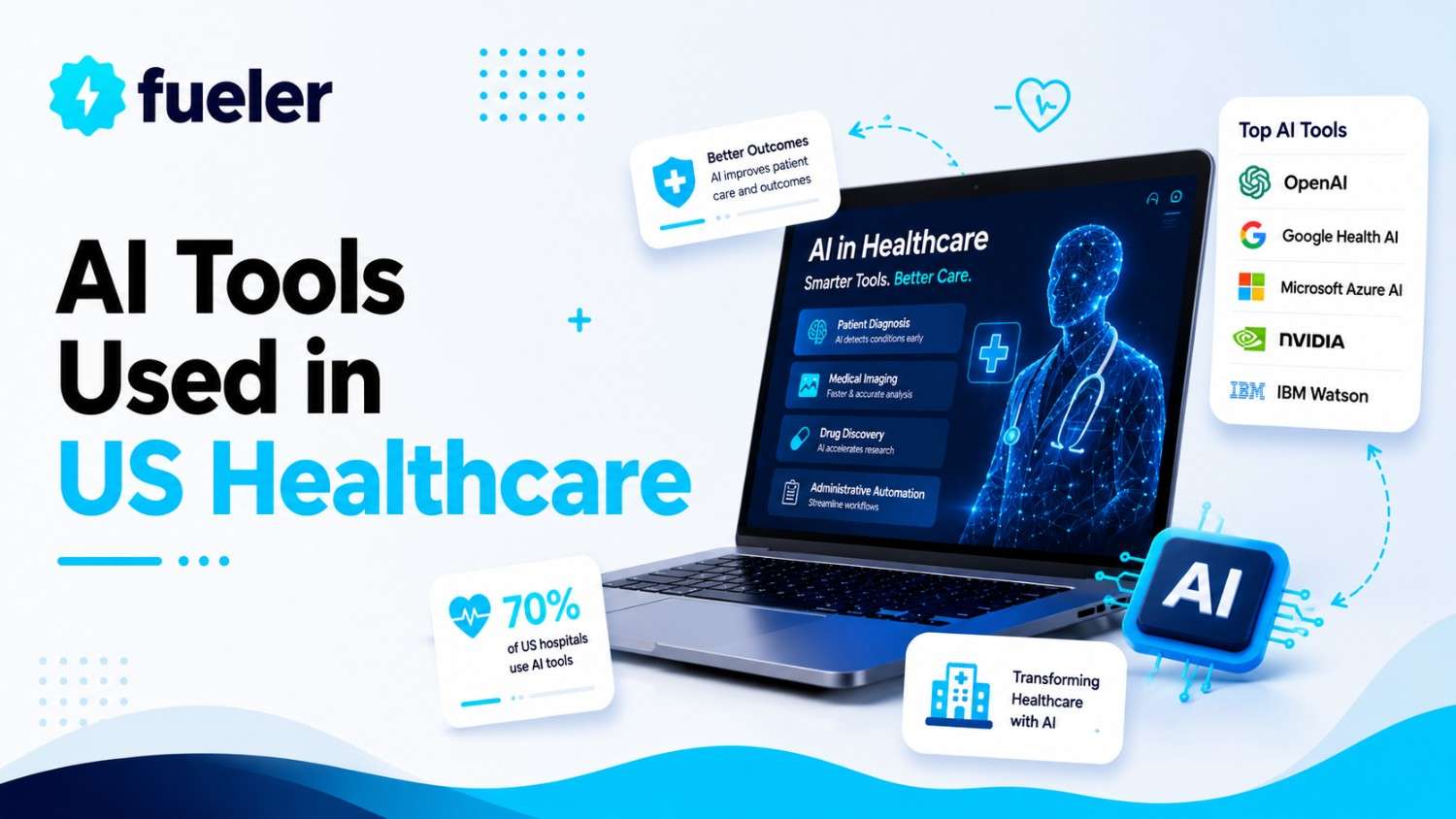
The healthcare sector in the United States is no longer just about stethoscopes and clipboards, it is being completely rewritten by the power of Artificial Intelligence. In 2026, we are seeing a shift where AI is not a experimental "nice-to-have" but a core requirement for any hospital system that wants to survive the rising costs and staffing shortages. From ambient listening tools that write medical notes in real-time to predictive models that can spot a stroke before a doctor even looks at the scan, these technologies are saving thousands of hours and, more importantly, thousands of lives every single day.
I’m Riten, the founder of Fueler - a skills-first portfolio platform that connects talented individuals with companies through assignments, portfolios, and projects, not just resumes/CVs. Think Dribbble/Behance for work samples + AngelList for hiring infrastructure.
1. Microsoft Nuance DAX Copilot
Nuance DAX Copilot has become the industry leader in "ambient clinical intelligence," effectively ending the era of doctors spending hours typing into computers after their shift. The AI works by securely listening to the conversation between a physician and a patient during a visit and automatically generating a structured, clinical-grade medical note. This allows the doctor to maintain eye contact and build a real human connection with the patient, knowing that the complex medical documentation is being handled accurately in the background by a system trained on millions of clinical encounters.
- The tool uses advanced natural language processing to distinguish between casual small talk and critical medical symptoms, ensuring that only relevant data is included in the final clinical note.
- It integrates directly with over 200 different Electronic Health Record (EHR) systems, including major players like Epic and Cerner, allowing the AI-generated notes to flow seamlessly into the patient's permanent record.
- Clinicians report saving an average of seven minutes per patient encounter, which adds up to nearly three hours of reclaimed time in a typical busy workday for a primary care physician.
- The system is built on the Microsoft Azure cloud, which provides enterprise-grade security and HITRUST certification to ensure that sensitive patient data remains private and compliant with federal regulations.
- Doctors can review and sign off on the generated notes in real-time using a mobile app, making it easy to finish all their paperwork before they even leave the clinic for the day.
Pricing: * Monthly Subscription: Approximately $369 per month per provider.
- Annual Commitment: Roughly $4,428 per year.
- Enterprise Setup: Custom pricing available for large hospital networks.
Why it matters: This tool matters because "physician burnout" is one of the biggest crises in the US healthcare system today. By removing the administrative weight of documentation, DAX Copilot allows doctors to actually be doctors again, improving both the quality of care and the mental health of our medical workforce.
2. Viz.ai (AI-Driven Stroke Coordination)
In the world of stroke care, there is a famous saying that "time is brain," and Viz.ai is the tool that ensures not a single second is wasted. This AI platform acts as a digital watchman for hospital imaging systems, scanning every CT scan the moment it is finished to look for signs of a major blood vessel blockage. If it detects a stroke, it doesn't wait for a radiologist to find it, it pushes an instant alert to the entire neurovascular team's smartphones, allowing them to coordinate surgery in minutes rather than hours.
- The AI is FDA-cleared to detect Large Vessel Occlusions (LVOs) and hemorrhages with extreme precision, often identifying a stroke faster than a human could open the digital file.
- It creates a synchronized workspace where surgeons, nurses, and neurologists can view the actual medical images on their phones and chat securely about the best treatment plan for the patient.
- The platform coordinates care between smaller "spoke" hospitals and larger "hub" surgical centers, automating the complex process of transferring a patient for life-saving emergency surgery.
- It includes advanced tools for measuring tissue perfusion, which helps doctors see exactly how much of the brain is at risk and whether a specific procedure is likely to be successful.
- By streamlining the communication chain, the platform has been shown to reduce the time to treatment by over an hour, which significantly increases the patient's chances of a full recovery.
Pricing: * Annual Hospital License: Typically starts at $25,000 and can exceed $100,000 depending on the volume of patients.
- Per-Case Model: Some smaller facilities use a modular pricing structure based on specific AI packages.
Why it matters: Viz.ai matters because it solves the "communication bottleneck" that often leads to permanent disability or death in stroke patients. It is a prime example of how AI can unite a medical team across different buildings to act as one single, high-speed life-saving unit.
3. PathAI (AI-Powered Pathology)
Pathology is the foundation of cancer diagnosis, but it has traditionally relied on doctors looking through microscopes at glass slides, a process that is slow and prone to human error. PathAI is digitizing this entire field by using deep learning to analyze high-resolution digital images of tissue samples to help pathologists identify cancer cells more accurately. The AI can spot subtle patterns and "biomarkers" that are nearly invisible to the human eye, ensuring that every patient gets the most precise diagnosis possible for their specific type of cancer.
- The AISight platform acts as a central hub for digital pathology, allowing labs to manage cases, view images, and run AI diagnostic tools all within a single cloud-native environment.
- It uses a "contributor network" of hundreds of board-certified pathologists to train its algorithms on millions of data points, making it one of the most reliable diagnostic aids in the world.
- The software can automatically quantify the amount of a specific protein or cell type in a sample, providing a level of mathematical precision that manual counting simply cannot match.
- It helps biopharma companies speed up clinical trials by identifying the exact patients who are most likely to respond to a new experimental drug based on their tissue profile.
- Pathologists can use the AI to triage their workload, focusing their attention on the most complex and high-risk cases while the AI handles the routine screening and measurements.
Pricing: * Subscription-Based: Varies widely based on lab size and the number of "suites" (Prostate, Breast, GI) activated.
- Enterprise License: Usually ranges from $50,000 to $250,000 per year for large diagnostic centers.
Why it matters: Cancer treatment is becoming "personalized," but you cannot have personalized treatment without a personalized diagnosis. PathAI matters because it provides the data-driven certainty needed to choose the right therapy the first time, potentially saving patients from the side effects of ineffective treatments.
4. Tempus (Precision Medicine & Genomics)
Tempus is building the world's largest library of clinical and molecular data to help doctors treat every patient as a unique individual rather than a statistic. By using AI to analyze a patient's genetic code alongside their medical history, Tempus can predict which medications will work best for them and which ones might cause dangerous side effects. This is especially revolutionary in oncology and psychiatry, where finding the right drug often involves a long and painful process of trial and error that patients simply cannot afford.
- The platform sequences the DNA and RNA of a patient’s tumor to identify specific mutations that can be targeted by modern "smart drugs" or immunotherapy treatments.
- It provides a "Clinical Decision Support" dashboard that ranks different treatment options based on how well they worked for other patients with the exact same genetic profile.
- Tempus integrates directly with hospital records to track how a patient is actually responding to a drug in the real world, constantly updating its AI models with new success data.
- The system helps match patients with clinical trials for new drugs that are specifically designed for their unique genetic makeup, giving them access to cutting-edge medicine.
- In psychiatry, the Tempus nP test helps doctors understand how a patient’s body processes common medications for depression and anxiety, reducing the risk of bad reactions.
Pricing: * Genetic Testing: Often covered by insurance, but out-of-pocket costs for specific panels can range from $250 to $3,000.
- Hospital Data Partnerships: Custom enterprise pricing for access to the broader data library and analytical tools.
Why it matters: We are moving away from "one-size-fits-all" medicine. Tempus matters because it uses AI to turn vast amounts of complex biological data into a simple, actionable plan that gives every American patient the best chance at a long and healthy life.
5. Keragon
Keragon is a healthcare-focused automation and integration platform designed to eliminate the manual, repetitive administrative work that slows down modern clinics and digital health teams. Instead of asking staff to juggle disconnected systems, Keragon securely connects EHRs, CRMs, billing tools, scheduling platforms, and other healthcare apps so data flows automatically between them. This allows clinical and operations teams to focus on patient care rather than copying information across multiple dashboards.
- The platform uses pre-built, HIPAA-compliant connectors to integrate with popular healthcare systems and enables teams to design automated workflows using a no-code/low-code builder.
- It supports automated patient intake routing, appointment synchronization, eligibility checks, billing triggers, and care coordination workflows across connected systems.
- By reducing manual data entry and eliminating duplicate records, organizations can significantly cut down administrative hours and reduce costly human errors.
- Keragon is built on secure cloud infrastructure with encrypted data processing and strict access controls to maintain compliance with healthcare privacy standards such as HIPAA.
Operations and clinical teams can monitor, adjust, and deploy workflow automations without relying heavily on engineering resources, accelerating implementation timelines.
Pricing:
- Subscription-Based Model: Custom pricing based on number of integrations, workflow volume, and organization size.
- Startup & Growth Plans: Scalable tiers for digital health companies and multi-location clinics.
- Enterprise Setup: Custom implementation and integration packages for larger health systems.
Why it matters: Administrative burden is one of the biggest cost drivers in healthcare today. By automating how data moves between critical systems, Keragon reduces operational friction, improves accuracy, and helps healthcare organizations scale without proportionally increasing headcount.
6. Aidoc (Radiology Workflow AI)
Radiologists in the US are currently facing a massive backlog of scans, which can lead to fatigue and the possibility of missing small but critical details. Aidoc is an "always-on" AI assistant that works in the background of a hospital's imaging network, constantly scanning every X-ray and CT scan for urgent findings. When the AI spots something like a brain bleed or a pulmonary embolism, it automatically moves that patient to the very top of the doctor's "to-do" list, ensuring the most sick people are seen first.
- The system is designed to be "vendor-neutral," meaning it works with any brand of CT or MRI machine, allowing a whole hospital system to be protected by the same AI safety net.
- It includes specialized modules for a wide range of conditions, including spinal fractures, abdominal air, and various types of blood clots in the lungs or brain.
- The AI provides a "pre-read" that highlights the area of concern on the image, helping the radiologist confirm the diagnosis much faster than if they were starting from scratch.
- It tracks the time it takes for a doctor to open a "flagged" scan, providing valuable data to hospital leadership about where their emergency workflows might be slowing down.
- The platform is continuously updated via the cloud, meaning the AI is always getting smarter as it sees more diverse cases from hospitals all across the country.
Pricing: * Enterprise Subscription: Often starts at $50,000 per year for a mid-sized hospital and scales based on the number of AI modules used.
- Implementation Fee: Usually includes a one-time setup cost for integrating with the hospital's PACS (Picture Archiving and Communication System).
Why it matters: This is about "smart triaging." Aidoc matters because it prevents patients with life-threatening emergencies from sitting in a digital queue for hours, literally changing the order of care to save the most lives in the shortest amount of time.
7. DeepScribe (Specialty-Specific Ambient AI)
While some tools are general, DeepScribe has carved out a niche by providing "ambient AI" that is specifically tuned for complex medical specialties like oncology, orthopedics, and cardiology. It understands the specific jargon and the unique way these specialists talk to their patients, which leads to much more accurate and useful medical notes. By focusing on the "heavy lifting" of specialty documentation, it helps highly-trained surgeons and experts focus on their patients' complex needs rather than their keyboards.
- The AI is trained on hundreds of thousands of specialty-specific visits, allowing it to correctly document complex drug regimens and surgical plans that general AI might struggle with.
- It offers "HealAI" features that can suggest the correct medical codes (ICD-10) for billing based on the conversation, which helps doctors get paid faster and reduces insurance denials.
- The platform features deep integration with specialty EHRs like Flatiron (for cancer care), ensuring that the data ends up exactly where the specialist needs it without any manual copy-pasting.
- Patients often feel more comfortable because the doctor is more engaged in the conversation, leading to higher "patient satisfaction scores" for the clinic or hospital.
- It provides a web-based dashboard where doctors can quickly edit and refine their notes, with the AI learning from their corrections to become more accurate over time.
Pricing: * Per-Visit Pricing: Can be as low as $3 per encounter for certain plans.
- Monthly Subscription: Often customized for the specific specialty, ranging from $150 to $400 per month.
Why it matters: Specialty care is where the most expensive and complex medical decisions are made. DeepScribe matters because it ensures that these critical details are captured accurately and efficiently, reducing the risk of errors in the most sensitive areas of medicine.
8. Suki (AI Assistant for Healthcare)
Suki is designed to be the "Alexa or Siri" for doctors, providing a voice-controlled assistant that can help with everything from writing notes to looking up lab results. It is built to be used on the go, allowing a doctor to dictate orders or check a patient's history while walking between hospital rooms. Because it is powered by advanced generative AI, Suki can answer questions like "What was this patient's last blood pressure reading?" and get an instant answer from the medical record.
- The "Suki Assistant" uses medically-tuned Large Language Models (LLMs) to understand complex spoken commands, allowing doctors to work completely hands-free during a procedure.
- It features a unique "pre-charting" function where the AI prepares a summary of the patient's history before the doctor even walks into the room, saving valuable prep time.
- The tool is highly bidirectional, meaning it can both pull information out of the medical record and push new notes or orders back into it with a simple voice command.
- An AAFP study showed that using Suki led to a 72% reduction in the time doctors spent on documentation, which is one of the highest efficiency gains in the industry.
- It supports multiple languages and can handle a variety of accents, ensuring that it works reliably for the diverse range of doctors working in the US healthcare system.
Pricing: * Monthly Subscription: Generally around $200 per month per user.
- Free Trial: Many clinics start with a 30-day pilot program to test the efficiency gains before committing to a full rollout.
Why it matters: Suki matters because it represents the future of "mobile" healthcare. It turns the medical record from a static database into a helpful partner that doctors can talk to, making the entire workday feel much more fluid and modern.
9. Olive (AI Automation for Operations)
Healthcare isn't just about what happens in the exam room; it is also about the massive amount of "back-office" work, like insurance claims, billing, and supply chain management. Olive is an AI platform designed to automate these repetitive administrative tasks, which are often the cause of high costs and slow services in US hospitals. By using "AI Workers" to handle the boring paperwork, Olive allows the human staff to focus on solving complex problems and providing a better experience for the patients.
- The platform uses robotic process automation (RPA) combined with AI to log into different insurance websites and check the status of a patient's coverage automatically.
- It can identify and fix errors in medical bills before they are sent out, which drastically reduces the number of "denied claims" that hospitals have to fight with insurance companies.
- Olive’s "Agentic AI" can proactively alert a hospital's pharmacy if they are running low on a critical medication, even placing the order automatically to prevent a shortage.
- The system connects disparate legacy software programs that don't normally talk to each other, acting as a "digital bridge" that keeps data flowing across the entire hospital system.
- Hospital administrators can track the "ROI" of their AI workers in real-time, seeing exactly how many hours and dollars are being saved by the automation platform.
Pricing: * Modular Pricing: Starts at $19 per user for specific "agents" like Meeting Assistant or CRM Manager.
- Enterprise Solutions: Large-scale automation for hospitals typically involves custom multi-year contracts ranging from $50,000 to over $500,000.
Why it matters: A huge portion of the US healthcare budget is wasted on administrative "bloat." Olive matters because it uses AI to prune that waste, making the entire business of healthcare more efficient so that more money can be spent on actually treating patients.
10. Paige (AI for Cancer Pathology)
Paige is one of the most advanced AI tools specifically designed to help pathologists detect and classify cancer in tissue samples with incredible speed. It was the first company to receive FDA approval for an AI-based pathology tool, and its "PanCancer Suite" can now help identify cancer across multiple different organs, including the prostate, breast, and gastrointestinal tract. By acting as a "co-pilot" for the pathologist, Paige ensures that even the most subtle signs of a tumor are brought to the doctor's attention for a final review.
- The "Virchow" foundation model is trained on over 1.5 million pathology slides, making it one of the most "medically intelligent" computer models ever built for cancer detection.
- The Paige Alba feature allows pathologists to use voice and text commands to ask the AI for specific insights, such as "find the most aggressive cells in this biopsy."
- It provides a "heat map" on the digital slide that shows the pathologist exactly where the suspected cancer is located, saving them from having to scan every inch of the slide manually.
- The platform can reveal molecular biomarkers directly from standard tissue images, which used to require separate, expensive, and time-consuming genetic tests.
- It integrates with modern digital scanners, allowing a lab to move from traditional glass slides to a fully digital workflow that is faster, safer, and easier to share with other experts.
Pricing: * Enterprise Subscription: Generally starts around $50,000 per year for a single "suite" (e.g., Prostate AI).
- Per-Slide Pricing: Available for smaller labs that want to pay only for the cases where the AI is actually used.
Why it matters: Cancer diagnosis is a high-stakes game where accuracy is everything. Paige matters because it gives pathologists a "second pair of eyes" that never gets tired, ensuring that every patient gets a world-class diagnosis regardless of how busy their local lab might be.
Show Your Value with a Professional Portfolio
Whether you are building the next AI model for a hospital or managing a digital health clinic, your skills are your most valuable asset. Fueler is the perfect platform to move beyond a boring text-only resume and showcase the actual impact of your work. By creating a skills-first portfolio, you can document your projects, upload your code samples, and show hiring managers exactly how you have contributed to the healthcare technology space. In a world where AI is changing everything, a dynamic portfolio is the best way to prove that you have the hands-on experience that modern companies are looking for.
Final Thoughts
The AI tools used in US healthcare in 2026 are not just futuristic concepts, they are the new backbone of our entire medical system. These technologies are tackling the biggest problems we face: doctor burnout, high costs, and the need for faster, more accurate diagnoses. By choosing the right AI partners, hospitals are transforming from reactive institutions into proactive centers of health. As we look forward, the combination of human empathy and AI precision will define the next decade of American medicine, making "better health for all" a tangible reality rather than just a goal.
FAQs
What are the best free AI tools for healthcare students in 2026?
While most professional medical AI tools are expensive, students can often access educational versions of platforms like Butterfly Network or use the free tier of Doxy.me to learn about telehealth. Additionally, many universities now provide access to medical LLMs and research-focused AI databases that allow students to practice with real-world data in a safe, simulated environment.
Is AI in healthcare HIPAA-compliant and secure for patient data?
Yes, every major AI tool used in US healthcare, such as Nuance DAX or Viz.ai, is built with strict adherence to HIPAA regulations and often carries HITRUST certification. This means that all data is encrypted at rest and in transit, and the AI providers have strict legal agreements with hospitals to ensure that patient privacy is never compromised during the data analysis process.
How does AI help reduce the cost of healthcare for the average American?
AI reduces costs by making the system more efficient—for example, by automating boring paperwork via tools like Olive or by preventing expensive hospital stays through early detection with tools like Aidoc. When doctors spend less time on admin and hospitals can treat patients faster and more accurately, the overall "cost of care" goes down, which eventually leads to lower insurance premiums and out-of-pocket costs.
Can AI replace my doctor in the near future?
The short answer is no; AI is designed to be a "co-pilot" or a "tool" that assists your doctor, not a replacement for human judgment and empathy. While AI can analyze data and spot patterns faster than a human, the final medical decisions and the physical care of the patient will always require a licensed professional who understands the unique personal and emotional needs of each individual.
How do hospitals pay for these expensive AI healthcare tools?
Hospitals often pay for these tools through annual subscription fees or "value-based" models where the tool pays for itself by saving time or preventing costly medical errors. In many cases, insurance companies like Medicare now offer "reimbursement codes" for using AI tools (like remote patient monitoring), meaning the hospital can actually get paid back for using this high-tech equipment to provide better care to their patients.
What is Fueler Portfolio?
Fueler is a career portfolio platform that helps companies find the best talent for their organization based on their proof of work. You can create your portfolio on Fueler. Thousands of freelancers around the world use Fueler to create their professional-looking portfolios and become financially independent. Discover inspiration for your portfolio
Sign up for free on Fueler or get in touch to learn more.

What should you do next?
You've read the article. Now turn your skills into proof of work and unlock more opportunities.
Build your proof of work portfolio
Create a clean portfolio with projects, assignments, resumes, and AI stack details that companies actually want to see.
Create your Fueler portfolio →Apply through assignments, not resumes
Stand out by solving real tasks from companies hiring on Fueler.
Explore assignments →Get discovered by companies
Make your work public and let recruiters discover your skills through actual projects instead of keywords.
Get discovered →
