Best AI Agent Use Cases for Startups and Enterprises in 2026

Riten Debnath
22 Feb, 2026
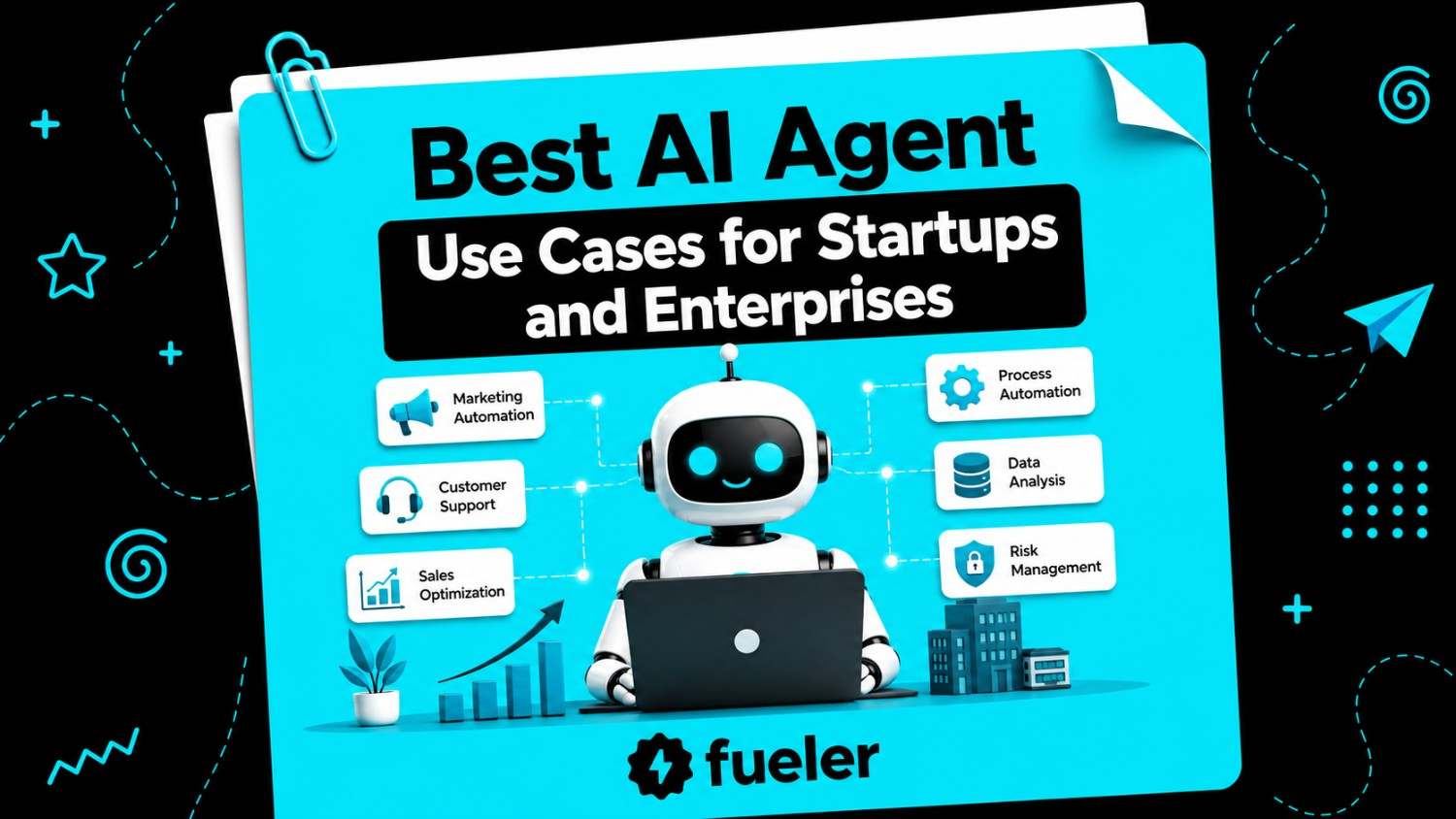
The conversation around AI has officially shifted from "what can it say?" to "what can it accomplish?" In 2026, we are no longer impressed by a chatbot that summarizes a meeting; we are looking for the autonomous agent that attended the meeting, identified the action items, updated the project management board, and followed up with the stakeholders to ensure the work was moving forward. For startups and enterprises alike, the implementation of these autonomous systems is no longer a luxury; it is a survival mechanism. This guide explores the high-impact use cases that are defining the professional landscape this year, showing you exactly where digital labor is delivering the highest return on investment.
I’m Riten, founder of Fueler, a skills-first portfolio platform that connects talented individuals with companies through assignments, portfolios, and projects, not just resumes/CVs. Think Dribbble/Behance for work samples + AngelList for hiring infrastructure.
1. Autonomous Sales Development Representatives (ASDRs)
In 2026, the "cold outreach" game has been completely transformed by agents that can research a lead with more depth than a human ever could in ten times the time. These agents don't just send mass emails; they analyze a prospect's recent LinkedIn posts, their company’s quarterly earnings, and even their podcast appearances to craft a message that feels genuinely personal. For startups with limited budgets, these agents act as a 24/7 sales team that never burns out and constantly fills the pipeline with high-quality opportunities.
- Hyper-Personalized Lead Research: These agents scan thousands of data points across the open web to find "trigger events" that make a prospect likely to buy right now. Instead of generic templates, the agent writes a unique opening line based on a specific achievement or pain point the prospect recently mentioned. This level of detail has moved email open rates from the industry average of 20% to over 60% for companies using autonomous sales systems.
- Autonomous Multi-Channel Follow-Ups: An agent doesn't just stop at one email; it coordinates a "dance" across LinkedIn, email, and even specialized industry forums. It knows exactly when to nudge a prospect and when to back off based on the prospect's digital behavior. This persistent but polite orchestration ensures that no lead falls through the cracks, maximizing the "Lifetime Value" of every single contact in your database.
- Instant Lead Qualification and Booking: When a prospect finally responds with a question, the agent answers it immediately using its deep knowledge of your product documentation. If the prospect is a good fit, the agent autonomously checks your calendar and sends a booking link, handling the entire scheduling process in seconds. This removes the "friction" that usually kills deals in the early stages, ensuring your sales calls are only with highly qualified buyers.
- CRM Enrichment and Data Hygiene: One of the biggest headaches for sales managers is keeping the CRM updated, but AI agents handle this as a background task. Every interaction, every change in job title, and every company news update is automatically logged into systems like Salesforce or HubSpot. This ensures your sales data is always "pristine," allowing for more accurate forecasting and better strategic decision-making at the leadership level.
- Real-Time Competitor Monitoring: Your sales agent can be programmed to watch your competitors' websites and social media for price changes or new feature launches. It can then automatically update your sales scripts with "rebuttal" points to help your team handle objections more effectively. This "competitive intelligence" gives your startup an unfair advantage by ensuring you are always one step ahead in the market.
Why it matters:
This use case is a primary driver for startup growth in 2026 because it turns "outreach" into a predictable, scalable science. Implementing this level of automation is a major career milestone that you should document in your professional portfolio to show you can drive revenue.
2. The Autonomous "Level 1" Software Engineer
Enterprises are now using agents to handle the "maintenance" work that typically drains the productivity of senior developers. These agents live inside the codebase, constantly hunting for bugs, updating outdated libraries, and writing unit tests for new features. This isn't just "auto-complete" like the tools of 2024; these are systems that understand the entire architecture of a project and can make complex, multi-file changes to improve performance and security.
- Autonomous Bug Detection and Patching: When a crash occurs in production, the agent doesn't just alert a human; it analyzes the error log, finds the faulty code, and writes a pull request to fix it. It then runs a full suite of tests to ensure the fix doesn't break any other part of the system. This "self-healing" code significantly reduces downtime and allows human engineers to sleep through the night while the AI handles the emergencies.
- Legacy Code Refactoring and Migration: Many large enterprises are stuck with old "technical debt" that is too expensive to fix manually, but AI agents can systematically refactor it. An agent can translate old COBOL or Java code into modern, high-performance Rust or Python, module by module. This allows companies to modernize their infrastructure in months rather than years, saving millions of dollars in maintenance costs.
- Real-Time Security Vulnerability Scanning: Agents act as a 24/7 security guard for your code, checking every new line for potential "holes" that hackers could exploit. They stay updated on the latest global security threats and automatically apply patches to your systems before the vulnerability can be used against you. This proactive defense is essential in 2026, where cyber-attacks are increasingly launched by AI themselves.
- Automated Technical Documentation: Most developers hate writing documentation, but agents can generate it perfectly by "reading" the code itself. They create API guides, ReadMe files, and architectural diagrams that are always up to date with the latest version of the software. This ensures that new hires can get up to speed in days instead of weeks, greatly increasing the overall "velocity" of the engineering team.
- Intelligent Code Review and Mentorship: When a human developer submits code, the agent reviews it first, checking for style consistency and potential logic errors. It provides constructive feedback, almost like a "Pair Programmer," helping junior developers learn better coding practices in real-time. This "embedded mentorship" improves the overall quality of the codebase while freeing up senior leads for higher-level architectural decisions.
Why it matters:
For enterprises, this use case represents a massive shift in how software is maintained and scaled. Demonstrating your ability to manage a "fleet" of coding agents is a high-intent skill that proves you are a modern engineering leader.
3. Autonomous Customer Success and Retention Engines
Customer support has evolved from "answering tickets" to "ensuring success" through agents that monitor customer health in real-time. In 2026, an enterprise agent doesn't wait for a customer to complain; it notices when a user hasn't logged in for three days or is struggling with a specific feature. The agent then reaches out with a personalized video tutorial or a helpful tip to get them back on track, drastically reducing "churn" and increasing customer loyalty.
- Proactive "At-Risk" Intervention: By analyzing patterns in user behavior, the agent can predict which customers are likely to cancel their subscription weeks before they actually do. It can autonomously trigger a retention campaign, such as offering a temporary discount or a free strategy session with a human. This "predictive success" model turns a potential loss into an opportunity to deepen the customer relationship.
- Hyper-Personalized Onboarding Journeys: Every new customer has different goals, and AI agents can tailor the onboarding process to match them perfectly. The agent asks the user what they want to achieve and then guides them only through the features they need to see, ignoring the rest. This "concierge" experience ensures that users see the "value" of the product immediately, which is the most critical factor in long-term retention.
- Autonomous Expansion Discovery: While helping a customer, the agent can identify when they have "outgrown" their current plan and might need additional features. It can then gently suggest an upgrade or a specialized "add-on" that solves their specific problem. This "soft-sell" approach feels like helpful advice rather than a pushy sales pitch, leading to much higher conversion rates for upsells.
- Context-Aware Technical Troubleshooting: Unlike the chatbots of old, 2026 success agents can "look" at the user's screen or logs to see exactly where they are stuck. They don't give generic advice; they give specific, step-by-step instructions based on the user's current state. This "surgical" support resolves issues in minutes that used to take days of "back-and-forth" emails with a human support desk.
- Continuous Feedback Loop Synthesis: The agent listens to every customer interaction across chat, email, and social media to identify "feature requests" and "common frustrations." It then synthesizes this data into a weekly report for the product team, prioritizing what should be built next. This ensures the company's roadmap is always aligned with what the customers actually want and need.
Why it matters:
In the world of SaaS, retention is the most important metric, and agents are the most efficient way to maintain it at scale. Showing that you can design "Success Workflows" using AI is a powerful way to demonstrate your value to any high-growth enterprise.
4. The Autonomous "Strategic" Marketing Department
Startups are now running entire marketing departments with just one or two humans overseeing a dozen specialized agents. These agents handle everything from social media management and SEO content creation to "media buying" on platforms like Google and Meta. They don't just "schedule" posts; they analyze what is working in real-time and adjust the creative strategy autonomously to maximize the "Return on Ad Spend" (ROAS).
- Real-Time Content Generation and Optimization: Marketing agents monitor trending topics in your industry and can write, design, and post a relevant blog or social update in minutes. They then "watch" how the audience reacts and automatically tweak the headlines or images for the next post to get more engagement. This "iterative creativity" allows a startup to stay constantly visible without needing a massive creative agency.
- Autonomous Media Buying and Bidding: These agents manage your advertising budget with a level of precision no human can match. They adjust your "bids" for keywords every few seconds based on the latest data, ensuring you never overpay for a click. This "micro-management" of the budget allows startups to get much more "bang for their buck" and compete with much larger brands in the digital space.
- SEO Content Orchestration at Scale: An agent can research thousands of "long-tail" keywords and write high-quality, helpful articles that answer specific customer questions. These aren't just "AI-fluff" pieces; they are data-rich, structured guides that search engines love to rank. This allows a company to dominate the search results for their niche in a fraction of the time it used to take.
- Personalized "Email-as-a-Service": Instead of a weekly newsletter, the agent sends every subscriber a unique email based on what they've clicked on in the past. If a user is interested in "AI Agents," they get deep-dive technical content; if they are interested in "Business Impact," they get case studies. This "segmentation of one" ensures that your emails are always relevant and never seen as spam.
- Community Management and Social Listening: Agents can "listen" to conversations on platforms like Reddit, Twitter, and specialized forums to find where people are talking about your product. They can then draft a helpful response for a human to approve, ensuring the brand is always part of the conversation. This "organic" presence builds trust and credibility in a way that traditional ads simply can't.
Why it matters:
For startups, this use case represents the ability to "punch above their weight class." Being the person who can orchestrate a full-scale marketing agent team is a top-tier skill that you should highlight in your career portfolio on platforms like Fueler.
5. Autonomous "Operations and Logistics" Managers
In the enterprise world, agents are being used to manage the "physical" side of the business, supply chains, inventory, and logistics. These agents can communicate with thousands of suppliers, track shipments across the globe in real-time, and automatically re-order parts before they run out. They are the "digital nervous system" that keeps the company running smoothly, even when global trade is unpredictable.
- Predictive Inventory Management: By analyzing historical sales data and current market trends, the agent can predict exactly how much of a product you will need next month. It then autonomously places orders with suppliers to ensure you never run out of stock but also don't waste money on excess inventory. This "just-in-time" logic is essential for maintaining a healthy "cash flow" in large-scale enterprises.
- Autonomous Supplier Negotiation: Advanced agents can be programmed to "shop around" for the best prices and terms across hundreds of different suppliers. They can even engage in basic negotiations, asking for bulk discounts or better shipping times based on the company's past history with that supplier. This ensures the enterprise is always getting the best possible deal without a human having to make a single phone call.
- Real-Time Supply Chain Rerouting: If a major shipping port is closed or a storm is delaying a delivery, the agent identifies the problem immediately and finds an alternative route. It can autonomously re-book shipments on a different carrier or source the materials from a closer supplier to avoid a production shutdown. This "resilience" is a massive competitive advantage in a world of increasing global instability.
- Automated Invoicing and Payment Processing: The agent handles the entire "paperwork" side of logistics, from verifying that the correct items were received to triggering the payment to the supplier. This "zero-touch" accounting reduces errors, prevents fraud, and ensures that suppliers are always paid on time, which builds stronger long-term business relationships.
- Sustainability and Carbon Tracking: In 2026, many enterprises are required to report their "carbon footprint," and agents handle this automatically. They track the environmental impact of every shipment and every supplier, suggesting ways to reduce emissions by optimizing routes or changing materials. This ensures the company stays compliant with regulations while also appealing to "eco-conscious" consumers.
Why it matters:
This use case shows that agents are not just for "digital" work; they are essential for the physical economy as well. Mastering the integration of AI into supply chains is a high-value skill that defines the next generation of operations leaders.
Why Every Professional Needs a Digital Portfolio in the AI Era
As these 2026 use cases show, AI agents are taking over the "doing," which means your value as a human is now in the "directing." Employers are no longer looking for people who can write code or send emails; they are looking for people who can architect the systems where agents do those things. This is why Fueler is so important. It’s not just a resume; it’s a living record of your ability to manage autonomous systems. By showcasing your "Agent Orchestration" projects on Fueler, you prove to potential employers that you are the one who knows how to harness this power for business growth.
Final Thoughts
The real value of AI agents isn't in their "intelligence," but in their "autonomy." Whether you are a startup founder looking to scale or an enterprise leader looking to optimize, the use cases listed above provide a roadmap for the next three years of business growth. The transition from "Chatbots" to "Agents" is the most important shift in the history of work, and those who learn to lead these digital workers today will be the most successful professionals of tomorrow. Don't just watch the revolution happen, build the agents that drive it, and then show the world what you've built.
Frequently Asked Questions (FAQs)
What is the biggest difference between an AI agent and a traditional automated workflow?
A traditional workflow is "rigid"if this happens, then do exactly that. It can't handle surprises. An AI agent is "flexible"; it has a goal and a "reasoning engine" that allows it to figure out the best path to that goal, even if it encounters a problem it hasn't seen before. It can "improvise" using the tools you've given it, which makes it much more powerful for complex, real-world business tasks.
How do I know if my startup is ready for AI agents?
If your team is spending more than 30% of their time on "repetitive digital tasks"like data entry, researching leads, or answering the same customer questions over and over, you are ready. Start with one specific "pain point," build an agent to solve it, and once you see the "ROI" (Return on Investment), you can slowly expand to other areas of the business.
Are AI agents safe to use for sensitive enterprise data?
In 2026, the best agents will be built with "Privacy-First" architectures. This means they can process your data without ever "sending" it back to the big AI companies for training. You can use "local" or "private cloud" models to ensure your trade secrets and customer data stay entirely within your own secure servers, meeting even the strictest global data protection rules.
Do I need to hire a "Prompt Engineer" to manage these agents?
Not really. While knowing how to talk to AI is important, the real skill in 2026 is "Agentic Architecture." This means knowing how to connect the AI's "brain" to the right "tools" (APIs) and "memory" (databases). It's more about systems thinking than just writing clever prompts. This is a skill that any modern manager or developer can learn with a bit of practice.
Where can I find examples of real AI agent projects to learn from?
The best place to see "Proof of Work" is on Fueler. Many modern developers and founders are posting their "Assignment Portfolios" and project walkthroughs there. You can see the actual results people are achieving with autonomous systems, which is the best way to get inspiration for your own projects and learn the "best practices" of the industry.
What is Fueler Portfolio?
Fueler is a career portfolio platform that helps companies find the best talent for their organization based on their proof of work. You can create your portfolio on Fueler, thousands of freelancers around the world use Fueler to create their professional-looking portfolios and become financially independent. Discover inspiration for your portfolio
Sign up for free on Fueler or get in touch to learn more.

What should you do next?
You've read the article. Now turn your skills into proof of work and unlock more opportunities.
Build your proof of work portfolio
Create a clean portfolio with projects, assignments, resumes, and AI stack details that companies actually want to see.
Create your Fueler portfolio →Apply through assignments, not resumes
Stand out by solving real tasks from companies hiring on Fueler.
Explore assignments →Get discovered by companies
Make your work public and let recruiters discover your skills through actual projects instead of keywords.
Get discovered →
