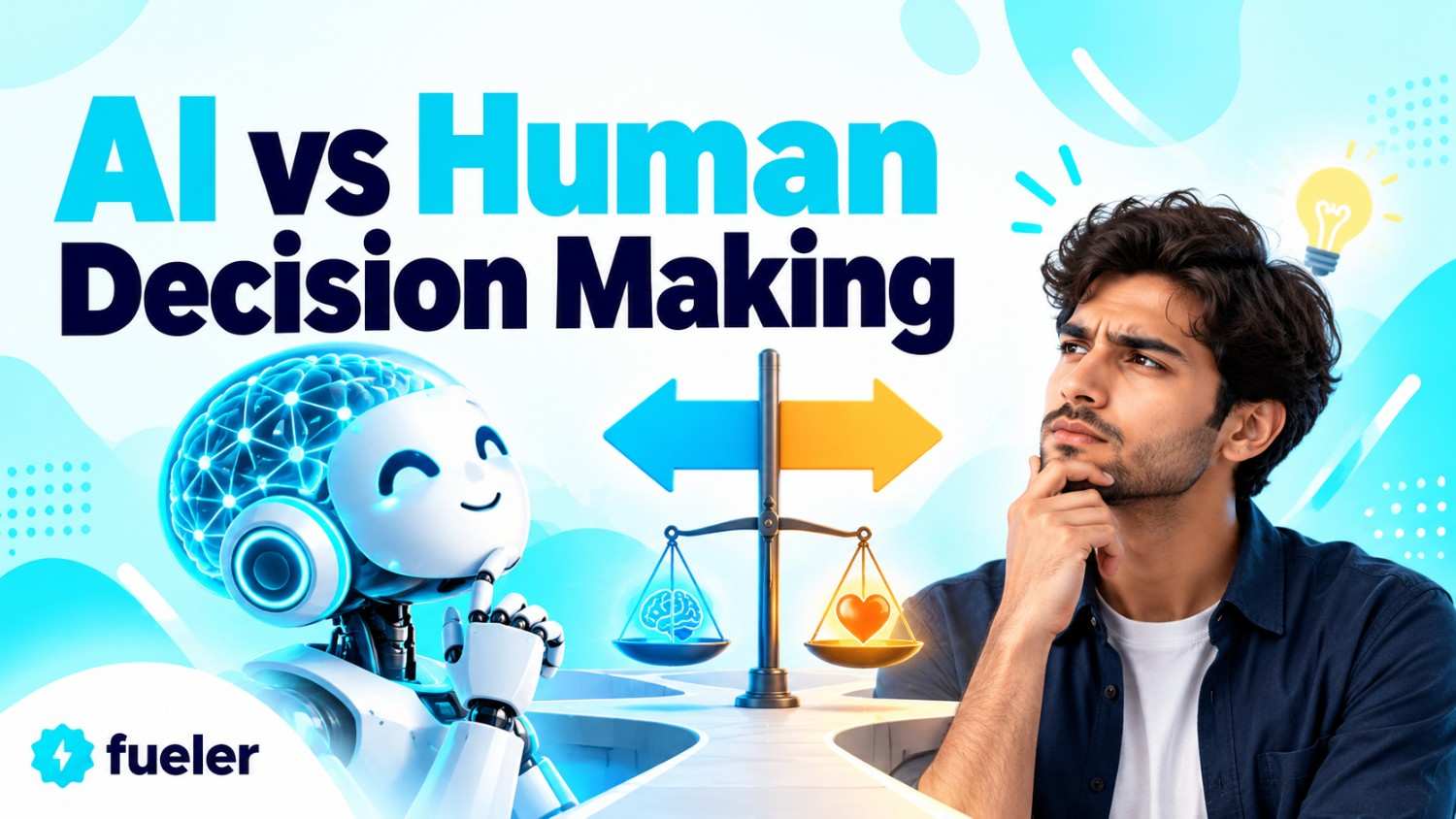
AI vs Human Decision Making: Which Performs Better?

Riten Debnath
18 May, 2026
Last updated: May 2026
Every single day, business leaders stand at a crossroads, forced to choose between the analytical precision of data models and the trusted intuition of human experience. For decades, the executive boardroom relied entirely on gut feelings, industry experience, and manual calculations to steer multi-million dollar corporations. Moving through 2026, the rapid rise of advanced enterprise intelligence has turned this traditional approach upside down, creating a fierce debate over who should hold the steering wheel. The central question is no longer just about automation, but about figuring out which system genuinely makes fewer mistakes when the stakes are incredibly high.
I’m Riten, founder of Fueler, a skills-first portfolio platform that connects talented individuals with companies through assignments, portfolios, and projects, not just resumes/CVs. Think Dribbble/Behance for work samples + AngelList for hiring infrastructure.
Choosing the wrong side in this technological shift can leave a company trapped with slow, biased choices or cold, detached mistakes that alienate customers. To help you navigate this changing landscape, we need to break down how human minds and advanced machine models perform across the core pillars of business operations. Let’s look at ten critical points of comparison to see where data-driven systems thrive and where human elements remain completely irreplaceable.
1. Speed of Processing Massive Data Layers
When a business needs to analyze millions of incoming customer transactions, global shipping logs, or live stock market feeds, human processing speeds quickly become a massive bottleneck. Machine networks can read, organize, and spot trends across petabytes of messy information in milliseconds. A human team would require weeks of intense, manual labor to produce the exact same analytical summary.
Instantaneous Analytical Auditing: Data systems scan through global operational logs instantly, pulling out relevant patterns without needing slow, manual file organization. This allows executive teams to view up-to-the-minute business summaries without waiting days for administrative staff to compile data.
Millisecond Transaction Validation: Financial networks evaluate thousands of simultaneous credit card charges instantly, blocking digital fraud before a human clerk could even open the file. This rapid screening protects corporate revenue and stops criminal activity before money leaves accounts.
Continuous Operational Tracking: Software models monitor machinery sensors around the clock, updating performance logs without taking breaks or shifting attention. This steady oversight ensures that minor mechanical drops are noticed long before a physical breakdown stops the assembly line.
Rapid Trend Discovery: Automated architectures connect scattered public data points in real time, alerting corporate strategy teams to sudden market movements. This gives businesses a massive head start when adjusting product prices or shifting marketing campaign targets.
Elimination of Administrative Delays: Shifting data cleanup tasks to automated pipelines allows corporate operations to move forward without waiting for manual spreadsheet updates. This speeds up daily corporate decisions and keeps teams focused on execution rather than paperwork.
Why it matters
In high-frequency environments like digital finance or international logistics, processing speed equals profitability. Relying on slow human manual reviews during rapid market shifts causes companies to miss critical windows of opportunity and experience costly operational delays.
2. Emotional Objectivity and Bias Elimination
Human choices are naturally shaped by personal fatigue, stress, workplace politics, and deep-seated subconscious biases that cloud clear judgment. Machine intelligence frameworks operate purely on mathematical logic, executing decisions based entirely on the hard evidence stored within your enterprise data layers. They do not get tired, experience bad moods, or favor specific team members over others.
Algorithmic Fairness Enforcement: Enterprise systems evaluate candidate project assignments purely on proven skill data, removing personal workplace favoritism from corporate promotions. This creates a transparent workspace where actual capability drives organizational growth, aligning employee talent with high-level goals.
Consistent Operational Logic: Automated models apply the exact same risk standards to every single file, ensuring corporate policies are followed perfectly across global offices. This uniformity reduces compliance errors and protects the company from costly regulatory penalties and internal disputes.
Stress-Free Crisis Management: During sudden supply chain emergencies, digital frameworks make calculations based on numbers rather than reacting out of panic. This logical approach keeps distribution channels open and prevents emotional overreactions that drain corporate capital reserves.
Reduction of Overconfidence Risks: Structured data models challenge overly optimistic executive assumptions by highlighting hidden financial dangers that humans routinely ignore. This introduces true objectivity into the boardroom, forcing leaders to face realistic project timelines and costs.
Auditable Compliance Records: Every single step of an automated decision is permanently logged, providing regulatory bodies with clear, objective proof of unbiased operations. This clean documentation simplifies annual financial audits and builds long-term shareholder trust.
Why it matters
Removing human emotion from structural corporate choices introduces an unmatched level of consistency to your operations. By relying on automated logic rather than unstable human feelings, businesses avoid costly internal political battles and protect their core assets from bad investments.
3. Handling Unstructured and Complex Datasets
Modern business data is no longer neatly organized in simple rows and columns; it lives in messy emails, video recordings, customer service chats, and complex legal contracts. Humans excel at understanding the subtle context of a single conversation, but they break down when trying to read thousands of documents at once. Advanced text processing systems bridge this gap by reading and mapping millions of messy files simultaneously.
Automated Document Asset Integration: The system continuously crawls all corporate cloud storage, communication channels, and databases to link related documents and projects together automatically. This removes the need for manual file cataloging and expensive, slow data organization projects.
Institutional Memory Retention Frameworks: It captures the complete project history, technical choices, and problem-solving steps taken by senior employees before they change companies. This protects your business from losing critical operational knowledge when senior staff members leave the team.
Cross-Project Duplicate Work Detection: The network analyzes ongoing research and development tasks across global offices, instantly alerting managers if two distant teams are accidentally building the exact same solution. This saves thousands of engineering hours and resource budgets.
Contextual Information Retrieval Engines: Instead of simple keyword searches, the system understands the true business context of an employee's question, delivering the exact historical files needed instantly. This speeds up daily corporate decision-making and keeps workflows moving forward smoothly.
Global Sentiment Trend Tracking: The system continuously monitors public discussions, industry forums, and digital reviews worldwide to spot emerging consumer complaints or desires before they turn into major movements. This gives product development teams a massive head start over competitors.
Why it matters
Enterprise platforms turn scattered company data into an organized, shared corporate brain that makes every employee smarter and faster. It stops your organization from repeating past mistakes and allows new project teams to build directly on top of previous operational successes.
4. Adaptability to Unprecedented Black Swan Events
When the global marketplace faces completely unexpected crises, like sudden trade port closures or rapid international policy shifts, historical data models often fail. This happens because machine frameworks require past examples to build accurate forecasts, leaving them blind during unique emergencies. Humans thrive in these chaotic moments, using creative problem-solving and abstract thinking to navigate uncharted economic waters.
Abstract Creative Problem Solving: Human leaders excel at inventing entirely new business models on the fly when old market frameworks collapse completely. This mental agility allows companies to survive unprecedented economic shifts that would crash a rigid data model.
Intuitive Risk Management: Experienced executives use their deep industry knowledge to make bold survival choices without needing millions of clean data points. This speed is vital when a sudden crisis requires an immediate operational pivot to save revenue.
Contextual Regulatory Navigation: When governments pass emergency laws during a global crisis, human managers understand the social and political spirit behind the rules. This context helps the business adapt its operations without breaking laws or alienating local communities.
Empathetic Stakeholder Communication: During severe corporate downturns, human leaders know how to speak to worried investors and employees with genuine empathy. This emotional connection maintains company morale and protects brand reputation far better than cold automated updates.
Dynamic Resource Reallocation: Human managers can rapidly shift team members from failing sectors into brand new experimental projects based on personal trust. This flexible team management keeps the workforce productive even when primary business goals are changing daily.
Why it matters
Data systems are excellent at optimizing predictable, repetitive workflows, but they remain completely helpless when the future looks nothing like the past. Human leadership is the ultimate safety net that keeps an enterprise standing when unexpected market shocks break standard operational playbooks.
5. Scalability and Operational Cost Efficiency
Running a global business across multiple continents requires managing massive workforces and operational budgets that can easily spin out of control under manual oversight. Human teams cannot scale their efforts without companies hiring more managers, expanding office space, and increasing administrative friction. Intelligence systems scale instantly across cloud servers, handling double the workload without increasing your permanent overhead costs.
Dynamic Capital Reallocation Management: The software tracks the live performance of digital marketing campaigns, automatically moving budget away from underperforming channels into high-yield regions. This optimization maximizes your daily return on spend without requiring manual review meetings.
Autonomous Supply Chain Re-Routing: It constantly checks global weather patterns, shipping lane congestion, and customs delays to reroute material deliveries before production lines slow down. This keeps manufacturing plants running efficiently without needing constant human dispatcher intervention.
Predictive Workforce Allocation Balancing: The system analyzes incoming customer service tickets and project deadlines to forecast exactly where staff will face burnout or long queues. This helps regional directors balance workloads before service quality drops significantly.
Operational Energy and Waste Reduction: It monitors the real-time power consumption and material waste of physical offices and manufacturing facilities, adjusting automated settings to lower utility costs. This improvement helps heavy industries meet strict sustainability metrics effortlessly.
Asset Lifecycle Maintenance Forecasting: By studying live machinery data and vehicle fleet performance logs, the architecture predicts equipment failures before they happen. This allows maintenance teams to fix tools during scheduled downtime, avoiding costly emergency stops.
Why it matters
Automated scalability turns operational efficiency into a major long-term competitive advantage for growing enterprises. It eliminates the slow, manual approval processes that cause project delays, keeping your business lean, agile, and ready to scale smoothly into new international territories.
6. Long-Term Strategy and Visionary Goal Setting
A machine model can tell you the most profitable price point for a product today, but it cannot decide what your company should stand for tomorrow. Setting a multi-year corporate vision requires understanding human culture, predicting social desires, and defining ethical values. Human founders and executives excel at imagining futures that do not exist yet, inspiring entire industries to move in radical new directions.
Inspirational Corporate Purpose Definition: Human leaders define the core values and social missions that make a company attractive to top-tier talent and loyal customers. This emotional foundation builds a strong brand identity that software formulas can never replicate.
Bold Ethical Alignment Frameworks: Executives navigate complex moral choices, ensuring the company's growth does not come at the expense of environmental health or human rights. This careful guidance protects the organization from severe public relations backlash and legal troubles.
Disruptive Innovation Conceptualization: Humans dream up completely revolutionary concepts that disrupt existing markets, creating brand new industries out of pure imagination. This visionary thinking keeps businesses ahead of structural decay and long-term industry stagnation.
Strategic Partnership Cultivation: Building deep alliances with other corporate leaders relies on mutual trust, shared values, and personal relationships developed over years. These critical human connections form the basis of major cross-industry mergers and acquisitions.
Long-Term Capital Commitment Confidence: Boards of directors use human courage and calculated risk-taking to invest millions into unproven, long-term research initiatives. This forward-looking approach creates breakthrough technologies that short-term data models would label too risky.
Why it matters
Without human vision, a business becomes a cold machine that only optimizes for immediate quarterly profits until a more creative competitor replaces it. Human strategic thinking provides the soul and long-term compass that turns a basic corporate entity into an enduring industry institution.
7. Understanding Complex Human Psychology and Nuance
Business is ultimately an interconnected web of human relationships, ranging from negotiating difficult vendor contracts to resolving intense internal executive conflicts. Automated systems process words and phrases literally, routinely missing the subtle sarcasm, hidden anxiety, and political undertones present in daily communications. Humans are naturally wired to read facial expressions, body language, and vocal inflections to find the real meaning behind a conversation.
Nuanced Corporate Contract Negotiation: Experienced human lawyers read the shifting energy in a boardroom to secure favorable financial terms without destroying partnerships. This social balance ensures both companies walk away from a deal feeling respected and satisfied.
High-Stakes Workplace Conflict Resolution: Managers identify hidden personal tensions between team members, using empathy and private discussions to heal broken professional relationships. This emotional care maintains a healthy team culture that digital tracking tools ignore.
Empathetic Customer Experience Management: When a client faces a severe business crisis, human support agents deliver personalized comfort alongside technical solutions. This deep emotional support turns angry users into passionate, lifelong brand advocates for your enterprise.
Subtle Cultural Alignment Navigation: Global executives adapt their marketing styles and business etiquette to match the local customs of new international markets. This cultural respect prevents embarrassing global advertising blunders that damage corporate reputations.
Team Morale and Motivation Building: Creative leaders know exactly when a tired workforce needs an inspiring speech, a day off, or public recognition. This human encouragement keeps productivity high when project deadlines become incredibly stressful.
Why it matters
A company that ignores human psychology will quickly alienate its workforce, anger its partners, and lose its customer base to more empathetic competitors. Human emotional intelligence serves as the essential social glue that keeps a complex business operating smoothly across different global cultures.
8. Error Detection and Quality Control Guardrails
Even the most advanced data intelligence systems can suffer from algorithmic "hallucinations" or create flawed recommendations based on biased source data. If a business automates its entire decision pipeline without human oversight, a single software glitch can cause massive financial ruin. Humans act as the ultimate critical safety guardrail, reviewing automated suggestions against real-world common sense before execution.
Automated Contract Risk Auditing: The framework reviews legal agreements and procurement forms to flag unusual liability clauses before your executive team signs them. This protects your business from predatory legal language that automated software might overlook as standard text.
Real-Time Data Privacy Enforcement: It tracks how customer data moves through your internal software tools, automatically blocking any process that violates strict rules. This keeps your company perfectly aligned with changing international laws without slowing down production.
Dynamic Policy Update Propagation: When global regulatory bodies pass new compliance laws, the framework automatically updates internal operational guidelines across departments. This ensures your global offices stay perfectly legal without requiring manual policy rewriting.
Algorithmic Audit Trail Creation: The system creates a permanent, unalterable digital log of how data was used to make strategic choices. This documentation provides external regulators with instant proof of legal compliance during annual financial reviews.
Ethical Operational Guardrail Management: It scans all internal communication and customer-facing software outputs to ensure your brand guidelines are strictly followed. This protects your corporate reputation from accidental offensive language caused by software glitches.
Why it matters
Blindly trusting automated calculations without human validation introduces severe structural vulnerabilities into an enterprise. Combining machine precision with human common sense creates an incredibly resilient operational framework that catches dangerous errors before they harm your brand.
9. Regulatory Compliance and Legal Accountability
When an automated system makes a terrible calculation that results in a severe financial loss or a data privacy breach, the software cannot stand in a court of law. Governments and regulatory bodies demand clear human accountability for every major corporate action taken by an enterprise. Human executives must fully understand the legal responsibilities of their choices, making them naturally more cautious and protective of company safety.
Legal Accountability Acceptance: Human directors sign official corporate filings, taking personal legal responsibility for the absolute truth and accuracy of business operations. This accountability ensures that executive teams maintain high ethical standards across all global projects.
Proactive Compliance Strategy Design: Legal executives interpret changing government regulations to design long-term corporate safety frameworks that protect consumer privacy. This careful planning shields the business from devastating multi-million dollar government fines.
Transparent Shareholder Reporting: Human leaders present annual business strategies directly to institutional investors, explaining complex operational risks in clear, honest language. This open communication builds deep shareholder trust and stabilizes long-term stock value.
Ethical Decision Boundary Setting: Management sets strict limitations on how data tools can be used within the company, protecting customer privacy rights. This balanced oversight prevents the business from crossing dangerous ethical boundaries for short-term gains.
Corporate Risk Exposure Management: Chief Financial Officers evaluate the legal and financial fallout of potential lawsuits before entering new international markets. This protective analysis keeps corporate cash reserves safe from unexpected international legal battles.
Why it matters
Advanced technology can automate tedious compliance tracking, but it can never replace the human judgment required to navigate international corporate law. True legal safety requires human leaders who understand that protecting consumer rights is vital for long-term business survival.
10. Creative Innovation and Breaking Existing Patterns
Machine models are fundamentally designed to find rules and patterns within historical data, which means they excel at repeating the past. They cannot easily create something entirely new that breaks those established patterns. Human strategic thinking is beautifully chaotic, capable of combining completely unrelated ideas to spark brilliant creative revolutions that change the world.
Cross-Industry Idea Synthesis: Humans take successful concepts from fields like art or biology and apply them directly to corporate software engineering. This creative blending produces unique products that data models could never discover through standard analysis.
Disruptive Brand Storytelling Creation: Creative marketing directors design emotionally moving brand campaigns that capture the cultural spirit of a generation. This powerful storytelling builds intense customer loyalty that goes far beyond simple price comparisons.
Experimental Business Model Design: Human founders fearlessly launch radical operational frameworks that challenge traditional industry standards, opening up untapped revenue channels. This bold experimentation prevents an enterprise from getting stuck in dying markets.
Unique Product Design Architecture: Designers use human artistic taste and physical ergonomics to build products that feel incredibly satisfying to use. This focus on human beauty and comfort creates premium consumer experiences that numbers alone cannot predict.
Fostering a Culture of Innovation: Visionary managers build workspace environments that encourage employees to take creative risks and share wild ideas. This supportive culture serves as the primary engine for continuous corporate breakthroughs over decades.
Why it matters
If a company relies entirely on historical data models to guide its product development, it will eventually build boring, predictable items that fail to excite customers. Human creativity is the vital spark that keeps businesses relevant, innovative, and capable of leading the market.
Verdict: Who Wins?
The Winner: Augmented Decision Making (A Collaborative Tie)
When forced to choose a definitive winner in a pure head-to-head battle, neither side can successfully run a modern enterprise alone. Purely human choices are far too slow and prone to emotional bias, while purely automated choices are rigid, easily confused by unique crises, and completely lack empathy.
The absolute winner is Augmented Decision Making, a hybrid model where advanced intelligence systems serve as the analytical engine while human leaders retain final creative and ethical control. This combination allows businesses to process data with incredible speed while ensuring every choice remains grounded in human values, common sense, and visionary strategy.
How does this connect to Building a Strong Career or Portfolio?
Understanding how these advanced business frameworks operate is the secret to standing out in today's highly competitive job market. Companies are no longer looking for workers who just follow basic instructions; they want strategic thinkers who know how to balance machine data with human judgment. To get hired by top-tier organizations, you need to show executives that you understand how technology and human intuition connect to drive real corporate growth.
This is exactly why building a proof-of-work portfolio is much more powerful than sending a traditional, boring text resume. When you create detailed case studies, run simulated market analyses, or share project breakdowns showing how you use data to solve actual business problems, you give employers undeniable proof of your value. Showing companies your actual strategic thinking through clear work samples makes it easy for hiring managers to see exactly how you will help their business succeed from day one.
Final Thoughts
The debate between analytical models and human judgment is not a battle to see which side can eliminate the other from the corporate landscape. The most successful enterprises moving through 2026 are those that build a cooperative workflow, allowing data networks to handle rapid processing while humans control high-level strategy. By using automated frameworks to clean up data silos and remove operational biases, human leaders free up their time to focus entirely on creative innovation and empathetic relationship building.
Frequently Asked Questions
What are the best enterprise decision intelligence platforms available for large businesses?
The top enterprise decision intelligence platforms include advanced frameworks like Palantir Foundry, IBM WatsonX, and Google Vertex AI, which help companies organize massive data layers. Other major platforms like Aera Decision Cloud and Cloverpop help executive teams model business logic, track choice histories, and automate complex operational workflows.
How do modern companies use predictive systems to reduce bad operational decisions?
Companies use predictive systems to connect their internal data silos with live external market data, such as consumer trends and competitor pricing changes. By running automated simulations, these systems flag hidden financial risks and operational bottlenecks, allowing managers to fix mistakes before they impact the company's bottom line.
Can small and mid-sized businesses use strategic intelligence systems affordably?
Yes, small and mid-sized businesses can access strategic intelligence systems through cloud-based software providers that offer flexible pricing tiers. Smaller enterprises often use integrated analytics platforms to automate data collection and track customer sentiment trends without needing to build custom infrastructure.
What is the difference between traditional business intelligence and decision intelligence?
Traditional business intelligence platforms only focus on looking backward, displaying past sales data and historical operational metrics on static digital dashboards. Modern decision intelligence systems look forward, using predictive modeling to simulate future business scenarios, challenge human biases, and recommend specific corporate actions.
How does an enterprise ensure its strategic data remains secure when using these platforms?
Enterprises secure their strategic data by deploying these frameworks inside highly protected cloud environments that feature strict data encryption and role-based access controls. They also use automated governance layers to monitor internal data movement, ensuring compliance with global privacy regulations while preventing sensitive corporate leaks.
What is Fueler Portfolio?
Fueler is a career portfolio platform that helps companies find the best talent for their organization based on their proof of work. You can create your portfolio on Fueler. Thousands of freelancers around the world use Fueler to create their professional-looking portfolios and become financially independent. Discover inspiration for your portfolio
Sign up for free on Fueler or get in touch to learn more.

What should you do next?
You've read the article. Now turn your skills into proof of work and unlock more opportunities.
Build your proof of work portfolio
Create a clean portfolio with projects, assignments, resumes, and AI stack details that companies actually want to see.
Create your Fueler portfolio →Apply through assignments, not resumes
Stand out by solving real tasks from companies hiring on Fueler.
Explore assignments →Get discovered by companies
Make your work public and let recruiters discover your skills through actual projects instead of keywords.
Get discovered →
