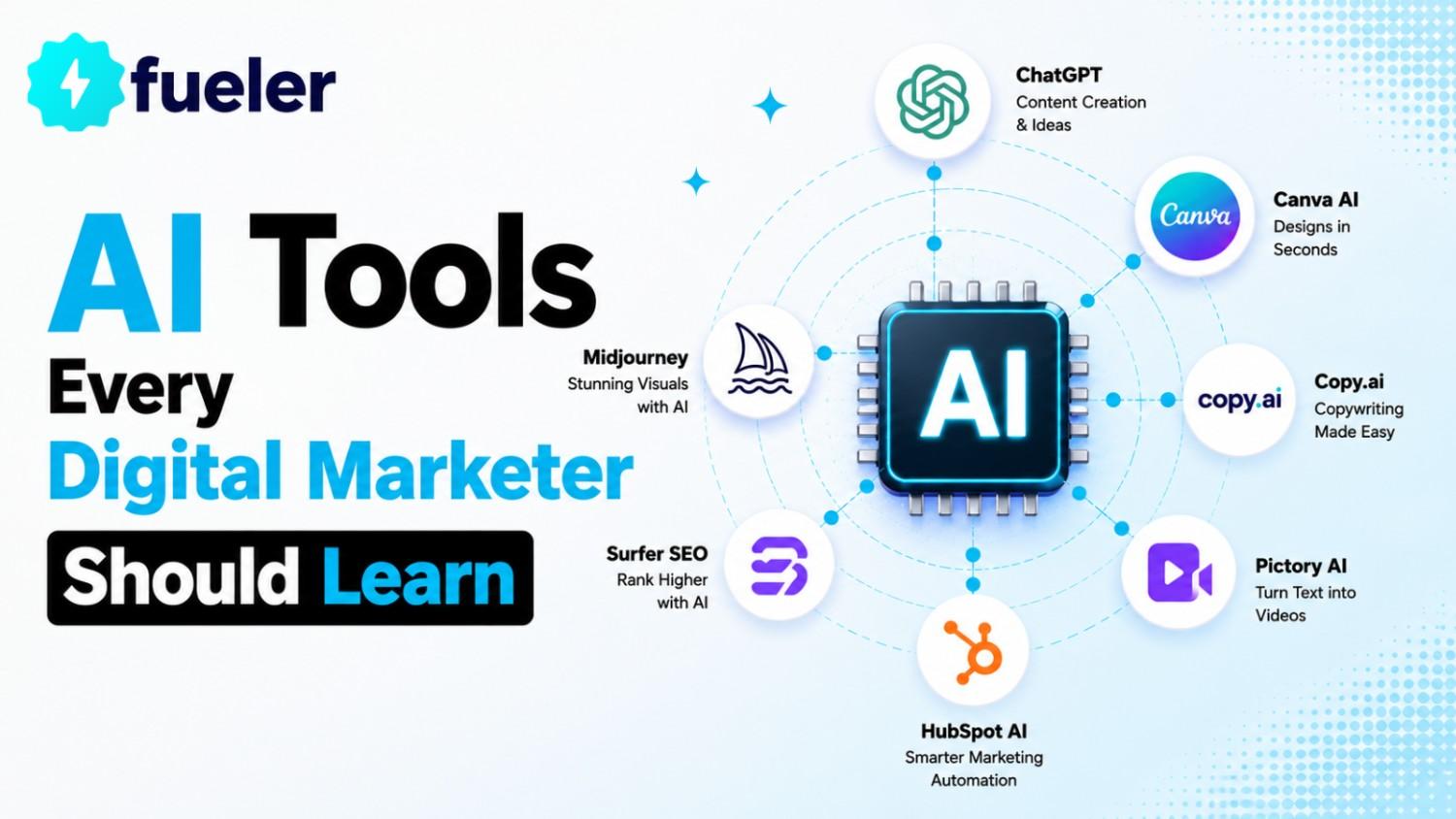
AI Tools Every Digital Marketer Should Learn in 2026

Riten Debnath
29 Jul, 2026
Last updated: July 2026
If your current digital marketing strategy relies on manually staring at a blank Google Doc, begging a designer for a simple thumbnail tweak, or spending four hours writing meta descriptions that no human will ever read, I have some news. You aren't just working hard; you are operating like an artisanal blacksmith in the middle of the Industrial Revolution.
The digital marketing landscape has officially moved past the stage where AI was just a glorified synonym for "autocorrect on steroids." Today, artificial intelligence tools execute complex growth loops, map user intent across multi-prompt engine searches, and automate multi-channel campaigns before you even finish your morning coffee.
I’m Riten, founder of Fueler, a skills-first portfolio platform building the career infrastructure for 100 million creative professionals. Fueler connects talented individuals with companies through assignments, portfolios, and projects, not just resumes or CVs. Think of it as Dribbble/Behance for work samples combined with AngelList for hiring infrastructure.
In this deep dive, we are skipping the generic hype and dissecting the exact AI toolstack driving real revenue in 2026. You will discover eight must-know marketing platforms, understand how agentic workflows replace manual task churn, and learn how to present actionable growth execution to secure high-tier marketing roles.

The Shift From Simple Prompting to Agentic Marketing Workflows
For years, marketers treated artificial intelligence like a magic trick. You typed a prompt into a text box, waited five seconds, and received a mid-tier draft that required thirty minutes of aggressive editing to sound remotely human.
In 2026, the industry moved from isolated chat windows to agentic workflow systems. Modern AI tools do not just generate passive text responses; they connect directly to live database pipelines, crawl real-time web instances, execute multi-step logic chains, and autonomously adjust ad campaign setups based on active conversion signals.
- Autonomous Lead Enrichment and Scraping: Drag-and-drop workflow platforms let you build automated research chains that gather lead details, check competitor pricing updates, and draft custom email follow-ups without manual copy-pasting.
- Real-Time Web Intelligence Integration: Connecting AI models directly to live web browsers ensures your campaign copy stays rooted in fresh search trends, preventing your team from launching ad campaigns built on outdated consumer intent data.
- Unified Cross-Platform Data Processing: Modern intelligence tools process customer touchpoints across social media, organic search, and direct ads in one place, solving multi-channel tracking issues without requiring messy manual spreadsheets.
- Dynamic Brand Voice Memory Assets: Advanced marketing systems store your brand style guides, past ad performances, and buyer profiles so generated content matches your actual tone without sounding like an overly polished robot.
- Automated SEO Audit and Schema Triggers: Intelligent monitoring crawlers continuously check your website's search markup, internal links, and page speeds, alerting your team to broken conversion pages before they hurt your organic rankings.
8 Essential AI Tools Every Digital Marketer Must Master
The market is flooded with thousands of point solutions claiming to "revolutionize" marketing, but most are thin wrappers around foundational models. To build a future-proof stack, you need dedicated platforms built for specialized, high-impact tasks.
Here are the eight existing, battle-tested AI tools driving modern growth marketing:
1. Gumloop: Advanced Agentic Workflow Automation
Gumloop serves as an agentic automation engine that lets marketers connect large language models directly to internal databases, APIs, and web scrapers without writing code. You can build drag-and-drop workflows that scrape SERPs, analyze top-ranking content structures, extract target positioning angles, and format structured briefs automatically.
- Visual Drag-and-Drop Pipeline Builder: You can connect custom data nodes, web scrapers, and AI models in a visual canvas to automate complex research tasks without writing software code.
- Direct External SaaS App Triggers: Built-in app connections allow your custom AI workflows to send messages, update database rows, and trigger actions across your software stack instantly.
- Automated Competitor Web Scraping: Workflow nodes automatically extract landing page copy, pricing changes, and headline tests from competitor websites to highlight positioning gaps.
- Smart Model Routing and Cost Control: The platform automatically assigns simple tasks to lightweight AI models and complex reasoning to heavy engines, keeping your overall software budget low.
- Instant Form and CRM Webhook Actions: Incoming customer signups automatically trigger multi-step research tasks that summarize lead details and push recommendations straight to your team.
2. Claude by Anthropic: Nuanced Copywriting and Strategic Analysis
Claude has become an essential companion for growth strategists who need long-form content generation, deep document synthesis, and nuanced messaging. Its expanded context window allows you to upload entire competitor whitepapers, historical ad accounts, or full brand guidelines, delivering strategic campaign angles without sounding robotic.
- Massive File and Document Processing: You can upload complete brand style guides, customer survey spreadsheets, and lengthy PDF reports in a single query for instant summary analysis.
- Human-Like Direct-Response Ad Writing: Advanced language capabilities generate empathetic, persuasive marketing copy that speaks directly to customer problems without using cliché buzzwords.
- Live Interactive Workspace Previews: Built-in workspace features let you generate, view, and refine website landing page layouts, email templates, and dashboard wireframes right beside your chat window.
- Technical Document and Feature Translation: The system easily breaks down complex software features into clear, benefit-driven marketing copy that regular buyers can understand.
- Customer Feedback Transcript Analysis: Processing dozens of sales call transcripts helps you spot recurring customer complaints and buyer objections to refine your core campaign angles.
3. Surfer SEO: Intent-Based Search Engine Optimization
Surfer SEO remains an industry standard for data-backed search engine content optimization. By analyzing top-ranking search results against structural, semantic, and NLP keyword metrics, Surfer gives writers exact structural blueprints to ensure articles rank reliably on primary organic search queries.
- Live Real-Time Article Scoring: An interactive content score updates as you type, showing exactly how well your article matches top-ranking search results for length, headers, and keyword usage.
- Automated Article Outline Generators: Structural builders pull popular subheadings and user questions straight from current search results to make sure your content covers the topic completely.
- Comprehensive Topical Map Builders: Keyword cluster maps highlight related subtopics and supporting articles you need to write to build broad search engine authority.
- Smart Internal Link Suggestions: Built-in site scans tell you exactly which existing pages should link to your new article to share search authority across your website.
- International Search Market Optimization: Language-specific scoring algorithms adapt keyword density targets across different countries and regional search markets seamlessly.
4. AEONITI: Answer Engine Optimization Observability
AEONITI addresses modern search behavior by tracking how brands appear inside conversational AI engines. As users move away from traditional blue links toward direct AI search answers, AEONITI monitors brand mentions across Claude, ChatGPT, Perplexity, and Gemini to protect mindshare.
- Cross-Engine Brand Citation Tracking: A single dashboard monitors how often conversational AI engines mention and recommend your brand when users ask industry questions.
- Automated Sentiment and Context Analysis: Sentiment algorithms evaluate whether AI engine responses describe your product favorably or unfavorably against your key competitors.
- Direct Citation Source Identification: The platform reveals the exact websites, blogs, and forums AI engines crawl to pull information about your company.
- Competitor Prompt Displacement Alerts: Immediate notification alerts tell your team when a competitor replaces your brand in standard AI recommendation lists.
- Market Share of Voice Quantification: Clear reporting metrics measure your brand's overall visibility across conversational search queries compared to other top industry players.
5. Jasper AI: Scaling Multi-Channel Brand Campaigns
Jasper focuses on enterprise marketing execution, helping large teams maintain tone, style, and brand rules across massive campaign launches. By storing style profiles and company knowledge bases, Jasper generates ad copy, blog posts, email sequences, and social media assets aligned with your brand identity.
- Centralized Brand Style Rulebooks: Built-in memory systems scan your existing company assets to enforce consistent voice rules, vocabulary, and formatting across every campaign draft.
- Multi-Asset Campaign Generation: Single promotional briefs generate matching blog post drafts, promotional email sequences, and social media captions all at the same time.
- Browser Extension Workflow Support: Dedicated browser plugins bring AI writing assistance directly into your favorite content management systems, social platforms, and email tools.
- Team Review and Approval Controls: Creative directors can review, adjust, and approve AI-generated campaign drafts before they go live to maintain enterprise quality.
- Built-in Originality and Style Scans: Integrated checking tools ensure published marketing assets match internal company quality rules and avoid generic phrasing.
6. HeyGen: Automated Studio-Quality Video Production
HeyGen removes traditional video production friction by turning written scripts into realistic avatar-led video assets. Marketers can generate high-converting short-form visual content, product walk-throughs, and localized video ads without hiring production crews, setting up studio lighting, or booking voice actors.
- Custom Spokesperson Avatar Creation: You can clone real company founders or team members to generate personalized video messages at scale without re-shooting footage.
- Automated Lip-Synced Translation: Video translation tools convert scripts into dozens of foreign languages while adjusting avatar lip movements to look natural to native speakers.
- Script-to-Video Scene Generation: Plain text scripts automatically transform into complete video scenes with matching visual backgrounds, captions, and music tracks.
- Dynamic Lead Personalization Tags: Custom text fields automatically swap recipient names, company logos, and website images into video frames for targeted sales outreach.
- High-Definition Video File Exports: Fast rendering engines produce crisp, broadcast-ready video files formatted for social media feeds and video ad platforms.
7. Zapier Central: Autonomous Application Orchestration
Zapier Central acts as an orchestration layer, allowing marketers to build AI bots that monitor data changes across thousands of web applications. Zapier Central acts as an orchestration layer for Agentic AI, allowing marketers to build AI bots that monitor data changes across thousands of web applications. Unlike basic linear integrations, these AI bots inspect incoming lead data, decide the optimal nurture sequence, and update sales pipelines autonomously. For example, Google Form automation can trigger follow-up workflows as soon as a prospect submits their information, reducing manual data entry and response time.
- Plain English Bot Setup: You can instruct AI automation bots using simple everyday sentences instead of building complicated coding logic or software integrations.
- Real-Time Web Application Triggers: Bots watch live web forms, payment channels, and chat software to run background marketing tasks the second a customer interacts.
- Smart Exception and Fallback Routing: When incoming lead data looks unusual, the bot automatically flags the account and routes the details to a human team member.
- Automated CRM Profile Enrichment: New signups are automatically paired with public web data to give your sales team complete background details before their first call.
- Behavior-Based Campaign Triggers: Bots launch targeted follow-up email chains based on the exact buttons and pages a user interacts with inside your app.
8. Perplexity AI: Real-Time Competitive Market Research
Perplexity AI has replaced standard browser tab sprawl for growth marketers conducting competitive research. Acting as an answer engine backed by live web citations, it lets you research competitor pricing models, trace industry shifts, and discover target audience pain points in minutes.
- Verified Live Web Link Citations: Every research summary includes direct links back to original web sources so you can double-check facts quickly.
- Step-by-Step Investigative Search: Guided search modes break broad questions down into smaller research steps to uncover detailed industry data.
- Document and PDF Analysis Uploads: You can drop competitor price sheets, market research reports, and customer survey PDFs straight into the tool for fast analysis.
- Shared Team Research Collections: Threaded workspaces allow marketing teams to organize, save, and share competitor research notes in one central location.
- Context-Aware Follow-Up Queries: You can ask follow-up questions to dig deeper into specific topic details without having to start your search over from scratch.
Why It Matters:
Mastering these eight specialized tools transitions you from an entry-level task executor to an efficient growth architect. Knowing which engine handles specific bottlenecks helps teams launch campaigns faster, cut software sprawl, and maintain high standards across all digital marketing channels.
How AI-Powered Analytics Prevents Campaign Burnout
Managing paid ad accounts, social distribution networks, and content engines manually creates immense operational stress. Marketers often spend more time building weekly performance reports than optimizing creative strategies or running structured experiments.
AI-powered analytics systems continuously analyze raw traffic metrics, ad spend velocity, and conversion signals. By flagging campaign anomalies automatically, these systems protect marketing budgets, highlight creative fatigue early, and surface high-converting audience pockets without human fatigue.
- Immediate Budget Spike Warnings: Automated monitoring systems instantly alert your campaign team the moment customer acquisition costs jump above your chosen ad limits.
- Long-Term Revenue Predictions: Machine learning models estimate future customer value early, giving your team confidence to scale winning ad campaigns safely.
- Automated Multi-Channel Dashboards: Live tracking pipelines pull metrics from paid ads, social channels, and web traffic into clean reports without manual CSV file downloads.
- Uncovered Audience Cohort Discovery: Pattern recognition algorithms highlight unexpected, high-converting customer groups hidden within your broad advertising targeting lists.
- Plain-Text Data Questions: Natural language search lets you ask simple questions about ad spend trends and instantly see clean visual charts in response.
Why It Matters:
Leveraging predictive analytics transforms how marketing teams make strategic budget allocations. It shifts decision-making from subjective guesses to objective data trends, protecting capital and freeing up time to develop high-converting campaign concepts.
Combining Human Creativity with AI Execution for Maximum Reach
Despite the capabilities of modern software tools, AI cannot build genuine human empathy, share authentic founder stories, or understand nuance. The most effective growth strategies combine human strategic direction with automated technical execution.
When human marketers handle brand positioning, creative hooks, and customer relationships while AI manages data processing, layout formatting, and routine optimization, content quality improves. This hybrid model keeps your brand authentic while maintaining high execution output across every channel.
- Human-Led Brand Positioning: Directing campaign messages with real human experience ensures your ads connect emotionally with real customer struggles instead of sounding generic.
- Rapid Ad Variant Generation: AI builds dozens of ad headline and copy variations based on your core ideas, speeding up audience testing.
- Strict Quality and Tone Filtering: Human editors review generated drafts to remove repetitive phrases, ensuring published content stays accurate, helpful, and natural.
- Targeted Message Personalization: Automated tools deliver custom copy variations to specific customer groups, helping your messaging resonate better with different buyers.
- Data-Driven Workflow Improvements: Real conversion results and customer feedback help your team refine automated tools to produce better marketing assets over time.
Why It Matters:
Combining human intuition with AI execution ensures your campaigns stay scalable without losing authenticity. Brands that rely purely on automated filler content face audience disconnect and declining search rankings, while hybrid teams build strong community trust and sustainable market reach.
How Does This Connect to Building a Strong Career or Portfolio?
Mastering modern AI tools is only valuable if you can prove your ability to drive business results. Employers and clients no longer hire marketers based on resume claims or basic tool list certifications; they want to see verified proof of execution.
Documenting how you set up agentic workflows, built automated research pipelines, or scaled organic conversion funnels creates an undeniable track record. Publishing real project case studies on Fueler showcases your practical proof of work, helping you stand out to growth-focused companies that value verifiable outcomes over traditional credentials.
Final Thoughts
The AI evolution in digital marketing is not about replacing human strategists; it is about replacing slow, manual workflows with automated execution loops. Marketers who master specialized platforms like Gumloop, Claude, and Surfer SEO will continue to outpace those clinging to outdated manual methods. Focus on building, documenting, and publishing real campaign systems, and let your practical proof of work drive your career growth.

Frequently Asked Questions
What are the best AI tools for digital marketing beginners in 2026?
Beginners should start with Claude for copywriting, Surfer SEO for content optimization, and Canva AI for visual design. These tools offer accessible user interfaces while introducing core artificial intelligence concepts like semantic optimization and structured prompting.
Will AI tools replace human digital marketers?
AI tools automate repetitive tasks like data entry, initial drafting, and reporting, but they cannot replace strategic positioning, human empathy, or creative direction. Marketers who leverage AI for execution will replace those who do not.
How do agentic workflows differ from traditional AI prompting?
Traditional prompting requires typing single text requests into a chat box for static answers. Agentic workflows run multi-step, autonomous logic loops across external databases, APIs, and web tools to complete end-to-end marketing tasks without manual intervention.
How can I prove my AI marketing skills to prospective employers?
Skip basic course certificates and build a portfolio documenting real project execution. Show step-by-step case studies explaining how you constructed AI workflows, optimized live search campaigns, or improved conversion metrics, publishing them on Fueler to prove your value.
What is Answer Engine Optimization (AEO) and why does it matter?
Answer Engine Optimization focuses on optimizing brand content so conversational AI platforms like ChatGPT, Perplexity, and Claude cite your business in direct answers. AEO ensures visibility as user search habits shift away from traditional search links.
Why 100,000+ professionals use Fueler
Fueler helps professionals showcase proof of work through projects, assignments, case studies, and achievements.
- Thousands of professionals use Fueler to create their digital portfolio
- Thousands of projects are published on Fueler. Check here
- Startups and Companies hire through proof of work on Fueler
- Used by freelancers, creators, marketers, video editors, writers, designers, and product managers
Our mission is to help the next 100 million professionals build a verified professional identity through proof of work

What should you do next?
You've read the article. Now turn your skills into proof of work and unlock more opportunities.
Build your proof of work portfolio
Create a clean portfolio with projects, assignments, resumes, and AI stack details that companies actually want to see.
Create your Fueler portfolio →Apply through assignments, not resumes
Stand out by solving real tasks from companies hiring on Fueler.
Explore assignments →Get discovered by companies
Make your work public and let recruiters discover your skills through actual projects instead of keywords.
Get discovered →
