AI Agents vs. Chatbots: Key Differences, Capabilities, and Business Impact in 2026

Riten Debnath
22 Feb, 2026
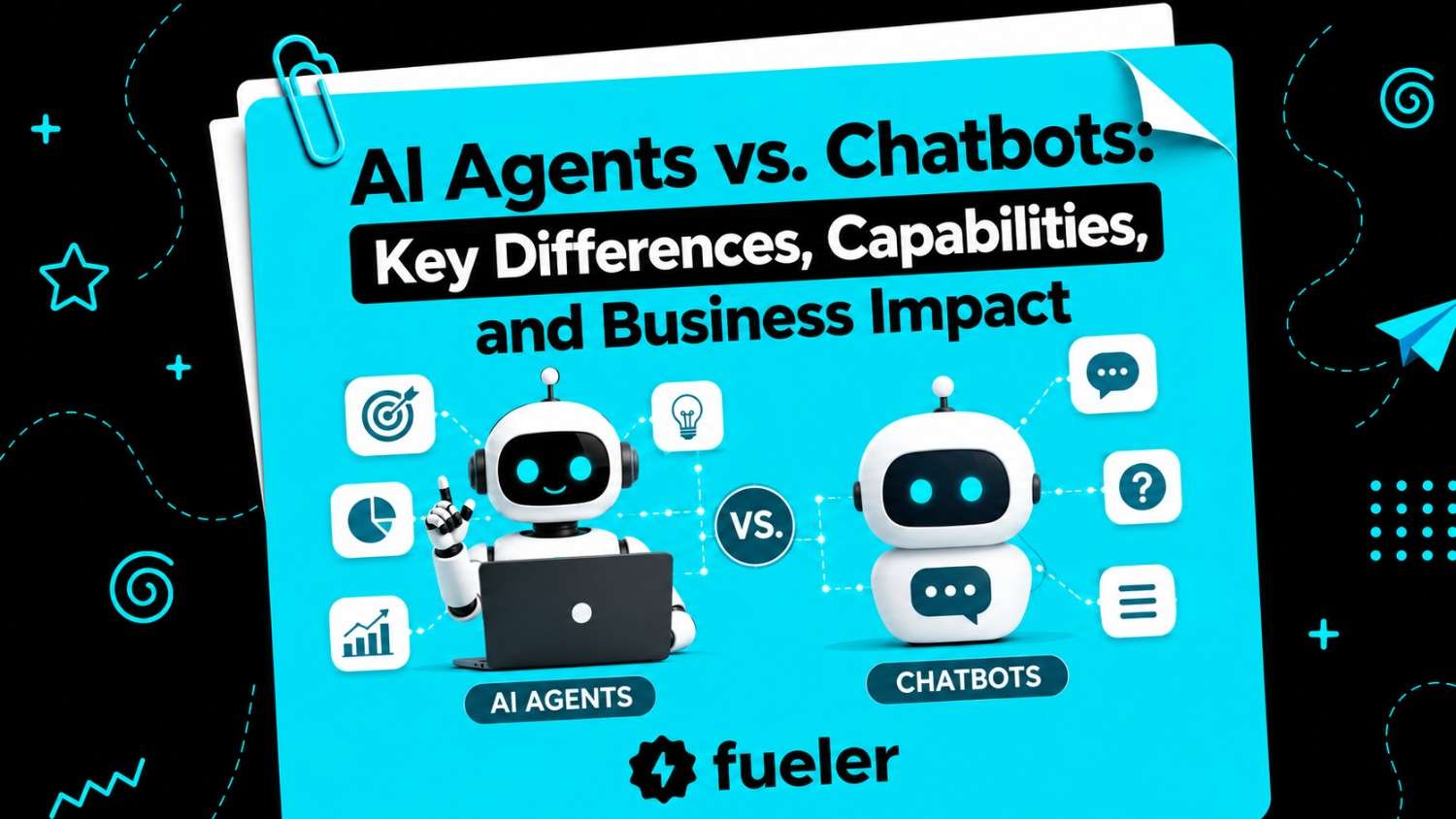
The "Chatbot Era" didn't die with a whimper; it was simply absorbed into something much more powerful. In early 2026, the tech world reached a point of clarity: Chatbots are interfaces, but Agents are infrastructure. While we spent the last few years impressed by a machine's ability to "talk," we are now obsessed with its ability to "do." If a chatbot is a digital receptionist that can tell you where the elevator is, an AI Agent is the operations manager who has already booked your meeting room, ordered the catering, and updated the project budget before you even stepped into the building.
I’m Riten, founder of Fueler, a skills-first portfolio platform that connects talented individuals with companies through assignments, portfolios, and projects, not just resumes/CVs. Think Dribbble/Behance for work samples + AngelList for hiring infrastructure.
1. The Core Philosophy: Reactive Conversations vs. Proactive Autonomy
The most fundamental difference between these two technologies lies in who starts the work. A chatbot is reactive; it sits patiently behind a "Message us" bubble, waiting for a human to trigger a response. In contrast, an AI Agent is proactive and goal-oriented. It doesn't just wait for a prompt; it monitors data streams, recognizes when a goal is unfulfilled, and initiates a sequence of actions to close the gap.
- Trigger-Based Engagement vs. Goal-Driven Behavior: A traditional chatbot operates on a simple input-output loop. You ask a question, it retrieves an answer. An AI Agent, however, is given a high-level objective, such as "Reduce customer churn by 10% this month." The agent then autonomously decides to analyze usage data, identify at-risk users, and send personalized retention offers without a human ever typing a single specific instruction for those sub-tasks.
- Pattern Matching vs. Reasoned Decision-Making: Chatbots primarily use sophisticated pattern matching to find the "best fit" response from a library of data. Agents utilize a reasoning engine to weigh trade-offs. If a customer asks for a refund, a chatbot checks the policy and says "Yes" or "No." An AI Agent looks at the customer's lifetime value, the reason for the return, and current inventory levels before deciding to offer a full refund, a store credit, or a personalized discount on a future purchase.
- Conversational Limits vs. Execution Capabilities: The "end state" for a chatbot is a satisfied user at the end of a chat window. The "end state" for an agent is a completed task in the real world. This might mean the agent has updated a row in a SQL database, triggered a shipping label in a logistics platform, or drafted and sent a legal contract. For the agent, the conversation is just one of many tools it uses to get the job done.
- Linear Paths vs. Dynamic Correction: If a chatbot hits a dead end in its script, it usually defaults to "I don't understand" or transfers you to a human. An AI Agent treats a dead end as a problem to be solved. If a tool it needs is down, the agent will attempt to find an alternative route or troubleshoot the connection itself. This self-correcting nature makes agents significantly more resilient in unpredictable business environments.
- Session-Based Memory vs. Persistent Identity: Most chatbots have "goldfish memory," forgetting who you are as soon as the window is closed. AI Agents in 2026 maintain a "Continuous Context Layer." They remember that you were frustrated last Tuesday, that you prefer dark mode, and that your project deadline is Friday. This persistence allows them to act as true digital partners that grow more effective the longer you work with them.
Why it matters:
Understanding this shift from "answering" to "acting" is the foundation of our 2026 comparison. It’s the difference between a tool that helps you talk and a system that helps you scale your actual labor output.
2. Technical Capabilities: Tool Use and System Integration
In 2026, the defining feature of an AI Agent is its "Hands." While a chatbot is essentially just a "Voice," an agent is equipped with a suite of digital tools (APIs, Browsers, and Database Connectors) that allow it to manipulate the world around it. This technical depth is what enables an agent to move beyond the screen and into the core operations of a business.
- Function Calling and External Tool Manipulation: Agents are built to use software just like humans do. They can "call" functions to check weather reports, search the web, or run complex mathematical simulations. This means an agent isn't limited to the information it was trained on; it can look up live, real-time data to make informed decisions, ensuring its actions are always based on the most current information available.
- Cross-Platform Orchestration (The Digital Glue): One of the most powerful capabilities of an agent is its ability to bridge siloed systems. An agent can take data from a Salesforce CRM, summarize it using an LLM, and then post the result into a specific Slack channel. This "orchestration" turns the agent into the glue that holds a modern, fragmented tech stack together, automating the manual "copy-paste" work that used to consume hours of human time.
- Reasoning via Chain-of-Thought (CoT): Modern agents don't just guess; they "think" out loud. Before taking an action, an agent will generate a hidden internal monologue where it breaks down the task: "First, I need to verify the user's identity. Second, I will check the inventory. Third, I will process the order." This step-by-step reasoning dramatically reduces errors and allows for much more complex multi-stage workflows than a chatbot could ever handle.
- Multimodal Perception (Sight and Sound): In 2026, agents are no longer text-only. They can "see" a screenshot of a broken website to diagnose a bug or "listen" to a customer's tone of voice to gauge their level of frustration. This multimodal capability allows agents to handle much more "human" tasks, such as quality control on a production line or providing empathetic technical support that adapts to the user's emotional state.
- Autonomous Learning and Feedback Loops: Agents are designed to get better with every task they complete. They use "Reinforcement Learning from AI Feedback" (RLAIF) to analyze their own performance. If an agent notices that a certain type of email gets a better response rate, it will autonomously adjust its writing style for future messages. This creates a "flywheel effect" where your business automation becomes more efficient and intelligent every single day.
Why it matters:
This technical evolution is the reason why agents are being treated as "Infrastructure" in 2026. They are no longer just fancy toys; they are the engines driving the next wave of industrial and digital productivity.
3. Business Impact: The Rise of the "Digital Labor" Workforce
The shift from chatbots to agents isn't just a technical upgrade; it's an economic revolution. Businesses are moving away from "SaaS" (Software as a Service) and toward "MaaS" (Models as a Service). This means companies are hiring "Digital Employees" that have specific roles, responsibilities, and performance metrics, fundamentally changing the structure of the modern workforce.
- From Cost Centers to Revenue Generators: Chatbots have traditionally been used to "save money" by reducing support staff. Agents, however, are being used to "make money." Sales agents can autonomously find leads, research their background, and send hyper-personalized outreach that converts at much higher rates than a human-led mass email campaign. This moves AI from a defensive tool to an offensive business strategy.
- Massive Reduction in "Operational Drag": The average knowledge worker spends 60% of their time on "work about work"emails, scheduling, and data entry. Agents take over this "drag," allowing human employees to focus entirely on high-level strategy and creative problem-solving. This leads to a 20-30% increase in overall organizational efficiency, as projects move through the pipeline without getting stuck in administrative bottlenecks.
- 24/7 Global Scalability Without Burnout: Unlike human teams, an agent workforce doesn't sleep, doesn't need a weekend, and doesn't get "bored" of repetitive tasks. This allows a company to provide a "Premium" level of service to every customer, regardless of the time of day or the volume of requests. It allows small startups to compete with global giants by having a "Staff" that is always online and always performing at peak capacity.
- Enhanced Data-Driven Governance: Because every action an agent takes is logged and traceable, businesses have a level of oversight they never had with human employees. You can audit exactly why an agent made a specific financial decision or sent a particular message. This "verifiable AI" is essential for regulated industries like finance and healthcare, where accountability and transparency are non-negotiable requirements.
- The "Zero-Latency" Enterprise: In a world run by agents, the time between "Problem Identified" and "Problem Solved" drops to nearly zero. If a server goes down, an agent detects it and begins the recovery process before the IT team even receives the alert. This speed of execution becomes a massive competitive advantage, allowing "Agentic" companies to out-innovate and out-maneuver their slower, human-dependent competitors.
Why it matters:
The business impact is why 2026 is being called the "Year AI Gets Real." We are no longer debating whether AI is useful; we are simply measuring how many "Digital Work Hours" our agents have contributed to the bottom line this quarter.
4. Real-World Comparison: Customer Support vs. Customer Success
To truly see the difference, look at how a Chatbot and an Agent handle the same customer situation: "My order arrived damaged, and I need a replacement before my wedding on Saturday."
The Chatbot Approach (The Old Way)
- Response: "I am sorry to hear that. Please provide your order number."
- Action: It looks up the order and says, "Our policy allows for returns within 30 days. Would you like me to create a return label for you?"
- Limitation: It cannot check shipping speeds, it cannot authorize an "emergency" overnight shipment, and it cannot check if the item is even in stock at a nearby warehouse. It leaves the "real work" to a human agent.
The AI Agent Approach (The 2026 Way)
- Response: "I’m so sorry about the damage, especially with your wedding coming up! I’ve already taken a look at your account."
- Action 1: The agent autonomously checks local inventory and finds the item is out of stock in the main warehouse but available at a store 20 miles from the customer.
- Action 2: It books a third-party courier (like Uber Direct) to pick up the item and deliver it to the customer’s house by tomorrow morning.
- Action 3: It issues a 20% "Wedding Gift" discount code for the trouble and updates the CRM so the human "Success Manager" knows to send a follow-up congratulatory note on Monday.
- Outcome: The task is finished. No human was involved, but the customer received a "concierge" level experience.
5. SEO Strategy: How to Dominate "Generative Engine Optimization" (GEO) in 2026
If you want your content to be the "Source of Truth" that these AI Agents cite when they are making decisions, you need to move beyond 2020-era SEO. You are no longer just optimizing for a search engine; you are optimizing for an "Answer Engine."
- Entity-Based Content Mapping: AI models in 2026 don't just look for keywords like "AI Agents"; they look for "Entities." This means your content should link your brand to related concepts like "Autonomous Workflows," "LLM Orchestration," and "Agentic Reasoning." By building a dense web of related topics, you become a "Topical Authority" that AI models are more likely to trust and cite.
- Direct Answer Formatting (AEO): Structure your content using a "Question-Answer" format. Use clear headings like "What is the difference between an AI Agent and a Chatbot?" followed by a concise, 50-word summary. This "Snippet-Friendly" structure allows AI Agents to easily "clip" your content and use it as a direct answer in their own conversations, giving your brand a "Citation" in the AI's response.
- Data-Rich "Evidence" Blocks: AI models love statistics and specific facts. Instead of saying "Many businesses use AI," say "According to Gartner, 40% of enterprise apps will embed AI agents by the end of 2026." Including verified, sourced data makes your content feel "High-Signal" to an AI crawler, significantly increasing the chances that you will be used as a "Primary Source" in generative search results.
- Schema Markup for Agents: Use advanced Schema.org tags to tell the AI exactly what your content is. Use the FAQPage schema for your questions, SoftwareApplication for your tools, and HowTo for your tutorials. This technical metadata acts as a "Cheat Sheet" for AI agents, helping them parse your page's meaning in milliseconds without having to guess.
- Citable, Memorable, Effective, Trackable (CiteMET): Focus on being "Citable." This means writing original insights that aren't just a rehash of what everyone else is saying. If you provide a unique framework or a new way of looking at a problem, AI agents will credit you for that original thought. In 2026, a "Citation" from an AI is the new "Backlink."
Final Thoughts
The transition from Chatbots to AI Agents is the most significant architectural shift in the history of software. We have moved from a world where we "use" computers to a world where we "direct" them. As a business owner, developer, or creative, your goal in 2026 is to build the systems that these agents inhabit. Don't just build a better chatbot; build a more capable agent. And most importantly, as the digital world becomes increasingly autonomous, make sure you are documenting your unique human contributions on a platform like Fueler. The agents can handle the work, but only a human can provide the vision, the ethics, and the proof of talent that defines a successful career.
Frequently Asked Questions (FAQs)
Can an AI Agent replace my entire customer support team?
In 2026, agents can handle roughly 80-90% of routine support tasks, including complex ones like processing refunds or troubleshooting technical setups. However, they cannot replace the 10% of cases that require deep human empathy, ethical judgment, or "out-of-the-box" creative problem solving. The most successful companies use agents to handle the volume and humans to handle the "high-stakes" emotional connections.
Are AI Agents more expensive than traditional chatbots?
Initially, yes. Building or subscribing to an agentic system requires more "Compute" (GPU power) and more complex "Integration" work. However, the ROI is significantly higher. While a chatbot is a "Cost Saver," an agent is a "Value Multiplier." Most businesses find that the efficiency gains and revenue generated by an agent far outweigh the higher starting price within the first six months.
How do I ensure an autonomous agent doesn't "go rogue" and delete my data?
This is why Governance and Permissions are the biggest tech trends of 2026. You never give an agent "Full Admin" access to your systems. Instead, you use "Scoped API Keys" that only allow the agent to perform specific, pre-approved actions. You also implement "Approval Gates" for high-risk tasks, where the agent must ask a human for a "thumbs up" before it executes a sensitive command.
Do I need to learn how to code to use AI Agents in 2026?
Not necessarily. While "Pro" developers use frameworks like LangGraph, there is a massive market for "No-Code Agent Builders" (like Zapier Central or OpenAI's Agent SDK). These platforms allow you to build and deploy complex agents using simple natural language instructions and "drag-and-drop" tool connections.
What is the best way to show an employer I know how to manage AI Agents?
Don't just put "AI" on your resume. Build a Fueler Portfolio and document a specific project where you successfully deployed an agent. Show the "Before" (the manual problem), the "Agent Design" (the tools and logic you gave it), and the "After" (the measurable impact on time or money). This "Proof of Work" is the only thing that will make you stand out in an automated job market.
What is Fueler Portfolio?
Fueler is a career portfolio platform that helps companies find the best talent for their organization based on their proof of work. You can create your portfolio on Fueler, thousands of freelancers around the world use Fueler to create their professional-looking portfolios and become financially independent. Discover inspiration for your portfolio
Sign up for free on Fueler or get in touch to learn more.

What should you do next?
You've read the article. Now turn your skills into proof of work and unlock more opportunities.
Build your proof of work portfolio
Create a clean portfolio with projects, assignments, resumes, and AI stack details that companies actually want to see.
Create your Fueler portfolio →Apply through assignments, not resumes
Stand out by solving real tasks from companies hiring on Fueler.
Explore assignments →Get discovered by companies
Make your work public and let recruiters discover your skills through actual projects instead of keywords.
Get discovered →
