Agency-Style Learning vs Traditional Classroom Learning: Which Builds Better Marketers?

Riten Debnath
28 Jul, 2026
Last updated: July 2026
Marketing in the modern economy is no longer about memorizing Kotler’s four Ps or passing two-hour written exams. If you look at how high-growth startups, venture-backed companies, and top performance marketing agencies hire today, they look for one primary signal: live proof of execution.
Over the last decade, the gap between what traditional college programs teach and what real-world marketing teams actually do has grown into a canyon. Textbooks published five years ago cannot explain how to optimize paid acquisition on Meta, leverage modern generative engine optimization, or run rapid A/B experiments using low-code tools.
I’m Riten, founder of Fueler, a skills-first portfolio platform building the career infrastructure for 100 million creative professionals. Fueler connects talented individuals with companies through assignments, portfolios, and projects, not just resumes or CVs. Think of it as Dribbble/Behance for work samples combined with AngelList for hiring infrastructure.
In this deep dive, we will break down agency-style learning versus traditional classroom learning. We will analyze how both models shape your skillset, evaluate their true financial ROI, and help you decide which path builds a sustainable marketing career.

Quick Answer Summary
- Definition: Agency-style learning is a team-based, project-driven educational model where students work on live client briefs, run real ad budgets, and build actual campaign assets. Traditional classroom learning relies on textbook theory, academic lectures, and standardized written examinations.
- Who It Is For: Agency-style learning is built for action-oriented students, career switchers, and startup aspirants who want fast job readiness. Traditional learning fits students who want a broad academic foundation and a globally recognized college degree.
- Cost Comparison: Traditional university degrees cost significantly more in tuition and time commitment, whereas agency-style programs offer targeted execution skill sets at a fraction of the cost.
- Key Takeaway: Agency-style programs produce immediate proof of work and campaign execution skills. Traditional university programs provide broader general management theory and structured social networks.
- Best Suited For: Individuals aiming for roles in performance marketing, growth marketing, content creation, brand strategy, and startup operations where work samples matter more than paper credentials.
What is Agency-Style Learning vs Traditional Classroom Learning?
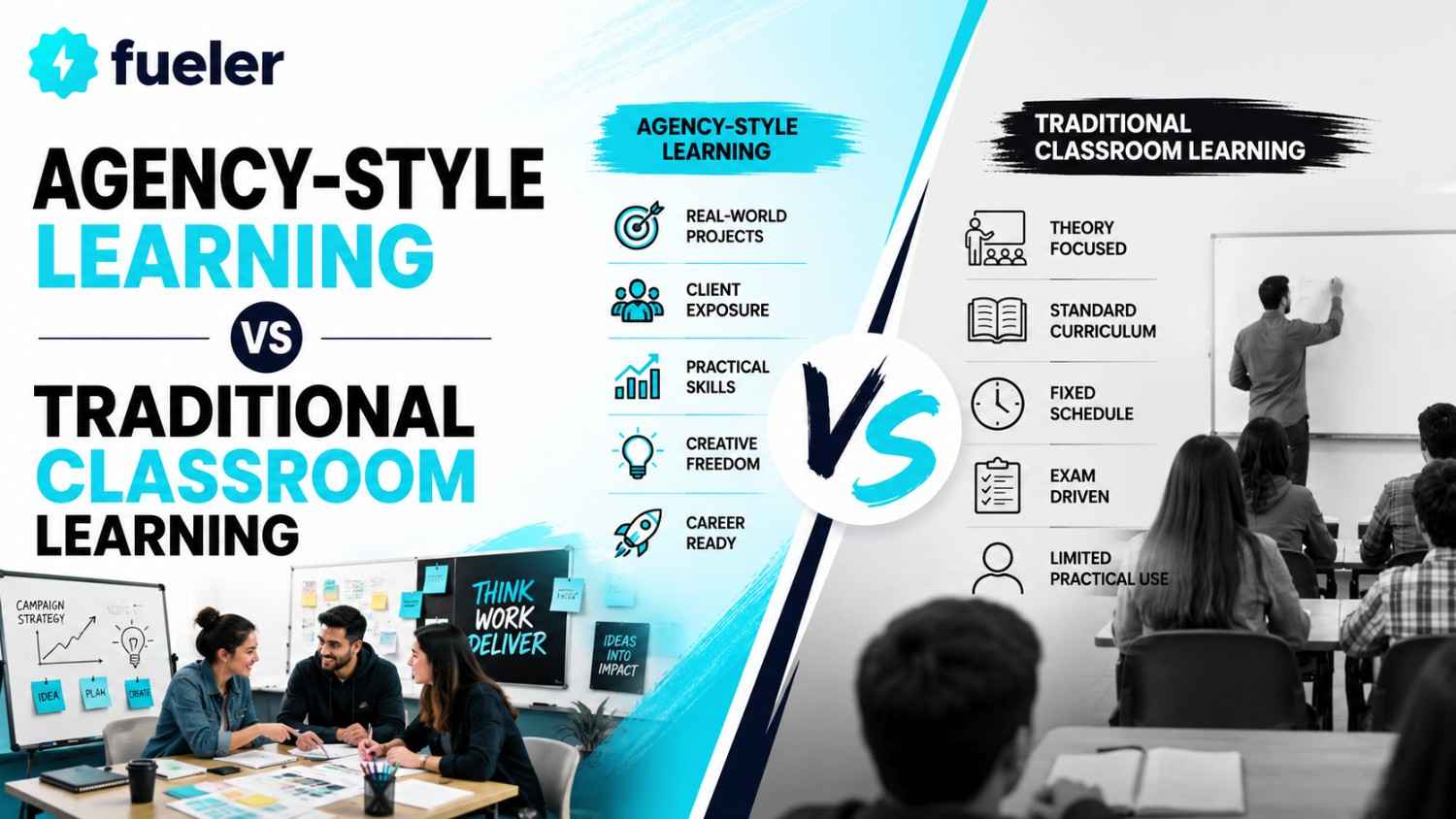
At its simplest level, agency-style learning turns the classroom into a functional workspace. Instead of sitting quietly in a lecture hall listening to slides, students are organized into client teams. They assume dedicated roles such as performance marketer, content strategist, SEO analyst, or creative lead.
In a traditional classroom, you spend months analyzing how giant corporations executed campaigns ten years ago. You write essays about consumer behavior theory, draw static marketing funnel diagrams on paper, and sit for midterm tests. The focus is on passive retention of academic concepts.
In an agency-style program, your team receives a live brand brief with defined budget parameters. You install tracking pixels, design creative assets, write search ad copy, set up email automation funnels, and test landing pages. You learn by doing the exact tasks an employer would pay you to complete on day one.
This difference matters because marketing technology changes constantly. Algorithms on Instagram, Google, and LinkedIn update every few months. A traditional university syllabus takes years to get official board approvals for updates, making much of its tactical content obsolete before students graduate.
Agency-style learning addresses this gap by operating in real time. Because you build active campaigns inside live software dashboards, you learn to adapt to platform changes immediately. You move from understanding theory to possessing proof of work.
Detailed Explanation
What Is the Core Structure of Each Model?
To choose the right path, you must understand how learning is structured in both environments. Agency-style learning organizes students into cross-functional teams that replicate real agency workflows. Each student takes ownership of a functional specialty while collaborating on shared client deliverables under tight deadlines.
Traditional classroom learning uses a top-down educational hierarchy. A professor delivers lectures to a large group of students, assigns textbook chapters, and conducts written evaluations. The curriculum follows a fixed linear syllabus regardless of real-time shifts in market demands or software updates.
Why Does the Learning Environment Dictate Career Readiness?
The environment where you study shapes the habits you build. In an agency-style setting, mistakes happen live inside digital software dashboards, forcing immediate troubleshooting. If your meta ad creative gets rejected or your landing page bounce rate spikes, you must fix it immediately.
In a traditional university, mistakes only result in lost marks on a term paper weeks after submission. You do not get the chance to iterate or optimize the outcome in real time. This creates a psychological gap where students understand marketing terms but freeze when asked to run a live dashboard.
How Do Students Gain Practical Experience in Practice?
In an agency setup, practical experience comes from running full marketing loops. A typical team will research competitors, define target personas, draft ad copy, build dedicated landing pages, configure conversion tracking, and launch paid campaigns with allocated test budgets.
In standard academic classrooms, practical experience is usually restricted to written case studies. Students discuss what companies like Nike or Apple did in past decades. While case studies build strategic thinking, they do not teach you how to set up Google Tag Manager or write high-converting email sequences.
Example Scenario: Learning Conversion Rate Optimization (CRO)
Traditional Classroom Approach:
1. Read a chapter on consumer psychology and landing page design.
2. Memorize key terms like "call to action," "above the fold," and "value proposition."
3. Answer a 10-point essay question on a written exam.
Agency-Style Learning Approach:
1. Build two distinct variations of a landing page using modern page builders.
2. Direct 500 live visits to both pages through a low-budget ad test.
3. Track click-through rates, analyze session recordings, and deploy the winning version.
What Are the Real-World Implications for Job Seekers?
When tech startups in Bangalore, Mumbai, or global tech hubs hire entry-level marketers, they spend very little time asking about university grades. They want to see work samples, past campaign numbers, and software familiarity. An agency-style graduate can open their laptop and show live dashboards, published copy, and active portfolios.
A traditional degree holder often arrives at interviews with impressive credentials but zero published work. Employers know they will have to invest three to six months training that graduate on basic execution tools. This makes proof-of-work candidates far more attractive to fast-moving marketing teams.
How It Works
Transitioning through an agency-style learning model follows a deliberate, step-by-step framework designed to mirror corporate operations. Here is how students progress from basic concepts to campaign execution:
- Agency Allocation and Role Assignment: Students are assigned to balanced agency cohorts. Each member assumes a specific role—such as Performance Marketer, Content Strategist, SEO Analyst, or Graphic Designer—matching their career interests.
- Tool Onboarding and Platform Setup: Learners set up professional accounts on key industry platforms. They gain hands-on access to keyword research software, ad managers, email automation tools, and analytics dashboards.
- Client Brief Receiving: Mentors or real brand clients provide detailed briefs. These documents specify target audience demographics, campaign objectives, brand guidelines, key performance indicators (KPIs), and budget constraints.
- Campaign Strategy Development: Teams conduct market research, analyze competitor positioning, build customer personas, and map out full conversion funnels.
- Creative and Technical Execution: The team builds required campaign assets. They write conversion copy, design visual creatives, set up landing pages, and configure analytics pixels.
- Live Testing and Budget Management: Teams publish campaigns with small budgets. They monitor real-time data, pause underperforming ad variations, and reallocate spend toward top-performing creatives.
- Performance Reporting and Client Pitching: Students gather campaign data into structured performance reports. They present findings, return-on-ad-spend (ROAS) results, and future scaling recommendations to industry mentors.
- Portfolio Archiving: Every completed assignment and verified metric is documented into an individual proof-of-work portfolio to present to potential employers.
Benefits of Agency-Style Learning
- Immediate Proof of Work: You graduate with a portfolio of live campaign assets, real data, and verified outcomes rather than a resume full of claims.
- Mastery of Current Marketing Tools: You learn to operate modern software platforms like Meta Ads Manager, Google Analytics, SEO tools, and low-code site builders.
- Cross-Functional Team Skills: Working in agency cohorts teaches you how to collaborate with designers, copywriters, and media buyers under strict deadlines.
- Faster Time to Job Readiness: Programs are streamlined to focus on execution skills, allowing you to enter the hiring market in months rather than years.
- Data-Driven Decision Making: You learn to evaluate campaigns using real metrics like customer acquisition cost (CAC), click-through rate (CTR), and return on ad spend (ROAS).
- Adaptability to Market Shifts: Because you operate inside active digital environments, algorithm changes and emerging tech tools become natural parts of your daily workflow.
Challenges and Limitations
While agency-style learning offers clear practical advantages, it is not a silver bullet for every student. You must evaluate its inherent limitations before making a decision.
First, agency-style programs heavily emphasize tactical execution. If a program focuses entirely on daily execution, students might miss out on broader corporate finance, organizational behavior, and high-level strategy. These broader subjects become important later in a management career.
Second, agency-style programs do not always carry traditional academic accreditation. If your goal is to pursue higher education abroad or work in conservative corporate institutions that require formal degree certificates, an agency program alone may not meet those entry criteria.
Finally, the fast-paced, high-accountability environment can overwhelm students who prefer structured reading schedules and predictable lecture routines. Working on live projects requires self-direction, resilience under pressure, and a willingness to learn through trial and error.
Comparison Table: Agency-Style Learning vs Traditional Business School
Fees and Cost Analysis
Evaluating the financial aspect of your education requires comparing upfront tuition expenses against long-term career returns.
Traditional University / Business School (2 to 4 Years)
- Average Tuition Fees: ₹5,000,000 to ₹2,500,000 ($6,000 to $30,000+)
- Living Expenses: High (multi-year campus stay or urban rent)
- Opportunity Cost: 2 to 4 years spent outside the full-time job market
- Primary Output: Degree certificate and institutional alumni network
Agency-Style Practical Programs (3 to 6 Months)
- Average Tuition Fees: ₹30,000 to ₹150,000 ($400 to $1,800)
- Living Expenses: Low (often available in remote or hybrid formats)
- Opportunity Cost: Minimal (fast transition into entry-level or freelance roles)
- Primary Output: Live portfolio, practical tool mastery, and campaign data
The return on investment (ROI) for agency-style learning centers on speed and reduced financial risk. Graduates can land entry-level performance marketing or content strategy roles without carrying heavy student debt. Conversely, traditional degrees offer broader, long-term brand equity that can prove valuable when climbing executive corporate ladders decades later.
Career Opportunities
Understanding where each educational path leads helps align your learning investment with your career goals.
High-Demand Marketing Roles
- Performance Marketing Specialist: Managing paid ad campaigns across Meta, Google, and LinkedIn to generate trackable leads and revenue.
- Growth Marketer: Testing channel strategies, referral funnels, and retention hooks across fast-growing startup environments.
- SEO & AEO Strategist: Optimizing digital content for traditional search engines, generative AI engines, and voice search systems.
- Content Operations Manager: Directing organic media production, short-form video strategies, and editorial calendars for brand channels.
- Founder’s Office / Chief of Staff (Marketing): Working alongside startup founders on business operations, growth marketing campaigns, and brand initiatives.
Industry Compensation Ranges
Entry-level marketers entering tech startups or digital agencies in major hubs like Bangalore can expect starting packages ranging from ₹4,00,000 to ₹8,00,000 per year. Candidates with strong proof-of-work portfolios often secure roles at the higher end of that spectrum.
With 3 to 5 years of hands-on experience, growth leads and performance marketing managers routinely earn between ₹12,00,000 and ₹25,00,000 per year. Compensation scales directly with your ability to manage larger budgets and deliver measurable revenue outcomes.
Who Should Choose Agency-Style Learning?
- Startup Aspirants: Individuals who want to join fast-paced startups like CRED, Meesho, or Urban Company where immediate skill execution is required.
- Career Switchers: Professionals transitioning into digital marketing from unrelated fields who need to build relevant skill sets quickly.
- Self-Starters and Creators: Learners who prefer building real projects over listening to passive lectures and taking written exams.
- Freelancers and Agency Founders: Anyone aiming to land private clients or build their own boutique marketing agency from scratch.
- Practical Learners: Students who understand concepts better by testing software dashboards, running experiments, and seeing immediate feedback.
Who Should Avoid Agency-Style Learning?
- Traditional Credential Seekers: Students who require a recognized university degree to fulfill family preferences or corporate entry requirements.
- Future Corporate Executives in Rigid Industries: Individuals targeting traditional multinational enterprises that strictly enforce degree filters for entry-level roles.
- Pure Academic Researchers: Scholars who wish to pursue academic research, doctoral studies, or theoretical marketing literature.
- Passive Learners: Students who prefer clear textbook instructions, predictable study schedules, and traditional written tests over open-ended problem solving.
Final Thoughts
Education should clear a direct path toward your long-term goals, not leave you buried under debt while trying to figure out how real job tools work. When I built Fueler, I saw firsthand how hiring patterns were changing across tech startups and creative companies. Employers are no longer impressed by a list of course modules on a PDF resume. They want to see what you have actually built, launched, and managed.
Traditional university education still holds value for broad networking, general business management fundamentals, and corporate credential requirements. However, if your goal is to become an execution-ready marketer who can drive actual user growth, agency-style learning offers a far more practical path.
The most effective marketers do not wait for a degree certificate to validate their skills. They set up campaign dashboards, write copy, launch experiments, build portfolios, and let their proof of work speak for itself.
Key Takeaways
- Execution Beats Theory: Modern marketing roles prioritize verified work samples and campaign experience over academic credentials.
- Real-Time Skill Alignment: Agency-style programs update their modules continually to reflect current software dashboards and platform algorithms.
- Accelerated Time-to-Market: Students gain practical job readiness within 3 to 6 months rather than spending years in multi-year academic degrees.
- Lower Financial Risk: Practical skill training requires significantly lower upfront tuition fees, providing a faster path to positive ROI.
- Portfolio as the New Resume: A verified portfolio showing real metrics, ad copy, and analytics tracking provides a stronger signal to recruiters than paper grades.
- Hybrid Thinking Works Best: Combining fundamental business strategy with hands-on agency execution creates the most resilient, long-term marketing careers.

Frequently Asked Questions
What is agency-style learning in digital marketing?
Agency-style learning is a practical education model where students learn marketing by executing live client briefs, managing real ad budgets, and building portfolios inside simulated agency team environments.
Is agency-style learning better than a traditional marketing degree?
Agency-style learning is better for gaining immediate practical execution skills, tool mastery, and proof of work. Traditional degrees are better for general management theory, academic credentials, and institutional alumni networks.
Do top companies hire marketers without traditional marketing degrees?
Yes, high-growth startups, tech companies, and agencies hire candidates without marketing degrees if they demonstrate verified campaign portfolios, practical software mastery, and track records of executing real projects.
How long does an agency-style learning program usually take?
Most agency-style practical training programs take between 3 and 6 months to complete, focusing entirely on hands-on campaign execution, tool setup, and portfolio creation.
Can beginners start with agency-style learning without prior experience?
Yes, agency-style learning is designed for beginners because it teaches tools, campaign setup, and execution strategies step-by-step through live projects rather than abstract theoretical lectures.
Why 100,000+ professionals use Fueler
Fueler helps professionals showcase proof of work through projects, assignments, case studies, and achievements.
- Thousands of professionals use Fueler to create their digital portfolio
- Thousands of projects are published on Fueler. Check here
- Startups and Companies hire through proof of work on Fueler
- Used by freelancers, creators, marketers, video editors, writers, designers, and product managers
Our mission is to help the next 100 million professionals build a verified professional identity through proof of work

What should you do next?
You've read the article. Now turn your skills into proof of work and unlock more opportunities.
Build your proof of work portfolio
Create a clean portfolio with projects, assignments, resumes, and AI stack details that companies actually want to see.
Create your Fueler portfolio →Apply through assignments, not resumes
Stand out by solving real tasks from companies hiring on Fueler.
Explore assignments →Get discovered by companies
Make your work public and let recruiters discover your skills through actual projects instead of keywords.
Get discovered →
