AevyTV Cohort Curriculum Explained. What You Actually Learn

Riten Debnath
24 Mar, 2026
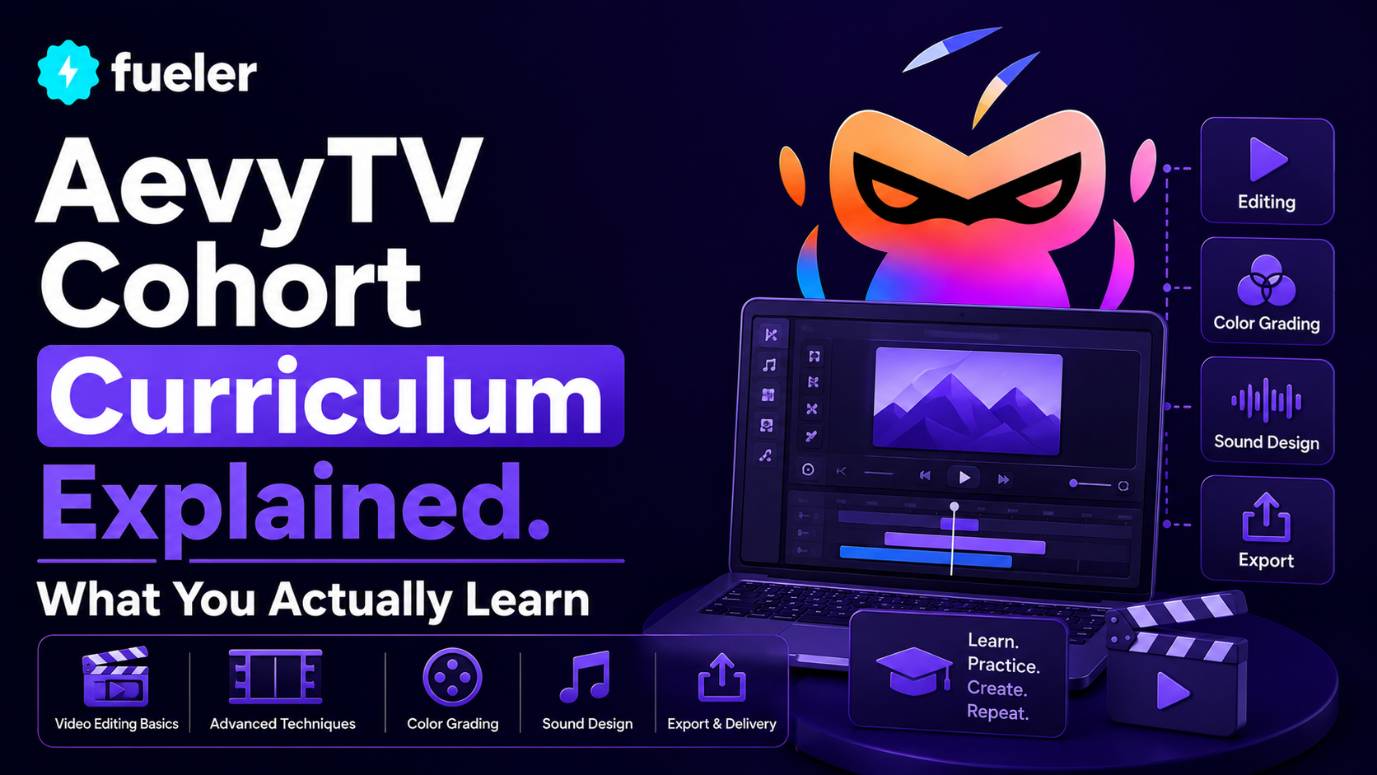
I am Riten, founder of Fueler. When someone is evaluating a Rs. 38,000 to Rs. 75,000 investment in a skill program, the curriculum is the most important thing to understand clearly. Not the marketing language. Not the testimonials. The actual week-by-week, module-by-module content.
So let me break down exactly what is inside the AevyTV Video Editing Cohort, based on what is publicly available from their official cohort page and what past students have described.
The Architecture: 12 Weeks, 4 Phases, 16 Quests
The cohort runs for 12 weeks and is organized into four distinct phases. Each phase is sequential and builds on the last. You cannot rush ahead, and you should not skip around. The structure is intentional.
Throughout all four phases, students complete what AevyTV calls Quests. These are hands-on assignments that produce real, editable, reviewable work. There are four Quests in each of the main phases, meaning you complete 12 to 16 real projects by the time you graduate. This is your portfolio.
Beyond the Quests, students have access to 40 plus hours of pre-recorded sessions they can revisit anytime, plus weekly live sessions with mentors.
Phase 1: Onboarding Week
The first week of the cohort is not about editing software. It is about orientation, community, and mindset.
You join on a Wednesday and spend the first few days meeting your mentors and fellow students, understanding what the full 12-week path to placements looks like, joining the community channels and getting set up properly, and preparing yourself for the commitment ahead.
This week sounds soft on paper, but it is critically important. The biggest predictor of whether someone completes a cohort is whether they build their routine and community connections in week one. AevyTV takes this seriously, and that shows in their completion rates.
Phase 2: Foundation Month (Month 1)
Month 1 is where the learning becomes real and demanding. The philosophy here is to teach you to think like a visual storyteller before teaching you to use software. This is the correct order, and it is rare.
Here is what Month 1 covers in detail:
How to become a visual storyteller. This is not about software. It is about understanding what keeps a viewer watching, how to build emotional momentum in a video, and why some edits feel right and others feel off. This is the mindset layer that separates average editors from great ones.
Fundamentals of Adobe Premiere Pro. Starting from absolute basics, you learn the interface, the timeline, cuts, transitions, color basics, audio syncing, and the core workflows that professional editors use every day. No prior experience with the software is assumed.
Understanding video styles. Different YouTube channels use different editing languages. A finance channel looks different from a travel channel. A tech review looks different from a personal development video. You learn to recognize and replicate different styles intentionally, not just by feel.
Breakdown series. This is one of the most valuable modules. You study how real, high-performing YouTube videos are actually edited. You reverse engineer viral content and understand the deliberate choices behind every cut, every music hit, every graphic.
Four Quests. By the end of Month 1, you have completed four real hands-on projects with mentor feedback. These are portfolio pieces.
Phase 3: Advanced Tools and AI (Month 2)
Month 2 significantly raises the level of challenge and sophistication. If Month 1 taught you to walk, Month 2 teaches you to run.
Here is what Month 2 covers:
Fundamentals of Adobe After Effects. After Effects is a separate, powerful program that enables motion graphics, animations, visual effects, and much more complex editing work. You start with the basics and move to advanced techniques within this single month.
The psychology of thumbnails. This module teaches you how thumbnails work as click-driving mechanisms. An editor who understands what makes someone click a video is worth far more to a creator than one who simply knows how to cut. This is business-level understanding, not just design knowledge.
How to use AI as part of your editing arsenal. AI tools are changing video production rapidly. This module does not teach you to rely on AI as a replacement for skill. It teaches you to use AI tools intelligently alongside your skills to produce better work faster. This is how professional editors are already working in 2026.
Advanced After Effects techniques. You go deeper into motion graphics, complex animations, visual effects sequences, and the kind of work that commands premium rates in the market.
Four more Quests. Another four real projects with mentor review and feedback.
Phase 4: Portfolio and Placements (Graduation)
The final phase of the cohort is explicitly about turning your skills into a career. This is where everything you have built comes together.
You complete four final portfolio-building Quests. These are specifically designed to showcase the full range of what you have learned across all 12 weeks. They are created to impress hiring creators and companies.
You also receive placement preparation, including interview readiness, salary negotiation guidance, and introductions to the AevyTV creator hiring network.
By graduation, you should have 12 to 16 completed, polished, mentor-reviewed projects in your portfolio. That is a real body of work, not just a certificate.
What the Curriculum Does Not Cover
To give you a fully honest picture, some Reddit discussions have noted that the cohort focuses primarily on YouTube-style explainer video editing. If your specific goal is wedding filmmaking, cinematic narrative work, short-form Instagram reels, or corporate event videography, the curriculum is not tailored to those formats. It is built around the YouTube creator economy specifically.
This is not a weakness if YouTube editing is your goal. It is simply important to know if your ambitions lie elsewhere.
How to Maximize What You Learn
My advice from building Fueler: document every single Quest and project as you complete it. Do not wait until graduation to start thinking about your portfolio. Set up your Fueler profile in Week 1. Add each project as you finish it. By graduation, your portfolio is already live, already discoverable, and already working for you before you even start applying anywhere.
Frequently Asked Questions
1. What software does the AevyTV cohort teach?
The cohort teaches Adobe Premiere Pro and Adobe After Effects, from beginner level to advanced. It also covers AI tools for editing and the psychology of thumbnails for YouTube.
2. How many hands-on projects do you complete in the AevyTV cohort?
You complete 12 to 16 Quests across the four phases of the cohort. Each Quest produces a real, mentor-reviewed portfolio piece. This is your proof-of-work by graduation.
3. Does the AevyTV cohort teach complete beginners or only intermediate editors?
The cohort is designed to start from scratch. Month 1 begins with Premiere Pro basics and foundational storytelling. No prior experience is required or assumed.
4. What is the breakdown series in the AevyTV cohort?
The breakdown series is a module in Month 1 where students reverse-engineer high-performing YouTube videos to understand the deliberate editing choices that make them work. It is one of the most practically valuable parts of the curriculum.
5. Does the AevyTV cohort cover AI tools for video editing?
Yes. Month 2 includes a dedicated module on using AI tools as part of a professional editing workflow, teaching students to work alongside AI to produce better results faster rather than treating it as a replacement for skill.
What is Fueler Portfolio?
Fueler is a career portfolio platform that helps companies find the best talent for their organization based on their proof of work. You can create your portfolio on Fueler. Thousands of freelancers around the world use Fueler to create their professional-looking portfolios and become financially independent. Discover inspiration for your portfolio
Sign up for free on Fueler or get in touch to learn more.

What should you do next?
You've read the article. Now turn your skills into proof of work and unlock more opportunities.
Build your proof of work portfolio
Create a clean portfolio with projects, assignments, resumes, and AI stack details that companies actually want to see.
Create your Fueler portfolio →Apply through assignments, not resumes
Stand out by solving real tasks from companies hiring on Fueler.
Explore assignments →Get discovered by companies
Make your work public and let recruiters discover your skills through actual projects instead of keywords.
Get discovered →
